
Corydoras aeneus: The Bronze Corydoras
Species Overview
Corydoras aeneus, the bronze cory, is one of the most widely kept and best-studied catfishes in the aquarium trade. It belongs to the family Callichthyidae (the armored catfishes), subfamily Corydoradinae, and was first described by the American naturalist Theodore Gill in 1858 under the name Hoplosoma aeneum. The specific epithet aeneus is Latin for "of bronze" or "coppery," a direct reference to the metallic sheen that gives the species its common name. Like virtually all callichthyids, it possesses two rows of overlapping bony plates (scutes) running along the flanks, an adipose fin, and three pairs of barbels used for locating food in soft substrates.
The natural range of C. aeneus is remarkably broad for a cory, spanning much of northern and central South America. It has been recorded from the island of Trinidad and from Venezuela, Colombia, and Guyana southward through the Amazon basin in Brazil, Peru, and Bolivia, with additional populations reported in Suriname and French Guiana. This wide distribution across several major river drainages explains why the species is so adaptable in captivity: wild fish encounter everything from clear, fast-flowing piedmont streams to sluggish, tannin-stained floodplain creeks and seasonal pools. The fish is most often collected in shallow, slow-moving water over sand, mud, and leaf litter, frequently in loose shoals numbering in the dozens.
Because of its hardiness, captive breeding history, and the enormous volume of farm-raised stock produced in Southeast Asia and Eastern Europe, the bronze cory is arguably the single most commercially important corydoradine in the hobby. It has also been the subject of a large body of scientific work on chemical communication, alarm pheromones, and the unusual "intestinal air-breathing" behavior that lets corys gulp atmospheric air at the surface and absorb oxygen through a highly vascularized hindgut.
Appearance & Size
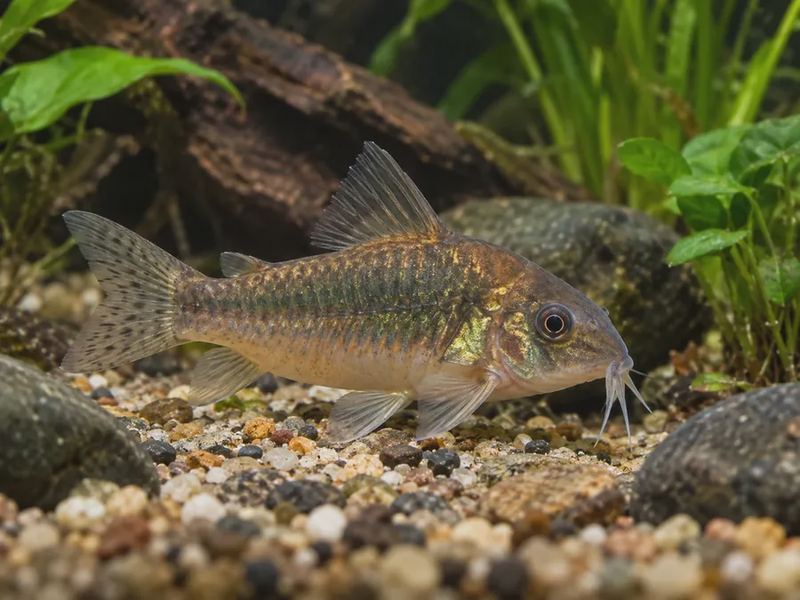
The bronze cory has a stocky, slightly arched body that is deeper than it is wide, with a flattened ventral profile that lets the fish rest directly on the substrate. The head is blunt and rounded when viewed from above, with a short snout and three pairs of well-developed barbels: one pair on the upper jaw, one pair on the lower jaw, and one pair at the corners of the mouth. The eyes are small and set high on the head, and the body is armored from just behind the head to the base of the caudal fin.
Coloration is the species' signature. Wild-type fish are a metallic bronze to olive-gold on the flanks, often with a faint greenish iridescence in good lighting, fading to a paler cream or pinkish belly. A subtle dark saddle may be visible across the nape or just behind the dorsal fin, and the scutes themselves frequently show a darker edge that gives the fish a faintly quilted appearance. The fins are typically translucent to pale yellowish, with the dorsal and caudal fins sometimes showing faint dark speckling. The species is sexually dimorphic: adult females are noticeably broader and fuller-bodied when viewed from above, while males are slimmer, more streamlined, and often slightly more intensely colored. Mature males also develop a longer, more pointed dorsal fin and, in some populations, a small fleshy flap or "spike" on the leading ray of the pectoral fin.
There is also an albino form — sometimes sold as the albino cory or, less accurately, as Corydoras aeneus "albino" — which is a true color morph of this species, not a separate taxon. Albino fish are creamy white to pale pink with red eyes and are equally hardy, though they can be more sensitive to bright lighting. A long-finned variant also circulates in the trade. Standard adult size is modest: most specimens reach 6–7.5 cm (2.4–3 in) total length, with well-fed females occasionally hitting 8 cm (3.1 in). Males typically mature at 5–6 cm (2–2.4 in).
Diet & Feeding
Corydoras aeneus is an omnivorous benthic forager. In the wild, stomach-content analyses of related corydoradines show a mixed diet of aquatic insect larvae (especially chironomids), small crustaceans, worms, detritus, and plant matter. The barbels are chemosensory and tactile, allowing the fish to sift through fine substrate and detect food items before they are visible. In the aquarium, this translates into a fish that will accept almost anything that reaches the bottom, but which benefits enormously from a varied, protein-forward diet.
A good staple is a sinking pellet or wafer formulated for bottom-dwellers, ideally 1–2 mm in size so it can be manipulated without excessive crumbling. Supplement with frozen or live foods two to four times per week: bloodworms, blackworms, daphnia, brine shrimp, and chopped earthworm are all taken eagerly. Blanched vegetables such as zucchini, cucumber, and spinach are useful for adding fiber and can be weighted down with a stainless steel clip. Avoid relying solely on flake food, as corys are slow, deliberate surface-to-bottom feeders and much of the flake will be consumed by midwater tankmates before it settles. Likewise, be careful not to overfeed: uneaten pellets foul the substrate and can contribute to the barbel erosion problems discussed below.
Feed once or twice daily in amounts the shoal can clear within about 15–20 minutes. Because corys are crepuscular and often most active at dawn and dusk, a feeding timed for the evening, shortly before lights-out, is usually well received. A varied diet with adequate protein supports the species' relatively long captive lifespan — bronze corys regularly live 5–10 years in good conditions, and 15-year-old specimens are not unheard of.
Aquarium Setup
Bronze corys are shoaling fish, and the single most important setup decision is to keep them in a group. A minimum of six is generally recommended, with eight to twelve being better; in smaller numbers the fish can become skittish, hide excessively, and show stress-related health problems. For a group of six to eight adults, a tank of at least 60 cm (24 in) in length and roughly 60 litres (16 US gal) is a reasonable floor, though a 90 cm (36 in), 100–120 litre tank gives the shoal more room to spread out and makes maintenance easier.
Substrate is critical. C. aeneus feeds by rooting through the top layer of the substrate, and rough or sharp gravel abrades the barbels, leading to secondary infections. Use fine, rounded sand — pool filter sand, play sand, or a dedicated aquarium sand — at a depth of 2–4 cm. A slightly darker sand tends to show the fish's bronze coloration to best advantage. If you prefer a planted tank, root tabs can be pushed into the sand, or you can use a thin sand cap over a nutrient layer, though corys will disturb a loose soil layer. Smooth, rounded gravel of 1–2 mm is a tolerable second choice; crushed coral, sharp black gravel, and large pebbles are not.
Plants are welcome and beneficial. The species is not a plant-eater and will not damage leaves, though it may uproot very shallow-rooted stems while foraging. Robust choices include Anubias, Microsorum (Java fern), Cryptocoryne species, Vallisneria, and floating plants such as Salvinia or Pistia, which provide shade and help keep nitrates in check. Driftwood and leaf litter (Indian almond, oak, or beech) are excellent additions: they release tannins that mimic the species' natural water, provide cover, and create a natural foraging surface for biofilm and microfauna.
Lighting should be moderate. Bronze corys are not demanding of light, and bright, unshaded illumination can make them shy; floating plants or a dimmable LED fixture set to 6–8 hours per day works well. Filtration should provide gentle, steady flow rather than a torrent — a sponge filter, a canister with a spray bar, or a hang-on-back with the flow diffused is ideal. Because corys are scaleless in the usual sense (their bodies are covered by bony plates rather than typical scales), they are somewhat more sensitive than many fish to medications and to poor water quality, so a mature, well-cycled filter and a regular partial-water-change routine are important.
Water Parameters
One of the reasons C. aeneus is so widely recommended to beginners is its tolerance of a broad range of water chemistry. Wild fish come from soft, slightly acidic to neutral waters, but captive-bred stock — which is what most aquarists will encounter — adapts readily to moderately hard, neutral-to-slightly-alkaline tap water. The key is stability: corys dislike rapid swings in temperature or pH far more than they dislike any particular value within their range. The table below summarizes suitable parameters for long-term maintenance.
| Parameter | Ideal Range | Tolerated Range | Notes |
|---|---|---|---|
| Temperature | 24–26 °C (75–79 °F) | 22–28 °C (72–82 °F) | Avoid prolonged exposure above 28 °C; warm water holds less oxygen. |
| pH | 6.5–7.5 | 6.0–8.0 | Captive-bred fish tolerate the higher end; wild-caught prefer 6.0–7.0. |
| General hardness (GH) | 4–12 °dGH | 2–18 °dGH | Soft to moderately hard; very soft water is fine if stable. |
| Carbonate hardness (KH) | 2–8 °dKH | 1–12 °dKH | Moderate KH helps buffer pH swings. |
| Ammonia / Nitrite | 0 ppm | 0 ppm | Any detectable level is a problem; corys are sensitive to both. |
| Nitrate | < 20 ppm | < 40 ppm | Keep low with weekly 25–30% water changes. |
| Dissolved oxygen | High | Moderate to high | Surface agitation is beneficial; corys gulp air at the surface. |
Perform a 25–30% water change weekly, siphoning gently over the sand surface to remove debris without disturbing the substrate deeply. Because corys are bottom-dwellers, they are directly exposed to whatever accumulates in the substrate, so good husbandry here pays off in fewer health problems. If you keep the species in a blackwater-style setup with leaf litter and low KH, monitor pH regularly, as the lack of buffering makes it easy to drift into dangerous territory.
Behavior & Compatibility
Bronze corys are peaceful, gregarious, and almost entirely non-aggressive. They spend much of the day rooting through the substrate in loose formation, occasionally darting to the surface to gulp air — a normal behavior, not a sign of distress, though frequent, frantic surface visits can indicate low oxygen or poor water quality. Within a shoal, males may engage in brief chasing and nudging, especially around feeding time or after a water change, but these interactions are rarely damaging. The species is diurnal-crepuscular, with peaks of activity in the morning and evening.
Because of their placid nature, bronze corys fit into a very wide range of community tanks. Good tankmates include small to medium tetras (Paracheirodon, Hemigrammus, Hyphessobrycon), rasboras, peaceful livebearers such as Poecilia and Xiphophorus, small rainbowfish, dwarf gouramis, and non-aggressive dwarf cichlids like Apistogramma and Mikrogeophagus ramirezi. Bottom-dwelling companions such as Otocinclus, Ancistrus (bristlenose pleco), and peaceful loaches also work well. Avoid large, boisterous cichlids (e.g., many Heros, Vieja, or Amphilophus species) that may bully or outcompete corys for food, and avoid known cory predators such as large Synodontis catfish or aggressive puffers. Goldfish are sometimes kept with corys, but the temperature mismatch and the goldfish's habit of rooting aggressively make it a poor long-term pairing.
Do not keep C. aeneus singly. Isolated fish often become lethargic, hide, and are more prone to disease. If you cannot commit to a shoal, choose a different species. Also note that corys are not effective "cleaner fish" in the sense often implied by the trade — they will eat some leftover food, but they produce their own waste and should be fed deliberately rather than treated as a janitorial service.
Breeding
Corydoras aeneus is one of the easiest corydoradines to spawn, and many aquarists have bred the species accidentally in community tanks. The trigger is usually a cool, soft water change — a 20–30% change with water a few degrees cooler than the tank, often coinciding with the onset of the rainy season in the wild — combined with heavy feeding of live or frozen foods. Within a day or two, males begin actively pursuing females, nudging the female's flanks and vibrating against her. In the characteristic cory spawning embrace (the "T-position"), the male grips the female's barbels with his pectoral fins while she forms a basket with her pelvic fins; sperm and eggs are released into this basket, and the female then deposits the fertilized eggs — usually one to four at a time — onto a clean, vertical surface such as a plant leaf, the aquarium glass, a filter tube, or a piece of slate. A single female may lay 100–300 eggs over several hours, often in repeated bouts across the day.
Adults will eat their own eggs, so if you want to raise the fry, either remove the eggs to a separate hatching container or move the adults out after spawning. Eggs hatch in roughly 4–6 days at 24–26 °C. The fry are tiny at first and subsist on their yolk sac for 2–3 days; once free-swimming, they can be fed microworms, freshly hatched brine shrimp nauplii, and finely crushed sinking fry food. Water quality in the fry container must be kept very clean, with gentle daily changes, as the fry are sensitive to ammonia. Growth is reasonably fast: fry reach 1.5–2 cm within a couple of months and can be sexed by around 4–6 months. Note that albino females crossed with normal males produce mixed broods, and the long-finned trait is inherited in a more complex, often recessive pattern.
Common Diseases & Health
The bronze cory is a hardy fish, but a handful of problems are common enough to be worth knowing about. The most frequently reported is barbel erosion — the gradual shortening or loss of the barbels, sometimes accompanied by redness or a fuzzy white growth at the base. This is almost always a husbandry issue rather than an infectious disease: rough or dirty substrate, chronically high nitrate, and overfeeding are the usual culprits. Correcting the substrate to fine sand, increasing water changes, and vacuuming the surface gently will usually allow the barbels to regrow over several weeks.
Ich (Ichthyophthirius multifiliis) is common in newly acquired corys, particularly if they have been chilled in transit. The classic white spots may be less obvious on the armored body than on other fish, so watch for flashing, clamped fins, and lethargy. Treat with a cory-safe ich medication or, preferably, a heat-and-salt or heat-and-observation protocol; note that corys are more sensitive than many fish to formalin- and malachite green-based products, so use half-dose or species-specific treatments and monitor closely.
Bacterial infections — fin rot, red blotch, and columnaris — appear when water quality slips or when fish are stressed by transport or aggression. Internal parasites such as Camallanus and intestinal flagellates can arrive with wild-caught or poorly quarantined stock, presenting as emaciation despite feeding, stringy white feces, or a swollen abdomen. A 2–4 week quarantine of new arrivals is strongly recommended, both to protect the existing shoal and to allow observation for these issues before treatment. Swim bladder problems are uncommon but can follow overfeeding or a sudden temperature drop; they often resolve with fasting and a small, warm water change.
Preventive care is straightforward: stable, well-oxygenated water; a varied diet; a clean sand substrate; a shoal of at least six; and quarantine for anything new. A healthy bronze cory is active, plump, and constantly foraging, with intact barbels and clear fins.
FAQs
How many bronze corys should I keep together?
A minimum of six, and eight to twelve is better. They are obligate shoalers, and a group this size lets them display natural behavior, reduces stress, and makes health problems easier to spot. A 60 cm (24 in) tank can comfortably house six to eight adults; go larger for a bigger shoal.
Can I keep a bronze cory in a 10-gallon tank?
A 10-gallon (about 38 litres) tank is on the small side for a proper shoal. If you keep it, stock it with six bronze corys and no other bottom-dwellers, use fine sand, and stay on top of weekly water changes. A 20-gallon long (about 75 litres) is a much better long-term home and gives the fish more floor space, which is what they actually use.
Do bronze corys eat algae?
Not meaningfully. They are omnivores that will graze biofilm and pick at soft algae incidentally, but they will not control an algae problem and should not be bought for that purpose. Feed them a proper sinking diet, and address algae through lighting, nutrients, and plant competition.
Why is my bronze cory swimming to the surface?
Occasional trips to gulp air are completely normal — the species has a vascularized hindgut and uses atmospheric oxygen. However, frequent, frantic surface visits, especially with gasping or hanging at the surface, usually indicate low dissolved oxygen, high ammonia or nitrite, or water that is too warm. Test the water, increase surface agitation, and check the temperature before assuming the behavior is benign.