
Peppered Cory (Corydoras paleatus) Care Guide
Species Overview
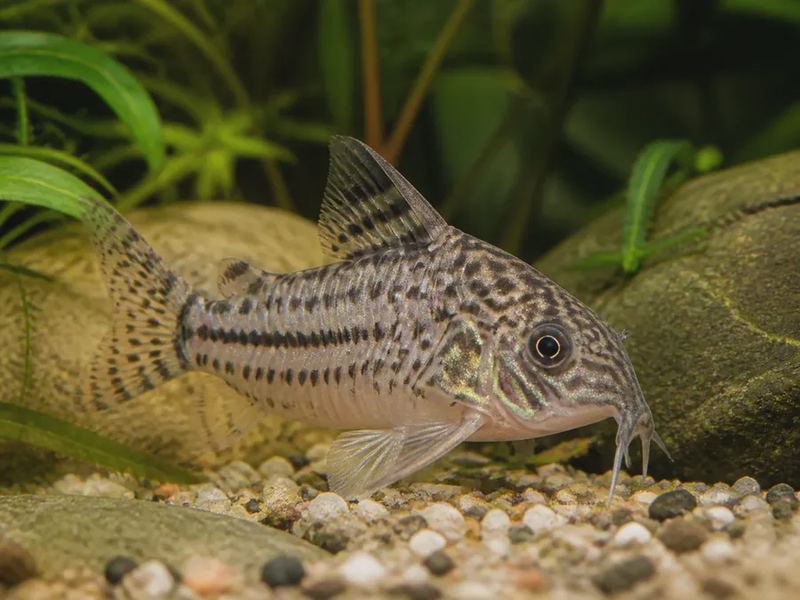
Corydoras paleatus, commonly known as the Peppered Cory or Peppered Catfish, is a small, armored catfish in the family Callichthyidae. First described by Jenyns in 1842, the species name paleatus derives from Latin for "speckled" or "peppered," referencing the distinctive dark spots scattered across its pale, olive-gray body. This species is native to the lower Paraná River basin and coastal drainages of southeastern Brazil, Uruguay, and Argentina, where it inhabits slow-moving streams, flooded forests, and shallow ponds with soft, sandy substrates and abundant leaf litter.
In the aquarium hobby, Corydoras paleatus is one of the most enduringly popular species, having been continuously bred in captivity since the early 20th century. Its importance lies in its hardiness, peaceful temperament, and role as a model organism for understanding corydoradine biology. As a shoaling species, it exhibits complex social behaviors, including synchronized resting and cooperative foraging. Ecologically, it is a benthic omnivore that sifts through substrate for detritus, small invertebrates, and plant matter, making it an excellent natural cleanup crew in planted tanks.
Tank Requirements
Minimum tank size: 20 gallons (75 liters) for a shoal of 5–6 individuals. While smaller tanks can house a group, larger volumes (30+ gallons) provide more stable water conditions and allow for natural schooling behavior.
Substrate: Soft, fine sand is essential. Corydoras have delicate barbels used to sift substrate for food; sharp gravel or rough sand can abrade these barbels, leading to infection. A depth of 1–2 inches (2.5–5 cm) of play sand or pool filter sand is ideal. If using planted tank substrate, cap it with a thin layer of fine sand.
Decor: Provide multiple hiding spots using driftwood, smooth rocks (no sharp edges), and caves made from PVC pipes or ceramic pots. Dried leaf litter (e.g., Indian almond leaves) mimics their natural habitat and releases tannins that have mild antifungal properties. Live plants such as Java fern, Anubias, and Cryptocoryne are excellent; they should be robust enough to tolerate occasional digging. Floating plants (e.g., Salvinia, Amazon frogbit) diffuse light and reduce stress.
Tank mates: Peppered Corys are peaceful and should be kept in groups of 5 or more to reduce stress and encourage natural behavior. Suitable tank mates include small tetras (neon, ember), rasboras, dwarf gouramis, and other peaceful community fish. Avoid large, aggressive cichlids or fast-moving species that outcompete them for food. Bottom-dwelling mates like kuhli loaches or smaller plecos (e.g., Ancistrus) are compatible if space permits.
Water Parameters
| Parameter | Optimal Range | Notes |
|---|---|---|
| Temperature | 72–78 °F (22–26 °C) | Breeding triggered by slight temperature drop to 70 °F (21 °C) |
| pH | 6.0–7.5 | Stable pH is more important than exact value; avoid sudden shifts >0.5 |
| General Hardness (GH) | 2–12 dGH | Soft to moderately hard; too soft (<2 dGH) may cause osmoregulatory stress |
| Carbonate Hardness (KH) | 3–8 dKH | Buffers pH; low KH can lead to pH crashes |
| Ammonia (NH₃) | 0 ppm | Any detectable ammonia is toxic; use API test kit |
| Nitrite (NO₂) | 0 ppm | Equally toxic; indicates incomplete biological filtration |
| Nitrate (NO₃) | <20 ppm | Above 40 ppm can impair barbel health; water changes reduce nitrate |
Key fact: Peppered Corys are scaleless fish (their body is covered in bony plates called scutes), making them more sensitive to high ammonia/nitrite and certain medications (e.g., copper-based treatments).
Filtration and Lighting
Filter type: A sponge filter or hang-on-back (HOB) filter with a pre-filter sponge is ideal. Canister filters work but must have intake covers to prevent fish from being sucked in. Sponge filters provide gentle biological and mechanical filtration without strong currents.
Flow preference: Low to moderate flow. In the wild, C. paleatus inhabits still or slow-moving waters. High current exhausts them and impedes feeding. Position filter outputs to create calm zones; baffle HOB outputs with a sponge if needed.
Lighting: Low to moderate (0.5–1.0 watts per liter using LED). Bright light can stress these fish, especially in bare tanks. Provide shaded areas via floating plants or driftwood. A photoperiod of 8–10 hours is sufficient; use a timer for consistency. If growing live plants, choose low-light species (e.g., Java moss, Vallisneria).
Diet and Nutrition
Staple food: High-quality sinking pellets or wafers designed for bottom feeders. Look for ingredients like fish meal, spirulina, and plant proteins. Brands such as Hikari Sinking Wafers or Omega One Shrimp Pellets are widely used. Feed once daily, offering only what they can consume in 2–3 minutes.
Treats: Offer live or frozen foods 2–3 times per week: bloodworms, daphnia, brine shrimp, or blackworms. These provide essential protein and stimulate natural foraging. Blanched vegetables (zucchini, spinach) can be added occasionally but remove uneaten portions after 4 hours to prevent water fouling.
Feeding frequency: Adults: once daily. Juveniles (under 6 months): twice daily with smaller portions. Portion rule: Feed an amount equal to the size of one of the fish’s eyes per fish per meal. Overfeeding is a leading cause of poor water quality and barbel erosion.
Supplements
Peppered Corys generally obtain all necessary nutrients from a varied diet, but two supplements are beneficial:
- Vitamin C: Add a vitamin C supplement (e.g., Seachem Nourish or liquid vitamin drops) to food once weekly. Vitamin C boosts immune function and helps prevent barbel degeneration.
- Calcium: If using RO/DI water or very soft water (GH <3 dGH), supplement with calcium carbonate via crushed coral in the filter or a liquid mineral replenisher (e.g., Seachem Equilibrium). Calcium supports scute (bony plate) health.
Do not add iodine or other trace elements unless a deficiency is confirmed; excess can be toxic.
Common Health Issues
| Disease | Symptoms | Treatment |
|---|---|---|
| Barbel erosion | Shortened, frayed, or missing barbels; often due to sharp substrate or poor water quality. | Improve substrate to fine sand; perform 25% water changes daily for 1 week; add Indian almond leaves. If infected, use antibacterial (e.g., Seachem Kanaplex) in a hospital tank. |
| White spot disease (Ich) | White cysts (1 mm) on fins, body; flashing (scratching); lethargy. | Raise temperature to 82 °F (28 °C) gradually; add aquarium salt (1 tsp per 5 gallons) if tolerated; use malachite green-based medication (half dose for scaleless fish). |
| Fin rot | Ragged, disintegrating fins with reddened bases; often secondary to poor water quality. | Improve water parameters; treat with erythromycin or tetracycline in quarantine. Add stress coat (aloe vera) to promote healing. |
| Swim bladder disorder | Fish floats upside down, sinks to bottom, or struggles to maintain position; often from overeating or constipation. | Fast for 24–48 hours; feed a blanched pea (skinned) to relieve constipation. Check water parameters for ammonia spikes. |
| Columnaris (cotton mouth) | White, cottony lesions around mouth or gills; frayed fins; rapid breathing. | Isolate immediately; treat with kanamycin sulfate or nitrofurazone. Increase aeration and reduce temperature to 75 °F (24 °C). |
Preventive care: Quarantine new fish for 2 weeks; maintain stable water parameters; avoid copper-based medications (toxic to corys).
Beginner Mistakes
- Keeping fewer than 5 individuals. Solitary corys become stressed, hide constantly, and are prone to disease. Always maintain a shoal of 5+.
- Using sharp or coarse gravel substrate. This abrades barbels and causes chronic infections. Use fine sand or smooth, rounded gravel.
- Overfeeding or feeding only flakes. Flakes float and corys are bottom feeders; sinking pellets are essential. Overfeeding fouls water and leads to barbel rot.
- Ignoring water changes. Peppered Corys are sensitive to nitrate buildup. Weekly 25% water changes are mandatory; skipping them causes health decline.
FAQ
How many Peppered Corys should I keep together?
A minimum of 5 to 6 individuals is required for proper schooling behavior. Larger groups of 8–10 are even better, as they display more natural interactions and reduced stress.
Can Peppered Corys live with bettas?
Yes, but only in tanks 20 gallons or larger with plenty of hiding spots. Bettas may occasionally nip at cory fins, but the corys’ armored plates offer protection. Monitor for aggression.
Why are my corys swimming rapidly to the surface?
This is normal behavior—corys are facultative air breathers and gulp air at the surface, absorbing oxygen through their intestinal lining. However, if they do this excessively, check for low dissolved oxygen (e.g., from high temperature or poor aeration).
How can I tell male from female?
Females are larger, rounder (especially when viewed from above), and have a more pronounced belly. Males are slimmer and slightly smaller. During breeding, females have a pinkish, distended vent area.
Are Peppered Corys compatible with shrimp?
Yes, adult Peppered Corys are generally safe with Neocaridina (cherry shrimp) and Caridina species. However, they may eat tiny shrimp fry if encountered. Provide ample moss or fine-leaved plants for shrimp hiding places.
References
- Journal of Fish Biology
- Neotropical Ichthyology (SciELO)
- American Museum of Natural History