
Gymnocorymbus ternetzi: The Black Skirt Tetra
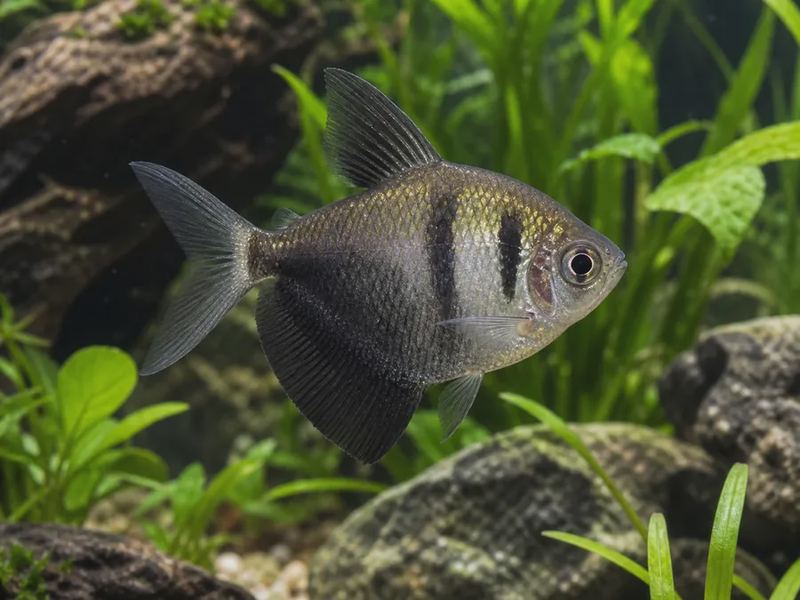
Species Overview
Gymnocorymbus ternetzi, the black skirt tetra, is a small characin in the family Characidae and one of the most widely kept freshwater schooling fish in the aquarium trade. The species was first described by the French ichthyologist Paul Chabanaud in 1924, who placed it in the genus Gymnocorymbus alongside its close relative Gymnocorymbus thayeri. The genus name derives from the Greek gymnos (naked) and korymbos (cluster or tuft), while the specific epithet ternetzi honors the German-born Brazilian zoologist Carl Ternetz, who collected specimens in the Paraguay River basin. For many years, black skirt tetras were also referred to under the genus Tetragonopterus, and older literature may still list them as Tetragonopterus ternetzi.
The natural range of Gymnocorymbus ternetzi extends across the Paraguay and Guaporé river basins in South America, encompassing parts of Brazil, Bolivia, Paraguay, and northern Argentina. The fish also occurs in the upper Paraná basin in Brazil, where it is believed to have been introduced or expanded its range through interconnected waterways. Wild populations inhabit slow-moving rivers, tributary streams, flooded forest pools, and oxbow lakes, often in areas with dense submerged vegetation, overhanging riparian roots, and soft, leaf-littered substrates. The water in these habitats tends to be warm, slightly acidic to neutral, and moderately soft, with seasonal fluctuations driven by rainfall and flooding. Black skirt tetras are typically found in shoals of a dozen or more individuals, a social structure that has important implications for their care in captivity.
Although the wild form is silvery with black markings, decades of selective breeding have produced several color and fin morphs that dominate the commercial trade. The "long-fin" or "veil-tail" variety carries elongated dorsal, anal, and caudal fins, while the "white skirt" and "gold skirt" morphs show reduced black pigmentation. GloFish® black skirt tetras, genetically modified to express fluorescent proteins, are also widely sold, though their care requirements are identical to those of the wild-type fish. Regardless of morph, all black skirt tetras share the same basic biology, temperament, and environmental needs.
Appearance & Size
The black skirt tetra has a laterally compressed, roughly diamond-shaped body that is deeper than that of many other small characins. Adults typically reach 5–7 cm (2–2.75 inches) in standard length, with females growing slightly larger and noticeably rounder than males. Under good lighting, the body shows a silvery, somewhat translucent ground color that reflects faint iridescent green or blue highlights along the flanks. Two or three prominent vertical black bands run down the sides: one behind the gill cover, one through the middle of the body, and a third that fades into the anal region. The dorsal and anal fins are also heavily pigmented with black, giving the fish its characteristic "skirt" appearance. A small, silvery adipose fin sits between the dorsal and caudal fins, a trait shared with many characids.
Sexual dimorphism is moderate but reliable once the fish are mature. Males tend to be slimmer, with a straighter ventral profile and more intensely black finnage, particularly the dorsal and anal fins, which may appear broader and more pointed. Females are fuller-bodied, especially when gravid, and their black markings are often slightly less pronounced. The anal fin of the male is sometimes described as having a slightly different shape, with a more angular posterior edge, though this character is easier to see in side-by-side comparisons than in isolated fish.
Juvenile black skirt tetras are more intensely black than adults, with the body bands often merging into a nearly solid dark patch. As the fish mature, the black pigment typically recedes and the silvery ground color becomes more prominent. This ontogenetic color change is normal and not a sign of poor health. Long-finned varieties can be more delicate, as the elongated fin rays are prone to nipping and bacterial infection if water quality is poor or tankmates are boisterous.
Diet & Feeding
Gymnocorymbus ternetzi is an opportunistic omnivore in the wild, feeding on small aquatic invertebrates, insect larvae, crustaceans, zooplankton, and plant matter. Its dentition is well suited to grasping and crushing small prey, and wild-caught specimens often have guts containing a mix of animal and plant material. In the aquarium, this dietary flexibility makes the species easy to feed, but it also means that a monotonous diet of a single flake food will not bring out the best color, condition, or breeding readiness in the fish.
A high-quality staple should form the base of the diet: a reputable tropical flake or micro-pellet containing 35–45% protein, supplemented with spirulina or other plant-based ingredients. To this, add frozen or live foods several times a week. Suitable options include Daphnia, Moina, baby brine shrimp (Artemia nauplii), bloodworms, blackworms, and chopped Tubifex. Live foods are particularly valuable for conditioning fish prior to spawning, as they mimic the invertebrate-rich diet of the wild. Vegetable matter in the form of blanched zucchini, spinach, or spirulina flakes should also be offered regularly to support digestive health and prevent constipation.
Black skirt tetras are mid-water feeders by preference, though they will readily rise to the surface for floating foods and will pick at sinking pellets. Feed two to three small meals per day, offering only what the fish can consume in two to three minutes. Overfeeding is one of the most common husbandry errors with this species; uneaten food degrades water quality and contributes to the obesity that plagues many captive characins. Because the fish are shoaling, ensure that food is dispersed widely enough that all members of the group get a share, and observe feeding behavior as a general health indicator—a black skirt tetra that refuses food is usually signaling a problem.
Aquarium Setup
A minimum tank size of 75 liters (20 US gallons) is appropriate for a small shoal of six to eight black skirt tetras, but larger is always better. Because these are active, shoaling fish that may reach 6–7 cm, a 90–120 cm (36–48 inch) tank with a footprint of at least 75–90 liters provides more swimming room and makes aggression within the group less likely. The fish occupy the middle and lower-middle water column, so horizontal swimming space is more important than height. A tight-fitting lid is recommended, as characins can jump when startled.
Substrate choice is flexible. A dark, fine-grained sand or rounded gravel suits the species well and helps the silvery body color and black markings stand out. Dark substrates also tend to reduce stress-related color fading. Avoid sharp or coarse gravel, which can damage the delicate finnage of long-finned morphs. Driftwood, bogwood, and dried Indian almond leaves are excellent additions; they leach tannins that mimic the soft, slightly acidic conditions of the species' native waters and provide cover for subdominant fish.
Planting should be moderate to dense, with a mix of rooted and floating species. Good choices include Vallisneria, Cryptocoryne, Amazon sword (Echinodorus), and floating plants such as Salvinia or Pistia. Floating plants diffuse overhead light and give the fish a sense of security, which encourages more natural shoaling behavior. Leave open swimming areas in the middle of the tank so the group can move freely. Lighting can be moderate; the species does not require intense illumination, and excessively bright light without cover tends to make black skirt tetras skittish. A photoperiod of 8–10 hours per day is sufficient and helps limit algae.
Filtration should provide gentle to moderate flow, as the species' native habitats are slow-moving. A sponge filter, a canister filter with a spray bar, or a hang-on-back filter with adjustable output all work well. Avoid strong laminar currents that push the fish constantly against one side of the tank. Because black skirt tetras are schooling fish, keep them in groups of at least six, and preferably eight to ten; a single specimen or a pair will often become withdrawn, nippy, or prone to stress-related disease.
Water Parameters
Black skirt tetras are adaptable but do best in water that approximates their native conditions: warm, slightly acidic, and moderately soft. They tolerate a fairly wide range of parameters, which is one reason they are recommended for beginners, but long-term health and coloration are best in stable, clean water with regular partial changes. The table below summarizes the recommended range, with the wild-type conditions given for comparison.
| Parameter | Recommended aquarium range | Wild habitat (approximate) |
|---|---|---|
| Temperature | 24–28 °C (75–82 °F) | 24–30 °C (75–86 °F), seasonally variable |
| pH | 6.0–7.5 | 5.5–7.0 |
| General hardness (GH) | 4–12 dGH (70–215 ppm) | 2–10 dGH (35–180 ppm) |
| Carbonate hardness (KH) | 2–8 dKH | 1–6 dKH |
| Ammonia | 0 ppm | Trace, effectively 0 ppm |
| Nitrite | 0 ppm | 0 ppm |
| Nitrate | <20 ppm | Usually <5 ppm |
Stability matters more than any single reading. A black skirt tetra kept at pH 7.2 and 26 °C in clean, well-oxygenated water will generally thrive, whereas a fish subjected to fluctuating pH, temperature swings, or accumulating nitrate will be stressed and prone to disease. Perform 25–30% water changes weekly, vacuum the substrate, and rinse filter media in tank water rather than under the tap. If your tap water is very hard or alkaline, consider mixing it with reverse-osmosis water or using driftwood and Indian almond leaves to soften and acidify it gradually. Avoid sudden, large shifts in parameters; adjust new water to match the tank before adding it.
Behavior & Compatibility
In the wild, Gymnocorymbus ternetzi is a shoaling species that forms loose, hierarchical groups. In the aquarium, this social nature translates into a strong preference for the company of conspecifics. A group of eight or more fish will typically swim together, with occasional chasing and fin displays that are normal and rarely injurious. When kept singly or in pairs, black skirt tetras may become nippy toward other fish, hide excessively, or show faded coloration. The presence of a proper shoal is therefore not merely aesthetic; it is a welfare requirement.
Black skirt tetras are generally peaceful and make good community fish, but they have a well-known tendency to nip the fins of slow-moving, long-finned tankmates. This behavior is more pronounced in small groups and in tanks with insufficient space or cover. Suitable tankmates include other peaceful characins (Paracheirodon innesi, Hemigrammus spp., Hyphessobrycon spp.), rasboras (Trigonostigma spp.), small barbs such as Pethia and Puntius species, Corydoras catfish, small loricariids such as Otocinclus, and peaceful dwarf cichlids like Apistogramma and Mikrogeophagus ramirezi. Livebearers such as guppies and platies can also work, though very small fry may be eaten.
Tankmates to avoid or treat with caution include bettas (Betta splendens), guppies with long, flowing fins, angelfish (Pterophyllum spp.), and other slow, long-finned species that are easy targets for nipping. Large or aggressive cichlids, predatory catfish, and anything big enough to eat a 5 cm tetra should be excluded. Invertebrates such as Neocaridina shrimp and small snails are usually ignored, though very small shrimp fry may be predated. As with any community tank, provide plenty of visual barriers—plants, driftwood, and rockwork—so that fish can retreat and re-establish territories without constant confrontation.
Breeding
Black skirt tetras are egg-scattering characins and are considered moderately easy to breed, though raising the fry requires some care. Condition a group of six to ten fish on live and frozen foods for two to three weeks, keeping males and females together but providing plenty of space. Females will visibly fill with eggs; males will display, chase, and nip at the females' flanks. When the females look conspicuously gravid, set up a dedicated spawning tank of 40–60 liters with soft, slightly acidic water (pH 6.0–6.8, GH 2–6 dGH) at 26–28 °C. Cover the bottom with a spawning mop, java moss, or a layer of marbles so that eggs can fall out of reach of the adults, which will readily eat them.
Introduce one or two females with two or three males in the evening. Spawning typically occurs at first light, with the male driving the female into fine-leaved plants or a spawning mop, where eggs and milt are released in a series of short embraces. A single female can produce 300–500 eggs over several hours, though not all will be fertile. After spawning, remove the adults immediately. Eggs are small, transparent, and slightly adhesive; they hatch in 24–36 hours at 26–28 °C. The fry are extremely small at first and require infusoria, rotifers, or commercial liquid fry food for the first 5–7 days, after which they can be transitioned to newly hatched brine shrimp nauplii and finely crushed flake. Growth is moderate; fry reach sexual maturity in roughly 6–8 months under good conditions.
Because the species has been bred in captivity for decades, commercial strains—particularly long-finned and GloFish® morphs—are widely available and often easier to obtain than wild-type fish. Note that GloFish® black skirt tetras are patented and their commercial breeding is restricted, though hobbyists may breed them for personal enjoyment. If you are breeding long-finned morphs, be aware that the elongated fin trait is not always fully expressed in offspring, and some fry may show intermediate fin lengths.
Common Diseases & Health
Black skirt tetras are hardy when kept in clean, stable water, but they are susceptible to the same diseases as other freshwater characins. The most common is Ichthyophthirius multifiliis, or "ich," a protozoan parasite that presents as small white spots on the body and fins, often accompanied by flashing, clamped fins, and lethargy. Ich is usually triggered by temperature fluctuations or stress from transport or poor water quality. Treatment typically involves raising the temperature to 28–30 °C for 10–14 days and adding an appropriate medication, such as malachite green or a copper-based product, following the manufacturer's instructions. Because the parasite's life cycle is temperature-dependent, completing the full treatment period is essential even after visible spots disappear.
Fin rot, caused by bacteria such as Aeromonas and Pseudomonas, is another frequent problem, particularly in long-finned morphs and in tanks with poor water quality. Early signs include frayed or whitish fin edges; advanced cases can progress to body ulcers. Improving water quality and treating with a broad-spectrum antibacterial medication usually resolves mild cases. Columnaris (Flavobacterium columnare) can cause saddle-shaped lesions and should be treated promptly, as it can be fatal. Velvet disease (Piscinoodinium), caused by a dinoflagellate parasite, produces a fine gold or rust-colored dusting on the skin and responds to similar treatments as ich.
Internal parasites such as Capillaria and Hexamita can cause weight loss, white stringy feces, and listlessness, particularly in wild-caught or newly imported fish. These are best treated with metronidazole or praziquantel, ideally under veterinary guidance. Preventive care is straightforward: quarantine new arrivals for at least two to four weeks, maintain excellent water quality, feed a varied diet, avoid overcrowding, and keep the shoal at an appropriate size to reduce stress. A healthy black skirt tetra is active, well-colored, and eager to feed; any deviation from this baseline warrants a check of water parameters and a close look at the fish for early signs of disease.
FAQs
How many black skirt tetras should I keep together?
A minimum of six is generally recommended, but eight to ten is better. These are shoaling fish, and a larger group reduces stress, encourages natural behavior, and minimizes the fin-nipping that can occur when the fish are kept in small numbers. In a 75–120 liter tank, a group of eight to ten black skirt tetras can be kept with a compatible community of similar-sized, peaceful fish.
Are black skirt tetras good for beginners?
Yes, with a few caveats. They are adaptable, accept a wide range of prepared foods, and tolerate a broad range of water parameters, which makes them forgiving of minor husbandry mistakes. However, they need a proper shoal, clean water, and tankmates that will not be bullied or that will not bully them. They are also more active and nippy than some other beginner species, so they are best kept in a tank of at least 75 liters with plenty of plants and cover.
Why is my black skirt tetra losing its black color?
Fading black pigment can be normal in older fish, but it is more often a sign of stress, poor water quality, or an inappropriate diet. Check ammonia, nitrite, and nitrate levels, confirm that the temperature is stable, and review the diet to ensure it includes both animal and plant matter. If the fish is also lethargic, hiding, or refusing food, treat for disease in a quarantine tank. In many cases, restoring good water quality and a varied diet will bring the color back within a few weeks.
Can black skirt tetras live with bettas?
It is generally not recommended. Black skirt tetras are fin-nippers by tendency, and bettas—especially males with long, flowing fins—are prime targets. Even a well-fed shoal may harass a betta persistently, leading to stress, fin damage, and secondary infections. If you want to keep a betta in a community tank, choose tankmates that are either too fast to be nipped or too large to be bullied, and avoid long-finned, slow-moving species altogether.