
Hasemania nana: The Silvertip Tetra
Species Overview
Hasemania nana, the silvertip tetra, is a small, lively characin that has been a mainstay of the freshwater aquarium hobby for decades. It belongs to the family Characidae, the largest and most diverse family of freshwater fishes in the order Characiformes, which also contains the tetras, piranhas, and pencilfishes. Within Characidae, Hasemania is a small genus, and H. nana is by far its best-known representative in the trade. The species was first described in 1908 by the German-American ichthyologist Carl H. Eigenmann under the name Hemigrammus nanus, based on material collected in Brazil. It was later moved to the genus Hasemania, which was erected to accommodate characins that lack a true adipose fin—a small, fleshy, ray-less fin normally located between the dorsal and caudal fins in most tetras. The loss of the adipose fin, combined with a distinctive silvery-white tip on the dorsal fin, makes the genus relatively easy to recognize.
Silvertip tetras are endemic to eastern Brazil, where they occur in coastal river systems of the states of Bahia and Minas Gerais. The type locality is in the vicinity of the Rio São Francisco basin and adjacent coastal drainages. In the wild, H. nana inhabits slow-moving to moderately flowing streams, tributaries, and flooded marginal habitats, often in areas with dense aquatic vegetation, submerged roots, and leaf litter. These are typically clear to slightly tea-colored "blackwater" or clearwater environments with soft, slightly acidic water and relatively warm temperatures. The fish form loose shoals, sometimes in quite large numbers, and are most often found in the middle and upper layers of the water column where they pick at small invertebrates and plant material. In the aquarium, they remain one of the more adaptable and hardy tetras, which is one reason they have stayed popular since their introduction to the hobby in the mid-twentieth century.
Appearance & Size
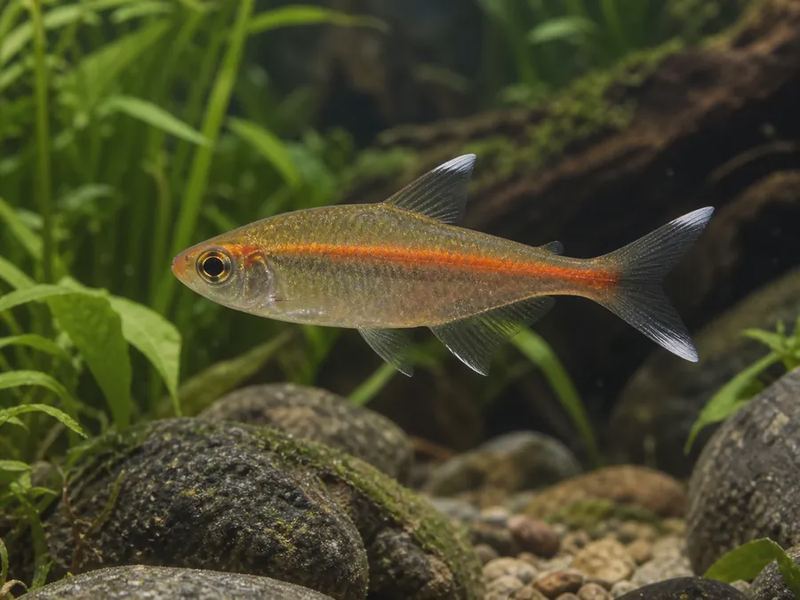
The silvertip tetra is a slender, laterally compressed fish with a somewhat elongated body shape typical of small characins. Adults typically reach 3–4 cm (about 1.2–1.6 inches) in standard length, with females often growing slightly larger and fuller-bodied than males. The body coloration is predominantly silvery to pale golden-brown, with a subtle iridescence that shifts with the light. The most striking feature—and the source of the common name—is the bright, silvery-white tip on the anterior portion of the dorsal fin. This white patch is present in both sexes but tends to be more pronounced in males, especially when they are displaying or in breeding condition. The anal fin in males is also more elongated and pointed, often edged with white or pale yellow, while females have a shorter, more rounded anal fin.
Juvenile fish are more uniformly silver and may lack the full intensity of the dorsal fin tip until they mature. In good condition, adults develop a warm, yellowish to orange hue along the flanks, particularly in the lower half of the body, and the eye may show a faint reddish or orange ring. The caudal fin is usually clear to slightly yellowish, and the remaining fins are mostly transparent to pale. There is some geographic and commercial variation in color intensity; wild-caught specimens and well-line-bred fish can be quite colorful, while stressed or poorly conditioned individuals appear washed out and drab. As with many tetras, the fish's coloration is a reliable indicator of health and water quality: a silvertip tetra that has lost its silver fin tip and shows a pale, grayish body is almost certainly experiencing stress, disease, or inappropriate water parameters.
Sexual dimorphism is moderate but generally reliable once the fish are mature. Males are slimmer, more intensely colored, and possess the extended, pointed anal fin mentioned above. Females are rounder in the belly, especially when gravid, and their anal fin is shorter and more triangular. Because silvertip tetras are small and relatively subtle in color compared with some of the more flamboyant tetras, they are often chosen for planted community aquariums where their shimmering silver highlights and active shoaling behavior provide movement and contrast without dominating the aquascape.
Diet & Feeding
In the wild, Hasemania nana is an opportunistic omnivore that feeds on small aquatic invertebrates, insect larvae, microcrustaceans, and plant matter. Its small mouth and relatively short digestive tract are typical of characins that forage continuously on tiny prey items throughout the day. In the aquarium, silvertip tetras are unfussy eaters and will readily accept a wide range of prepared and frozen foods. A high-quality staple diet of micro-pellets or finely crushed flake food should form the base of the diet, supplemented regularly with frozen or live foods such as Daphnia, Artemia (brine shrimp), bloodworms, and microworms. Live and frozen foods are particularly valuable for conditioning fish prior to breeding and for maintaining the intense coloration of males.
Because these fish are small and have high metabolisms, they benefit from being fed two or three small meals per day rather than one large feeding. Overfeeding is a common mistake and a frequent cause of obesity, poor water quality, and subsequent health problems in small tetras. Uneaten food should be removed promptly, and the amount offered should be adjusted so that the fish consume everything within a minute or two. Silvertip tetras will also graze on soft algae and aufwuchs on plant leaves and driftwood, though this should not be relied upon as a primary food source. A varied diet that includes both plant and animal matter supports healthy coloration, robust immune function, and successful reproduction. As with most schooling species, competition for food can be intense, so it is worth ensuring that slower or subordinate individuals get their share, especially in a mixed community tank.
Aquarium Setup
Silvertip tetras are best kept in a well-planted aquarium that mimics the shaded, vegetated streams of their native Brazil. A tank of at least 60 cm (24 inches) in length and around 40–60 liters (10–15 US gallons) is suitable for a small group, but larger tanks—ideally 80 cm (32 inches) or more—are preferable because they allow the fish to form a proper shoal and display more natural behavior. These are active, midwater swimmers that appreciate open swimming space in the center of the tank, bordered by dense plantings along the back and sides. A dark substrate, such as fine gravel or aquarium soil, helps bring out the fish's silvery coloration and creates a more naturalistic look.
Live plants are highly recommended. Species such as Vallisneria, Rotala, Ludwigia, Hygrophila, and floating plants like Salvinia or Pistia provide cover, diffuse light, and help maintain water quality. Driftwood and botanicals such as Indian almond leaves or alder cones can be added to simulate the leaf-litter habitats the species occupies in the wild; these also release tannins that gently lower pH and hardness and have mild antimicrobial properties. Lighting should be moderate and not overly intense, partly because the fish look best under subdued light and partly because high light without adequate CO₂ and nutrients encourages algae. A gentle to moderate water flow from a filter or small powerhead suits them well, but strong currents should be avoided.
Filtration should be efficient but not overpowering. A sponge filter or a canister filter with a spray bar works well, providing biological filtration without creating excessive turbulence. The tank should be fully cycled before introducing fish, and a tight-fitting lid is advisable because silvertip tetras, like many small characins, can jump when startled. Because they are a shoaling species, they should be kept in groups of at least six to eight individuals, with ten or more being even better. A larger shoal reduces aggression, encourages natural behavior, and makes the fish feel more secure, which in turn makes them more visible and colorful in the aquarium.
Water Parameters
In the wild, Hasemania nana inhabits soft, slightly acidic waters with stable temperatures. In captivity, however, the species is notably adaptable and can thrive within a fairly broad range, provided that conditions are stable and the water is clean. The table below summarizes the recommended parameters for long-term maintenance. Wild-caught fish may be more sensitive and do best toward the softer, more acidic end of the range, while tank-bred specimens are usually more tolerant of neutral to slightly hard water.
| Parameter | Recommended Range | Notes |
|---|---|---|
| Temperature | 22–28 °C (72–82 °F) | 24–26 °C (75–79 °F) is ideal for most aquariums; avoid prolonged exposure above 28 °C. |
| pH | 5.5–7.5 | Slightly acidic to neutral is best; stable values matter more than a specific number. |
| General Hardness (GH) | 2–15 dGH | Soft to moderately hard; wild fish prefer the lower end (2–8 dGH). |
| Carbonate Hardness (KH) | 1–8 dKH | Low to moderate; avoid very high KH if aiming for natural blackwater conditions. |
| Ammonia / Nitrite | 0 ppm | Any detectable ammonia or nitrite indicates a filtration or stocking problem. |
| Nitrate | < 20 ppm | Regular partial water changes of 20–30% weekly help keep nitrate low. |
Consistency is arguably more important than chasing exact values. Sudden shifts in temperature, pH, or hardness can stress silvertip tetras and make them vulnerable to disease, particularly ich and fin rot. When performing water changes, match the replacement water to the tank temperature and, where possible, to its chemistry. If the fish are wild-caught, acclimating them slowly via drip or drip-style methods is strongly recommended. In most community aquariums, stable dechlorinated tap water that falls within the ranges above will support silvertip tetras very well, and there is no need to use RO/DI water unless the local supply is unusually hard or alkaline.
Behavior & Compatibility
The silvertip tetra is a peaceful, active shoaling fish that spends most of its time in the middle and upper levels of the aquarium. In a properly sized group, the fish swim together in a loose but cohesive school, with males frequently sparring and displaying to one another in short, harmless chases. This behavior is normal and is one of the pleasures of keeping the species; it becomes more pronounced when the fish are in good condition and when the group is large enough to diffuse aggression. Kept singly or in pairs, silvertip tetras can become shy, hide more, and may nip at other fish out of stress. A group of at least eight to ten is strongly recommended, and a shoal of fifteen or more in a larger tank is even better.
Because of their small size and peaceful temperament, silvertip tetras mix well with a wide range of community fish. Good tankmates include other small, peaceful characins such as neon tetras, cardinal tetras, glowlight tetras, and rummy-nose tetras; small rasboras like Boraras and Trigonostigma species; peaceful dwarf cichlids such as Apistogramma and Mikrogeophagus ramirezi; and small catfish including Corydoras species and otocinclus. They also do well with livebearers such as guppies and platies, provided the water parameters overlap appropriately. Bottom-dwelling species like Corydoras and small loaches make excellent companions because they occupy a different part of the tank and do not compete directly for food or space.
Fish to avoid include large or aggressive species that would view the silvertip tetra as a snack, such as most medium-to-large cichlids, large barbs, and predatory catfish. Fin-nippers like tiger barbs and some serpae tetras can also be problematic, particularly if kept in small numbers. Invertebrates such as cherry shrimp and Neocaridina are generally safe with adult silvertip tetras, though very small shrimplets may occasionally be picked off. Snails are ignored. As with any community tank, the key is to choose tankmates that share similar water requirements, are of comparable size, and are not overly boisterous. Given stable water, a varied diet, and a proper shoal, silvertip tetras are hardy, long-lived fish that can live for three to five years or more in captivity.
Breeding
Hasemania nana is an egg-scattering characin that is relatively straightforward to breed in captivity, though raising the fry requires some care. As with many tetras, the best results come from conditioning a group of well-fed adults on live and frozen foods for two to three weeks before spawning. A separate breeding tank of 10–20 liters (3–5 US gallons) is ideal, filled with soft, slightly acidic water at around 26–28 °C (79–82 °F) and kept dimly lit. The tank should contain fine-leaved plants such as Java moss, spawning mops, or a layer of marbles or mesh at the bottom to prevent the adults from eating the eggs, which they will readily do. A small, mature sponge filter provides gentle filtration without sucking up eggs or fry.
To spawn, introduce a gravid female and one or two well-conditioned males in the evening. Spawning usually occurs in the early morning, with the male chasing the female through the plants and both fish releasing eggs and milt over fine vegetation or the substrate. A single female can produce 100–200 small, adhesive eggs. Once spawning is complete, the adults should be removed immediately. The eggs typically hatch within 24–36 hours, and the free-swimming fry appear about three to five days later, once their yolk sacs are absorbed. At that point, they should be fed infusoria, vinegar eels, or commercial liquid fry food for the first few days, progressing to newly hatched brine shrimp nauplii and microworms as they grow. Frequent small water changes and careful attention to water quality are essential, as the fry are sensitive to ammonia and organic waste. Growth is relatively fast under good conditions, and juveniles begin to show adult coloration and the characteristic silver dorsal tip within a few weeks to a couple of months.
Common Diseases & Health
Silvertip tetras are generally hardy, but like all aquarium fish they are susceptible to a handful of common health problems, most of which are linked to stress, poor water quality, or sudden environmental changes. The most frequently encountered disease is ich (white spot disease), caused by the ciliate Ichthyophthirius multifiliis. It presents as small white spots on the fins and body, along with flashing, lethargy, and clamped fins. Ich is best treated early with raised temperature (around 28–30 °C, if the fish tolerate it), increased aeration, and a suitable medication such as malachite green or formalin-based products, following the manufacturer's instructions carefully. Because the parasite's life cycle is temperature-dependent, treatment must continue for the full recommended period even after visible spots disappear.
Fin rot and other bacterial infections are usually secondary to stress, overcrowding, or poor water quality. They appear as frayed, discolored, or receding fins and are best addressed by correcting the underlying husbandry issues—improving filtration, increasing water changes, and reducing stocking—alongside an appropriate antibiotic if the infection is severe. Internal parasites and "wasting disease" can occur in newly imported or wild-caught fish and may require antiparasitic treatment. Neon tetra disease, caused by the microsporidian Pleistophora hyphessobryconis, is a serious and generally incurable condition that can affect various tetras, including silvertips; affected fish show loss of color, spinal curvature, and emaciation, and should be isolated or humanely euthanized to prevent spread. As always, prevention is better than cure: quarantine new arrivals for two to four weeks, maintain stable and appropriate water parameters, feed a varied diet, and avoid overcrowding. A healthy, well-conditioned silvertip tetra is a robust fish that rarely falls ill.
FAQs
How many silvertip tetras should I keep together?
Silvertip tetras are a shoaling species and should be kept in groups of at least six to eight, with ten or more being ideal. Larger groups reduce stress, encourage natural schooling behavior, and bring out the best coloration in the fish.
Are silvertip tetras suitable for a beginner aquarium?
Yes. They are peaceful, adaptable, and relatively hardy, making them a good choice for beginners who can provide a cycled tank, stable water parameters, and a varied diet. They do best in a mature, well-planted aquarium rather than a brand-new setup.
Can silvertip tetras live with bettas or shrimp?
They can usually be kept with a peaceful betta in a sufficiently large tank with plenty of cover, though individual bettas vary in temperament. Adult cherry and Neocaridina shrimp are generally safe, but very small shrimplets may be eaten.
Why has my silvertip tetra lost its silver fin tip and color?
Loss of the characteristic silver dorsal tip and overall pale coloration is usually a sign of stress, poor water quality, disease, or an inappropriate diet. Check temperature, pH, ammonia, nitrite, and nitrate levels, perform a partial water change, and review the diet. Coloration typically returns once conditions improve.