
Hemigrammus erythrozonus: The Glowlight Tetra
Species Overview
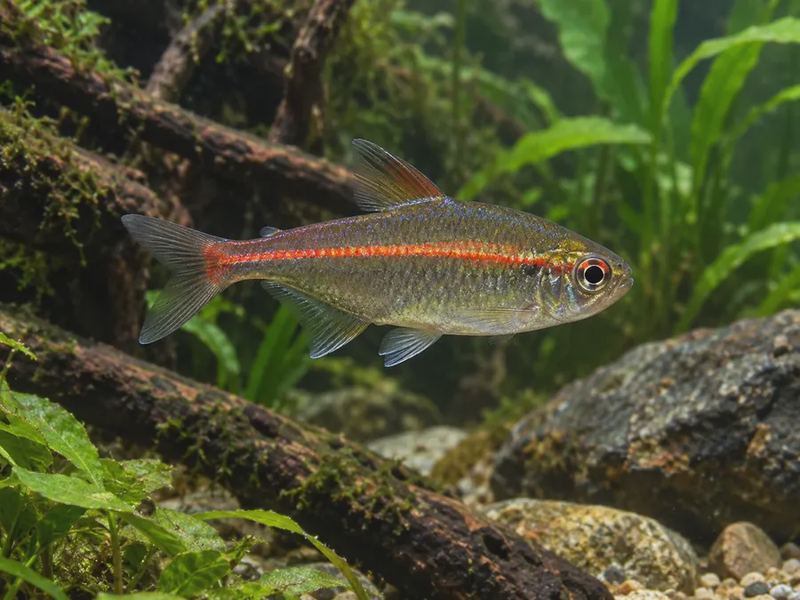
Hemigrammus erythrozonus, known throughout the aquarium hobby as the glowlight tetra, is one of the most enduringly popular small characins in freshwater aquaria. It is a member of the family Characidae, a vast and ecologically diverse group of Neotropical fishes that includes the tetras, the piranhas, and a host of lesser-known relatives. Within the genus Hemigrammus — a name derived from the Greek for "half-line," referring to the incomplete lateral line characteristic of the group — the glowlight tetra is distinguished by its slender build and the single, luminous red-orange stripe that runs the length of its body.
The species was described by the American ichthyologist Carl H. Eigenmann in 1909, based on specimens collected in the rivers of British Guiana, as Guyana was then known. Eigenmann was one of the foremost authorities on South American freshwater fishes of his era, and his description placed the glowlight tetra firmly within the characin radiation that dominates the waterways of northern South America. Despite being known to science for more than a century, the species has never become a major commercial fishery export; virtually all glowlight tetras sold in the aquarium trade today are captive-bred, a fact that has important implications for their hardiness and adaptability in home aquaria.
The natural range of Hemigrammus erythrozonus centers on the Essequibo River basin of Guyana, with additional populations reported from tributaries in Suriname and possibly adjacent regions of the Guiana Shield. The Essequibo is one of South America's larger rivers, draining a vast watershed of rainforest and savanna before emptying into the Atlantic Ocean. Glowlight tetras are typically found in the smaller tributaries, creeks, and flooded forest habitats associated with this system rather than in the main river channel itself.
In the wild, these fish inhabit slow-moving, heavily vegetated waters that are often stained a tea-like brown by tannins and other dissolved organic compounds leached from leaf litter and submerged wood. Such "blackwater" and clearwater habitats are characteristically soft and acidic, with low mineral content and dim, filtered light reaching the water surface through the forest canopy. The fish congregate in loose shoals among roots, fallen branches, and aquatic plants, where they find both shelter from predators and a steady supply of small invertebrates. Understanding this native habitat is the single most useful key to keeping the species well in captivity, because it explains nearly every husbandry recommendation that follows.
Appearance & Size
The glowlight tetra is a small, elegantly proportioned fish. Adults typically reach 3 to 4 centimeters (roughly 1.2 to 1.6 inches) in standard length, with females growing slightly larger and noticeably fuller-bodied than males. The body is elongated and laterally compressed, tapering gently toward a forked caudal fin. The overall coloration is a translucent silvery-tan, which in good lighting takes on a subtle iridescence across the flanks.
The defining feature of the species — and the source of its common name — is a brilliant, neon-like stripe of red to orange that originates just behind the eye and runs horizontally along the midline of the body, terminating at the base of the caudal fin. This stripe is not a pigment patch in the ordinary sense; it is produced by specialized iridophores and reflective tissue that scatter light, giving the line an almost self-luminous quality, particularly when the fish is viewed under subdued lighting against a dark background. A second, fainter silvery-white line often runs just above the red stripe, and the dorsal, anal, and adipose fins may show touches of white or pale orange at their tips.
Sexual dimorphism is modest but generally discernible in mature, well-conditioned fish. Males tend to be slimmer and more streamlined, with a straighter ventral profile, and their red stripe is sometimes more intensely colored. Females, especially when gravid with eggs, develop a visibly rounded belly that breaks the ventral line. The swim bladder, visible as a silvery, somewhat opaque area in the upper forward part of the body, is more conspicuous in females due to the greater depth of the body cavity. Juveniles are similar in pattern to adults but smaller and less intensely colored, with the red stripe often appearing paler until the fish approach maturity.
It is worth noting that the glowlight tetra is frequently confused with the similarly named and similarly sized glowlight danio (Danio choprae) and with certain other striped tetras such as the black neon tetra (Hyphessobrycon herbertaxelrodi). The glowlight tetra can be reliably distinguished by its single red-orange lateral stripe, the absence of a black band, and its characin body form, which lacks the barbels and different fin proportions of the danionins. Under proper care, glowlight tetras are long-lived for their size, with reports of captive specimens exceeding five years and occasional individuals reaching eight years or more.
Diet & Feeding
In the wild, Hemigrammus erythrozonus is an opportunistic micro-predator and omnivore. Stomach-content studies of related Hemigrammus species consistently reveal a diet dominated by small aquatic and terrestrial invertebrates — chiefly insect larvae, tiny crustaceans such as copepods and cladocerans, and the occasional worm or rotifer — supplemented by plant matter, algae, and detritus. The fish's small mouth and modest size restrict it to prey items of perhaps a millimeter or two, and it feeds primarily in the water column and from the surfaces of leaves and wood rather than from the substrate.
In captivity, the glowlight tetra is an unfussy and enthusiastic eater, which is one of the reasons it has remained a mainstay of the community tank for decades. A high-quality staple diet of finely crushed or micro-pellet flake food should form the foundation, but the species will thrive rather than merely survive when this base is supplemented with frozen and live foods. Daphnia, baby brine shrimp, cyclops, and chopped bloodworm are all taken eagerly and closely mimic the invertebrate prey the fish would encounter in nature. These live and frozen foods are particularly valuable for conditioning fish prior to spawning and for bringing out the full intensity of the red lateral stripe.
Feeding frequency should reflect the fish's small stomach capacity and high metabolic rate. Two small meals per day is ideal, with each portion sized to be consumed within a minute or two. Overfeeding is one of the most common husbandry errors with small tetras: uneaten food decays rapidly, fouling the water and promoting the growth of algae and pathogenic bacteria, while the fish themselves become obese and prone to fatty liver and reduced fertility. Because glowlight tetras are mid-water feeders by inclination, sinking foods should be offered sparingly unless there are bottom-dwelling tankmates to clean up the excess.
One useful refinement is to vary the diet deliberately across the week rather than offering the same food at every meal. A rotation of flake, frozen daphnia, frozen brine shrimp, and an occasional live treat not only covers a broader nutritional spectrum but also stimulates natural foraging behavior. Fish kept on such a regimen typically display deeper color, more active spawning behavior, and greater resistance to the minor stresses of aquarium life than those maintained on a monotonous diet. Vitamin-enriched foods are worth considering for breeding stock, as they support egg quality and larval development.
Aquarium Setup
The glowlight tetra is a shoaling species that should never be kept singly or in pairs. A group of at least six, and preferably eight to twelve or more, is the minimum for the fish to display natural behavior and feel secure. Because of this social requirement, the tank should be large enough to accommodate a proper shoal without crowding. A 60-centimeter (24-inch) tank of around 40 to 60 liters (10 to 15 US gallons) can house a small group adequately, but a 75- to 90-centimeter tank (roughly 20 to 30 US gallons) is a far better choice, providing room for a larger shoal and for the dither fish and bottom-dwellers that make an attractive community. As always, the welfare of the fish should determine stocking, not the desire to fill every cubic inch of water.
Substrate choice matters more for this species than for many tetras, because its natural habitat is soft and organic-rich. A dark, fine-grained substrate — sand or a rounded fine gravel — is ideal. Dark substrate serves two purposes: it mimics the leaf-litter and silt of the native creeks, and it provides contrast that makes the red lateral stripe appear even more luminous. Sharp or coarse gravel should be avoided, as it can abrade the delicate barbels and underside of fish that occasionally graze near the bottom, and it traps debris that degrades water quality.
Plants are central to a good glowlight tetra setup. In the wild the fish shelter among dense vegetation and submerged roots, and in the aquarium they will spend much of their time weaving between plant stems. Hardy, undemanding species such as Vallisneria, Cryptocoryne, Anubias, and various stem plants all work well, as do floating plants such as Salvinia or Pistia, whose trailing roots create the shaded, dappled conditions the fish prefer. A dark background, whether painted or provided by a dense planting, further enhances the species' coloration. Driftwood and botanicals such as Indian almond leaves are excellent additions: they release tannins that gently acidify and soften the water, mirroring the blackwater conditions of the Essequibo tributaries, and they provide surfaces for the biofilm and microfauna on which the fish will graze.
Lighting should be moderate rather than intense. The glowlight tetra's reflective stripe is at its most striking under subdued illumination, and bright, unshaded light tends to wash out the fish's color and encourage algae. A single low- to medium-output LED fixture, ideally with floating plants diffusing the light from above, is sufficient for most plant species and produces the most flattering display. Filtration should be gentle; a small canister filter or a sponge filter turned down to a modest flow rate is preferable to a powerful powerhead, which will buffet these small, weak-swimming fish and may discourage them from venturing into the open. The tank should be well covered, as the species is capable of jumping, particularly when startled or during spawning chases.
Water Parameters
Captive-bred glowlight tetras are considerably more tolerant of water chemistry than their wild-caught counterparts, but they still do best in soft, slightly acidic water that approximates their native conditions. The table below summarizes the recommended range for long-term maintenance. Stability matters at least as much as any single reading; fish subjected to fluctuating pH or temperature are far more likely to succumb to disease than those kept consistently within a slightly imperfect range.
| Parameter | Ideal Range | Acceptable Range | Notes |
|---|---|---|---|
| Temperature | 24–27 °C (75–81 °F) | 22–28 °C (72–82 °F) | Avoid prolonged exposure to the extremes; 25 °C is a good midpoint. |
| pH | 6.0–7.0 | 5.5–7.5 | Acidic to neutral; wild fish prefer the lower end. |
| General Hardness (GH) | 2–8 °dGH | 1–12 °dGH | Soft water is strongly preferred; hard water dulls color. |
| Carbonate Hardness (KH) | 1–5 °dKH | 0–8 °dKH | Low KH helps buffer pH stability in soft water. |
| Ammonia / Nitrite | 0 ppm | 0 ppm | Any detectable reading indicates a filtration problem. |
| Nitrate | < 20 ppm | < 40 ppm | Regular partial water changes keep nitrate low. |
Weekly partial water changes of 20 to 30 percent are the cornerstone of maintaining these parameters. In soft-water aquaria, it is important to remember that the water has little buffering capacity, so pH can drift if organic waste accumulates; consistent maintenance prevents this. Where tap water is hard or alkaline, mixing with reverse-osmosis water or filtering over peat can bring the parameters into the preferred range. Wild-caught specimens, which are occasionally available, should be kept strictly within the ideal column and acclimated slowly, as they are far less forgiving than tank-bred stock.
Behavior & Compatibility
Glowlight tetras are peaceful, active, and mildly gregarious. In a suitably sized shoal they display a characteristic loose schooling behavior, with individuals maintaining a few body lengths of spacing but moving as a coordinated group, particularly when feeding or when a perceived threat passes. A single fish or a pair kept in isolation often becomes withdrawn, hides constantly, and may refuse food — a clear sign that the species' social needs are not being met. Within the shoal, a gentle but persistent dominance hierarchy exists, expressed through brief chases and fin displays rather than outright aggression. These interactions are normal and rarely result in injury.
Because of their small size and peaceful disposition, glowlight tetras are ideal community fish, but their tankmates must be chosen with care. Suitable companions include other small, calm characins such as neon and cardinal tetras, rummy-nose tetras, and pencilfish; small rasboras such as Boraras and Trigonostigma species; peaceful dwarf cichlids like Apistogramma and Mikrogeophagus; corydoras catfish; and small livebearers such as guppies and endlers, provided the water is not too hard. A group of glowlight tetras also makes an excellent dither fish for shy or reclusive species, since their confident, mid-water activity signals safety to more timid tankmates.
Species to avoid include anything large enough to eat a 3-centimeter fish — which is a longer list than many aquarists expect, encompassing angelfish, most medium-to-large cichlids, larger gouramis, and many catfish. Fin-nippers such as tiger barbs and some serpae tetras are also poor choices, as they will harass the glowlight tetra's trailing fins. Boisterous, fast-swimming tankmates can intimidate the species into hiding, and predatory invertebrates such as large crayfish should be excluded for obvious reasons. As a general rule, if a proposed tankmate is more than three or four times the glowlight tetra's length, or has a mouth large enough to encompass it, the pairing should be reconsidered.
Breeding
Hemigrammus erythrozonus is one of the more straightforward tetras to breed in captivity, and it has been spawned in home aquaria for generations. As with most characins, the species is an egg-scatterer with no parental care: adults spawn among fine-leaved plants or over a substrate, the eggs are adhesive or weakly so, and the parents will readily eat both eggs and fry if not removed. Successful breeding therefore depends on separating the adults from the eggs shortly after spawning and on providing the fry with appropriately small first foods.
Conditioning is the first step. A group of six to ten fish, or a selected trio of one female and two males, should be fed heavily on live and frozen foods — daphnia, brine shrimp, and bloodworm — for two to three weeks. Females will visibly swell with eggs, and males will intensify their color and begin to display and chase. A dedicated spawning tank of 10 to 20 liters is then prepared with soft, slightly acidic water (pH around 6.0 to 6.5, GH below 5 °dGH), a temperature of 26 to 28 °C, and either a dense clump of fine-leaved plants such as Taxiphyllum moss or a spawning mop. Some breeders use a bare-bottom tank with a layer of marbles or a mesh grid so that eggs fall out of reach of the adults. Filtration should be gentle, and a small air-driven sponge filter is ideal.
Spawning typically occurs in the early morning, triggered by the first light and often by a small partial water change with slightly cooler, softer water the evening before. The male pursues the female through the plants, and the pair release eggs and milt in a series of quick embraces. A well-conditioned female may produce 100 to 300 eggs, which are small, transparent, and slightly adhesive. The adults should be removed immediately after spawning, as they will begin eating the eggs within hours. Eggs typically hatch in 24 to 36 hours, and the free-swimming fry — which are extremely small — exhaust their yolk sacs over the following two to four days. First foods should be infusoria or a liquid fry food, progressing to microworms and then to newly hatched brine shrimp as the fry grow. Water quality in the rearing tank must be kept pristine, with frequent small water changes using water of matching temperature and chemistry. Growth is moderate; fry reach sexual maturity in roughly six to nine months.
Common Diseases & Health
Glowlight tetras are hardy when kept in clean, stable, soft water, but like all aquarium fish they are susceptible to the common diseases of the freshwater hobby. The single most important preventive measure is excellent water quality: most outbreaks of disease in this species can be traced to overcrowding, overfeeding, inadequate water changes, or sudden fluctuations in temperature or pH. A well-maintained tank with a proper shoal, appropriate tankmates, and a varied diet will produce fish that rarely fall ill.
Ichthyophthirius multifiliis, or "ich," is the most frequently encountered parasite. It presents as fine white spots scattered across the body and fins, often accompanied by flashing (rubbing against objects), clamped fins, and lethargy. Ich is usually triggered by a temperature drop or other stressor, and it responds well to raising the temperature to around 30 °C for a week or two combined with an appropriate antiparasitic medication; the higher temperature accelerates the parasite's life cycle so that the free-swimming stage is exposed to treatment. Because the parasite is highly contagious, the whole tank should be treated, not just affected individuals.
Fin and tail rot, caused by opportunistic bacteria such as Aeromonas and Flavobacterium, appears as ragged, receding fin edges and is almost always a sign of poor water quality or chronic stress. Correcting the underlying husbandry problem and treating with a suitable antibacterial agent usually resolves it. Velvet disease, caused by the dinoflagellate Piscinoodinium, produces a fine golden or rusty dusting on the skin and is best treated with copper-based medication or a proprietary remedy, again alongside improved water quality. Neon tetra disease, caused by the sporozoan Pleistophora hyphessobryconis, is incurable and can affect Hemigrammus species; affected fish should be humanely euthanized and removed promptly to prevent spread, and the tank should not receive new tetras for some weeks afterward.
Beyond infectious disease, glowlight tetras may suffer from nutritional deficiencies if fed a monotonous diet, and from physical damage if kept with nippy or boisterous tankmates. Quarantine of new arrivals for two to four weeks before introduction to the main tank is a simple and highly effective practice that prevents the majority of disease outbreaks. Observation is the aquarist's best diagnostic tool: a daily glance at the shoal, checking for appetite, color, fin condition, and swimming behavior, will catch most problems while they are still easy to treat.
FAQs
How many glowlight tetras should I keep together?
A minimum of six, but eight to twelve or more is strongly recommended. This is a shoaling species that becomes stressed and withdrawn when kept in small numbers. A larger group not only keeps the fish healthier and more colorful but also produces the beautiful, coordinated schooling behavior that makes the species so attractive in a planted tank.
Can glowlight tetras live in hard water?
They can survive in moderately hard water, particularly if they are tank-bred, but they will not thrive. Hard, alkaline water tends to dull the red lateral stripe, shorten lifespan, and make the fish more susceptible to disease. If your tap water is hard, mixing it with reverse-osmosis water or filtering over peat will bring the parameters closer to the soft, slightly acidic conditions the species prefers.
What tankmates are suitable for glowlight tetras?
Other small, peaceful community fish are ideal: neon and cardinal tetras, rummy-nose tetras, pencilfish, small rasboras, corydoras catfish, and peaceful dwarf cichlids such as Apistogramma. Avoid large or predatory fish that could eat them, and avoid fin-nippers like tiger barbs. As a rule, a tankmate more than three or four times the glowlight tetra's length is a risk.
How long do glowlight tetras live?
With good care, most individuals live three to five years, and well-maintained fish frequently exceed five years. Some aquarists report specimens reaching eight years or more. Lifespan is strongly influenced by water quality, diet, temperature, and the absence of chronic stress, so the single best investment in your fish's longevity is consistent husbandry.