
Hemigrammus rhodostomus: The Firehead Tetra
Species Overview
Hemigrammus rhodostomus, commonly known as the firehead tetra, redhead tetra, or red-nosed tetra, is a small characin belonging to the family Characidae, subfamily Stethaprioninae. The species was described in 1924 by the French ichthyologist Paul Chabanaud, who based the original description on specimens collected in the lower Amazon basin. The genus name Hemigrammus derives from the Greek hemi (half) and gramme (line), a reference to the incomplete lateral line characteristic of many members of the genus, while the specific epithet rhodostomus combines the Greek rhodon (rose) and stoma (mouth), referring to the vivid red pigmentation of the snout and anterior head that gives the fish both its scientific and common names.
The firehead tetra is native to the Amazon River basin of South America, with confirmed populations in the lower and middle Amazon, the Rio Negro, and portions of the Rio Madeira drainage in Brazil, as well as tributaries in eastern Peru and southeastern Colombia. It is a true blackwater and clearwater species, inhabiting slow-moving creeks, flooded forest margins, and side channels where submerged roots, leaf litter, and marginal vegetation create complex structural habitat. In the wild, these fish are typically found in loose shoals numbering from a dozen to well over a hundred individuals, often associating with other small characids such as Paracheirodon axelrodi and Hemigrammus bleheri. Water in many of these habitats is soft, acidic, and stained tea-brown by dissolved tannins and humic acids, with very low mineral content and conductivity often below 50 µS/cm.
Taxonomically, H. rhodostomus is frequently confused with two closely related species: Hemigrammus bleheri, the brilliant rummy-nose tetra, and Petitella georgiae, the false rummy-nose tetra. All three share the diagnostic red head and black-and-white striped caudal fin, and all three are sold interchangeably in the aquarium trade under the "rummy-nose" umbrella. Distinguishing them requires attention to the extent of the red pigmentation (in H. rhodostomus the red typically does not extend past the gill cover, whereas in H. bleheri it reaches further onto the flanks), the shape and patterning of the caudal fin stripes, and the number of anal-fin rays. For the practical aquarist, care requirements across the three species are nearly identical, and the guidance in this profile applies broadly to all three.
Appearance & Size
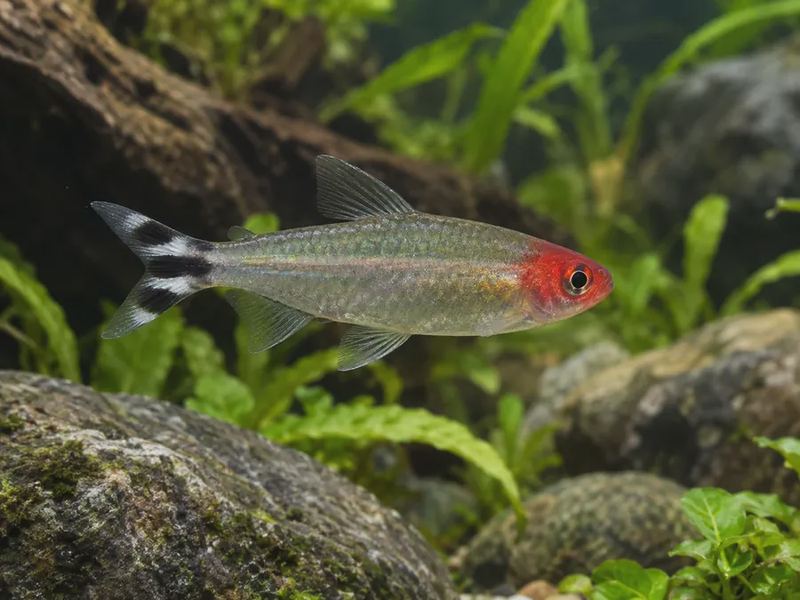
The firehead tetra is a slender, laterally compressed characin reaching a maximum standard length of approximately 4 to 5 centimeters (roughly 1.6 to 2 inches) in well-maintained aquaria, with females tending to grow slightly larger and fuller-bodied than males. The body is silvery and largely translucent, with a subtle olive-green iridescence along the upper flanks that becomes more pronounced under good lighting. The most striking feature is the brilliant crimson-red pigmentation covering the snout, lips, and anterior head as far back as the operculum. This red coloration is a reliable indicator of health and condition: well-fed, unstressed fish in appropriate water chemistry display intense, saturated red, while fish kept in hard, alkaline, or nitrate-laden water often fade to a dull pink or orange.
The caudal fin is boldly patterned in horizontal bands of black and white, a feature sometimes described as a "flag" or "checkerboard" tail. In H. rhodostomus, the central caudal rays are typically black, bordered above and below by white or transparent zones, though the exact arrangement varies with the angle of view and the fish's mood. The anal fin is relatively long, with a translucent base and a dark anterior edge, and the dorsal fin is small and set roughly at the midpoint of the back. The eye is large and silver, with a dark pupil, and the iris may show a faint reddish tint in mature fish.
Sexual dimorphism is subtle but observable in mature specimens. Males tend to be slimmer, with a straighter ventral profile and slightly more extended dorsal and anal fins. Females, particularly when gravid, develop a noticeably rounded belly and appear deeper-bodied when viewed from the front. The red head coloration is typically equally intense in both sexes, though some breeders report that dominant males display the most saturated red during spawning condition. Juvenile fish lack the full intensity of the red head and may show only a faint pinkish wash until they reach roughly 2 centimeters in length.
Diet & Feeding
In the wild, Hemigrammus rhodostomus is a micro-predator and opportunistic omnivore. Stomach-content analyses of related Amazonian characids indicate a diet dominated by small aquatic and terrestrial invertebrates—particularly cladocerans, copepods, ostracods, insect larvae, and wingless terrestrial insects that fall onto the water surface—supplemented by filamentous algae and plant material. In the aquarium, this translates into a fish that eagerly accepts a wide range of prepared and frozen foods but does best on a varied diet rich in animal protein.
A high-quality staple should form the base of the diet. Micro-pellets or finely crushed flake food formulated for small tropical fish, containing 40 percent or more crude protein, are appropriate. Because these fish feed primarily in the midwater column and rarely graze from the substrate, slow-sinking or neutrally buoyant foods are preferable to heavy granules that drop quickly. Frozen and live foods should be offered several times per week to maintain condition and coloration: brine shrimp (Artemia), daphnia, cyclops, bloodworms (used sparingly, as they are rich and can lead to obesity), and micro-worms are all taken enthusiastically. Many keepers report that regular feedings of live or frozen Artemia and daphnia noticeably intensify the red head coloration.
Feeding frequency should be two to three small meals per day rather than one large feeding, as the species has a short digestive tract and a relatively high metabolic rate. Offer only what the shoal can consume within two to three minutes, and siphon uneaten food promptly to avoid degrading water quality—particularly important given the soft, acidic conditions this species prefers, where nitrification is slower and pH swings are easier to trigger. Fasting one day per week is a reasonable practice for adult fish and helps prevent the accumulation of body fat that can impair spawning. Because firehead tetras are shoaling fish, they feed more confidently and competitively in groups of eight or more, and isolated individuals may become shy and underfeed.
Aquarium Setup
A minimum tank size of 60 liters (approximately 16 US gallons) is suitable for a small shoal of six to eight firehead tetras, but a tank of 90 to 120 liters (24 to 32 US gallons) or larger is strongly recommended for a proper group of ten or more, which is the minimum shoal size for natural behavior and reduced stress. The tank should be longer than it is tall, as these fish swim primarily in the middle and upper water column and appreciate horizontal swimming space. A tight-fitting lid is essential: like many small characids, firehead tetras are capable jumpers, particularly when startled or during spawning chases.
Substrate choice should reflect the natural blackwater habitat. A dark, inert substrate—fine sand, rounded gravel, or an aquasoil with low buffering capacity—helps the fish feel secure and provides a visual backdrop that intensifies the red head and the black-and-white caudal pattern. Avoid brightly colored or white substrates, which tend to wash out the fish's coloration and can reflect excessive light. Driftwood, particularly Malaysian driftwood or locally collected hardwood that has been properly cured, is highly desirable both as structure and as a source of tannins that help maintain the soft, acidic conditions this species requires. Botanical additions such as Indian almond leaves, alder cones, and beech or oak leaves further mimic the natural environment, release humic substances, and provide a grazing surface for microfauna that the tetras will pick at.
Planting should be moderate to dense, with a mix of floating and rooted species. Floating plants such as Salvinia, Phyllanthus fluitans, or duckweed (if you can tolerate it) provide shade, reduce light intensity, and offer a sense of overhead cover that makes these fish noticeably more outgoing. Rooted plants—Cryptocoryne species, Vallisneria, Echinodorus, and various stem plants—can be arranged around the sides and back, leaving an open swimming area in the center. Lighting should be moderate rather than intense; a low-to-medium output LED fixture run for seven to eight hours per day is appropriate, and the tannin-stained water will naturally attenuate light penetration. Filtration should be gentle and reliable—a sponge filter, a small canister filter with a spray bar, or a well-baffled hang-on-back unit—since firehead tetras are sensitive to strong current and to fluctuating water quality. Avoid powerheads and other high-flow equipment unless the tank is large enough to provide a calm refuge zone.
Water Parameters
Water chemistry is the single most important factor in the long-term health of Hemigrammus rhodostomus. This is a soft-water, acidic species that does poorly in hard, alkaline conditions, where it is prone to chronic stress, faded coloration, fin erosion, and increased susceptibility to bacterial infections. The table below summarizes the target parameters, along with the extremes occasionally reported in the wild and the values typically found in successful captive setups.
| Parameter | Target Range | Wild / Tolerated Range | Notes |
|---|---|---|---|
| Temperature | 24–28 °C (75–82 °F) | 23–30 °C (73–86 °F) | Stable temperatures are more important than any specific value; avoid rapid swings. |
| pH | 5.5–6.8 | 4.8–7.2 | Below 6.5 is ideal; values above 7.2 are poorly tolerated long-term. |
| General Hardness (GH) | 1–5 dGH (18–90 ppm) | 0–8 dGH | Very soft water is essential; avoid GH above 10 dGH. |
| Carbonate Hardness (KH) | 0–3 dKH | 0–5 dKH | Low KH helps stabilize pH in the acidic range with CO₂ or tannins. |
| Conductivity / TDS | 30–150 µS/cm (TDS 20–100 ppm) | 10–250 µS/cm | Wild fish often come from water below 50 µS/cm. |
| Nitrate (NO₃⁻) | < 20 ppm | < 40 ppm | Keep as low as possible; nitrate accumulation fades red coloration. |
| Ammonia / Nitrite | 0 ppm | 0 ppm | Any detectable reading indicates a filtration problem. |
Achieving these parameters usually requires either a source of naturally soft water (rainwater, RO/DI water, or very soft tap water) or blending. If your tap water is hard, mixing RO/DI water with tap at a ratio of roughly 70:30 or 80:20 will typically bring GH and KH into range. Avoid chemical pH adjusters, which cause unstable swings; instead, rely on botanical tannins, a thin layer of aquarium-safe peat in the filter, or a small amount of blackwater extract to gently lower pH and hardness. Drip acclimation over 45 to 90 minutes is strongly recommended when introducing new fish, and any large water change should be temperature- and chemistry-matched to the tank. Weekly water changes of 20 to 30 percent are appropriate for a well-stocked, well-filtered aquarium.
Behavior & Compatibility
The firehead tetra is a peaceful, active shoaling species that spends most of its time in the middle and upper portions of the water column. In groups of ten or more, it displays classic shoaling behavior: fish orient loosely in the same direction, maintain relatively even spacing, and react collectively to perceived threats. In groups of fewer than six, however, the fish often become nervous, hide more, feed less aggressively, and may nip at one another's fins—a clear sign that the shoal is too small. The species is not aggressive toward tankmates and does not defend a territory, though males will briefly spar during spawning condition, chasing one another in short bursts without causing injury.
Compatible tankmates include other small, peaceful, soft-water species from similar biotopes. Good choices include other small characids such as Paracheirodon axelrodi (cardinal tetra), Paracheirodon innesi (neon tetra), Hemigrammus erythrozonus (glowlight tetra), and Nannostomus pencilfish; small cichlids such as Apistogramma and Mikrogeophagus ramirezi; peaceful catfish including Corydoras species and small loricariids such as Otocinclus; and small rasboras from Southeast Asia if water parameters are adjusted carefully. Avoid large or boisterous tankmates, including most medium-to-large cichlids, angelfish, and any fish large enough to consider a 4-centimeter tetra a meal. Also avoid known fin-nippers such as tiger barbs and some serpae tetras, which can harass the relatively long-finned firehead tetra and induce chronic stress.
Invertebrate tankmates are generally safe. Caridina and Neocaridina shrimp, nerite snails, and Malaysian trumpet snails all coexist peacefully with firehead tetras, though very small shrimp fry may be predated. Because this species occupies the midwater column and rarely descends to the substrate, bottom-dwelling tankmates experience little competition for food. As always, quarantine new additions for two to four weeks before introducing them to the display tank, as imported characids frequently carry ectoparasites and bacterial pathogens.
Breeding
Hemigrammus rhodostomus is a broadcast spawner that, like many Amazonian characids, is moderately challenging to breed in captivity but achievable with careful conditioning and a dedicated spawning setup. Commercial availability is largely met by wild-caught and, increasingly, farm-raised fish from Southeast Asia and Eastern Europe, where large-scale breeding is practiced. For the home aquarist, the primary obstacles are the species' need for very soft, acidic water and its tendency to eat its own eggs and fry.
Conditioning begins two to three weeks before spawning. Separate males and females into well-planted conditioning tanks and feed heavily on live and frozen foods—Artemia, daphnia, bloodworms, and micro-worms—with several small feedings per day. Females will visibly fill with eggs and become noticeably deeper-bodied; males will intensify in color and begin displaying to one another. Water in the conditioning tanks should be soft (GH below 4 dGH) and slightly acidic (pH 5.5–6.5), with temperature around 26 °C (79 °F).
The spawning tank should be small—10 to 20 liters is sufficient—and set up with very soft, acidic water (GH 1–3 dGH, KH 0–2 dKH, pH 5.0–6.0), a temperature of 26–28 °C, and subdued lighting. Provide spawning substrate in the form of fine-leaved plants such as Taxiphyllum moss, a spawning mop, or a layer of marbles or glass beads on the bottom to allow eggs to fall out of reach of the adults. Introduce a well-conditioned pair or a small group (two males to three females) in the evening; spawning typically occurs at first light. The male courts the female with rapid darting displays, and the pair spawns among fine vegetation, releasing eggs and milt simultaneously. A single female may release 100 to 300 eggs, which are small, transparent, and slightly adhesive.
Remove the adults immediately after spawning, as they will consume the eggs. Eggs hatch in approximately 24 to 36 hours at 26–28 °C. The free-swimming fry are extremely small—roughly 3 millimeters—and require infusoria, rotifers, or commercial liquid fry food for the first five to seven days, after which they can transition to newly hatched Artemia nauplii and microworms. Fry are sensitive to water quality and require gentle filtration (a seasoned sponge filter is ideal) and small, frequent water changes. Sexual maturity is reached at around four to six months, and adults can be spawned every four to six weeks if conditioned properly between attempts.
Common Diseases & Health
The firehead tetra is a hardy species when its environmental requirements are met, but it is notably sensitive to poor water quality, hard or alkaline water, and temperature fluctuations. The most common health issues in captivity are directly or indirectly linked to husbandry errors. Ichthyophthirius multifiliis, or ich, is the most frequent ectoparasitic infection, presenting as fine white spots on the fins and body, flashing against decor, and clamped fins. Ich is best treated with raised temperature (28–30 °C), increased aeration, and a suitable antiparasitic medication; note that some characids are sensitive to malachite green and formalin, so half-dose treatments are often recommended, and the underlying stressor—usually temperature or water quality—must be corrected.
Fin rot, caused by Flavobacterium columnare and other opportunistic bacteria, is common in fish kept in hard, alkaline water or in tanks with elevated nitrate. It presents as frayed, whitish fin margins that progress toward the fin base if untreated. Improving water quality, reducing nitrate, and treating with a broad-spectrum antibacterial agent usually resolves early cases. Columnaris itself, presenting as white saddle-shaped lesions on the back, is more serious and requires prompt antibiotic treatment. Piscinoodinium (velvet) and Ichthyobodo (costia) are also reported in imported wild-caught fish, particularly during the first few weeks after arrival, and are best prevented by quarantine and careful acclimation.
Prevention is far more effective than treatment. Maintain stable, soft, acidic water; keep nitrate below 20 ppm; perform regular partial water changes with matched water; quarantine all new arrivals for two to four weeks; and avoid overcrowding. Feed a varied, high-quality diet to support immune function, and observe your shoal daily—early signs of trouble, such as faded red coloration, listlessness, or reduced feeding, are usually visible before overt disease develops. Because firehead tetras are shoaling fish, a single sick individual is often the first indication of a tank-wide problem, and prompt investigation is warranted.
FAQs
How many firehead tetras should I keep together?
A minimum of eight to ten is recommended; twelve or more is better. Firehead tetras are obligate shoalers, and small groups show increased stress, hiding, and fin-nipping. A 90-liter (24-gallon) tank or larger comfortably houses a dozen adults alongside a few peaceful tankmates.
What is the difference between the firehead tetra, the rummy-nose tetra, and the false rummy-nose tetra?
All three share the red head and black-and-white caudal fin, and all are sold as "rummy-nose" tetras. Hemigrammus rhodostomus (firehead or redhead tetra) has red pigmentation that typically stops at the gill cover, while Hemigrammus bleheri (brilliant rummy-nose) has red extending further onto the flanks, and Petitella georgiae (false rummy-nose) is distinguished by details of the caudal-fin striping and anal-fin ray counts. Care requirements are essentially identical for all three.
Why is my firehead tetra losing its red color?
Fading red is almost always a husbandry signal. The most common causes are hard or alkaline water, elevated nitrate, chronic stress from an undersized shoal or aggressive tankmates, and a monotonous diet. Correcting water chemistry, increasing shoal size, reducing nitrate through water changes, and offering regular live or frozen foods usually restores full coloration within a few weeks.
Can firehead tetras live in a community tank with angelfish or discus?
Discus are compatible in terms of water chemistry, since both prefer soft, acidic, warm water, and many keepers house them together successfully. Angelfish are a riskier choice: adult angelfish will eat small tetras, and even sub-adults may harass them. If you keep angelfish, choose a large tank (150 liters or more), introduce the tetras first, and maintain a shoal of at least twelve so the tetras feel secure. Avoid medium and large cichlids altogether.