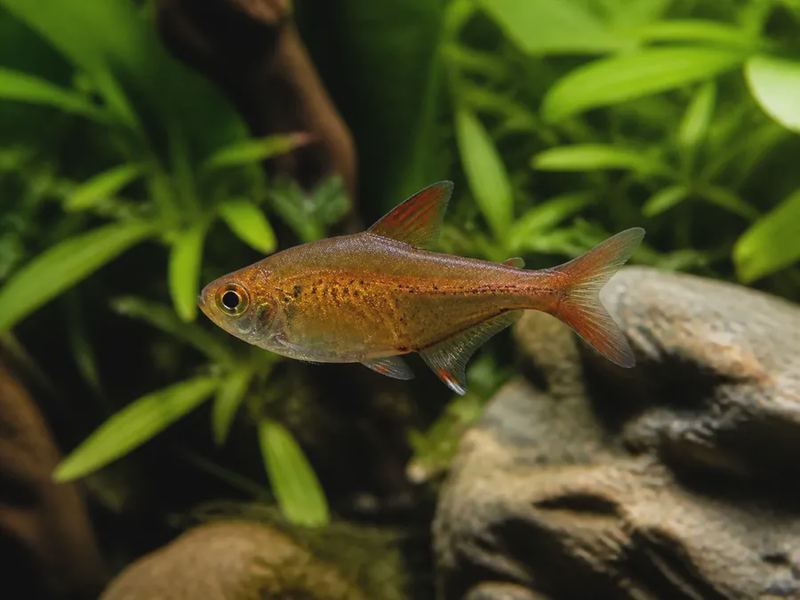
Hyphessobrycon amandae — Ember Tetra
Species Overview
The Ember Tetra, Hyphessobrycon amandae, is one of the most beloved and visually striking of the smaller characin species, a true gem of the aquarium hobby. Described scientifically by Géry in 1987, this diminutive fish was named in honor of Amanda Bleher, the daughter of the renowned German explorer and ornamental fish exporter Heiko Bleher, who collected the type specimens. The genus name Hyphessobrycon is derived from the Greek words “hyphesso†(meaning “small†or “lesserâ€) and “brycon†(a term for a type of characin), while the specific epithet amandae pays tribute to its namesake. Taxonomically, the Ember Tetra belongs to the family Characidae, a vast and diverse group that includes over 1,000 described species, ranging from the piranha to the cardinal tetra. Within this family, H. amandae is classified in the “rosy tetra†clade, a group of small, often red or orange-hued species that share similar morphological characteristics and ecological niches.
The natural range of the Ember Tetra is remarkably restricted, a factor that adds to its appeal and underscores the importance of responsible sourcing. Endemic to the Araguaia River basin in central Brazil, this species is found primarily in the state of Mato Grosso, within the vast cerrado (savanna) biome. The Araguaia River is one of the major tributaries of the Tocantins River, and its watershed is characterized by a complex mosaic of seasonal floodplains, slow-moving streams, and shallow, heavily vegetated pools. In the wild, Hyphessobrycon amandae inhabits what are known as “blackwater†environments—waters that are stained a deep tea color by the decomposition of organic matter such as leaves, twigs, and wood. This tannin-rich water is typically soft, acidic, and low in mineral content, creating a specific chemical environment that the fish have adapted to over millennia. The habitat is often shaded by dense riparian vegetation, which limits direct sunlight and keeps water temperatures relatively stable, though the shallow nature of these pools means they can experience significant diurnal temperature fluctuations, particularly during the dry season when water levels recede and the fish become concentrated in smaller, warmer refuges.
In the aquarium trade, the Ember Tetra was relatively rare for many years following its discovery, but advances in commercial breeding, particularly in Eastern Europe and Southeast Asia, have made it a staple in the hobby. Wild-caught specimens are occasionally available, but the vast majority of fish sold today are tank-raised, which has contributed to their hardiness and adaptability in captive environments. Despite their small size, Ember Tetras have captured the hearts of aquarists worldwide, not only for their fiery coloration but also for their peaceful temperament and ease of care, making them an ideal choice for both nano tanks and larger community aquariums. Their restricted natural range also makes them a species of interest for conservationists, as habitat destruction in the cerrado region—primarily from agricultural expansion and gold mining—poses a potential threat to their wild populations, though they remain unassessed by the IUCN Red List at this time.
Appearance & Size
The Ember Tetra is a masterclass in minimalism and vibrant color. At first glance, one might mistake it for a tiny, glowing ember floating in the water column, and it is this very appearance that gives the species its common name. The body is slender, laterally compressed, and elongated, with a streamlined profile that is typical of many small characins. The most striking feature is, of course, the coloration. The entire body of a healthy, well-maintained Ember Tetra is a translucent, fiery orange-red, ranging from a deep, almost blood-red on the caudal peduncle and tail fin to a slightly lighter, more golden-orange on the flanks and belly. This coloration is not static; it can intensify or fade depending on the fish’s mood, health, and environmental conditions. When the fish is stressed, frightened, or in suboptimal water conditions, the coloration will often pale to a washed-out yellow or even a translucent gray, whereas a dominant, well-fed male in a dark, planted aquarium will display an almost neon-like intensity that is truly breathtaking.
Sexual dimorphism in Hyphessobrycon amandae is subtle but discernible to the trained eye. Males are generally slightly smaller and slimmer than females, but their coloration is typically more intense and saturated. The dorsal, anal, and caudal fins of males often have a more pronounced red hue, and in some high-quality specimens, the edges of the fins may appear almost black or dark crimson. Females, conversely, tend to be slightly larger, deeper-bodied, and rounder in the ventral region, particularly when gravid (carrying eggs). When viewed from above, a mature female will show a distinctly wider, more robust profile. The fins themselves are relatively simple; the dorsal fin is positioned slightly behind the midpoint of the body, the anal fin is elongated and runs along the posterior half of the belly, and the caudal fin is forked. There is no adipose fin in this species, a feature shared by many but not all characins. The eyes are relatively large for the fish’s size, a common adaptation in fish from tannin-stained, low-light environments, and they are a striking dark black with a subtle golden iris.
In terms of size, the Ember Tetra is one of the smallest tetras in the hobby, reaching a maximum standard length of approximately 2 to 2.5 centimeters (0.8 to 1 inch). Most adult specimens will plateau at around 2.2 centimeters (0.87 inches), with females occasionally pushing slightly larger when full of eggs. This diminutive stature is a significant advantage for aquarists with limited space, as it allows for the creation of thriving naturalistic communities in tanks as small as 10 gallons. However, it is crucial to note that while the fish are small, they are highly active and shoaling by nature, and their wellbeing depends on being kept in groups of at least 10 to 12 individuals. A larger group not only encourages natural schooling behavior and reduces stress but also makes the display more spectacular, as the combined glow of a large shoal creates a “river of fire†effect against a backdrop of green plants.
Diet & Feeding
In their natural habitat, Ember Tetras are micro-predators and omnivores, feeding on a diverse array of small invertebrates, zooplankton, insect larvae, and organic detritus that accumulates among submerged leaf litter and aquatic vegetation. Their small mouths are perfectly adapted for capturing tiny prey items such as copepods, daphnia, mosquito larvae, and other microscopic organisms that drift through the water column. They are not aggressive hunters; rather, they are opportunistic foragers, constantly picking at surfaces and sifting through fine debris to find edible morsels. This natural diet is rich in protein and essential fatty acids, which drives their vibrant coloration and overall vitality.
In the aquarium, replicating this diverse diet is straightforward, as Hyphessobrycon amandae is an unfussy and enthusiastic eater. They will readily accept high-quality flake foods, micro-pellets, and granules, provided that the particle size is small enough for their tiny mouths. A finely crushed flake or a micro-pellet designed for nano fish is ideal. However, to truly unlock their best coloration and promote optimal health, a varied diet that includes live and frozen foods is highly recommended. Foods such as baby brine shrimp (Artemia nauplii), microworms, vinegar eels, and finely chopped or whole frozen daphnia and cyclops are eagerly consumed. These protein-rich foods mimic their natural prey and provide the carotenoids and other pigments necessary to intensify their fiery red-orange hues. It is a common observation among aquarists that Ember Tetras fed a diet rich in live and frozen foods display significantly more vivid colors than those fed only dry flake food.
Feeding frequency should be moderate, with small amounts offered two to three times per day. Because of their small size and high metabolic rate, they benefit from more frequent, smaller feedings rather than one large meal. Overfeeding must be strictly avoided, as uneaten food will quickly decompose and pollute the water, leading to ammonia spikes and subsequent health issues. A good rule of thumb is to offer only as much food as the fish can consume within two minutes, ensuring that no food reaches the substrate. Observing the fish during feeding is also a valuable health check; healthy Ember Tetras will actively dart to the surface and mid-water to grab food, displaying a voracious appetite. A sudden loss of appetite or a reluctance to feed is often the first sign of stress or disease. For aquarists keeping them in a planted tank, the fish will also naturally graze on micro-organisms and biofilm that grow on plant leaves and hardscape, supplementing their diet and contributing to their overall well-being. This natural foraging behavior also makes them excellent candidates for mature, established aquariums where a natural food web has developed.
Aquarium Setup
Creating an optimal environment for Hyphessobrycon amandae is both an art and a science, and getting it right will reward the aquarist with a stunning, active, and long-lived shoal. Given their small size, Ember Tetras are ideal for nano and small community tanks. A minimum tank size of 10 gallons (38 liters) is recommended for a small group of 8-10 fish, but a larger tank of 20 gallons (75 liters) or more is preferable, as it provides a more stable water volume, greater swimming space, and allows for a larger, more impressive shoal. The tank should have a secure lid, as these fish, while not known jumpers, can occasionally leap when startled, particularly during water changes or when introduced to a new environment.
The substrate choice can significantly influence both the aesthetic and the fish’s sense of security. A dark, fine-grained substrate, such as aquarium sand or small, dark-colored gravel, is highly recommended. Dark substrates not only mimic the natural blackwater habitats of the Araguaia basin but also dramatically enhance the visual impact of the fish, making their fiery coloration pop against the dark background. Over the substrate, a layer of botanicals—such as Indian almond leaves (Terminalia catappa), oak leaves, and alder cones—is highly beneficial. These botanicals slowly release tannins and humic substances into the water, lowering the pH, softening the water, and imparting a faint, tea-colored tint that replicates their wild conditions. These compounds also possess mild antifungal and antibacterial properties, contributing to the overall health of the fish.
Planting is essential for a thriving Ember Tetra aquarium. These fish naturally inhabit densely vegetated environments, and the presence of live plants provides them with cover, security, and a sense of refuge. A well-planted tank with a mix of foreground, midground, and background plants will create a naturalistic and functional ecosystem. Dense clumps of fine-leaved stem plants such as Cabomba, Limnophila, or Myriophyllum provide excellent cover and mimic their natural habitat. Java moss (Taxiphyllum barbieri) and Christmas moss (Vesicularia montagnei) are also excellent additions, as they provide a refuge for micro-organisms that the fish can graze on. Floating plants, such as Salvinia or Limnobium, are particularly valuable, as they diffuse light and create dappled shade, replicating the filtered sunlight of their native streams. The lighting should be moderate to subdued; bright, intense lighting can stress these fish, as they are accustomed to shaded conditions. A dimmer switch or floating plants can help achieve the desired light levels. Hardscape elements such as driftwood and twisted branches not only add aesthetic appeal but also provide additional hiding places and surfaces for biofilm growth, which the fish will eagerly graze on.
Water Parameters
Maintaining stable and appropriate water parameters is paramount to the long-term health and vibrancy of Hyphessobrycon amandae. As a species originating from blackwater environments, they have evolved to thrive in soft, acidic water with very low mineral content. While commercially bred specimens are generally more adaptable than their wild counterparts, replicating their natural conditions as closely as possible will encourage optimal coloration, breeding behavior, and disease resistance. The most critical aspect of water chemistry is stability; sudden fluctuations in pH, temperature, or hardness are far more harmful than slightly off-target but consistent values.
The temperature range for Ember Tetras is relatively broad, which contributes to their hardiness. In the wild, they experience seasonal temperature variations, with water temperatures ranging from the low 70s°F (22-23°C) during cooler periods to the mid-80s°F (29-30°C) during the hottest parts of the dry season. In the aquarium, a stable temperature between 74°F and 82°F (23.5°C to 27.8°C) is ideal. A heater with a reliable thermostat is essential to maintain this range, as ambient room temperatures can fluctuate significantly. For those interested in breeding, a gradual increase in temperature to the upper end of this range, combined with frequent water changes, can simulate the onset of the rainy season and trigger spawning behavior.
The pH and water hardness are where the blackwater adaptation becomes most critical. Ember Tetras prefer a slightly acidic to acidic pH, ideally in the range of 5.5 to 7.0. While they can tolerate a neutral pH of 7.0, particularly tank-raised individuals, prolonged exposure to alkaline water (pH above 7.5) can lead to chronic stress and increased susceptibility to disease. The general hardness (GH) should be very low, ideally between 1 and 8 dGH (degrees General Hardness), and the carbonate hardness (KH) should be between 1 and 5 dKH. This soft, low-alkalinity water is essential for maintaining a stable acidic pH. In areas with hard, alkaline tap water, aquarists may need to use reverse osmosis (RO) or deionized (DI) water mixed with tap water to achieve the desired parameters, or rely on the natural acidifying effects of tannins released from peat moss, driftwood, and leaf litter. The following table summarizes the recommended water parameters for optimal health:
| Parameter | Ideal Range | Acceptable Range |
|---|---|---|
| Temperature | 75°F – 80°F (24°C – 27°C) | 72°F – 84°F (22°C – 29°C) |
| pH | 6.0 – 6.8 | 5.5 – 7.2 |
| General Hardness (GH) | 2 – 6 dGH | 1 – 10 dGH |
| Carbonate Hardness (KH) | 1 – 3 dKH | 1 – 6 dKH |
| Nitrate (NO₃) | < 20 ppm | < 40 ppm |
Regular water testing is essential to ensure these parameters remain within acceptable bounds. A weekly water change of 25-30% is recommended to maintain water quality, remove accumulated nitrates, and replenish trace minerals. When performing water changes, it is crucial to match the temperature and pH of the new water to the tank water to avoid shocking the fish. The use of a liquid test kit, rather than test strips, is recommended for accurate and reliable readings.
Behavior & Compatibility
The behavioral profile of Hyphessobrycon amandae is one of its most endearing qualities. These are quintessential shoaling fish, meaning they must be kept in groups to feel secure and exhibit natural behavior. A lone Ember Tetra will be shy, withdrawn, and often lose its vibrant coloration, hiding in the shadows and refusing to eat. When kept in a group of at least 10-12 individuals, they form a tight-knit shoal that moves gracefully through the water column, creating a mesmerizing display of synchronized movement. The shoaling behavior is not merely a social preference; it is a survival mechanism that provides protection from predators and reduces individual stress. Within the shoal, a clear hierarchy exists, with dominant males displaying more intense coloration and engaging in subtle fin-flaring displays to establish their rank, though this rarely leads to actual aggression.
In terms of temperament, the Ember Tetra is exceptionally peaceful, making it an ideal community fish. They are completely non-aggressive and will not nip the fins of long-finned tankmates, nor will they harass smaller or slower fish. Their small mouths and gentle nature mean they pose no threat to adult shrimp, including dwarf shrimp such as Neocaridina davidi (cherry shrimp) or Caridina cantonensis (bee shrimp). In fact, they make excellent tankmates for shrimp, as they will not prey on adult shrimp and will happily coexist alongside them, foraging for the same micro-foods. However, it should be noted that they will readily consume shrimp fry (baby shrimp) if given the opportunity, so a heavily planted tank with plenty of hiding places is essential if breeding shrimp is a goal.
When selecting tankmates for a community aquarium, it is important to choose species that share similar water parameter requirements and temperament. Ideal tankmates include other small, peaceful tetras such as the Green Neon Tetra (Paracheirodon simulans), the Black Neon Tetra (Hyphessobrycon herbertaxelrodi), and the Pristella Tetra (Pristella maxillaris). Other excellent companions include small rasboras like the Chili Rasbora (Boraras brigittae) and the Mosquito Rasbora (Boraras urophthalmoides), as well as dwarf pencilfish from the genus Nannostomus. Pygmy corydoras (Corydoras pygmaeus, Corydoras habrosus) are superb bottom-dwelling companions, as they are peaceful and occupy a different niche in the tank. Small peaceful gouramis such as the Sparkling Gourami (Trichopsis pumila) or the Honey Gourami (Trichogaster chuna) can also coexist harmoniously. Avoid keeping Ember Tetras with large, boisterous, or aggressive fish such as angelfish, larger cichlids, or barbs, as these may either prey upon the small tetras or outcompete them for food, causing chronic stress. A species-only tank, with a large shoal of Ember Tetras, is arguably the most striking display, allowing their fiery colors to take center stage.
Breeding
Breeding Hyphessobrycon amandae is a rewarding endeavor that is well within the reach of the dedicated hobbyist, though it requires patience, attention to detail, and a separate breeding tank. These are egg-scattering fish that do not exhibit parental care; once the eggs are laid and fertilized, the adults will eagerly consume them if given the chance. Therefore, a dedicated breeding setup is essential for any significant success. The first step is to condition a group of adult fish with a high-quality diet rich in live and frozen foods. Offer small portions of baby brine shrimp, microworms, and finely chopped bloodworms two to three times daily for one to two weeks prior to attempting breeding. Healthy, well-conditioned females will become noticeably plumper with eggs, while males will display intensified, almost iridescent coloration.
The breeding tank itself should be small, typically 5 to 10 gallons, and filled with aged, soft, acidic water. The water should be even softer and more acidic than the main display tank, ideally with a pH of 5.5 to 6.0 and a GH of less than 2 dGH. This can be achieved by using reverse osmosis (RO) water and adding a small amount of blackwater extract or a handful of Indian almond leaves to lower the pH and tint the water. The tank should be dimly lit, as Ember Tetras prefer subdued lighting for spawning. To protect the eggs from predation, a spawning mop, a clump of fine-leaved Java moss, or a mesh grid placed at the bottom of the tank is essential. The fish will scatter their eggs among these fine structures, and the eggs will fall through to safety, away from the hungry adults.
To initiate spawning, introduce a conditioned pair or a small group (one male to two or three females) into the breeding tank in the evening. It is common for spawning to occur the following morning, triggered by the first light of day. The male will perform a courtship display, swimming rapidly around the female, flaring his fins, and vibrating his body. The female, if receptive, will respond by positioning herself beside the male, and the pair will then perform a simultaneous, rapid darting motion, during which the eggs and sperm are released. This process is repeated multiple times over the course of an hour or two, with a single female capable of producing anywhere from 50 to 150 small, translucent eggs. The eggs are non-adhesive and will sink to the bottom or become trapped in the moss.
Once spawning is complete, the adult fish must be removed immediately to prevent them from eating the eggs. The eggs are extremely sensitive to light and fungal infections. The tank should be kept dark, and a few drops of methylene blue can be added to the water to inhibit fungal growth on the eggs. The eggs will hatch in approximately 24 to 36 hours, depending on the temperature (warmer water accelerates hatching). The tiny fry are almost invisible to the naked eye for the first few days, as they remain attached to a yolk sac. Once the yolk sac is absorbed, typically after 3 to 4 days, the fry become free-swimming and will require food. Their first food should be infusoria or a commercial liquid fry food, followed by newly hatched baby brine shrimp after a week or so. The fry grow slowly, and it will take several months before they begin to show their characteristic orange-red coloration. Regular, small water changes are crucial for the healthy development of the fry, as they are highly sensitive to water quality deterioration.
Common Diseases & Health
While Hyphessobrycon amandae is a relatively hardy species when provided with stable water conditions and a varied diet, they are not immune to the common diseases that afflict freshwater aquarium fish. The best defense against disease is prevention, which is achieved through meticulous tank maintenance, regular water changes, a balanced diet, and quarantining any new fish before introducing them to the main display tank. Stress is the primary underlying cause of most aquarium diseases; fish kept in suboptimal conditions—such as poor water quality, overcrowding, or incompatible tankmates—are far more susceptible to pathogens than fish in a healthy, stable environment.
One of the most common ailments seen in tetras is Ichthyophthirius multifiliis, commonly known as “Ich†or white spot disease. This parasitic infection is characterized by the appearance of small, white, salt-like grains on the fish’s body, fins, and gills. Infected fish will often flash (rub against objects), clamp their fins, and exhibit rapid gill movement. Ich is highly contagious and can be introduced via new fish, plants, or contaminated water. Treatment typically involves raising the water temperature gradually to 86°F (30°C) for several days, combined with an over-the-counter ich medication containing malachite green or formalin. Ember Tetras are sensitive to medications, so it is important to follow the dosage instructions carefully and ensure adequate aeration, as warmer water holds less dissolved oxygen.
Another common issue is Neon Tetra Disease (Pleistophora hyphessobryconis), a parasitic infection that, despite its name, can affect various small characins, including Ember Tetras. This disease is particularly insidious because it is incurable and often fatal. Symptoms include a loss of coloration, particularly in the red areas of the body, a pale or whitish appearance, erratic swimming, and in advanced stages, spinal curvature (lordosis or scoliosis). The parasite is often introduced through live foods, particularly tubifex worms, or through infected fish. There is no effective treatment, and affected fish should be removed and euthanized humanely to prevent the spread of the parasite to healthy individuals. Prevention is key: avoid feeding live tubifex worms, quarantine new fish for a minimum of 4-6 weeks, and maintain pristine water quality.
Fin rot and fungal infections are also relatively common, particularly in fish that have been stressed or injured. Fin rot is typically a bacterial infection that causes the fins to appear frayed, ragged, or discolored, often with a white or cloudy edge. It is usually a secondary infection that occurs after physical damage or a decline in water quality. Treatment involves improving water conditions, performing frequent water changes, and using a broad-spectrum antibacterial medication. Fungal infections, which appear as white, cottony growths on the body or mouth, are also opportunistic and are best treated with antifungal medications while addressing the underlying water quality issues. To maintain the health of your Ember Tetras, it is crucial to provide a stress-free environment, avoid overfeeding, and perform regular water changes. Observing your fish daily for any changes in behavior, appetite, or appearance is the most effective way to catch problems early, when they are most treatable.
FAQs
Q1: How many Ember Tetras should I keep together, and can they be kept in a nano tank?
Ember Tetras are obligate shoaling fish, and they must be kept in groups of at least 10 to 12 individuals to feel secure and display natural behavior. A smaller group will result in shy, stressed fish that often lose their vibrant coloration. Due to their tiny adult size (around 2 cm), they are perfectly suited for nano tanks. A well-established 10-gallon (38-liter) aquarium is the absolute minimum for a small shoal of 10 fish. However, a larger tank, such as a 20-gallon long (75 liters), is highly recommended, as it provides more stable water conditions, greater swimming space, and allows for a larger, more spectacular shoal of 15-20 individuals.
Q2: Will Ember Tetras eat my shrimp?
Adult Ember Tetras are completely harmless to adult dwarf shrimp, such as Cherry Shrimp (Neocaridina davidi) or Amano Shrimp (Caridina multidentata). Their mouths are simply too small to prey on adult shrimp. However, they are opportunistic micro-predators and will readily consume shrimp fry (baby shrimp) if they can catch them. If you are trying to breed shrimp in the same tank, providing dense areas of cover, such as thick Java moss or a dedicated shrimp cave, is essential to allow the fry to survive. The presence of Ember Tetras can actually be beneficial, as they will compete with the shrimp for food but also help keep the tank clean by consuming leftover food and micro-organisms.
Q3: Why are my Ember Tetras not showing their bright orange-red color?
A loss of color in Ember Tetras is almost always a sign of stress, poor water quality, or an inadequate diet. First, check your water parameters, specifically ammonia, nitrite, and nitrate levels, and ensure the temperature and pH are within their preferred range. Sudden fluctuations in water chemistry are a common cause of color loss. Second, ensure they are kept in a sufficiently large group; a small group will cause chronic stress and fade their colors. Third, evaluate their diet. A diet consisting solely of dry flake food will not provide the necessary pigments for vibrant coloration. Supplement their diet with high-quality frozen or live foods, such as baby brine shrimp, daphnia, and cyclops, which are rich in carotenoids and will dramatically enhance their fiery hues. Finally, a dark substrate and background, along with floating plants to diffuse light, will make their existing coloration appear more intense.
Q4: What is the lifespan of an Ember Tetra?
With proper care, including stable water conditions, a varied and nutritious diet, and a stress-free environment, Ember Tetras have a typical lifespan of 2 to 4 years in the aquarium. Some exceptionally well-cared-for specimens have been known to live for up to 5 years. To maximize their lifespan, it is crucial to avoid overfeeding, which can lead to obesity and organ damage, and to maintain excellent water quality through regular partial water changes. Providing a heavily planted tank with plenty of hiding places also contributes to reducing stress and promoting longevity.
References
- Journal of Fish Biology
- Freshwater Biology (Wiley)
- National Museum of Natural History, Paris