
Megalancistrus parananus: The Sailfin Pleco
Species Overview
Megalancistrus parananus is a large, robust loricariid catfish that has been a fixture in the aquarium hobby for decades, though it is frequently misidentified in the trade. The species was first described by Peters in 1881 as Chaetostoma parananus, based on specimens collected from the Paraná River basin. It was later reassigned to the genus Megalancistrus, which currently contains two recognized species: M. parananus and M. aculeatus. The genus name derives from the Greek megas (large) and ankistron (fishhook), a reference to the prominent, hooked odontodes that develop on the cheeks and pectoral fins of mature males. The specific epithet parananus refers to the Paraná River, the type locality and primary center of the species' distribution.
One important clarification for hobbyists: despite the common name "Sailfin Pleco" being applied broadly in the trade, Megalancistrus parananus is not a member of the family Characidae. It belongs to the family Loricariidae, the armored suckermouth catfishes, within the order Siluriformes. The Characidae are the tetras and their relatives — an entirely different lineage of Neotropical fishes. This distinction matters because husbandry requirements, anatomy, and behavior differ substantially between the two groups. The confusion likely arises from the shared South American distribution and from the loose use of "pleco" as a catch-all term in aquarium retail.
The natural range of M. parananus encompasses the Paraná River basin, one of the largest drainage systems in South America. This includes the main Paraná channel, its major tributaries such as the Paraguay and Uruguay rivers, and associated floodplain habitats across southern Brazil, Paraguay, and northeastern Argentina. Within this vast system, the species occupies rocky riffles, rapids, and fast-flowing stretches with abundant submerged boulders and cobble. These are highly oxygenated, moderately hard, and often slightly alkaline waters. Fish are typically found clinging to rock surfaces in current, where they graze on aufwuchs — the complex biofilm of algae, diatoms, microorganisms, and detritus that coats submerged substrates. Juveniles are more often encountered in shallower, marginal habitats, while large adults tend to occupy deeper runs and pools adjacent to rapids.
Appearance & Size
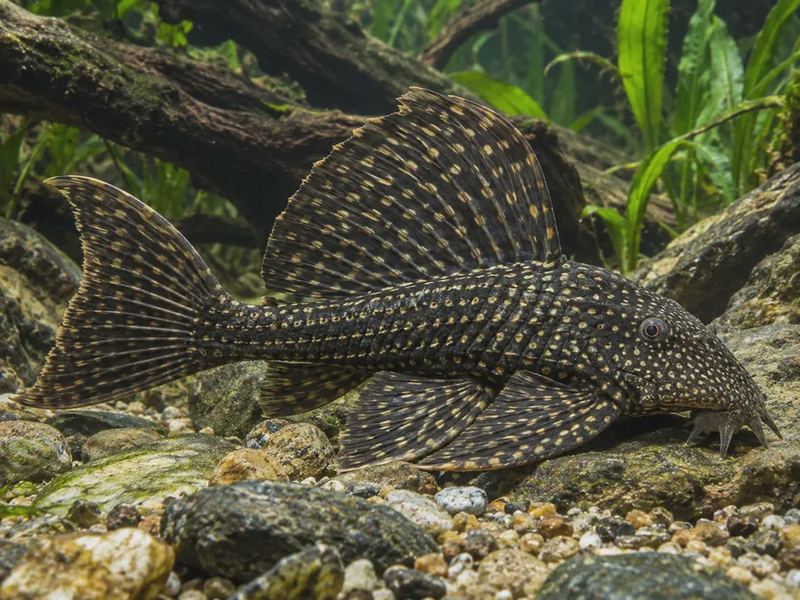
Megalancistrus parananus is a heavily built, dorsoventrally flattened loricariid with a broad head, a wide suckermouth, and a body covered in bony plates (scutes) except for the ventral surface. The ground coloration is typically dark olive-brown to greyish-black, overlaid with a mottled or vermiculated pattern of lighter tan to yellowish spots and blotches. This cryptic patterning breaks up the fish's outline against rocky substrates and is more pronounced in juveniles; large adults often become darker and less contrasty. The dorsal fin is tall and sail-like, particularly in males, which is the origin of the common name. The caudal fin is large and rounded to slightly emarginate. Mature males develop prominent odontodes (dermal teeth) on the cheeks, pectoral fin rays, and sometimes the leading edge of the dorsal fin. These are not aggressive weapons in the usual sense but are used in male-male contests and possibly in courtship.
Size is one of the most important considerations for prospective keepers. M. parananus is a genuinely large species. Wild-caught adults commonly reach 40–50 cm (16–20 inches) in standard length, and exceptionally large males may approach 60 cm (24 inches). Even in captivity, where growth is often slower and somewhat stunted by suboptimal conditions, fish routinely exceed 30 cm within a few years. This is not a "small pleco" and should never be sold or purchased as one. The body mass is substantial; a 45 cm specimen is a heavy, powerful fish capable of displacing decor and producing significant waste. Sexual dimorphism is moderate: males grow larger, develop broader heads and more pronounced odontodes, and typically show a taller dorsal fin. Females are somewhat fuller-bodied, especially when gravid, and lack the heavy cheek spination of mature males.
There is a persistent identification problem in the aquarium trade. Many fish sold as "Sailfin Pleco" or "Common Pleco" are actually Pterygoplichthys species, particularly P. pardalis and P. disjunctivus. These are distinguished by having more dorsal fin rays (typically 10–14 in Pterygoplichthys versus 7–8 in Megalancistrus) and by differences in head shape and odontode distribution. True M. parananus is less frequently imported than the Pterygoplichthys complex, and buyers should examine dorsal ray counts and head morphology carefully, or purchase from a reputable source that provides collection data.
Diet & Feeding
In the wild, Megalancistrus parananus is an opportunistic grazer and detritivore. Stomach content analyses of loricariids from the Paraná basin show a diet dominated by diatoms, filamentous algae, aquatic insect larvae, and fine organic detritus, with occasional ingestion of small invertebrates and plant material. The species is not a wood-eater in the specialized sense of Panaque; it lacks the enlarged, spoon-shaped teeth adapted for excavating wood. Instead, its teeth are fine and numerous, suited to scraping biofilm from hard surfaces. In captivity, this natural feeding mode should be replicated as closely as possible.
A high-quality diet for M. parananus rests on three pillars. First, a constant supply of grazing surfaces: well-aged driftwood, smooth river stones, and slate that develop a natural biofilm. These should be present in every tank, not as the sole food source but as a behavioral and nutritional supplement. Second, sinking prepared foods formulated for loricariids. Spirulina-based wafers, algae tabs, and vegetable-based sinking pellets should form the staple. Look for products with high fiber content and recognizable plant ingredients rather than fishmeal-heavy formulas. Third, regular offerings of fresh vegetables: blanched zucchini, cucumber, sweet potato, and romaine lettuce are all readily accepted. These should be weighted or clipped to the substrate and removed after 12–24 hours to prevent fouling. A slice of zucchini every two or three days is a reasonable schedule for an adult fish.
Protein should not be neglected entirely, especially for juveniles and gravid females. Occasional feedings of frozen bloodworms, mysis shrimp, or chopped earthworms provide essential amino acids and are taken eagerly. However, protein should remain a minority of the diet; excessive protein in loricariid tanks contributes to fatty liver disease, bloating, and water quality problems. A useful ratio is roughly 70–80% plant and algal material to 20–30% animal protein by volume. Feeding should occur after lights-out or in dim conditions, as this species is largely nocturnal and crepuscular. Adults can be fed once daily or every other day; juveniles benefit from twice-daily small feedings. Overfeeding is the single most common husbandry error with large plecos and is a leading cause of the health problems described below.
Aquarium Setup
The single most important factor in housing Megalancistrus parananus is tank size. Given the adult length of 40–60 cm and the species' high waste output, a minimum aquarium of 180 cm (6 feet) in length and at least 75 cm (30 inches) in width is appropriate for a single adult. Volume should be no less than 500 liters (130 US gallons), and 700–1000 liters is preferable for long-term maintenance. Juveniles can be raised in smaller quarters, but the keeper must plan for the eventual adult size from day one. This is not a species that can be humanely housed in a 120 cm tank, regardless of what retail labels suggest. The footprint matters more than height; a wide, long tank with a large bottom area suits the fish's benthic habits far better than a tall, narrow one.
Filtration must be robust. M. parananus produces copious waste, and its grazing behavior constantly disturbs the substrate. A combination of a large canister filter, a sump, and one or more powerheads or wavemakers is ideal. The goal is high biological filtration capacity plus strong, well-distributed water movement. Turnover of 8–12 tank volumes per hour is a reasonable target. Because the species comes from fast-flowing, highly oxygenated waters, surface agitation and gas exchange should be generous. An air pump with a large airstone or a venturi on a return line helps maintain dissolved oxygen, particularly at higher temperatures.
Substrate should be fine sand or smooth, rounded gravel. Sharp-edged gravel can abrade the soft ventral surface and the barbels around the mouth, leading to infection. Sand is preferred because it passes through the gut harmlessly if ingested during grazing and does not trap debris as readily as coarse gravel. A thin layer, 2–3 cm, is sufficient; deep substrate beds are unnecessary and can become anaerobic. Decor should center on smooth rocks — river cobbles, slate, and large pebbles — arranged to create caves, crevices, and grazing surfaces. Driftwood is valuable both as a grazing substrate and as a structural element. PVC pipes and ceramic caves can serve as refuges, particularly for juveniles and subadults. Plants are generally not safe with large loricariids; the fish will uproot, rasp, and dislodge most species. If plants are desired, choose tough, well-anchored species such as Anubias, Microsorum, or Bolbitis attached to rock or wood, and accept that some damage will occur. Floating plants are usually ignored. Lighting should be moderate and can follow a standard tropical photoperiod of 8–10 hours; the fish is nocturnal and will be most active after dark. A dim blue or red moonlight LED allows observation of natural behavior without disturbing the fish.
Water Parameters
The natural waters of the Paraná basin where M. parananus occurs are typically warm, well-oxygenated, and moderately mineralized. The species is adaptable but does best when these conditions are approximated. Stability is more important than chasing exact figures; large, mature specimens tolerate a range of values provided changes are gradual. The table below summarizes recommended parameters for long-term maintenance.
| Parameter | Range | Notes |
|---|---|---|
| Temperature | 24–28 °C (75–82 °F) | Optimal 25–27 °C; avoid prolonged exposure above 30 °C |
| pH | 6.5–7.8 | Slightly acidic to slightly alkaline; 7.0–7.4 ideal |
| General hardness (GH) | 6–15 °dGH | Moderate hardness; avoid very soft water |
| Carbonate hardness (KH) | 4–10 °dKH | Supports stable pH |
| Ammonia (NH₃/NH₄⁺) | 0 ppm | Any detectable level is a problem |
| Nitrite (NO₂⁻) | 0 ppm | Toxic at low concentrations |
| Nitrate (NO₃⁻) | <20 ppm | Keep as low as possible; large weekly water changes |
| Dissolved oxygen | >6 mg/L | High flow and surface agitation recommended |
| Water changes | 30–50% weekly | Essential given waste output |
Because the species is a heavy polluter, nitrate accumulation is the primary long-term water quality challenge. Weekly water changes of 30–50% are not optional; they are the foundation of successful maintenance. A good habit is to test nitrate before each change and adjust volume accordingly. Rinsing filter media in tank water (never tap water) during water changes preserves the nitrifying bacterial colony. Temperature should be maintained with a reliable heater and monitored with a separate thermometer; a heater failure in a large tank can be catastrophic, so a controller or redundant heating is prudent.
Behavior & Compatibility
Megalancistrus parananus is a largely nocturnal, benthic fish that spends the day hidden in caves, under driftwood, or wedged between rocks. At night it emerges to graze, and in tanks with dim lighting it may become active during the day, particularly if food is offered. Despite its size, it is generally peaceful toward tankmates it cannot swallow. It is, however, territorial toward conspecifics and toward other large loricariids, especially in confined spaces. Males will spar over caves and feeding sites, using their odontodes and body blocks rather than inflicting serious damage. In tanks of adequate size with multiple hiding spots, aggression is usually manageable; in cramped quarters, it can lead to chronic stress and injury.
Compatible tankmates include medium to large characins (the true Characidae, such as Hyphessobrycon and Astyanax species), larger peaceful cichlids from South America such as Geophagus and Satanoperca, and robust catfish like Pimelodus and larger Corydoras. Avoid small fish that could be inadvertently consumed, and avoid fin-nippers that might harass the pleco's dorsal and caudal fins. Very aggressive cichlids, particularly large Amphilophus or Parachromis, are poor choices; they may bully or injure the pleco, particularly during breeding. Bottom-dwelling loaches and other loricariids can be kept with care, but each additional bottom-feeder increases competition for food and space. A single adult M. parananus per tank is the safest arrangement; if multiple are kept, the tank should be at least 250 cm long with numerous distinct territories.
One behavioral note worth emphasizing: this species is a powerful digger and rearranger. It will move sand, displace small rocks, and uproot plants. Decor should be placed with this in mind, and any structure that could trap or crush the fish — stacked rocks, heavy driftwood — must be secured. The fish's body is armored but not invulnerable; a collapse can cause internal injury. It is also a capable jumper when startled, so a tight-fitting lid is essential.
Breeding
Breeding Megalancistrus parananus in captivity is uncommon and not well documented in the hobby literature. The species is a cave-spawning loricariid, and reports from commercial breeders and advanced hobbyists suggest that reproduction follows the general pattern of large loricariids: males establish a spawning cave, females deposit a clutch of large, adhesive eggs on the cave walls or ceiling, and the male guards the eggs and fry until they become free-swimming. Clutch size in related species ranges from a few hundred to over a thousand eggs, depending on female size. Incubation is temperature-dependent, typically 5–10 days at 26–28 °C. The male fans the eggs with his pectoral fins and may fast during the guarding period.
Triggering spawning in captivity appears to require a combination of factors: a large, well-conditioned pair or group; a substantial drop in barometric pressure associated with a cool water change (simulating the onset of the rainy season); abundant live and frozen foods; and the presence of suitable spawning caves. Caves should be large enough for the male to enter and turn around, typically 15–20 cm in diameter and 30–40 cm deep, made of PVC, ceramic, or slate. Water quality must be excellent, and the tank should be mature and stable. Sexing adults is straightforward: males are larger, broader-headed, and develop prominent cheek odontodes; females are fuller-bodied when gravid. Given the species' size and the difficulty of conditioning large adults, breeding is best attempted in a dedicated tank of at least 1000 liters. Fry can be raised on finely crushed spirulina wafers, blanched zucchini, and microworms, with meticulous attention to water quality as they are sensitive to nitrogenous waste.
Common Diseases & Health
The most common health problems in captive Megalancistrus parananus are directly related to husbandry. Head and lateral line erosion (HLLE) is frequently seen in large plecos kept in tanks with high nitrate, low dissolved oxygen, or inadequate diet. It presents as pitting and erosion of the skin along the head and lateral line, exposing underlying bone. Treatment centers on correcting water quality, increasing water changes, improving diet, and adding vitamin supplementation. Bloating and intestinal blockage are also common, often caused by overfeeding, ingestion of sharp gravel, or a diet too high in protein and too low in fiber. A bloated fish should be fasted, kept in warm, well-oxygenated water, and offered peeled, blanched peas or daphnia to encourage passage. Persistent bloating can indicate bacterial infection and may require veterinary intervention.
Fin rot and body fungus occur secondary to injury, poor water quality, or stress. The armored body of loricariids is resistant to many pathogens, but damaged areas — often from aggressive tankmates or sharp decor — can become infected. Treatment involves correcting the underlying cause, improving water quality, and, if necessary, using appropriate antibiotics or antifungals in a hospital tank. Ich (Ichthyophthirius multifiliis) can affect plecos, though the armored skin makes them less susceptible than scaleless fish. Standard treatments are effective, but care must be taken with copper-based medications, which are toxic to loricariids at therapeutic doses for many other fish; use half-dose protocols or alternatives such as heat and salt, and consult a veterinarian or experienced hobbyist before treating.
Prevention is far easier than cure. A mature, well-filtered tank with low nitrate, stable temperature, high dissolved oxygen, and a balanced, plant-rich diet will keep most M. parananus healthy for many years. This species is long-lived; captive specimens have been maintained for 15–20 years, and some reports suggest longer. Regular observation, weekly water testing, and prompt attention to any change in appetite or behavior are the best tools a keeper has.
FAQs
Q: Is Megalancistrus parananus the same as the common sailfin pleco sold in pet stores?
A: Usually not. Most fish sold as "sailfin pleco" or "common pleco" are Pterygoplichthys species, especially P. pardalis. True M. parananus has 7–8 dorsal fin rays, while Pterygoplichthys has 10–14. The two also differ in head shape and odontode pattern. If exact identification matters, ask the seller for collection data and count the dorsal rays.
Q: How big does Megalancistrus parananus get, and what tank size do I need?
A: Adults commonly reach 40–50 cm (16–20 inches) and occasionally 60 cm (24 inches). A single adult requires a tank of at least 180 cm (6 feet) in length and 500 liters (130 gallons), with 700–1000 liters preferred. This is not a suitable species for small or medium aquariums.
Q: Can I keep M. parananus with small fish like tetras?
A: Generally yes, provided the tetras are too large to be swallowed. The pleco is peaceful toward fish it cannot eat, and small characins make good tankmates. Avoid very small fish that could be ingested, and avoid aggressive cichlids that might harass or injure the pleco.
Q: What should I feed a sailfin pleco to keep it healthy?
A: The diet should be predominantly plant-based: spirulina wafers, algae tabs, blanched zucchini, cucumber, sweet potato, and romaine lettuce, supplemented with occasional frozen bloodworms or mysis. Driftwood and smooth rocks provide grazing surfaces for natural biofilm. Avoid high-protein diets, which contribute to fatty liver disease and bloating, and remove uneaten vegetables within 24 hours.