
Nannostomus beckfordi: The Golden Pencilfish
Species Overview
Nannostomus beckfordi, the golden pencilfish, is one of the most widely kept and quietly rewarding small characins in the freshwater hobby. Described by the German-born zoologist Albert Günther in 1872, the species was among the first pencilfish to enter the European aquarium trade and remains the archetype against which its relatives are judged. The genus name Nannostomus derives from the Greek nannos (small) and stoma (mouth), a reference to the tiny, upturned, terminal mouth that betrays the fish's surface-and-crevice feeding habits. The specific epithet honours the collector who supplied early specimens to European museums. Taxonomically, the species sits within the family Lebiasinidae, a group of slender, soft-rayed characiform fishes native to northern South America; older literature frequently places it under the broad umbrella of "Characidae" in the loose sense, and hobby references often still list it there, but modern classification assigns it firmly to Lebiasinidae.
The natural range of Nannostomus beckfordi is broad for a small ornamental fish. It occurs across the Guiana Shield and the Amazon basin margins, with populations documented in Guyana (the type locality is in the Demerara region), Suriname, French Guiana, and the Brazilian states of Amapá and Pará, as well as in the lower Rio Negro system. The species is strongly associated with slow-moving, heavily vegetated blackwater and clearwater habitats: forest creeks, flooded margins, oxbow lakes, and the quiet backwaters of larger rivers where submerged roots, leaf litter, and dense stands of aquatic plants create a mosaic of cover. Water in these habitats is typically warm, soft, and acidic, stained tea-coloured by tannins and humic acids, with very low mineral content and a pH that can sit anywhere from roughly 4.5 to 6.5 depending on locality and season. The fish are most abundant in the shallows, where they hover in loose shoals among fine-leaved plants and fallen branches, picking at microfauna on the surfaces around them.
Because the species is so widespread, wild-caught imports vary considerably in colour and pattern. This variation, combined with decades of commercial breeding in Southeast Asia and Eastern Europe, means that hobbyists encounter several distinct "forms" — a wild-type golden-brown fish with a bold black lateral stripe and red flashes, a red-morph or "red beckfordi" line, and various selectively bred strains with enhanced red or orange coloration. All are the same species and interbreed freely. The fish is peaceful, diurnal, and remarkably long-lived for its size when maintained well, with captive individuals regularly reaching four to six years.
Appearance & Size
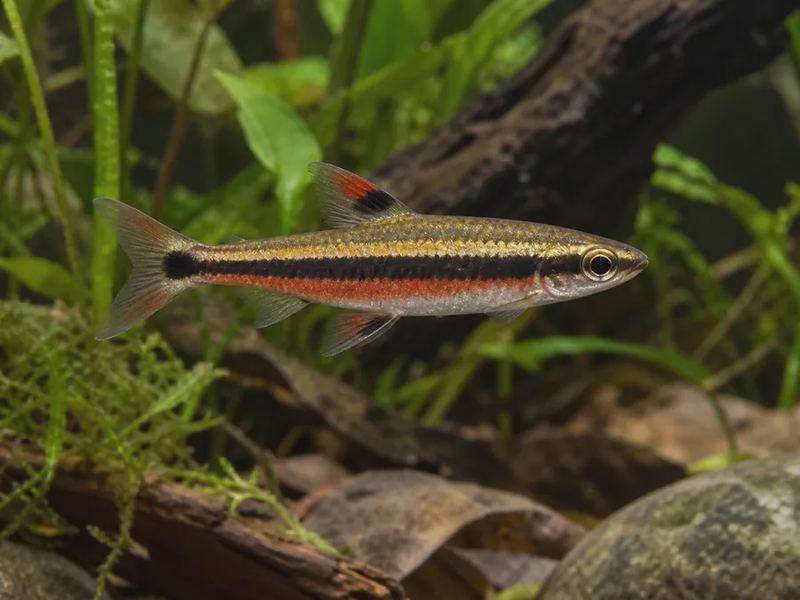
The golden pencilfish is a small, elongate fish with a torpedo-shaped body that is roughly cylindrical in cross-section and tapers to a fine caudal peduncle. Adults typically reach 3.5 to 4.5 cm (1.4–1.8 inches) standard length, with well-conditioned females occasionally touching 5 cm; males are usually slightly smaller and noticeably slimmer, particularly when viewed from above. The body is covered in small, closely set scales that give the fish a smooth, almost lacquered appearance under good lighting.
Coloration is where this species earns its common name. The base body colour is a warm golden-tan to olive-brown, brightest along the flanks and shading to a paler belly. A prominent, straight black lateral stripe runs from the snout, through the eye, and along the mid-flank to the base of the caudal fin, where it often broadens slightly. Above this stripe, especially in males in good condition, the dorsal region may carry a reddish or orange wash. The fins are largely transparent to pale yellow, but the anal fin in males is marked with a striking red or orange band edged in black, and the adipose fin — a small, fleshy flap characteristic of characiform fishes — sits on the back between the dorsal and caudal fins. The eye is relatively large and silvered, with a dark pupil.
Males and females are relatively easy to distinguish once mature. Males are slimmer, more intensely coloured, and develop a more pronounced red anal fin; the black lateral stripe in males is often sharper and more continuous. Females are fuller-bodied, particularly when gravid, with a rounder abdomen and somewhat muted coloration. Juveniles are more cryptic, with a less defined stripe and a more uniform brownish tone, and they frequently adopt a cryptic posture among plants. One of the more charming traits of Nannostomus beckfordi is its reversible colour pattern: at night, or when stressed, the fish can dramatically pale, and the black lateral stripe may fade or break up, only to return within minutes once the fish feels secure. This is a normal behaviour, not a sign of disease, and is well documented across the genus.
Diet & Feeding
In the wild, Nannostomus beckfordi is a micro-predator and opportunistic grazer. Stomach-content analyses of related lebiasinids show a diet dominated by tiny aquatic invertebrates — cladocerans, copepods, ostracods, insect larvae, and rotifers — supplemented by algae, detritus, and the small organisms living within aufwuchs on plant surfaces. The fish's small, forward-facing mouth is well suited to picking individual prey items from fine-leaved plants, roots, and the water column, and it will also take food from the surface film. This dietary breadth is one reason the species adapts so readily to captivity, but it also means the fish does best on a varied, protein-rich regimen rather than a single flake food.
In the aquarium, golden pencilfish should be offered a staple of high-quality micro-pellets or finely crushed flake, supplemented several times a week with live or frozen foods. Suitable live foods include Artemia nauplii and adults, Daphnia, moina, microworms, grindal worms, and — for larger adults — whiteworms and small bloodworm. Frozen equivalents are a fine substitute when live food is impractical. Because the species has a small stomach and a high metabolic rate, two small feedings per day are preferable to one large one; uneaten food should be siphoned out promptly, as the fish are messy eaters when fed dry foods and the soft, acidic water favoured by the species offers little buffering against a spike in dissolved organics.
One practical consideration is competition. Golden pencilfish are not aggressive feeders, and in a community tank they can be outcompeted by boisterous tetras, barbs, or livebearers. Target-feed them near the shoal, or feed at both ends of the tank, to ensure every fish gets its share. Newly imported wild fish may refuse dry food for the first week or two and should be tempted with live foods until they settle. A well-fed pencilfish shows a rounded belly, bright colour, and active midwater foraging; a persistently thin fish in a well-maintained tank is usually either being outcompeted, carrying an internal parasite, or suffering from chronic stress.
Aquarium Setup
A tank for Nannostomus beckfordi should be planned around the fish's natural habitat: warm, soft, acidic water, dense plant cover, subdued lighting, and plenty of horizontal swimming space. A group of eight to ten fish can be comfortably housed in a well-filtered 60 cm (24-inch) aquarium of around 55–70 litres, but larger is always better, and a 90 cm tank with a footprint of 80 × 35 cm or more is ideal for a substantial shoal. The species is a shoaling fish and should never be kept singly or in pairs; groups of at least eight, and preferably ten to twelve, produce the most natural behaviour and the brightest coloration, as subordinate males colour down in very small groups.
Substrate choice is flexible but should suit the plants. A fine, dark, inert sand or a nutrient-rich planted substrate both work well; dark substrate tends to intensify the fish's colours and mimics the leaf-litter floors of their native creeks. A thin layer of dried Indian almond, oak, or beech leaves on the substrate is a worthwhile addition: it releases tannins that gently acidify and soften the water, provides grazing surfaces for microfauna, and gives the tank the dim, naturalistic feel the species prefers. Leaves should be replaced as they decompose.
Plants are effectively non-negotiable for this species. Fine-leaved species such as Cabomba, Limnophila, Myriophyllum, Rotala, and floating plants like Salvinia or Pistia create the dappled light and dense cover the fish use for security and spawning. Floating plants are especially valuable because they shade the tank, reduce evaporation-driven pH swings, and encourage the fish to shoal in the open midwater rather than hiding. Driftwood branches and coconut-shell caves add structure without dominating the aquascape. Lighting should be moderate to subdued; a bright, open, high-tech aquascape tends to make pencilfish nervous and washed out, whereas a dim, planted, tannin-tinted tank brings out their best colours. Filtration should be gentle — a sponge filter, a small canister with a spray bar, or a well-baffled hang-on-back — because the species dislikes strong current. A tight-fitting lid is essential, as pencilfish are accomplished jumpers, particularly when startled or during spawning chases.
Water Parameters
Wild Nannostomus beckfordi come from soft, acidic, warm water, and while captive-bred fish are considerably more tolerant than wild-caught ones, the species will always look and breed best in conditions close to its natural range. The table below summarises the recommended parameters for long-term maintenance, with the wild-type range given for context.
| Parameter | Ideal captive range | Wild habitat range |
|---|---|---|
| Temperature | 24–27 °C (75–81 °F) | 24–29 °C (75–84 °F) |
| pH | 5.5–7.0 | 4.5–6.5 |
| General hardness (GH) | 2–8 °dGH | 0–4 °dGH |
| Carbonate hardness (KH) | 1–5 °dKH | 0–3 °dKH |
| Total dissolved solids (TDS) | 80–250 ppm | 10–80 ppm |
| Nitrate (NO₃⁻) | < 20 ppm | Near zero |
Stability matters more than any single number. A tank held at pH 6.8 and 6 °dGH with consistent maintenance will produce healthier fish than one swinging between pH 5.5 and 7.5 because of inadequate buffering or irregular water changes. Captive-bred golden pencilfish adapt well to moderately hard, neutral water — many commercial strains are raised in it — but wild-caught imports should be acclimated slowly to the dealer's or hobbyist's water and then maintained in soft, acidic conditions if possible. Avoid sudden temperature drops, which are a common cause of stress and opportunistic infections in newly shipped fish. If the local tap water is hard, mixing it with reverse-osmosis water or rainwater (provided it is clean and not collected from contaminated surfaces) is the simplest way to reach the target range; Indian almond leaves and botanical extracts will further soften and acidify the water naturally.
Behavior & Compatibility
Golden pencilfish are peaceful, active, midwater shoalers with a gentle, almost hummingbird-like mode of swimming: they hover, dart a few centimetres, hover again, and rarely chase one another with any real aggression. Within a shoal, males perform frequent display behaviour — flaring fins, tilting the body, and briefly sparring — but serious damage is essentially unknown. The species is best described as a "dither fish" in the classic sense: its calm, visible activity reassures shy tankmates, and its presence encourages other small fishes to come out into the open. Kept in a proper shoal, it is one of the most rewarding small characins for a planted community tank.
Ideal tankmates are other small, peaceful, soft-water fishes from similar habitats. Good choices include small tetras such as Paracheirodon axelrodi (cardinal tetra), Hemigrammus erythrozonus (glowlight tetra), and Hyphessobrycon species; dwarf cichlids like Apistogramma and Mikrogeophagus ramirezi; small catfishes including Corydoras and Otocinclus; and peaceful rasboras such as Boraras and Trigonostigma species. Hatchetfish, another surface-dwelling characiform, make particularly apt companions because they share the pencilfish's preference for dim, planted, tannin-stained water. Invertebrates such as cherry shrimp and nerite snails are generally ignored, though very small shrimplets may be taken opportunistically.
Tankmates to avoid include anything large enough to eat a 4 cm pencilfish, anything boisterous enough to bully it at feeding time, and anything that nips fins. Angelfish, large barbs, most cichlids above dwarf size, and aggressive livebearers are poor choices. Fin-nippers such as tiger barbs and some serpae tetras can harass pencilfish, and the stress of constant harassment often manifests as faded colour, hiding, and increased susceptibility to disease. As a general rule, if a proposed tankmate is more than about twice the pencilfish's length or notably more aggressive at the food dish, it belongs in a different aquarium.
Breeding
Nannostomus beckfordi is one of the easier pencilfish to breed, and captive spawning is well within reach of a patient hobbyist. The species is an egg-scatterer with no parental care: adults spawn among fine-leaved plants or over a moss-covered spawning mop, the eggs adhere loosely to vegetation, and the parents will eat both eggs and fry if left in the tank. Condition a group of six to ten fish on live and frozen foods for two to three weeks, keeping males and females together so that the females visibly fill with eggs. A slightly cooler water change — a few degrees below the maintenance temperature — often triggers spawning, as does an increase in live food and the appearance of early-morning light through the tank.
For controlled breeding, set up a dedicated 40–60 litre spawning tank with soft, acidic water (pH 5.5–6.5, 2–5 °dGH, 26–27 °C), a sponge filter, and either a dense clump of fine-leaved plants such as Cabomba or a synthetic spawning mop. Introduce one or two well-conditioned males with two or three gravid females in the evening. Spawning typically occurs at first light over the following one to three days. The males chase and display, and the females release small batches of eggs — typically 20 to 80 per female, sometimes more — which fall into the plants or mop. Once spawning is finished, remove the adults immediately; they will otherwise consume the eggs within hours.
Eggs hatch in roughly 24 to 48 hours at 26–27 °C, and the fry are exceptionally small — among the smallest of any commonly bred aquarium fish. They remain on the substrate or among plants for the first few days, absorbing the yolk sac, and then become free-swimming. First foods must be correspondingly tiny: infusoria, green-water cultures, rotifers, or commercial liquid fry foods for the first week, followed by newly hatched Artemia nauplii and microworms as the fry grow. Water quality in the fry tank must be kept pristine, with gentle filtration and small, frequent water changes using water of the same temperature and chemistry. Growth is moderate; fry reach sexual maturity in roughly four to six months and full adult size in about eight to ten months. Because the species is so widely bred commercially, hobbyists interested in a breeding project may also consider the closely related and slightly more challenging Nannostomus marginatus or the striking Nannostomus eques once they have gained experience with beckfordi.
Common Diseases & Health
Golden pencilfish are hardy when kept in clean, stable, soft, acidic water, but they are not immune to the standard freshwater ailments. The most common problems are stress-related and environmental rather than exotic: Ichthyophthirius multifiliis (white spot), velvet (Piscinoodinium or Amyloodinium), fin rot, and internal parasites. Newly imported wild fish are particularly prone to white spot and velvet, because the stress of capture, shipping, and acclimation suppresses the immune system. A quarantine tank of at least four weeks, with careful observation and prophylactic treatment only where justified, is strongly recommended for any new arrival before it joins a display tank.
Prevention is straightforward and rests on the fundamentals: stable temperature, soft acidic water, low nitrate, a varied diet, and a properly sized shoal. Pencilfish kept singly or in tiny groups are chronically stressed and far more disease-prone than those in a proper shoal. Overcrowding, strong current, bright lighting, and boisterous tankmates all compound stress. When disease does appear, treat promptly with an appropriate remedy — many hobbyists use a mild salt bath or a commercial anti-parasitic for external protozoans, and praziquantel or metronidazole for internal parasites — but always confirm the diagnosis first, because the treatments for bacterial, fungal, parasitic, and protozoal infections differ substantially. Never medicate a display tank unnecessarily, and always remove carbon filtration during treatment. A well-maintained golden pencilfish is a robust, long-lived fish; most health problems in this species trace back to water quality, temperature swings, or social stress rather than to any inherent fragility.
FAQs
How many golden pencilfish should I keep together?
A minimum of eight, and preferably ten to twelve, in a tank of 60 cm or more. The species is a shoaler, and groups of this size produce the most natural behaviour, the brightest male coloration, and the lowest stress levels. Single fish or pairs tend to hide, fade in colour, and succumb to disease more readily.
Can golden pencilfish live in a community tank?
Yes, provided the tankmates are small, peaceful, and suited to soft, acidic water. Cardinal and glowlight tetras, dwarf cichlids such as Apistogramma, Corydoras, Otocinclus, and peaceful rasboras are all excellent companions. Avoid large or boisterous fishes, fin-nippers, and anything big enough to swallow a 4 cm pencilfish.
Why has my pencilfish lost its black stripe?
Almost certainly because it is dark or stressed. Nannostomus beckfordi can dramatically pale and fade its lateral stripe at night or when frightened, and the colour returns within minutes once the fish feels secure. If the fading persists during the day, check water quality, temperature stability, tankmate aggression, and whether the fish is being outcompeted at feeding time.
What water parameters do golden pencilfish need?
Aim for 24–27 °C, pH 5.5–7.0, general hardness of 2–8 °dGH, and nitrate below 20 ppm. Captive-bred fish tolerate slightly harder, more neutral water than wild-caught imports, but the species will always look and breed best in soft, acidic, tannin-tinted conditions close to its Amazonian and Guianan habitat. Stability is more important than chasing an exact number.