
Neon Tetra (Paracheirodon innesi): Care Guide
Species Overview
The Neon Tetra, Paracheirodon innesi, is arguably the most recognized and widely kept freshwater aquarium fish in the world. Belonging to the family Characidae, which encompasses over 1,000 species including piranhas and other tetras, this diminutive characin has been a cornerstone of the aquarium hobby since its introduction to the West in the 1930s. The species was first described scientifically in 1936 by George S. Myers, who named it Hyphessobrycon innesi in honor of William T. Innes, the influential American aquarist and founder of The Aquarium magazine. Later taxonomic revision placed the species in the genus Paracheirodon, alongside its close relatives the Cardinal Tetra (Paracheirodon axelrodi) and the Green Neon Tetra (Paracheirodon simulans). The specific epithet innesi remains a lasting tribute to Innes, whose 1938 book, Exotic Aquarium Fishes, was instrumental in popularizing the species among hobbyists worldwide.
In its natural habitat, the Neon Tetra is endemic to the blackwater and clearwater tributaries of the upper Amazon and Orinoco river basins in South America. Its primary range extends through the western Amazon basin, specifically in Peru and Colombia, with significant populations found along the Putumayo, Napo, and Ucayali river systems. The fish also occurs in the upper Rio Negro drainage in Brazil, though it is less abundant there than the Cardinal Tetra. These regions are characterized by dense, overhanging rainforest canopy that filters direct sunlight, resulting in dim, dappled lighting conditions at the water surface. The water itself is typically stained a deep tea-brown color due to the decomposition of fallen leaves, branches, and other organic matter, a condition known as blackwater. These blackwater environments are notably poor in dissolved minerals and electrolytes, with extremely low conductivity and a naturally acidic pH. The substrate in these habitats is typically composed of sand, silt, and large deposits of leaf litter, which provide both cover and a rich microfauna of infusoria and small invertebrates that serve as a primary food source for juvenile and adult tetras alike.
The Neon Tetra’s discovery in the wild was a significant event in ichthyology, as it represented the first truly brilliant, non-pigmented freshwater fish known to science. Its coloration is produced by structural light reflection, a phenomenon that fascinated early researchers and continues to intrigue biologists today. The bright blue stripe along its flank is a result of light reflecting off guanine crystals embedded in the skin, while the red stripe below is a pigment-based coloration that intensifies with age and environmental conditions. This combination of structural and pigment-based coloration is a rare and highly adaptive trait, allowing the fish to remain visible to conspecifics in the murky, tannin-stained water while also providing a degree of camouflage from predators against the dark, shaded backdrop of its natural habitat. The species’ remarkable success in the aquarium trade, with millions of individuals bred and wild-caught annually, underscores its resilience and adaptability, yet it also highlights the importance of ethical sourcing and captive breeding programs to protect wild populations.
Appearance & Size
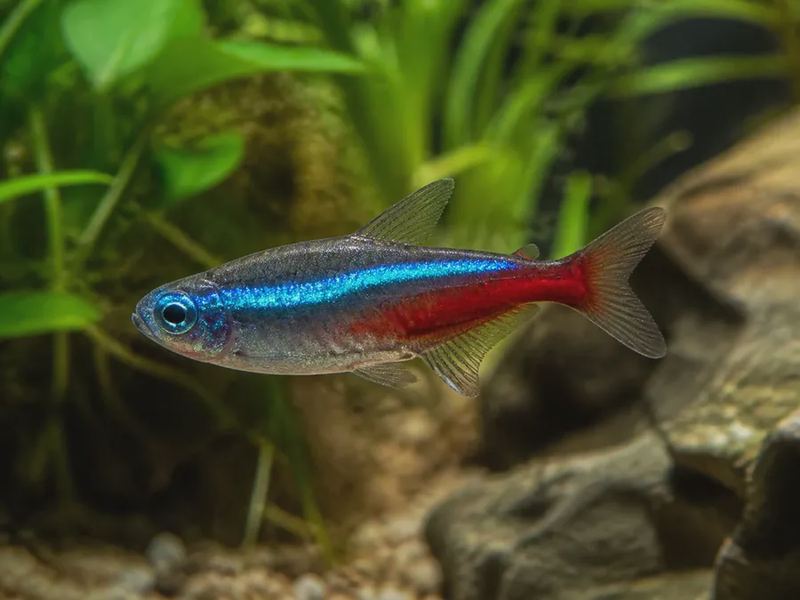
The Neon Tetra is a slender, fusiform fish, perfectly adapted for swift, darting movements through dense aquatic vegetation. Its body is laterally compressed, with a pointed snout and a relatively large eye that aids in foraging under low-light conditions. The most striking feature is the two distinct horizontal stripes that run the entire length of the body. The upper stripe, a vivid iridescent blue, extends from the eye to the adipose fin, and is often described as having a metallic, almost electric sheen. This blue is not pigment-based but rather a structural color produced by the reflection of light from guanine crystals arranged in layers beneath the skin. The lower stripe, a brilliant red, begins at the midsection of the body and runs posteriorly to the base of the tail fin. This red pigmentation is more variable, often intensifying with age, sexual maturity, and environmental stress levels. The ventral portion of the body, below the red stripe, is a silvery-white, and the fins are generally translucent with a faint yellowish or orange tint.
Adult Neon Tetras typically reach a maximum standard length of 3.5 to 4.0 centimeters (1.4 to 1.6 inches), making them a true nano-species. Females are generally larger and rounder-bodied than males, particularly when gravid with eggs, while males tend to be slightly more slender and sometimes display a straighter blue stripe. The two are otherwise nearly identical in coloration, making sex determination challenging outside of breeding condition. Juvenile Neons initially lack the red stripe entirely, which develops gradually over the first few months of life. The blue stripe is present from a very young age, but it is less intense and more greenish-blue in juveniles. This ontogenetic change in coloration is a key indicator of maturity and is often used by aquarists to estimate the age of young fish. The species is often confused with the Cardinal Tetra (Paracheirodon axelrodi), but the two can be easily distinguished by the extent of the red stripe: in the Neon Tetra, the red stripe is confined to the posterior half of the body, while in the Cardinal Tetra, the red stripe runs the entire length of the body from the snout to the tail. This subtle yet definitive difference is the most reliable method for field identification and is critical for hobbyists who wish to keep species-pure stock.
Diet & Feeding
In its natural blackwater habitat, Paracheirodon innesi is an omnivorous micro-predator, feeding primarily on small invertebrates, zooplankton, and insect larvae. The stomach contents of wild-caught specimens have been analyzed and found to consist predominantly of tiny crustaceans such as copepods, cladocerans (water fleas), and rotifers, as well as mosquito larvae, small chironomid larvae, and other aquatic insect pupae. They also consume filamentous algae and organic detritus, which provides essential plant matter and trace nutrients. This diet is highly protein-rich and supports the fish’s rapid metabolism and vibrant coloration. The fish are surface and mid-water feeders by nature, rarely foraging on the substrate, and they exhibit a characteristic hovering-and-darting feeding behavior, snapping at prey items that drift within their visual field.
In the aquarium, the Neon Tetra is an undemanding and adaptable feeder, readily accepting a wide variety of commercially prepared foods. A high-quality flake food or micro-pellet should form the staple of their diet, but to truly replicate their natural nutritional intake and promote optimal health and color, a varied diet is essential. Live and frozen foods are eagerly consumed and provide the necessary protein and fatty acids. Daphnia, Artemia (brine shrimp) nauplii, Moina, and finely chopped bloodworms or blackworms are excellent choices. Frozen foods should be thawed in a small cup of aquarium water before feeding to avoid temperature shock. Vegetable matter should not be overlooked; spirulina-based flakes or blanched, finely chopped spinach and zucchini can be offered once or twice a week to ensure a balanced diet. Overfeeding is a common issue, as Neons have small stomachs and will eat continuously if given the opportunity. Feed small amounts two to three times daily, only giving what the fish can consume within two minutes. Any uneaten food should be removed promptly to prevent water quality degradation, which is the primary cause of disease in this species. A varied, high-quality diet not only maintains physical health but also significantly enhances the intensity of the blue and red stripes, as carotenoids from food are deposited in the skin.
Aquarium Setup
Setting up an aquarium for Neon Tetras requires careful attention to replicating the conditions of their native blackwater habitat, particularly regarding tank size, substrate, planting, and lighting. A minimum tank size of 10 gallons (38 liters) is recommended for a small school of six to eight individuals, but a 20-gallon long (75 liters) or larger tank is far more suitable, as it provides ample swimming space and allows for a larger, more stable school. Neon Tetras are a shoaling species that thrives in groups of at least 10 to 12 individuals; a larger group not only reduces stress and promotes natural schooling behavior but also displays their iridescent colors to stunning effect. The aquarium should be heavily planted, as dense vegetation provides essential cover and mimics the shaded, structured environment of their natural streams. Fine-leaved plants such as Cabomba, Myriophyllum, Limnophila, and various species of Rotala are ideal, as they offer refuge and create dappled light patterns. Floating plants like Salvinia or Pistia are also highly recommended, as they diffuse overhead lighting and reduce light intensity, which is crucial for the fish’s comfort.
The substrate should be dark in color, ideally a fine sand or small-grained gravel, as this not only mimics the sandy, leaf-littered bottoms of their native rivers but also helps the fish feel secure, as they are less visible against a dark background. Adding a layer of dried Indian almond leaves (Terminalia catappa) or oak leaves to the substrate is a highly beneficial practice. These leaves slowly release tannins and humic acids into the water, which naturally lower pH, soften the water, and provide antibacterial and antifungal properties. They also create a natural micro-ecosystem, supporting infusoria that serve as a supplemental food source. Lighting should be subdued; bright, intense lighting is stressful to Neon Tetras and will cause them to lose color and hide. Use low-wattage LED lights or fluorescent tubes, and incorporate floating plants to create shaded zones. Driftwood, particularly pieces of Malaysian driftwood or bogwood, should be added to provide additional structure and to leach tannins, further acidifying the water. A gentle sponge filter or a small hang-on-back filter with an adjustable flow is recommended, as these fish prefer calm, slow-moving water. Strong water currents should be avoided, as they exhaust the fish and inhibit their natural hovering behavior. The tank should be cycled completely before introducing the fish, and a period of several weeks is recommended to allow the biological filter to mature and for the water to stabilize to the desired parameters.
Water Parameters
Maintaining precise water parameters is arguably the most critical factor in the long-term health and longevity of Paracheirodon innesi. These fish are physiologically adapted to the soft, acidic, and mineral-poor waters of the Amazon basin, and any significant deviation from these conditions will cause stress, suppress the immune system, and ultimately lead to disease and premature death. The most important parameters are temperature, pH, and general hardness (GH). The following table provides the recommended ranges for both wild-caught and captive-bred specimens, with captive-bred fish being slightly more tolerant of less extreme conditions.
| Parameter | Recommended Range | Ideal Range | Notes |
|---|---|---|---|
| Temperature | 20.0 – 26.0 °C (68 – 79 °F) | 22.0 – 24.0 °C (72 – 75 °F) | Stable temperatures are crucial; avoid fluctuations >2°C/day. |
| pH | 5.0 – 7.0 | 5.5 – 6.5 | Acidic conditions are essential for wild-caught fish; captive-bred tolerate 7.0. |
| General Hardness (GH) | 1 – 10 dGH | 2 – 5 dGH | Soft water is critical; hard water inhibits breeding and causes stress. |
| Carbonate Hardness (KH) | 1 – 5 dKH | 1 – 3 dKH | Low KH buffers pH; use peat filtration or RO water to lower if needed. |
| Conductivity | 50 – 200 µS/cm | 50 – 100 µS/cm | Measure with a TDS meter; low conductivity mimics blackwater. |
To achieve these parameters, the use of reverse osmosis (RO) or deionized (DI) water mixed with a small amount of tap water is often necessary, especially for hobbyists with naturally hard, alkaline tap water. A ratio of 70-80% RO/DI water to 20-30% tap water is a common starting point, but the exact ratio should be determined by testing the source water. The water should be buffered with natural materials such as peat moss, which can be added to the filter, or by using commercially available blackwater extracts that contain humic acids and tannins. These additives not only lower pH and hardness but also provide beneficial compounds that mimic the fish’s natural environment. It is essential to acclimate new fish slowly to the aquarium water, using the drip-acclimation method over a period of 30 to 60 minutes, as rapid changes in pH and osmotic pressure are a leading cause of shock and mortality. Regular water changes of 20-25% weekly are recommended, using water that has been pre-mixed and heated to the same temperature and parameters as the aquarium. Consistency is key; Neon Tetras are far more tolerant of slightly suboptimal but stable parameters than they are of rapid fluctuations in optimal conditions.
Behavior & Compatibility
Neon Tetras are a quintessential shoaling species, exhibiting a strong, innate drive to form and maintain cohesive groups. In the wild, this behavior is a survival mechanism, as a large group confuses predators and increases the chances of individual survival. In the aquarium, a school of at least 10 to 12 individuals is essential for the fish to feel secure and display natural behaviors. A single or small group of Neons will become stressed, reclusive, and may lose their vibrant coloration. When kept in a proper school, they will actively swim in the middle water column, darting in synchronized movements, and will readily explore all areas of the tank. They are a peaceful, non-aggressive species that will not nip fins or harass other tankmates. They are, however, a prey species, and their natural instinct is to flee from larger, predatory fish. Therefore, tankmates must be chosen with extreme care.
Compatible tankmates include other small, peaceful characins such as Ember Tetras (Hyphessobrycon amandae), Green Neon Tetras (Paracheirodon simulans), and small pencilfish. Other suitable community fish include small rasboras like the Chili Rasbora (Boraras brigittae) and the Galaxy Rasbora (Danio margaritatus), as well as small, peaceful Corydoras catfish species such as Corydoras pygmaeus or Corydoras habrosus. Dwarf shrimp, such as Neocaridina davidi (Cherry Shrimp) or Caridina cantonensis (Crystal Red Shrimp), are also excellent tankmates, as Neons will not prey on adult shrimp. Invertebrates like Malaysian Trumpet Snails and Nerite Snails are beneficial for substrate maintenance. Absolutely avoid any fish that is large enough to swallow a Neon, including angelfish, larger gouramis, barbs, and all cichlids, even dwarf cichlids like Apistogramma species, which may view Neons as food. Also avoid fin-nippers like Tiger Barbs (Puntigrus tetrazona) and Serpae Tetras (Hyphessobrycon eques), as the long flowing fins of the Neon are a target. The aquarium should be densely planted to provide escape routes and visual barriers, which greatly reduces stress levels in a community setting. The Neon Tetra is a shoaling fish, not a schooling fish; they will not form a tight, polarized school like some marine species, but rather a loose, scattered group that moves cohesively around the tank.
Breeding
Breeding Neon Tetras is a challenging but highly rewarding endeavor that is best attempted by experienced aquarists. The primary difficulty lies in replicating the specific seasonal conditions that trigger spawning in the wild. In their native Amazonian habitat, spawning is triggered by the onset of the rainy season, which brings a drop in water temperature, a decrease in pH, and a significant influx of fresh, mineral-poor water. To induce breeding in captivity, a dedicated breeding tank must be set up, typically a small 5- to 10-gallon aquarium filled with very soft, acidic water (pH 5.0-5.5, GH less than 2 dGH). The water should be tinted with peat extract or almond leaves, and a spawning mop or a dense clump of fine-leaved plants like Java moss should be provided as a substrate for egg deposition. The tank should be kept dimly lit, as Neons prefer to spawn in low-light conditions.
Before spawning, the chosen breeding pair (or a group of 2-3 males and 2-3 females) should be conditioned for two weeks on a high-protein diet of live and frozen foods such as Daphnia, Artemia, and bloodworms. The females will become noticeably plump with eggs, and the males will display more intense coloration. A partial water change with cooler, softer water (about 2-3°C cooler than the main tank) is often the final trigger to initiate spawning. Spawning typically occurs at dawn, with the male performing a courtship display, swimming in a zigzag pattern around the female. The female will release a batch of 100 to 200 eggs, which the male immediately fertilizes. The eggs are non-adhesive and will fall through the spawning mop or plant clump to the tank bottom. The parent fish must be removed immediately after spawning, as they will readily consume the eggs. The eggs are extremely sensitive to light and fungal infection; they should be kept in dim light, and methylene blue or a commercial antifungal agent can be added to the water to prevent fungal growth.
The eggs hatch in approximately 24 to 30 hours, depending on water temperature. The newly hatched fry are minuscule, measuring only about 2 millimeters in length, and are virtually invisible to the naked eye. They remain attached to the substrate or plants for the first few days, absorbing their yolk sacs. Once the yolk sac is fully absorbed, which occurs around day 3-4, the fry must be fed infusoria (a culture of microscopic organisms) or commercially available liquid fry food. After about a week, they can be transitioned to newly hatched Artemia nauplii or microworms. The fry grow slowly and are extremely sensitive to water quality; daily partial water changes with water of the same temperature and chemistry are essential. The blue stripe begins to appear at around 3-4 weeks, but the red stripe does not develop until the fish are 2-3 months old. It is important to note that many commercially available “Neon Tetras” are actually a hybrid or a selectively bred strain, and some are even the closely related Green Neon Tetra (Paracheirodon simulans), which is easier to breed. True Paracheirodon innesi breeding is a test of patience and precision, but the successful rearing of a new generation is a deeply satisfying achievement for any serious aquarist.
Common Diseases & Health
Neon Tetras are susceptible to a range of diseases, but the most infamous and devastating is “Neon Tetra Disease” (NTD), caused by the microsporidian parasite Pleistophora hyphessobryconis. This pathogen is highly contagious and is often introduced to an aquarium via infected wild-caught fish. The disease manifests initially with a loss of color, particularly the red stripe, which may appear faded or patchy. As the parasite proliferates, it causes the formation of cysts in the muscle tissue, leading to a characteristic “blotchy” appearance. The fish may become restless, lose its appetite, and exhibit difficulty swimming, often swimming at odd angles or becoming lethargic. In advanced stages, the spine may become curved, and the fish may develop open sores. There is no known cure for Neon Tetra Disease, and it is invariably fatal. The parasite can survive in the aquarium environment for extended periods, so any fish showing symptoms should be immediately removed and euthanized humanely. The entire tank should be treated with a broad-spectrum antiparasitic medication, and the temperature should be raised slightly to accelerate the parasite’s life cycle, though this is often ineffective. Prevention is the only reliable strategy: quarantine all new fish for at least 4-6 weeks before introducing them to the main tank, and source fish only from reputable, disease-free suppliers.
Aside from NTD, Neon Tetras are also prone to common freshwater fish ailments such as Ichthyophthirius multifiliis, commonly known as “Ich” or White Spot Disease. Ich presents as small, white, salt-like grains on the fins and body, and is caused by a ciliated protozoan. It is highly contagious and is triggered by stress, often due to sudden temperature changes or poor water quality. Treatment involves raising the water temperature gradually to 30°C (86°F) and adding a commercial Ich medication containing malachite green or formalin. Fin rot, caused by bacterial infections (often Pseudomonas or Aeromonas), manifests as frayed, discolored, or decaying fins. This is typically a secondary infection resulting from poor water conditions or physical injury. Improving water quality through more frequent water changes and adding a broad-spectrum antibacterial medication is the standard treatment. Columnaris, a bacterial infection that causes white, cottony lesions on the mouth and body, is another common issue, particularly in newly imported fish. It is treatable with antibiotics, but early detection is critical. The best defense against all diseases is maintaining excellent water quality, providing a varied and nutritious diet, and minimizing stress through appropriate tank setup and compatible tankmates. Regular observation of the fish’s behavior and appearance is essential, as early detection and quarantine of affected individuals can prevent the spread of disease to the entire school.
FAQs
Q1: Why are my Neon Tetras losing their color?
Color loss in Neon Tetras is almost always a direct response to stress. The most common stressors include poor water quality (high ammonia, nitrite, or nitrate levels), incorrect water parameters (pH too high or hardness too high), sudden temperature fluctuations, and aggressive tankmates. Inadequate lighting or a lack of dark substrate can also cause them to pale. To remedy this, test your water immediately and perform a 25-50% water change. Ensure the temperature is stable within the 22-24°C (72-75°F) range, and verify that your pH is below 7.0. If the fish are in a brightly lit, sparsely decorated tank, add floating plants and a dark substrate to provide shade and security. If the color loss is accompanied by a fading of the red stripe specifically, and the fish are swimming erratically, it could be an early sign of Neon Tetra Disease, which is untreatable.
Q2: How many Neon Tetras should I keep together?
Neon Tetras are a shoaling species and must be kept in groups of at least 10 to 12 individuals. Keeping fewer than this will cause them significant stress, leading to shyness, loss of color, and increased susceptibility to disease. A larger school of 15-20 individuals is even better, as it creates a spectacular display of synchronized swimming and provides the fish with a strong sense of security. The tank size should be scaled accordingly; a 20-gallon long tank is ideal for a school of 15-20 Neons, as it provides ample horizontal swimming space.
Q3: Can I keep Neon Tetras with a Betta fish?
This is a risky combination. While a single, peaceful Betta (Betta splendens) may ignore a school of Neons, many Bettas are highly territorial and will view the bright, darting Neons as a threat or, worse, as prey. The Betta may chase, nip at, or even kill the tetras. Conversely, the Neons may nip at the Betta’s long, flowing fins, causing stress and fin damage. If you wish to attempt this combination, you need a heavily planted tank of at least 20 gallons to provide ample hiding places and visual barriers. However, the safest recommendation is to avoid this pairing entirely and choose tankmates that are known to be compatible, such as other small tetras, rasboras, or Corydoras catfish.
Q4: What is the difference between a Neon Tetra and a Cardinal Tetra?
The most reliable way to distinguish the two species is by the extent of the red stripe. In the Neon Tetra (Paracheirodon innesi), the red stripe runs only from the middle of the body to the tail. In the Cardinal Tetra (Paracheirodon axelrodi), the red stripe runs the entire length of the body, from the snout, through the eye, and all the way to the tail. Cardinals are also slightly larger and generally considered more sensitive to water quality, requiring even softer and more acidic conditions than Neons. While both are stunning, they should not be mixed in the same tank if you intend to breed them, as they can hybridize.
References
- Journal of Fish Biology
- Freshwater Biology (Wiley)
- National Museum of Natural History, Paris