
Astronotus Ocellatus Oscar: Complete Care Guide
Species Overview
The Oscar (Astronotus ocellatus) stands as one of the most recognizable and charismatic freshwater fish in the aquarium hobby, a true icon of the cichlid family (Cichlidae). First formally described in 1831 by the French naturalist Achille Valenciennes, the species was originally placed in the genus Lobotes before being reclassified into the genus Astronotus by Johann Jakob Heckel in 1840. The genus name derives from the Greek astron (star) and noton (back), referring to the star-like pattern of dark spots often visible on the dorsal region of juvenile specimens. The specific epithet ocellatus refers to the prominent eyespot (ocellus) located at the base of the caudal fin, a feature that has fascinated aquarists and biologists alike for nearly two centuries.
Oscars are native to the tropical river systems of South America, with their natural range encompassing the Amazon and Orinoco River basins, as well as the Essequibo River drainage in Guyana and the Paraná River system in parts of Paraguay and Argentina. They are found in a variety of slow-moving aquatic environments, including floodplain lakes, oxbow lakes, secondary river channels, and seasonally inundated forest swamps. In these habitats, Oscars typically inhabit areas with soft, muddy or sandy substrates, abundant submerged wood, and dense marginal vegetation. They are not found in fast-flowing, high-oxygen whitewater rapids; rather, they prefer the calm, warm, and often turbid waters characteristic of the lowland floodplains. Seasonal flooding plays a crucial role in their life cycle, as rising waters allow them to expand into newly inundated forest areas to feed and breed, retreating to deeper permanent water bodies as the dry season recedes.
In the aquarium trade, Oscars have achieved legendary status, often referred to as the "water dogs" of the hobby due to their remarkable intelligence, interactive behavior, and ability to recognize their keepers. They are among the few freshwater fish that will actively solicit attention, beg for food, and even accept hand-feeding. However, their popularity is matched by their demanding care requirements, large size, and aggressive tendencies, making them unsuitable for novice aquarists or small community tanks. Understanding the full biological profile of Astronotus ocellatus is essential for anyone considering keeping this magnificent but challenging species.
Appearance & Size
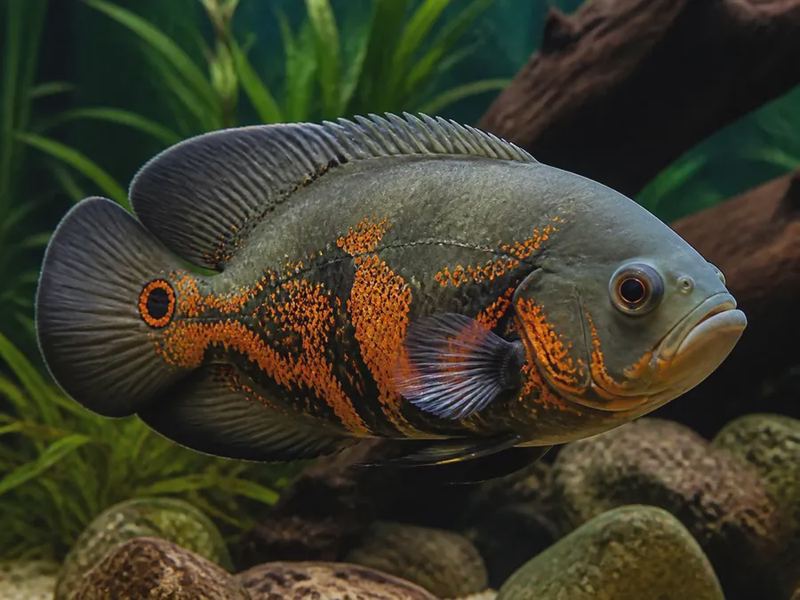
Wild Oscars exhibit a base coloration that ranges from olive-green to brownish-gray, often with a mottled pattern of darker blotches and lighter irregular patches. The most distinctive wild-type feature is the black ocellus, or eyespot, ringed with orange or red, located on the upper portion of the caudal peduncle and extending onto the caudal fin base. This eyespot is believed to serve a defensive function, mimicking the eye of a larger predator to confuse potential attackers or divert attacks away from the actual head. Additional dark vertical banding is often visible on the flanks of juveniles, which gradually fades or breaks up into irregular blotches as the fish matures. The overall body shape is deep and laterally compressed, with a large head, thick lips, and powerful pharyngeal jaws capable of crushing hard-shelled prey.
Selective breeding in the aquarium trade has produced a stunning array of color morphs that deviate significantly from the wild phenotype. The most common captive-bred varieties include the Tiger Oscar, which retains the wild pattern but with more pronounced dark mottling; the Red Oscar, characterized by a predominantly red or orange body with reduced dark patterning; the Albino Oscar, displaying a white or cream body with red or pink eyes and a complete absence of melanin; the Longfin Oscar, featuring elongated, flowing fins; and the highly sought-after Lemon Oscar, which exhibits a bright yellow base color. Regardless of morph, all Oscars share the same robust body plan and distinctive facial features, including thick, fleshy lips and large, expressive eyes that give them an almost anthropomorphic quality.
In terms of size, Oscars are among the largest freshwater cichlids kept in the aquarium. Wild specimens typically reach a standard length of 25 to 35 centimeters (10 to 14 inches), with occasional individuals exceeding 40 centimeters (16 inches). Aquarium-kept Oscars generally attain lengths of 30 to 35 centimeters (12 to 14 inches) under optimal conditions, though growth rates vary considerably depending on diet, water quality, and tank size. Females are typically slightly smaller and less robust than males, though sexing is difficult without careful examination of the genital papilla during breeding periods. Oscars grow rapidly during their first year, often reaching 15 to 20 centimeters (6 to 8 inches) within 12 months if fed a high-quality, protein-rich diet. Their lifespan in captivity is equally impressive, with well-cared-for individuals routinely living 10 to 15 years, and some exceptional specimens reaching 20 years or more. This longevity is a critical consideration for prospective owners, as an Oscar is a long-term commitment that will outlive many other common aquarium pets.
Diet & Feeding
In their natural habitat, Oscars are opportunistic omnivores with a pronounced carnivorous bias. Wild diet studies have revealed a diverse menu consisting primarily of aquatic invertebrates, including large insect larvae, crustaceans, and mollusks, supplemented by smaller fish, amphibians, and occasionally terrestrial insects that fall into the water. They are also known to consume plant matter, including fruits and seeds that drop from overhanging vegetation, particularly during flood periods when forest floors become accessible. Oscars are ambush predators and scavengers, using their powerful jaws to crush the shells of snails and crabs, and their strong pharyngeal teeth to grind up tougher food items. They are not active pursuit hunters; rather, they rely on a combination of camouflage, patience, and explosive bursts of speed to capture prey.
In the aquarium, providing a varied and nutritionally complete diet is paramount to maintaining health, growth, and vibrant coloration. High-quality commercial cichlid pellets should form the staple of the diet, specifically those formulated for large carnivorous cichlids with a protein content of 40% to 50%. These pellets should be supplemented with a rotating variety of fresh and frozen foods, including whole fish such as feeder goldfish (though these are not recommended due to disease risk and poor nutritional value), earthworms, bloodworms, krill, shrimp, and mussels. Many experienced keepers also offer chopped squid, beef heart (sparingly, as it is high in fat and can cause digestive issues), and occasional blanched vegetables like peas or zucchini to provide fiber. It is essential to avoid feeding mammalian meats like beef or chicken as a staple, as the high saturated fat content can lead to fatty liver disease and other metabolic disorders.
Feeding frequency and portion control are critical aspects of Oscar care. Juvenile Oscars (under 10 centimeters) should be fed two to three times daily, offering only as much food as they can consume within two to three minutes. Adult Oscars should be fed once daily, with one or two days of fasting per week to prevent obesity and maintain digestive health. Oscars are notorious for their enthusiastic feeding behavior and will readily overeat if given the opportunity, leading to bloating, constipation, and poor water quality from uneaten food. A common mistake among new keepers is overfeeding, which not only harms the fish but also contributes to elevated ammonia and nitrite levels in the tank. Observing the fish's body condition—a slightly rounded belly, not a distended one—is the best guide for adjusting portions. Additionally, Oscars are messy eaters that produce significant waste, so a robust filtration system and regular water changes are essential to manage the biological load generated by their feeding habits.
Aquarium Setup
Oscars are large, active, and highly destructive fish that require a substantial aquarium to thrive. The absolute minimum tank size for a single adult Oscar is 75 gallons (284 liters), though 100 gallons (379 liters) or larger is strongly recommended to provide adequate swimming space and dilute waste products. For a pair or a community of Oscars, a tank of 150 gallons (568 liters) or more is necessary. The footprint of the tank matters more than the height; a long, wide tank (e.g., 6 feet by 2 feet) provides the horizontal swimming space Oscars naturally prefer. Glass tanks are preferable to acrylic for Oscars because they are less prone to scratching from the fish's powerful movements and the substrate they may displace. A secure, heavy-duty lid is essential, as Oscars are known jumpers, particularly when startled or during aggressive interactions.
Substrate selection should prioritize practicality over aesthetics. Oscars are avid diggers and will constantly rearrange their environment, uprooting plants and moving gravel. A fine sand substrate or smooth, rounded gravel is ideal, as it allows them to exhibit natural sifting behavior without damaging their delicate barbels and mouths. Avoid sharp-edged gravel, which can cause abrasions and infections. Bare-bottom tanks are also common in Oscar keepers, particularly for breeding or quarantine purposes, as they are easier to clean and prevent substrate ingestion. Regarding plants, live aquatic plants are generally not viable in an Oscar tank; the fish will uproot, shred, or consume nearly any plant species. If live plants are desired, only the most robust species such as Anubias or Java fern attached to driftwood or rocks may survive, though even these are at risk. Most keepers opt for artificial silk plants or no plants at all, instead decorating with large pieces of driftwood, smooth rocks, and caves constructed from PVC pipes or terracotta pots to provide shelter and territorial boundaries.
Lighting requirements for Oscars are modest. They are not light-demanding fish and prefer subdued, dimly lit environments that mimic their natural turbid-water habitats. Standard LED lighting on a 8- to 10-hour photoperiod is sufficient for viewing and does not stress the fish. Floating plants or a light cover can help diffuse intense lighting if needed. Filtration is the most critical piece of equipment in an Oscar setup. Due to their large bioload and messy eating habits, a high-capacity canister filter or a sump system rated for at least twice the tank volume is recommended. Over-filtering is always better than under-filtering. Powerheads or wavemakers can be added to provide gentle water movement, though Oscars prefer calm, slow-flowing conditions and may become stressed by strong currents. Regular maintenance, including weekly water changes of 25% to 50%, gravel vacuuming, and filter media cleaning, is non-negotiable for maintaining optimal water quality and preventing disease outbreaks.
Water Parameters
Oscars are relatively adaptable fish but thrive best when maintained within water parameters that closely mimic their natural Amazonian habitat. In the wild, Oscars inhabit warm, soft, slightly acidic waters that are often stained dark with tannins from decaying vegetation. However, captive-bred Oscars have demonstrated remarkable tolerance for a wider range of conditions, including harder, more alkaline water, provided that changes are gradual and stability is maintained. Sudden fluctuations in water chemistry are far more detrimental to Oscar health than being kept at slightly suboptimal but consistent values. The following table outlines the recommended water parameters for keeping Oscars in a home aquarium.
| Parameter | Optimal Range | Acceptable Range |
|---|---|---|
| Temperature (°C / °F) | 24–28°C / 75–82°F | 22–30°C / 72–86°F |
| pH | 6.5–7.0 | 6.0–7.5 |
| General Hardness (GH) | 5–12 dGH | 3–20 dGH |
| Carbonate Hardness (KH) | 3–8 dKH | 2–12 dKH |
| Ammonia (NH₃) | 0 ppm | 0 ppm |
| Nitrite (NO₂⁻) | 0 ppm | 0 ppm |
| Nitrate (NO₃⁻) | <20 ppm | <40 ppm (with water changes) |
| Total Dissolved Solids (TDS) | 100–200 ppm | 50–400 ppm |
Temperature should be maintained consistently within the optimal range, as Oscars are ectothermic and their metabolic rate, immune function, and digestive efficiency are directly tied to water temperature. A reliable submersible heater with a thermostat is essential, and a backup heater is recommended in case of failure. Oscars are particularly sensitive to temperature swings of more than 2–3°C in a short period, which can induce stress, immunosuppression, and susceptibility to diseases like ich. pH stability is more important than hitting an exact target; if your tap water is naturally at pH 7.5, it is better to keep Oscars at that stable pH than to chase an acidic pH with chemical buffers that may fluctuate. If softer, more acidic water is desired, this can be achieved through the use of reverse osmosis (RO) water mixed with tap water, or by adding driftwood and Indian almond leaves (Terminalia catappa) to leach tannins and lower pH naturally.
Ammonia and nitrite must always be maintained at zero, as even trace amounts are highly toxic to Oscars and can cause irreversible gill damage, neurological issues, and death. This requires a fully cycled biological filter before introducing the fish. Nitrate, the end product of the nitrogen cycle, should be kept below 20 ppm for optimal health, though Oscars can tolerate up to 40 ppm with regular water changes. High nitrate levels over prolonged periods contribute to poor growth, faded coloration, and increased susceptibility to disease. Regular testing with a reliable liquid test kit is essential, and water changes should be performed weekly or more frequently if nitrate levels exceed recommended thresholds. It is also worth noting that Oscars produce a significant amount of ammonia through their gills and urine, so the biological filtration capacity must be robust enough to process this load efficiently. A well-maintained Oscar tank is one that receives consistent, proactive water management rather than reactive crisis intervention.
Behavior & Compatibility
Oscars are renowned for their complex and highly individualistic behavior. They possess a level of intelligence and problem-solving ability that is rare among fish, with studies demonstrating their capacity for learning, memory, and even recognition of specific human caregivers. They are diurnal, active during the day, and exhibit distinct personality traits—some are bold and outgoing, while others are shy and reclusive. Oscars are also highly territorial, particularly as they mature, and will establish a defined territory within the tank that they defend vigorously against perceived intruders. This territoriality is most pronounced during breeding periods but can manifest year-round in confined spaces. They are not schooling fish and should be kept singly, as a bonded pair, or in a large group in an exceptionally spacious tank where territories can be established without constant conflict.
When it comes to tankmates, Oscars are not suitable for a typical community aquarium. They are predators by nature and will view any fish small enough to fit in their mouths as food. This includes neon tetras, guppies, danios, and other small species. Even larger fish are at risk, as Oscars can be aggressive and will bully, fin-nip, or outright kill tankmates that invade their space. The best approach for keeping Oscars is either a species-only tank or a tank with a few carefully selected, similarly sized, robust tankmates that can hold their own. Suitable larger tankmates may include other large South American cichlids such as Green Terrors (Andinoacara rivulatus), Severums (Heros spp.), or Jack Dempseys (Rocio octofasciata), though these combinations require a tank of at least 150 gallons and careful monitoring for aggression. Silver Arowanas (Osteoglossum bicirrhosum), large Plecostomus species (e.g., Pterygoplichthys spp.), and medium-sized catfish like Redtail Catfish (Phractocephalus hemioliopterus) are sometimes kept with Oscars in massive public-aquarium-style setups, but these species also grow enormous and are beyond the scope of most home aquariums.
A safer approach is to keep Oscars with bottom-dwelling, armored catfish such as large Synodontis species or Loricariidae plecos, which occupy a different ecological niche and are too armored to be easily predated. However, even these can become targets of aggression if the Oscar feels its territory is threatened. It is generally recommended to add tankmates before the Oscar reaches full size, allowing them to grow up together and establish a social hierarchy, though this does not guarantee peaceful coexistence. Many experienced keepers ultimately choose to keep Oscars alone, as this eliminates the risk of injury or death to other fish and allows the Oscar's personality to fully develop without stress. Oscars are highly social with their human keepers, often following them around the tank, begging for food, and even accepting gentle petting. This interactive nature often makes a single Oscar a far more rewarding pet than a community tank of smaller, less engaging species.
Breeding
Breeding Oscars in captivity is a rewarding but demanding endeavor that requires mature fish, a spacious tank, and optimal water conditions. Oscars reach sexual maturity at approximately 12 to 18 months of age, though they may not successfully spawn until they are 2 to 3 years old and have reached a size of at least 20 centimeters (8 inches). Sexing Oscars is notoriously difficult, as there are no reliable external morphological differences between males and females outside of the breeding season. The most accurate method is to observe the genital papilla: males have a pointed, narrow papilla, while females have a broader, U-shaped papilla. This examination is best performed when the fish are in breeding condition, as the papilla becomes more prominent. Behavioral cues can also help; pairs will often form through natural bonding, and the female may appear rounder when full of eggs.
To encourage breeding, keepers should provide a flat, smooth surface as a spawning site, such as a large flat rock, a piece of slate, or even a terracotta saucer placed on the substrate. The water temperature should be gradually raised to the upper end of the optimal range (around 28°C / 82°F), and frequent water changes with slightly cooler water can simulate the onset of the rainy season, which triggers spawning in the wild. A high-quality diet rich in protein, including live or frozen foods, should be provided to condition the pair. Once a pair has formed, they will exhibit intense courtship behavior, including lip-locking, tail-slapping, and parallel swimming. The female will lay a clutch of 300 to 800 eggs (or more in larger females) on the prepared surface, and the male will immediately fertilize them. Both parents will actively guard the eggs, fanning them with their pectoral fins to provide oxygenation and removing any dead or fungus-infected eggs.
The eggs typically hatch within 48 to 72 hours, depending on temperature. The fry are initially tiny and remain attached to the spawning site, absorbing their yolk sacs for the first 4 to 5 days. Once free-swimming, they should be fed infusoria or commercially available liquid fry food for the first few days, graduating to freshly hatched brine shrimp (Artemia nauplii) and finely crushed flake food as they grow. Both parents will continue to guard and protect the fry, herding them into pits dug in the substrate and defending them fiercely. Raising fry is a significant undertaking, as they grow quickly and require frequent water changes to maintain water quality, as well as progressively larger food items. The fry are also highly cannibalistic, so they may need to be separated by size as they grow. Oscars are generally devoted parents and can be bred successfully in captivity, but the sheer number of offspring and their rapid growth rate means that a dedicated grow-out tank is essential. It is also worth noting that Oscars will form strong pair bonds and may breed repeatedly, so once a pair has spawned successfully, they can often be encouraged to spawn again every few weeks under optimal conditions.
Common Diseases & Health
Oscars are generally hardy fish, but they are susceptible to a range of diseases, many of which are stress-related and preventable through proper husbandry. The most common ailment affecting Oscars is Ichthyophthirius multifiliis, commonly known as "ich" or white spot disease. This protozoan parasite manifests as small, white, salt-like spots on the body, fins, and gills, accompanied by flashing (rubbing against objects), rapid breathing, and lethargy. Ich is often triggered by sudden temperature drops or poor water quality. Treatment involves raising the water temperature gradually to 30°C (86°F) over 24 hours, adding aquarium salt (1 tablespoon per 5 gallons), and using a commercial ich medication containing malachite green or formalin. Another common external parasite is Cryptocaryon irritans, which is similar to ich but more aggressive; treatment protocols are similar.
Hole-in-the-head disease (HITH) and lateral line erosion (LLE) are conditions frequently observed in Oscars, characterized by pitting and erosion of the skin and sensory pits on the head and along the lateral line. The exact etiology is debated, but it is strongly associated with chronic stress, poor water quality, nutritional deficiencies (particularly lack of vitamin C and minerals), and the presence of activated carbon in filtration systems, which some believe leaches harmful compounds. Treatment involves improving water quality, removing activated carbon, providing a varied and nutritious diet, and adding vitamin and mineral supplements to the food. In severe cases, metronidazole can be used in the water or food to address potential parasitic involvement. HITH is often progressive and can be disfiguring, but early intervention can halt and sometimes reverse the damage.
Bacterial infections, such as fin rot, mouth rot (columnaris), and septicemia, are also prevalent, particularly in fish kept in suboptimal conditions. Fin rot presents as frayed, discolored, or deteriorating fins, while columnaris appears as white, cotton-like patches on the mouth, body, or gills, often accompanied by rapid gill movement. These infections are typically secondary to physical injury, stress, or poor water quality. Treatment includes improving water conditions, ensuring excellent hygiene, and administering broad-spectrum antibiotics such as tetracycline, kanamycin, or nitrofurazone, either in the water or mixed into food. It is crucial to isolate affected fish in a quarantine tank to prevent the spread of infection and to avoid contaminating the main display tank with medications that may harm beneficial bacteria. Additionally, Oscars are prone to intestinal parasites, including Spironucleus (hexamita) and tapeworms, which can cause weight loss, white stringy feces, and reduced appetite. Treatment with praziquantel or metronidazole is effective, but accurate diagnosis is essential. Prevention remains the best medicine: maintaining pristine water quality, providing a balanced diet, avoiding overfeeding, and quarantining all new fish and plants before introduction to the main tank are the most effective strategies for keeping Oscars healthy and disease-free for their entire 15-year lifespan.
FAQs
1. How big of a tank do I need for one Oscar?
An absolute minimum of 75 gallons (284 liters) is required for a single adult Oscar, but 100 gallons (379 liters) or larger is strongly recommended. Oscars are highly active, grow to 12–14 inches, and produce a massive bioload. A larger tank not only provides essential swimming space but also helps dilute waste products, making water quality management significantly easier. For a pair or any tankmates, a 150-gallon (568-liter) tank or larger is necessary. Remember, the footprint (length and width) is more important than height.
2. Can I keep Oscars with other fish?
Generally, no. Oscars are predatory and highly territorial. Any fish small enough to be swallowed will be eaten, and larger fish will likely be bullied or injured. The safest option is a species-only tank. If you insist on tankmates, only consider similarly sized, robust species like large plecos, silver dollars, or other large South American cichlids, and only in a very large tank (150+ gallons) with plenty of hiding places. Even then, aggression is unpredictable, and you should have a backup plan to separate them if conflicts arise.
3. Why is my Oscar losing its color and turning dark?
Oscars naturally darken or lighten in response to mood, stress, and environmental conditions. A sudden darkening, often accompanied by hiding or clamped fins, is a common sign of stress, which can be caused by poor water quality, aggressive tankmates, sudden temperature or pH swings, or loud noises/vibrations near the tank. Juvenile Oscars also naturally darken as they mature. If the fish is otherwise eating and behaving normally, a temporary color change is usually not a cause for alarm. However, if accompanied by other symptoms like rapid breathing or lethargy, test your water parameters immediately and perform a water change.
4. How long do Oscars live, and how fast do they grow?
With proper care, Oscars can live for 10 to 15 years, and some exceptional individuals have been reported to live over 20 years. They are fast growers, typically reaching 6–8 inches within their first year and achieving their full adult size of 12–14 inches by 2 to 3 years of age. Growth rate is heavily influenced by diet, water quality, and tank size. A cramped tank or poor nutrition will stunt their growth and shorten their lifespan. They are a significant long-term commitment, so be prepared for a decade or more of dedicated care.
References
- Nature Ecology & Evolution
- Journal of Evolutionary Biology
- Max Planck Institute for Evolutionary Biology