
Symphysodon aequifasciatus Discus Care Guide
Species Overview
The discus, Symphysodon aequifasciatus, is arguably the most iconic and challenging freshwater fish in the aquarium hobby, a status it has held for nearly a century. Belonging to the family Cichlidae, this species is one of three recognized within the genus Symphysodon, the others being S. discus (the Heckel discus) and the recently described S. haraldi (the blue or brown discus, depending on taxonomic interpretation). The taxonomic history of the genus is notoriously convoluted, with numerous subspecies and color morphs having been described over the decades. The name aequifasciatus, derived from Latin, translates to "equal-banded," a reference to the nine vertical bars that adorn the flanks of all discus species. These bars are a key feature for species identification, with the width and intensity of the central bar being particularly diagnostic.
The species was first formally described in 1854 by the German naturalist Johann Jakob Heckel, based on specimens collected from the Rio Negro in Brazil. However, it was not until the 1930s that discus were successfully imported to Europe and North America, where their breathtaking coloration and unique parental care immediately captivated aquarists. The initial failures to keep these fish alive for more than a few weeks earned them a reputation for being impossibly delicate, a myth that persists in some circles today. In reality, S. aequifasciatus is not inherently fragile; rather, it requires specific, stable water conditions and a diet that mimics its natural food sources. Modern understanding of their ecology and husbandry has transformed them from a near-impossible dream into a achievable, albeit demanding, goal for dedicated hobbyists.
Geographically, Symphysodon aequifasciatus is distributed across a vast expanse of the Amazon Basin in South America. Its range includes the calm, slow-moving tributaries and flooded forest floors of the Rio Negro, the Solimões (the upper Amazon), and the Rio Amazonas proper, primarily within Brazil. It is also found in Peru and Colombia in the upper reaches of the Amazon and its major affluents. Crucially, these fish are not found in the fast-flowing, sediment-laden "whitewater" rivers that characterize much of the Amazon's main stem. Instead, they are denizens of "blackwater" and "clearwater" habitats. Blackwater systems, like the Rio Negro, are stained a deep tea color by tannins released from decaying vegetation, are extremely soft, and have a naturally low pH (often between 4.0 and 6.0). Clearwater rivers, such as the Rio Tapajós, are also soft and acidic but lack the heavy tannin staining. In these environments, discus are typically found in shallow, littoral zones, sheltering among submerged tree roots, fallen branches, and dense mats of aquatic vegetation, where they form loose aggregations away from the strongest currents.
Appearance & Size
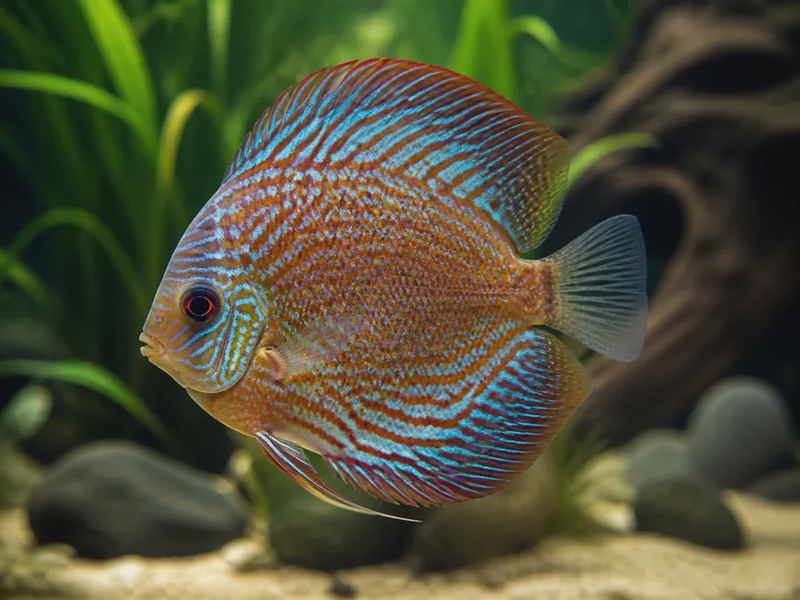
The discus's common name is a direct reference to its body shape: a highly compressed, laterally flattened, almost perfectly circular disc. This morphology is an adaptation for maneuvering through the tangled root systems of its flooded forest habitat. The dorsal and anal fins are elongated and sweep back along the body, while the pelvic fins are long and filamentous. The caudal fin is relatively short and fan-shaped. This body plan gives the discus an almost otherworldly, graceful appearance, unlike any other cichlid. The base coloration of S. aequifasciatus in the wild is typically brownish or olive-green, with a series of nine prominent, dark vertical bars. These bars are not static; the fish can intensify or fade them rapidly, using them for communication, camouflage, and as an indicator of stress or social status.
Beyond the base brown, the flanks are often overlaid with a brilliant iridescent blue or green sheen, particularly on the dorsal and anal fins and the upper half of the body. This iridescence is caused by structural coloration, where light is refracted by layers of guanine crystals in the skin, creating a shimmering effect that changes with the viewing angle. While the wild form is beautiful, it is the selectively bred domestic strains that have pushed the aesthetic envelope. Over decades of captive breeding, aquarists have developed a staggering array of color morphs, including the brilliant Royal Blue, the fiery Red Turquoise, the solid Red (often from S. haraldi lineage), the ghostly White, and the striking Pigeon Blood, which is characterized by a heavy peppering of dark spots over a pale base. It is important to note that many of these domestic strains are hybrids, and their genetics may involve all three Symphysodon species.
In terms of size, discus are considered a medium-to-large cichlid. A fully grown adult S. aequifasciatus typically reaches a standard length (excluding the caudal fin) of 15 to 20 centimeters (6 to 8 inches). Some exceptional specimens in captivity, particularly those given ample space and a high-quality diet, can approach 23 centimeters (9 inches). The overall height, including the elongated dorsal and anal fins, can easily exceed 25 centimeters (10 inches). They are slow-growing fish, and it can take two to three years for them to reach their full adult size and sexual maturity. Sexing discus is notoriously difficult, especially in juveniles. In mature adults, males are often slightly larger and may have a more prominent, blunter head profile, while females may have a smaller, more pointed snout and a more rounded belly when gravid. However, these differences are subtle and not always reliable, making venting (examining the genital papilla) the only definitive method for sexing.
Diet & Feeding
Understanding the natural diet of Symphysodon aequifasciatus is the single most important factor in successfully keeping them. For decades, they were mistakenly fed a predominantly beef-heart-based diet, which led to chronic digestive issues, fatty liver disease, and poor long-term health. The truth is that in the wild, discus are primarily insectivorous and planktivorous. They are not piscivorous in the traditional sense. Their diet consists overwhelmingly of aquatic insect larvae, particularly those of chironomid midges (bloodworms), mosquito larvae, and the larvae of caddisflies and mayflies. They also consume a significant amount of zooplankton, including cladocerans (like Daphnia) and copepods, which they filter from the water column. A key component of their diet, particularly for juveniles, is the mucus secreted by their parents, which provides essential nutrients and antibodies.
This natural diet is exceptionally high in protein and relatively low in fat and indigestible plant matter. In the aquarium, this translates to a need for a varied, high-quality diet that mimics these nutritional parameters. The cornerstone of a modern discus diet should be a high-quality commercial discus pellet or flake food. These are formulated to be highly digestible and contain the necessary protein, vitamins, and minerals. These should be supplemented with frozen foods, which are far superior to freeze-dried options due to their higher moisture content and palatability. Excellent choices include frozen bloodworms (as a treat, not a staple), frozen brine shrimp (enriched with vitamins), frozen Daphnia, and frozen mosquito larvae. Live foods, such as blackworms and white worms, are eagerly accepted and excellent for conditioning fish, but they carry a risk of introducing pathogens and should be sourced from reputable suppliers.
Feeding frequency is crucial. Juvenile discus have high metabolic rates and should be fed three to five times per day with smaller portions. Adults can be fed two to three times per day. The key is to offer only what they can consume in two to three minutes to avoid polluting the water. The old practice of feeding large quantities of beef heart should be abandoned. If a hobbyist insists on using a homemade mix, it should be based on seafood (white fish, shrimp, squid) and spirulina, not mammalian heart. The high melting point of beef fat makes it indigestible for tropical fish and is a primary cause of the bloat and wasting diseases that plague poorly kept discus. Observing your fish during feeding is an excellent health check; a healthy discus will be eager, aggressive feeders, while a lethargic or disinterested fish is often the first sign of an impending health problem.
Aquarium Setup
Setting up an aquarium for Symphysodon aequifasciatus requires a departure from the norms of the standard community tank. The primary goal is to create a stable, low-stress environment that replicates the calm, dimly lit conditions of their native blackwater habitats. The most critical piece of advice is to acquire a group of at least six juvenile fish and grow them out together. This allows them to establish a natural pecking order and form a cohesive school, which dramatically reduces stress and aggression. Keeping a single discus or a pair in a community tank almost always results in a nervous, poorly colored fish that is prone to disease.
Tank size is non-negotiable. A group of six adult discus requires a tank with a minimum footprint of 48 inches by 18 inches (a 75-gallon or 90-gallon aquarium). Taller tanks are often preferred because discus grow to a significant height, but a larger footprint is more important for swimming space and social dynamics. A 125-gallon tank (72" x 18" x 24") is an ideal size for a group of six to eight adults. The aquarium should be placed in a low-traffic area, away from direct sunlight and loud noises, as discus are easily startled. The substrate should be fine sand or a very smooth, small-grained gravel. Sharp substrates can injure their delicate barbels and the underside of their bodies as they forage. Bare-bottom tanks are also a common practice in breeding and grow-out operations because they are far easier to keep clean, but a sand substrate is more aesthetically pleasing and provides a more natural environment.
Aquascaping for discus should prioritize function over form. They do not require dense planting; in fact, open swimming areas are essential. The ideal setup includes a few large pieces of driftwood (Mopani or Malaysian wood are excellent) to create caves and visual breaks, and a scattering of smooth river stones. Plants can be included, but they must be able to tolerate the warm, soft, acidic water. Hardy, low-light species like Anubias and Microsorum (Java fern) are ideal, as they can be attached to the driftwood. Floating plants, such as Salvinia or Limnobium (frogbit), are highly recommended, as they diffuse the light and provide shade, which makes discus feel more secure. Lighting should be subdued. High-intensity lighting is stressful and can cause them to wash out their colors. A standard T8 or T5 fluorescent fixture, or an LED unit dimmed to a lower intensity, is more than sufficient. The goal is to create a dappled, shaded environment.
Water Parameters
Water quality is the absolute linchpin of discus keeping. These fish are not difficult because they require exotic water chemistry; they are difficult because they require pristine water. The nitrogen cycle must be fully mature before adding discus. They are exceptionally sensitive to ammonia and nitrite, and even low levels of nitrate can inhibit growth and suppress the immune system. The most common mistake is keeping discus in water that is too "clean" in terms of chemistry but too "dirty" in terms of organic waste. The solution is frequent, large water changes. A typical routine for adult discus is a 50% water change daily or every other day. For juveniles, daily water changes of 50-75% are often necessary to maximize growth rates. This is not optional; it is a fundamental requirement of the species.
In terms of chemistry, discus are very adaptable to a wide range of pH, provided it is stable. While wild fish are found in pH 4.0-6.0, most captive-bred discus are raised in pH 6.5-7.5. A pH of 6.8-7.0 is a safe and stable target for domestic strains. The hardness should be soft to moderately hard. The key is to avoid sudden fluctuations. The temperature is one parameter where discus are more demanding. They require consistently warm water, ideally between 28°C and 30°C (82°F and 86°F). Temperatures below 27°C (80°F) can slow their metabolism, making them susceptible to infections, and are a common trigger for "discus plague." The following table summarizes the recommended water parameters for captive-bred S. aequifasciatus.
| Parameter | Recommended Range | Ideal Target |
|---|---|---|
| Temperature | 28°C - 30°C (82°F - 86°F) | 29°C (84°F) |
| pH | 6.0 - 7.5 | 6.8 - 7.0 |
| General Hardness (GH) | 1 - 8 dGH | 3 - 5 dGH |
| Carbonate Hardness (KH) | 1 - 4 dKH | 2 - 3 dKH |
| Nitrate (NO3) | < 20 ppm | < 10 ppm |
| Ammonia (NH3) / Nitrite (NO2) | 0 ppm | 0 ppm |
Filtration must be robust but gentle. A high-quality canister filter rated for at least twice the tank volume is recommended, with a spray bar to diffuse the outflow and avoid strong currents. Sponge filters are excellent for biological filtration and are a must in breeding tanks. The use of peat moss in the filter can help lower pH and add beneficial tannins, but it must be monitored to prevent pH crashes. Reverse osmosis (RO) water mixed with tap water is often used to achieve very soft water, but for most domestic discus, properly dechlorinated and aged tap water is perfectly acceptable if the parameters are within the ranges above.
Behavior & Compatibility
Discus are a highly social, gregarious species. In the wild, they are almost always found in loose schools of a dozen or more individuals. This social structure is crucial for their well-being; they are not solitary fish. In the aquarium, they should always be kept in a group of at least six, and ideally more. A group of six to eight is a good target for a 75-125 gallon tank. Within this group, they will establish a clear dominance hierarchy. This is a normal and healthy behavior, characterized by subtle fin displays, lateral tilting, and occasional chases. This aggression is usually mild and rarely results in physical injury. However, if the group is too small (e.g., only two or three fish), the dominant individual may relentlessly harass the subordinate fish, leading to chronic stress, suppressed appetite, and eventual death. A larger group dilutes this aggression, spreading it across multiple individuals.
When selecting tankmates, the golden rule is to choose species that are peaceful, non-competitive, and will not intimidate the discus. Because discus are slow, deliberate feeders, they cannot be housed with fast, aggressive eaters that will outcompete them for food. The classic community tank staples like tetras are excellent choices, but the species matters. Small, peaceful tetras like Cardinals (Paracheirodon axelrodi), Rummynose tetras (Hemigrammus rhodostomus), and Green Neon tetras are ideal. They are too small to be considered prey, are not fin-nippers, and their schooling activity provides a calming visual cue for the discus. Other suitable tankmates include small catfish like the Corydoras species (which are bottom dwellers and won't compete for mid-water food), and dwarf cichlids like the Ram (Mikrogeophagus ramirezi), which share similar water preferences. Small, peaceful gouramis, such as the Honey Gourami, can also work.
It is critical to avoid certain types of fish. Any aggressive or semi-aggressive cichlid, such as Angelfish (Pterophyllum scalare), Oscars, or Jack Dempseys, is an absolute no. Angelfish are particularly problematic as they are closely related to discus and will compete for territory and food. Large, boisterous barbs (like Tiger Barbs) and any known fin-nippers, such as Serpae Tetras, should be avoided, as they will constantly harass the slow-moving discus and damage their long, flowing fins. Bottom-dwelling plecos, especially the common Hypostomus plecostomus and the Sailfin Pleco, are also poor choices. Many plecos are nocturnal and may attempt to suck on the discus's slime coat while they sleep, causing severe stress and open wounds. If a pleco is desired, a small species like the Bristlenose Pleco (Ancistrus spp.) is a safer, though still not risk-free, option. The safest approach is to keep a species-only tank, which is the most common and recommended method for serious discus keepers.
Breeding
Breeding Symphysodon aequifasciatus is the ultimate test of an aquarist's skill, but it is a natural and achievable behavior when the fish are provided with optimal conditions. The process begins with the formation of a monogamous pair. In a group of young fish, they will naturally pair off. A bonded pair will often isolate themselves from the group, defend a territory, and exhibit a distinct "trembling" or "nodding" display towards each other. Once a pair is observed, they should be moved to a dedicated breeding tank. This tank is typically smaller, around 30-40 gallons, and is kept bare-bottomed for ease of cleaning. The water should be very soft (GH < 4 dGH), acidic (pH 6.0-6.5), and warm (30°C / 86°F). The tank should contain a spawning cone—a tall, sloped ceramic or slate structure—which the pair will use as their spawning site.
Condition for spawning is achieved through a high-quality diet of live and frozen foods. The female will become noticeably plumper as she develops eggs. When ready, the pair will meticulously clean the spawning cone. The female will then lay a batch of 150 to 400 eggs in a circular pattern, and the male will follow to fertilize them. The parents will then take turns fanning the eggs with their pectoral fins to provide oxygenation and removing any infertile or fungused eggs. The eggs hatch in approximately 48 to 60 hours. At this stage, the wriggling larvae are moved by the parents to a pre-dug pit in the substrate or to the side of the cone. They will remain here for another four to five days, absorbing their yolk sacs.
The most remarkable aspect of discus breeding is the parental care of the fry. Once the fry are free-swimming, they instinctively swim towards their parents and begin to feed on the parental mucus. This mucus, which is secreted in copious amounts from the parents' skin, is their sole source of nutrition for the first two to three weeks of life. This secretion is rich in proteins, antibodies, and hormones, and it is essential for the fry's development and immune system. Observing this behavior is a truly spectacular and moving sight. The fry will "peck" at the parents' flanks constantly, and the parents will appear to be covered in a moving black film. This is a demanding period for the parents, and they will often lose significant weight. After about three weeks, the fry can be weaned onto newly hatched brine shrimp (Artemia nauplii). At this point, the fry should be separated from the parents and moved to a grow-out tank. They will grow quickly, and the process of raising them to adulthood is a rewarding, albeit lengthy, project.
Common Diseases & Health
Discus are not inherently more susceptible to disease than other fish, but their sensitivity to poor water quality and stress makes them prone to a specific set of ailments. The single most common cause of disease in discus is poor husbandry, primarily infrequent water changes and fluctuating parameters. When the water quality declines, the fish's immune system is compromised, allowing opportunistic pathogens to take hold. The most notorious of these is "Discus Plague," a term often used loosely to describe a range of viral or bacterial infections that cause the fish to darken, clamp their fins, produce excessive slime, and become lethargic. There is no single cure; the only effective treatment is to immediately improve water quality through large, daily water changes and to raise the temperature to 32°C (90°F) to accelerate the fish's metabolism and immune response.
Parasitic infections are also common. Ichthyophthirius multifiliis, commonly known as Ich or White Spot, is a protozoan parasite that appears as tiny white grains of salt on the fins and body. It is often triggered by a sudden drop in temperature. Treatment involves raising the temperature and using a commercial malachite green or formalin-based medication. External flukes (monogeneans) like Gyrodactylus and Dactylogyrus are another frequent problem, causing the fish to flash (scratch against objects) and produce excess mucus. These are treated with praziquantel. Internal parasites, particularly Spiroclea and other flagellates, are a major concern in wild-caught fish and can cause chronic weight loss and white, stringy feces. These require treatment with metronidazole or other antiparasitic medications.
Bacterial infections are usually secondary to physical damage or parasitic infestations. Fin rot, characterized by frayed and disintegrating fins, is often caused by poor water quality and is treated with antibiotics and improved hygiene. A more serious condition is a bacterial infection of the swim bladder, which causes the fish to lose buoyancy and swim erratically. The most important thing to remember is that prevention is always better than cure. Quarantining all new fish for a minimum of four weeks in a separate tank is non-negotiable. Maintaining a rigorous water change schedule, feeding a high-quality diet, and minimizing stress are the best defenses against disease. A healthy discus is a voracious eater, has a smooth, bright coloration, and is active and responsive. Any deviation from this baseline should be investigated immediately.
FAQs
Q: Are discus really as difficult to keep as people say?
A: They are not difficult in the sense of requiring exotic, unattainable conditions. They are demanding in terms of their need for pristine water quality and a stable environment. The "difficulty" comes from the commitment to a strict maintenance routine—typically daily or every-other-day water changes—and a high-quality, varied diet. If you are prepared for this level of dedication, they are no more challenging than many other sensitive species. If you are looking for a low-maintenance fish, they are not for you.
Q: Can I keep a single discus in a community tank?
A: No. A single discus will be chronically stressed, which is a death sentence. They are a shoaling species that requires the company of its own kind for security and social interaction. Keeping one alone in a community tank is a common but fatal mistake. You must keep a group of at least six discus in a species-only or carefully planned community tank. The stress of solitude will suppress their immune system and lead to disease and premature death.
Q: What is the ideal tank size for a group of discus?
A: For a group of six adult discus, the minimum tank size is a 75-gallon aquarium (48" x 18" x 21"). A 90-gallon or 125-gallon tank is much better, as it provides more swimming space and helps to dilute aggression. The footprint is more important than the height. While tall tanks are aesthetically pleasing, discus need horizontal swimming space to establish their social hierarchy and feel comfortable.
Q: What is the best food for discus?
A: The best diet is a varied one. The staple should be a high-quality commercial discus pellet or flake food. This should be supplemented with frozen foods such as bloodworms, brine shrimp, Daphnia, and mosquito larvae. Live foods like blackworms are excellent for conditioning but should be sourced from a reputable dealer to avoid introducing pathogens. Avoid beef heart as a staple food; it is too high in fat and indigestible proteins for their digestive systems.
References
- Nature Ecology & Evolution
- Journal of Evolutionary Biology
- Max Planck Institute for Evolutionary Biology