
Symphysodon discus: Biology and Captive Husbandry
Species Overview
The Discus, Symphysodon discus, stands as one of the most iconic and challenging freshwater fish in the aquarium hobby, often referred to as the “King of the Aquarium.” Belonging to the family Cichlidae, this species was first formally described by Heckel in 1840, making it the type species for the genus Symphysodon. The genus name derives from the Greek words “sym” (together) and “physa” (bellows), referring to the compressed, disc-like body shape that distinguishes these fish from all other cichlids. It is crucial to distinguish Symphysodon discus (Heckel’s Discus) from its close relatives, the Brown Discus (Symphysodon aequifasciatus) and the Blue/Brown Discus (Symphysodon haraldi), which were reclassified in 2006 based on genetic and morphological studies by Ready et al. While all three species share a similar body plan, S. discus is characterized by its nine vertical bars, with the central bar typically being the most pronounced and dark, a feature that is often the simplest way to distinguish it from other Symphysodon species in the wild.
Geographically, the true Heckel Discus is endemic to the Amazon River basin, with its primary range concentrated in the lower and middle Rio Negro, the Rio Abacaxis, and the Rio Trombetas in Brazil. Unlike the Brown Discus which has a broader distribution across the Amazon, S. discus exhibits a more restricted range, predominantly inhabiting blackwater tributaries. These environments are characterized by water that is heavily stained with tannins and organic acids leached from decomposing vegetation, creating tea-colored water with exceptionally low mineral content and acidic pH levels. The Rio Negro itself, a major tributary of the Amazon, is the quintessential habitat for this species, where water conductivity often measures below 10 microsiemens per centimeter and pH values routinely fall between 4.0 and 5.5. In these dark, acidic waters, the Discus has evolved over millennia to thrive in conditions that are lethal to most other fish species, making them exquisitely adapted to a very specific and stable aquatic ecosystem.
In their natural habitat, Symphysodon discus are found in calm, slow-moving waters, typically along flooded forest margins, oxbow lakes, and sheltered backwaters where the current is minimal. They exhibit a strong preference for submerged root systems, fallen branches, and dense aquatic vegetation, which provide both cover from avian predators and a substrate upon which they graze for biofilm and microorganisms. The water depth in these regions rarely exceeds a few meters, and the canopy of the rainforest provides significant shading, meaning that direct sunlight rarely penetrates to the water’s surface. The seasonal flooding cycle of the Amazon is integral to their life history; during the high-water season (January to June), the fish disperse into the flooded forests to feed on the abundant resources, while during the low-water season, they retreat to deeper channels and lakes, where they aggregate in large groups. Understanding these natural rhythms is essential for replicating their care in captivity, as the stability of their native blackwater systems is starkly different from the fluctuating conditions often found in community aquariums.
Appearance & Size
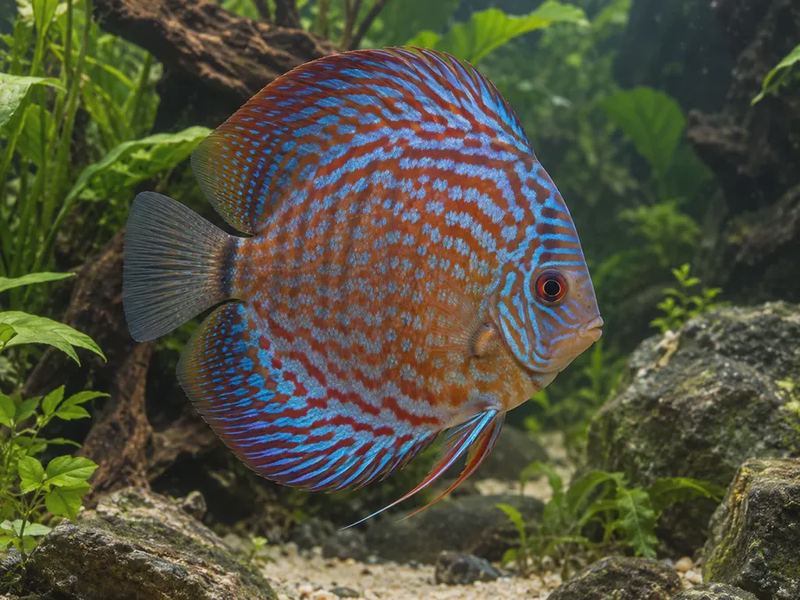
The Discus is immediately recognizable by its highly compressed, laterally flattened, circular body, which resembles a discus thrower’s implement—hence its common name. In Symphysodon discus, the body is nearly perfectly round, with the dorsal and anal fins extending along the majority of the body’s height and tapering to a point at the caudal peduncle. The base coloration in wild specimens is typically a muted brownish-olive to tan, though this can vary due to locality and water conditions. The defining characteristic of Heckel’s Discus is the presence of nine distinct vertical dark bars that traverse the body. The third, fifth, and ninth bars are notably wider and more intensely pigmented than the others, with the fifth bar (situated mid-body) being the most prominent, often appearing as a thick, solid black band. In contrast, the other bars are thinner and may break up or fade depending on the fish’s mood, health, or stress levels. This barring pattern is not merely aesthetic; it serves as a communication mechanism and a form of disruptive camouflage in the dappled light of their blackwater habitat.
Beyond the bars, the body is often suffused with a mosaic of small blue, green, or turquoise iridescent lines and spots that extend across the flanks, operculum, and unpaired fins. This iridescence is caused by structural coloration—the reflection of light off guanine crystals within the chromatophores—and can vary dramatically in intensity based on the fish’s mood and water chemistry. The eye is a striking orange to red hue, which contrasts vividly against the darker body, and is positioned high on the head, allowing the fish to observe potential threats from above. The dorsal and anal fins are often edged with a fine blue or white margin, and in mature males, these fins may be slightly more pointed and extended than those of females. It is important to note that while domestic strains have been selectively bred for spectacular colors—ranging from brilliant reds, blues, and even albino forms—the wild Heckel Discus generally possesses a more subdued, earthy palette, which is a testament to its adaptation to the dark, tannin-rich waters of its native range.
In terms of size, Symphysodon discus is one of the larger cichlid species, though not the largest. A fully grown adult will typically reach a standard length (excluding the caudal fin) of between 15 to 20 centimeters (6 to 8 inches), with some exceptional wild specimens reported to approach 22 centimeters (8.5 inches). When measured from the tip of the dorsal fin to the tip of the anal fin, the total vertical height can exceed the body length, often reaching 20 to 25 centimeters in large individuals. Growth rates are highly dependent on water quality and nutrition; fish kept in optimal conditions can reach sexual maturity at around 12 to 18 months of age, though they will continue to grow slowly for another 2 to 3 years. Wild specimens are often slightly smaller than their aquarium-raised counterparts due to the scarcity of food during the dry season, whereas captive discus, fed a rich and varied diet, can achieve maximum size more reliably. Sexing juvenile discus is notoriously difficult, but mature males tend to be slightly larger with broader heads and more pointed dorsal and anal fin extensions, while females often have a more rounded, blunt head profile and a smaller body frame, though these differences are subtle and not definitive without observing breeding behavior.
Diet & Feeding
In their natural habitat, Symphysodon discus are omnivorous with a distinct trophic specialization that sets them apart from many other cichlids. Extensive stomach content analyses conducted in the Rio Negro basin have revealed that their primary dietary component is not small fish or insects, but rather a combination of aquatic invertebrates, zooplankton, insect larvae, and, crucially, periphyton and biofilm. Biofilm, a complex matrix of algae, bacteria, fungi, and microscopic organisms, is scraped from submerged wood, leaves, and plant surfaces. This grazing behavior is fundamental to their health, providing not only caloric intake but also essential micronutrients and fiber that aid in digestion. In the wild, they are adapted to a low-protein, high-fiber diet, which contrasts sharply with the high-protein diets often fed in captivity, an imbalance that can lead to digestive issues and obesity over time.
As juveniles, Symphysodon discus exhibit a fascinating and unique feeding behavior: they feed on the epidermal mucus secreted by their parents. This “parental mucus feeding” is a hallmark of the genus and is essential for juvenile survival in the first few weeks of life. The mucus is rich in proteins, glycoproteins, and antibodies, providing both nutrition and passive immunity to the developing fry. This behavior is so critical that fry will not survive without access to parental mucus, and it has been observed that the stress of rearing fry can cause significant weight loss in the parent fish. In the aquarium, this behavior is often replicated by providing fry with finely powdered foods and high-quality flake, but the initial reliance on parental care remains a key consideration for breeders.
For captive adult discus, a varied and balanced diet is paramount. In their natural environment, they are continuous grazers, and in the aquarium, they should be fed two to three times daily in small quantities. The staple diet should consist of high-quality commercial pellets specifically formulated for discus, which are typically high in protein (around 45-50%) but also contain plant matter and spirulina. These should be supplemented with frozen or live foods such as bloodworms (Chironomidae larvae), brine shrimp (Artemia), blackworms (Lumbriculus variegatus), and daphnia. However, it is critical to avoid mammalian heart or beef heart mixtures, which are high in saturated fats and can cause steatosis (fatty liver disease) and intestinal blockages over time. Instead, a homemade seafood-based mix—made from fish fillets, shrimp, and spirulina with added vitamins and minerals—is a superior alternative. Offering a variety of foods not only ensures nutritional completeness but also stimulates natural foraging behavior, reducing stress and enhancing the fish’s natural coloration. It is also advisable to feed them in a quarantine tank or provide a designated feeding area to observe their appetite and monitor for any signs of illness.
Aquarium Setup
Providing an appropriate aquarium environment for Symphysodon discus is non-negotiable for long-term success. These fish are highly sensitive to environmental instability and require a spacious, mature, and meticulously maintained tank. As a shoaling species, they must be kept in groups of at least six individuals to establish a proper social hierarchy and reduce chronic stress, which is a leading cause of disease. Consequently, the minimum recommended tank size for a group of six adult discus is 75 gallons (approximately 284 liters), though a 120-gallon (454 liters) tank is far preferable for a larger group or if tankmates are included. The tank should be long and wide rather than tall, as while discus are deep-bodied, they require horizontal swimming space. The aquarium should be placed in a quiet, low-traffic area away from direct sunlight and drafts, as excessive noise and light can readily stress these fish.
The substrate should be fine sand or very small, smooth gravel, as discus are not diggers, but a soft substrate helps replicate their natural environment and is easier to keep clean. Bare-bottom tanks are often used by breeders for ease of maintenance, but for a display tank, a thin layer of fine sand is aesthetically pleasing and allows the fish to exhibit natural sifting behaviors. Driftwood is an essential component of the hardscape, not only for aesthetics but also for its functional role in slowly releasing tannins into the water, which helps lower pH and provides a natural grazing surface for the fish. Malaysian driftwood, Mopani wood, or bogwood are excellent choices. Live plants can be included, but species that thrive in soft, acidic water and low to moderate lighting are best. Amazon sword plants (Echinodorus species), Java fern (Microsorum pteropus), and Anubias species are robust choices that can tolerate the higher temperatures required by discus. Floating plants such as Salvinia or Pistia can also be used to diffuse lighting and create shaded areas, mimicking the dappled light of their native habitat. Dense planting should be concentrated at the sides and back of the tank, leaving a large open swimming area in the center.
Lighting should be subdued, as discus are naturally found in heavily shaded waters. Strong, intense lighting will not only stress the fish but also encourage the growth of algae on the substrate and glass. LED lighting with a dimmable function or a lower-wattage fluorescent tube is recommended, providing an intensity of around 0.5 to 1 watt per gallon. The photoperiod should be limited to 8 to 10 hours per day, and the use of floating plants can further reduce light intensity and provide cover. Filtration is arguably the most critical aspect of the setup. Because discus produce a high bioload and are extremely sensitive to ammonia and nitrite, a robust biological filtration system is essential. A sump filter is the gold standard, offering a large media volume for beneficial bacteria, but high-quality canister filters or two large hang-on-back filters can also work effectively. The water flow should be gentle to moderate, as discus prefer calm waters; strong currents will stress them. The use of a sponge filter in addition to the primary filter is recommended as it provides supplemental biological filtration and aeration. Finally, a tight-fitting lid is mandatory, as discus are known jumpers when startled.
Water Parameters
Water chemistry is the single most critical factor in the health and longevity of Symphysodon discus. In the wild, they inhabit blackwater environments that are exceptionally soft, acidic, and thermally stable. Replicating these conditions in captivity is essential, and deviations from these parameters will quickly lead to stress, immunosuppression, and disease. The most important rule is stability; while discus can adapt to slightly different conditions over time, rapid fluctuations in pH, temperature, or hardness are catastrophic. A heater with a reliable thermostat is essential, and the temperature should be maintained continuously at 28°C to 30°C (82°F to 86°F). At these temperatures, their metabolism is elevated, and their immune system functions optimally. Temperatures below 26°C (79°F) will cause them to become lethargic and highly susceptible to infections.
The pH should be maintained between 5.5 and 6.5 for wild-caught Heckel Discus, though many captive-bred strains can tolerate a slightly higher pH of up to 7.0. However, for optimal health and breeding behavior, keeping the pH in the acidic range is strongly recommended. To achieve this, hobbyists often use reverse osmosis (RO) water mixed with tap water, or they rely on natural acidification methods such as the addition of driftwood, peat moss in the filter, or the use of blackwater extract. The general hardness (GH) should be very low, between 1 and 4 dGH, and the carbonate hardness (KH) should be below 2 dKH to provide buffering capacity without preventing pH depression. Conductivity, a measure of total dissolved solids, should be maintained below 100 microsiemens per centimeter, ideally between 20 and 50 µS/cm for wild fish. It is worth noting that many commercially bred discus have been raised in harder, more alkaline water and can thrive in tap water with a pH of 7.2 to 7.6, provided it is consistent. However, for the purist keeping S. discus from wild stock, the water must be exceptionally pure and soft.
Frequent water changes are non-negotiable. Discus are intolerant of nitrate levels above 20 ppm, and even lower levels are preferable. A 50% water change performed two to three times per week is the standard recommendation for adult discus, while juvenile discus in grow-out tanks may require daily changes of 50-75% to promote rapid growth and prevent stunting. The replacement water must be pre-heated and pre-treated to match the tank’s existing parameters exactly. Using a Python siphon or similar system can make this process easier, but the water should be aged or aerated for 24 hours before use to off-gas chlorine and stabilize the pH. The following table summarizes the ideal water parameters for Symphysodon discus:
| Parameter | Ideal Range | Critical Threshold |
|---|---|---|
| Temperature | 28 – 30 °C (82 – 86 °F) | Do not exceed 32°C or drop below 26°C |
| pH | 5.5 – 6.5 (wild) / 6.0 – 7.0 (captive) | Rapid change of >0.2 units is dangerous |
| General Hardness (GH) | 1 – 4 dGH | Above 8 dGH can cause chronic stress |
| Carbonate Hardness (KH) | 0 – 2 dKH | Above 3 dKH buffers pH too high |
| Conductivity | 20 – 100 µS/cm | Above 200 µS/cm for extended periods |
| Ammonia / Nitrite | 0 ppm | Any detectable level is toxic |
| Nitrate | < 20 ppm | Above 40 ppm is harmful |
Behavior & Compatibility
Symphysodon discus is a highly social, gregarious species that forms complex hierarchical groups in the wild. They are not aggressive in the traditional cichlid sense, but they do exhibit a distinct pecking order within their own species. In the aquarium, they should always be kept in groups of six or more, as smaller groups often result in one individual being relentlessly bullied, leading to chronic stress, suppressed appetite, and eventual death. Within a properly sized group, the dominant pair will often separate themselves and claim a territory for breeding, while the rest of the group will form a loose shoal. They are known for their relatively peaceful demeanor, rarely engaging in physical combat, instead relying on visual displays and posturing to assert dominance.
When selecting tankmates, compatibility is a delicate balance. Discus are slow-moving, deliberate feeders and are easily outcompeted for food by faster, more aggressive fish. Therefore, tankmates must be peaceful, non-competitive, and able to thrive in the same warm, soft, acidic water conditions. Excellent tankmates include small, peaceful tetras such as Cardinal Tetras (Paracheirodon axelrodi), Rummy-nose Tetras (Hemigrammus rhodostomus), and Ember Tetras (Hyphessobrycon amandae), whose small size and shoaling behavior create a natural dithering effect, making the discus feel more secure. Small catfish such as the various Corydoras species (e.g., Corydoras sterbai or Corydoras panda) are also suitable bottom-dwelling tankmates, as they are peaceful and help keep the substrate clean. Dwarf cichlids like some Apistogramma species can also be kept, but caution is needed as they may become territorial during breeding.
Conversely, there are many fish that should be strictly avoided. Any large, boisterous, or semi-aggressive fish, such as angelfish (Pterophyllum scalare), severums (Heros species), or large barbs, will cause stress and are not suitable. Fast-swimming fish like danios or larger rainbowfish will outcompete discus for food, causing malnutrition. Bottom-dwelling plecos, particularly the common pleco (Hypostomus plecostomus), are also problematic, as they are nocturnal and may attempt to attach to the discus’s flat sides to rasp on their mucus coat, causing open sores and severe stress. Additionally, any fish that requires cooler water temperatures (<26°C) or harder, more alkaline water should be excluded. The key principle is to stock the tank with species that are not only peaceful but also share the same environmental requirements, ensuring a harmonious and healthy community. It is also advisable to add the discus to the aquarium first, allowing them to establish their territory and dominance before introducing any dither fish, which reduces initial aggression.
Breeding
Breeding Symphysodon discus is considered the pinnacle of achievement for many aquarists, and while challenging, it is entirely feasible with the right approach and conditions. In the wild, breeding is triggered by the onset of the rainy season, when water levels rise and temperatures stabilize. In captivity, the trigger is typically a combination of pristine water quality, a high-quality varied diet, and the presence of a compatible pair. Discus are monogamous, biparental substrate spawners. They will form a pair bond from within a group, and this pair will often select a vertical surface—such as a piece of slate, a broad leaf, or even the glass of the aquarium—on which to lay their eggs. To encourage breeding, it is often necessary to use a dedicated breeding tank of around 30 to 40 gallons, with a bare bottom or very light substrate, a sponge filter for gentle filtration, and a spawning cone or slate tile placed at a slight angle. The water should be exceptionally soft (GH < 3 dGH) and acidic (pH 5.0-5.5), with a temperature of 29-30°C (84-86°F).
Once a pair is established, they will begin a courtship ritual involving lip-locking, shivering, and cleaning the chosen spawning site. The female will then lay a string of eggs, typically between 200 and 400, in neat rows, while the male follows behind, fertilizing them. After spawning, the parents take on the role of guardians, fanning the eggs with their pectoral fins to provide oxygenation and removing any infertile or fungus-infected eggs. The eggs will hatch in approximately 60 hours at 29°C (84°F). The newly hatched wrigglers remain attached to the spawning site via a thread, absorbing their yolk sacs for the next 4 to 5 days. Once the fry become free-swimming, they will immediately approach their parents and begin to feed on the parental epidermal mucus. This is a critical stage, and if the parents are inexperienced or overly stressed, they may consume the fry. It is sometimes necessary to intervene by providing a substitute mucus food, but the natural parental care is always preferred. The fry will continue to feed on the mucus for approximately two to three weeks, during which time they will also begin to accept newly hatched brine shrimp nauplii and finely crushed flake food.
Raising the fry is a demanding task. They require frequent, small water changes—often 50% daily—with water of identical temperature and chemistry to the breeding tank. Their growth rate is highly dependent on feeding frequency and water purity. Over the first few months, they should be fed five to six times daily with a combination of baby brine shrimp, microworms, and a high-protein commercial fry powder. At around four to six weeks of age, they will begin to lose their vertical bars and develop their juvenile coloration. It is at this point that they can be moved to a larger grow-out tank. It is essential to maintain impeccable water quality during this phase, as juvenile discus are highly susceptible to bacterial infections and parasitic infestations if water conditions deteriorate. Sexual maturity is typically reached at around 12 to 18 months of age, though the fish will continue to grow for several more years. Successful breeding is a testament to the aquarist’s ability to replicate the stable, pristine conditions of the Amazonian blackwater, and the rewards of witnessing the intricate parental care of these magnificent fish are immeasurable.
Common Diseases & Health
Discus are notoriously susceptible to a range of diseases, most of which are opportunistic infections that strike when the fish are immunocompromised due to poor water quality, stress, or sudden environmental changes. The most common and devastating disease affecting discus is Hole-in-the-Head disease (HITH), also known as Head and Lateral Line Erosion (HLLE). This condition presents as small pits or erosions that develop on the head and along the lateral line. While the exact etiology is debated, it is strongly correlated with poor water quality, particularly high nitrate levels, a deficiency in vitamin C and other essential minerals, and the presence of activated carbon in the filtration system, which can leach phosphates. The protozoan parasite Hexamita (or Spiro-nucleus) is often found in the lesions, though it is likely a secondary invader. Treatment involves improving water quality drastically, increasing the frequency of water changes, providing a vitamin-rich diet, and treating the water with metronidazole if the parasitic infection is severe.
Another common ailment is Ichthyophthirius multifiliis, commonly known as “Ich” or White Spot Disease. This external protozoan parasite manifests as tiny white salt-like granules on the body and fins, accompanied by flashing (rubbing against objects) and rapid gill movement. Ich is almost always triggered by a sudden drop in water temperature or the introduction of a new fish without adequate quarantine. Treatment requires raising the water temperature to 30-32°C (86-90°F) to accelerate the parasite’s life cycle, combined with a commercial ich medication containing malachite green or formalin. However, discus are sensitive to many medications, so it is crucial to use a half-dose and monitor closely. Bacterial infections, such as fin rot and columnaris (Flavobacterium columnare), are also frequent, presenting as frayed fins, white cottony patches on the skin, or ulcerative lesions. These are typically secondary infections that occur after the fish has suffered a physical injury or stress-induced immunosuppression. Treatment involves broad-spectrum antibiotics such as kanamycin or nitrofurazone, applied in a quarantine tank to avoid disrupting the biological filter.
Prevention is unequivocally the best medicine for discus. The cornerstone of disease prevention is impeccable water quality, achieved through large, frequent water changes and rigorous maintenance of the filtration system. Quarantining all new fish for a minimum of four to six weeks in a separate tank is essential to prevent the introduction of pathogens. A balanced, varied diet rich in vitamins and minerals, particularly vitamin C, B-complex vitamins, and trace elements, is vital for maintaining a robust immune system. Additionally, minimizing stress through stable water parameters, a peaceful social environment, and adequate hiding places is critical. Observing the fish daily for changes in appetite, coloration, or behavior is the most effective way to catch potential health issues early. A discus that refuses food, darkens in color, or isolates itself from the group is almost always showing the first signs of distress, and immediate investigation into water quality is warranted. With diligent care, captive discus can live for 10 to 15 years, a testament to the resilience of these remarkable fish when provided with the correct environment.
FAQs
Q1: Why is my discus fish turning dark or black?
Darkening of the body coloration in a discus is a primary indicator of stress. This can be caused by several factors: poor water quality (high ammonia or nitrate), sudden changes in temperature or pH, bullying from tankmates, or the presence of disease. Wild Heckel Discus naturally have a darker base color, but a captive-bred discus that suddenly darkens significantly should be evaluated. First, test your water parameters immediately and perform a large water change if needed. Observe the fish for other symptoms like clamped fins, rapid breathing, or loss of appetite. If the fish is otherwise active and eating, it may simply be exhibiting its natural mood barring, but if it persists, it indicates a chronic stressor that must be identified and rectified.
Q2: Can I keep a single discus fish by itself?
No. Discus are highly social, shoaling fish that require the company of their own kind to feel secure. Keeping a single discus will lead to chronic stress, which suppresses its immune system, leading to frequent disease, poor growth, and a shortened lifespan. They thrive in groups of at least six individuals. The social hierarchy and interaction within a group are natural behaviors that are essential for their psychological and physical well-being. A solitary discus will often become reclusive, refuse food, and waste away. Always plan to keep a group of discus, never a single specimen.
Q3: How often should I change the water for my discus tank?
Due to their high sensitivity to nitrogenous waste and their large bioload, discus require substantial and frequent water changes. For adult discus in a well-planted, established tank, a 50% water change two to three times per week is recommended. For juvenile discus (under 1 year old) that are being grown out, daily water changes of 50-75% are often necessary to promote rapid growth and prevent stunting. The key is to maintain nitrate levels below 20 ppm at all times. The replacement water must be pre-treated to match the tank’s temperature and pH exactly to avoid shocking the fish.
Q4: What is the difference between wild-caught and captive-bred discus?
The primary difference lies in their adaptability and hardiness. Wild-caught Symphysodon discus are accustomed to exceptionally soft, acidic, and warm blackwater conditions and are generally more sensitive to variations in water chemistry. They are also more prone to parasitic infections due to the stress of capture and transport. Captive-bred discus, on the other hand, have been raised in aquarium conditions for many generations and are often adapted to a wider range of water parameters, including harder, more alkaline tap water. They are typically hardier, less prone to disease, and more accepting of prepared foods. For beginners, captive-bred discus are always the recommended choice, while wild-caught specimens are best left to experienced, dedicated hobbyists who can provide the specific blackwater conditions they require.