
Boraras brigittae: The Chili Rasbora
Species Overview
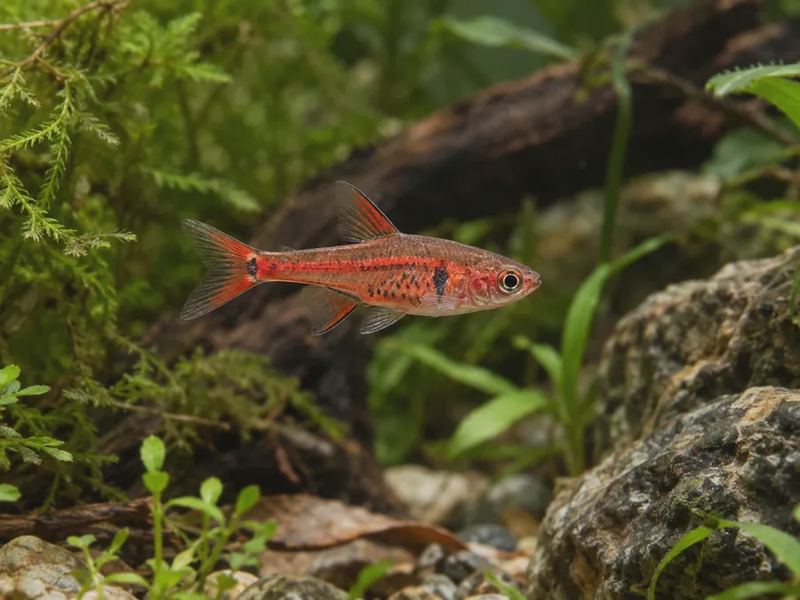
Boraras brigittae, universally known in the aquarium trade as the chili rasbora (also marketed as the mosquito rasbora), is one of the smallest and most striking cyprinids available to freshwater aquarists. It belongs to the family Cyprinidae — the largest family of freshwater fishes — within the order Cypriniformes, and sits in the genus Boraras, a small assemblage of miniature rasboras native to Southeast Asia. The species was scientifically described by the Dutch ichthyologist Maurice Kottelat in 1991, who named it in honor of his wife, Brigitte. Prior to formal description, fish matching this species were occasionally exported under the name Rasbora urophthalma or confused with its close relative Boraras maculatus, the dwarf rasbora. The genus Boraras is distinguished from the larger, more familiar Rasbora genus by a combination of osteological characters and its dramatically reduced adult size, and the name itself is an anagram of "Rasbora."
The natural range of Boraras brigittae is restricted to southern Borneo, Indonesia, where it occurs in the peat swamp forests and associated blackwater streams of Kalimantan, particularly in the southern regions near the Barito River basin. These habitats are among the most chemically distinctive freshwater environments on Earth. They are characterized by water that is stained a deep tea or cola color by dissolved humic acids and tannins leached from decaying leaf litter, with very low mineral content, low pH values that can dip below 5.0 in the wild, and minimal light penetration through the forest canopy. The substrate is typically soft mud, silt, and accumulated organic detritus, and the water is often sluggish or nearly still, with dense marginal vegetation and submerged root systems providing cover. Understanding this habitat is the single most important key to keeping the species well in captivity, because virtually every husbandry requirement — soft acidic water, dim lighting, abundant botanicals, and gentle flow — is a direct reflection of the blackwater swamp it evolved in.
Appearance & Size
The chili rasbora is a genuinely tiny fish, and this is central to both its appeal and its care requirements. Adults typically reach only 15 to 20 millimeters (roughly 0.6 to 0.8 inches) in standard length, with well-conditioned females occasionally approaching 22 millimeters. It is frequently cited as one of the smallest freshwater aquarium fishes in the hobby, rivaled only by a handful of other miniature cyprinids and the smallest killifish. Because of this diminutive size, a group of these fish can be maintained comfortably in volumes that would be hopelessly inadequate for almost any other schooling species.
In coloration, Boraras brigittae is spectacular relative to its size. The body is slender and laterally compressed, with a translucent, pale orange-to-pinkish base coloration. Running horizontally along the flank is a broad, dark, often reddish-brown to blackish stripe that extends from behind the eye toward the caudal peduncle, where it terminates in a distinct dark blotch. Above and around this stripe, mature males develop intense, saturated red-to-crimson pigmentation, particularly on the anterior body and around the eye, giving rise to the "chili" common name. The fins are largely transparent to faintly red, and the anal and caudal fins frequently carry red or orange hues in males. Females are generally rounder in the belly, slightly larger when gravid, and noticeably less colorful, with paler red tones and a more subdued overall appearance. Males also tend to have a more slender, streamlined profile and more sharply defined dark markings. As with many blackwater cyprinids, the fish's colors intensify when kept in soft, acidic, tannin-rich water under subdued lighting and when fed a varied, live-heavy diet; conversely, fish maintained in hard, bright, barren conditions often look washed out and pale.
Diet & Feeding
In the wild, Boraras brigittae is a micropredator and opportunistic forager that feeds on tiny aquatic invertebrates, insect larvae, microcrustaceans, and other minute organisms it encounters among leaf litter, roots, and vegetation. Its small mouth and reduced body size mean it cannot handle large food items, and its natural diet is composed almost entirely of very small prey. Replicating this in captivity is straightforward but requires attention to particle size and variety.
In the aquarium, chili rasboras readily accept a range of foods provided they are small enough. High-quality micro-pellets and finely crushed flake foods form a practical staple, but the species truly thrives when offered regular feedings of live or frozen fare such as Artemia nauplii, microworms, vinegar eels, Daphnia, moina, and cyclops. Live foods are especially valuable for conditioning fish prior to spawning and for maintaining the vivid red coloration that makes the species so desirable. Because the fish are timid and slow to compete, food should be delivered in small amounts several times daily rather than in a single large feeding, and care should be taken that more boisterous tankmates do not monopolize the food supply. A varied diet also reduces the risk of nutritional deficiencies, which in miniature cyprinids can manifest as faded color, lethargy, and increased susceptibility to disease. Overfeeding is a common error; uneaten food in a small, soft-water aquarium can foul the water quickly, so portions should be sized to be consumed within a minute or two.
Aquarium Setup
Setting up an aquarium for Boraras brigittae is less about providing a large volume and more about recreating the conditions of a shaded blackwater stream. A tank of 10 to 20 US gallons (roughly 38 to 76 liters) is more than sufficient for a group of eight to twelve fish, and even a well-maintained 5-gallon nano aquarium can work for a small shoal provided the keeper is diligent about water quality. Because these fish are schooling by nature, they should never be kept singly or in pairs; groups of at least eight, and preferably ten to fifteen or more, produce more natural behavior, reduce stress, and encourage males to display their best coloration. In a larger group, aggression and skittishness are distributed among many individuals, and the shoal becomes a genuinely captivating centerpiece.
The substrate should be dark and soft — a fine black or dark-brown sand, or an aquasoil designed for planted tanks, works well. A dark substrate not only mimics the muddy, leaf-littered floor of the natural habitat but also enhances the fish's red pigmentation by providing contrast. Driftwood, particularly Malaysian driftwood or similar pieces, is highly recommended; it leaches tannins, provides surfaces for biofilm, and creates the structural complexity these fish appreciate. Dried Indian almond leaves, alder cones, and other botanical additions are excellent for replicating blackwater conditions and are actively grazed by the fish and their associated microfauna.
Planting should be dense, with both rooted and floating species. Floating plants such as Salvinia, Pistia, or duckweed are especially valuable because they diffuse overhead light and create the shaded, dappled environment the species prefers. Among rooted plants, fine-leaved species like Taxiphyllum mosses, Cryptocoryne species, and small Bucephalandra work well, as do stem plants that tolerate soft, acidic water. Lighting should be moderate to low; intense, bright lighting tends to wash out coloration and can stress the fish, and it also encourages algae in the nutrient-poor, tannin-stained water these fish do best in. Filtration should be gentle. A small sponge filter driven by an air pump, or a low-flow internal filter, provides adequate biological filtration without creating strong currents that exhaust these weak-swimming fish. The tank should be well-covered, as the species can jump, particularly when startled or during spawning activity.
Water Parameters
Water chemistry is where chili rasbora care most often goes wrong, and it is also where the species rewards careful attention most dramatically. Boraras brigittae is a blackwater specialist adapted to extremely soft, acidic, mineral-poor conditions. While captive-bred specimens are often somewhat more tolerant than wild-caught fish, they still do best in water that approximates their natural environment. Hard, alkaline water is poorly tolerated over the long term and is associated with faded coloration, reduced appetite, and increased susceptibility to disease. The table below summarizes the recommended parameters for the species.
| Parameter | Recommended Range | Notes |
|---|---|---|
| Temperature | 20–28 °C (68–82 °F) | 24–26 °C (75–79 °F) is ideal for most setups |
| pH | 4.0–7.0 | 5.0–6.5 is optimal; avoid sustained values above 7.0 |
| General Hardness (GH) | 1–8 dGH | Very soft water preferred; 2–5 dGH is ideal |
| Carbonate Hardness (KH) | 0–4 dKH | Near-zero KH helps stabilize low pH |
| Total Dissolved Solids (TDS) | 30–150 ppm | Lower values more closely mimic wild blackwater |
| Nitrate (NO₃) | < 20 ppm | Keep as low as possible; sensitive to accumulation |
Achieving these parameters usually requires the use of reverse osmosis (RO) or rainwater as a base, remineralized only lightly if at all, combined with botanical additions such as Indian almond leaves, alder cones, or commercial blackwater extracts to lower pH and introduce tannins. Kepers in areas with naturally soft, acidic tap water may be able to use it directly, but hard tap water should always be treated or blended. Stability matters as much as absolute values; sudden swings in pH or temperature are more dangerous to these fish than a slightly imperfect but consistent reading. Regular partial water changes of 20 to 30 percent weekly, using water matched in temperature and chemistry to the tank, help maintain quality without shocking the fish.
Behavior & Compatibility
In the aquarium, Boraras brigittae is a peaceful, active, and mildly shoaling species. Unlike some rasboras that form tight, coordinated schools, chili rasboras tend to spread out loosely while still maintaining visual contact with one another, and males frequently spar and display by flaring their fins and intensifying their red coloration. These displays are almost always harmless and are one of the pleasures of keeping the species in a well-conditioned group. The fish are midwater to upper-water inhabitants, though they will readily explore plant cover and root structures, and they are generally bold once settled, though they can be shy in bare or brightly lit tanks.
Because of their extremely small size, chili rasboras are vulnerable to predation and should only be housed with tankmates that cannot swallow them. Suitable companions include other small, peaceful schooling species such as Boraras maculatus, Boraras merah, and Boraras urophthalmoides; small rasboras like Trigonostigma species; peaceful dwarf cichlids such as Apistogramma and Dicrossus; small catfish including Corydoras and Otocinclus; and peaceful anabantoids such as sparkling gouramis (Trichopsis pumila) and wild-type bettas. Invertebrates like Neocaridina and Caridina shrimp are excellent companions, as are small snails, and the species is often kept in planted shrimp tanks for exactly this reason. Fish to avoid include anything large enough to eat them, as well as boisterous or nippy species such as many barbs, larger tetras, and aggressive cichlids. Even seemingly peaceful medium-sized fish can intimidate chili rasboras into hiding, so tankmate selection should err on the side of caution.
Breeding
Boraras brigittae is an egg-scattering cyprinid that spawns without parental care, and it can be bred in captivity with some planning and patience. The species is not particularly difficult to condition, but raising the fry presents the real challenge because of their minuscule size. A dedicated spawning setup is usually the most reliable approach. A small tank of 5 to 10 gallons, furnished with fine-leaved plants such as Java moss or spawning mops, soft acidic water, and a gentle sponge filter, provides suitable conditions. A dark substrate or bare bottom makes it easier to see eggs and fry, and a layer of marbles or dense moss can help protect eggs from being eaten by the adults, which will readily consume their own spawn.
Conditioning begins with heavy feeding of live and frozen foods over one to two weeks, which brings females into spawning condition — a gravid female will appear noticeably plumper and rounder. A slight drop in temperature and a partial water change with slightly cooler, very soft water often triggers spawning, mimicking the onset of the rainy season in the wild. During spawning, males chase females through fine vegetation, and eggs are scattered among plants and moss, where they adhere loosely. Adults should be removed after spawning to prevent predation on the eggs. Eggs typically hatch within 24 to 48 hours depending on temperature, and the fry are extremely small — among the smallest of any commonly bred aquarium fish — requiring infusoria, green water, or specialized liquid fry foods for the first days, progressing to microworms and Artemia nauplii as they grow. Growth is slow, and fry may take several weeks to reach a size at which they can be safely maintained with adults. Because of the difficulty of raising the fry, captive-bred chili rasboras are less commonly produced on a commercial scale than wild-caught or farmed imports, though dedicated hobbyists breed them regularly.
Common Diseases & Health
Chili rasboras are generally hardy when kept in appropriate water, but their small size and sensitivity to poor conditions make prevention far more important than treatment. The most common health problems are those associated with stress and suboptimal husbandry: Ichthyophthirius multifiliis (ich), velvet (Oodinium), fin rot, and internal parasites. Ich and velvet are especially dangerous to small fish because the parasite burden relative to body mass is high, and infestations can progress rapidly. Introducing new fish without quarantine is a frequent cause of outbreaks, so a two- to four-week quarantine period for all new arrivals is strongly recommended. Many of the medications used to treat these diseases are harsh on soft-water fish and can disrupt biological filtration, so treatment should be undertaken carefully, with attention to water quality and temperature throughout.
Because chili rasboras are sensitive to water chemistry, sudden changes in pH, hardness, or temperature can cause osmotic stress and open the door to disease. New fish should be drip-acclimated slowly, particularly if they have been shipped or kept in different water. Maintaining stable, soft, acidic conditions, performing regular partial water changes, avoiding overfeeding, and providing a varied diet are the most effective health measures. It is also worth noting that these fish are small enough that a single missed water change or a spike in ammonia can have outsized effects, so routine testing of ammonia, nitrite, and nitrate is advisable, especially in smaller aquariums. When kept well, chili rasboras are long-lived for their size, with reports of healthy individuals living three to five years or more.
FAQs
How many chili rasboras should I keep together?
A minimum of eight is generally recommended, and a group of ten to fifteen or more is better. These are shoaling fish, and larger groups reduce stress, encourage natural behavior, and bring out the best coloration in males. A small group in a 10-gallon tank is a classic and highly effective setup.
Can chili rasboras live in a nano tank?
Yes — they are among the best fish for nano aquariums precisely because of their tiny size. A well-maintained 5- to 10-gallon tank with soft, acidic water, gentle filtration, and dense planting can house a small group comfortably. The main caveat is that water parameters in small volumes can shift quickly, so diligent maintenance is essential.
Do chili rasboras need blackwater conditions?
They do not strictly require blackwater, and captive-bred fish often adapt to a range of soft, slightly acidic conditions. However, they look and feel their best in water that mimics their natural habitat: soft, acidic, tannin-rich, and dimly lit. Botanical additions such as Indian almond leaves are a simple way to approximate this environment.
What tankmates are safe for chili rasboras?
Any fish small and peaceful enough not to eat them. Good choices include other Boraras species, small rasboras, Corydoras, Otocinclus, sparkling gouramis, wild-type bettas, and dwarf cichlids such as Apistogramma. Avoid large, boisterous, or predatory fish, and remember that a fish only slightly larger than the rasbora may still attempt to eat it.