
Cyprinus carpio: Koi Biology and Pond Husbandry
Species Overview
The common carp, Cyprinus carpio, is one of the most historically significant and widely distributed freshwater fish species on Earth. While the term “koi” in the aquarium trade specifically refers to the ornamental, selectively bred varieties of this species—collectively known as Nishikigoi in Japanese, meaning “brocaded carp”—the wild progenitor remains a robust, adaptable cyprinid native to the Black, Caspian, and Aral Sea drainages of Eurasia. Specifically, the natural range extends from the Danube River basin in Eastern Europe eastward through the rivers of Ukraine, Russia, and into the Amur River system along the Sino-Russian border. The species was first formally described by Carl Linnaeus in his 1758 Systema Naturae, though archaeological evidence suggests humans were already managing carp populations in China as early as the 5th millennium BCE, making Cyprinus carpio one of the oldest domesticated fish species in recorded history.
Wild carp inhabit slow-moving, turbid, warm-water rivers, floodplain lakes, and brackish estuaries, preferring soft, muddy substrates where they can root for benthic invertebrates. They are exceptionally tolerant of low oxygen conditions and can survive in waters that would stress most other cyprinids, thanks to their ability to gulp atmospheric air at the surface when dissolved oxygen drops critically low. The ornamental koi varieties we recognize today—including Kohaku (white and red), Taisho Sanke (white, red, and black), and Showa Sanshoku (black with red and white)—originated in the Niigata prefecture of Japan during the 19th century, where rice farmers in the mountains of Honshu began selecting natural color mutations from their food carp stocks. By the early 20th century, these colorful mutations were stabilized into distinct breeds, and the global ornamental trade in koi was born. Today, Cyprinus carpio exists in three broad forms: the wild river carp, the semi-domesticated “mirror” and “leather” carp bred for European aquaculture, and the highly ornamental Japanese koi that commands premium prices in the aquarium and water garden industry.
From an ecological and evolutionary standpoint, Cyprinus carpio is a remarkably successful invasive species, having been introduced to every continent except Antarctica. Its hardiness, omnivorous feeding habits, and high fecundity—a single large female can release over one million eggs in a single spawning season—have allowed feral populations to establish in North America, Australia, New Zealand, and much of Africa, often with detrimental effects on native aquatic vegetation and turbidity levels. For the aquarist, however, the koi represents a unique commitment: these are not typical aquarium fish but rather pond-dwelling giants that require extensive filtration, substantial water volume, and years of patient husbandry to reach their full potential of size, color, and pattern development.
Appearance & Size
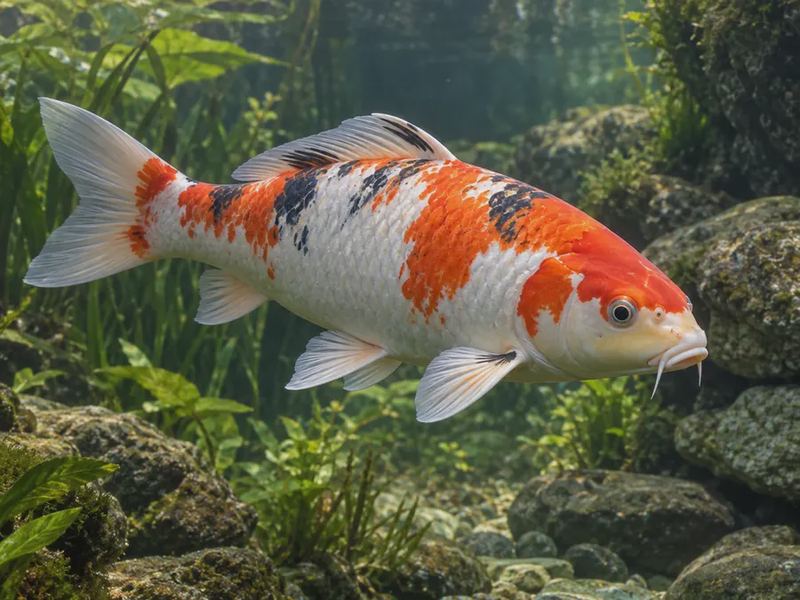
The physical appearance of Cyprinus carpio varies dramatically between its wild form and the numerous ornamental koi varieties. Wild carp are typically olive-brown to bronze on the dorsal surface, fading to a pale yellow or white belly, with large, thick scales arranged in a regular pattern that provides armor-like protection. They possess two barbels on each side of the upper jaw—a pair of long, fleshy maxillary barbels and a shorter pair of rostral barbels—which are chemosensory organs used to locate food in murky substrates. These barbels are a key distinguishing feature separating carp from goldfish (Carassius auratus), which lack them entirely. The body is deep and laterally compressed, with a long dorsal fin containing 17-21 soft rays and a slightly concave caudal fin. The mouth is protractile and downward-facing, an adaptation for bottom feeding that allows the fish to extend its jaws forward to suction prey from soft sediment.
Ornamental koi varieties exhibit a staggering range of color patterns, scale types, and fin morphologies. Standard koi have large, overlapping scales similar to the wild type, but selectively bred lines include the “Doitsu” (German) scale pattern, which features a single row of large scales along the lateral line and dorsal ridge, with the rest of the body completely bare. Color patterns are classified into over 20 recognized varieties by Japanese koi associations, with the most prized individuals displaying crisp white bases (Shiroji), deep crimson red (Beni), and jet black (Sumi) that is dense and evenly distributed. Some varieties, such as the Ogon, are solid metallic gold or platinum, resulting from a recessive gene that produces guanine-rich iridophores in the skin. The Gin Rin (diamond) scale type adds a shimmering, glittering effect to any base color, while the Hikari Muji varieties display a metallic sheen across the entire body. Butterfly koi, also known as Dragon carp, possess long, flowing pectoral and caudal fins that trail elegantly in the water, though this trait is considered a hybrid influence from wild Indonesian long-finned carp and is not recognized in traditional Japanese koi standards.
Size is where Cyprinus carpio truly distinguishes itself from typical aquarium fish. In a well-maintained pond with adequate nutrition and space, koi will readily reach 24-30 inches (60-75 cm) within five to seven years, and exceptional specimens in large, deep mud-bottom ponds can exceed 36 inches (90 cm) and weigh over 40 pounds (18 kg). The world record for a koi, a specimen named “Big Girl” owned by a UK collector, exceeded 48 inches (122 cm) in length. Wild carp are equally large, with the all-tackle angling record exceeding 75 pounds (34 kg). Growth rate is directly proportional to water temperature, food availability, and pond volume; a koi kept in a 50-gallon aquarium will likely remain stunted at 10-12 inches due to chronic stress and elevated growth-inhibiting hormones (somatostatin) released into the water, whereas the same genetic stock in a 10,000-gallon pond will grow three times as large. This growth plasticity is crucial for prospective keepers to understand: koi are not fish that can be “scaled down” to aquarium life without severe welfare compromise.
Diet & Feeding
Cyprinus carpio is a true omnivore with a strong benthic feeding bias. In the wild, its diet consists primarily of aquatic insect larvae (especially chironomid midges and mayfly nymphs), crustaceans such as Daphnia and Cyclops, mollusks, and annelid worms. They also consume substantial plant matter, including soft aquatic vegetation, algae, and seeds that fall into the water. The carp’s pharyngeal teeth—a set of robust, molariform teeth located in the throat—are perfectly adapted for crushing the shells of snails and mussels, allowing this species to exploit a food source many other fish cannot access. Wild carp will also ingest significant quantities of detritus and sediment, extracting organic nutrients from decomposing material in the substrate.
For ornamental koi, a high-quality commercial diet should form the staple of nutrition. Premium koi foods are typically floating pellets with a protein content of 30-40%, derived from fish meal, squid meal, wheat germ, and spirulina. The protein requirement varies seasonally: during the warm summer months when water temperatures exceed 68°F (20°C), koi require higher protein to support growth and tissue repair, while in cooler spring and autumn periods, a lower-protein, wheat-germ-based food is recommended to aid digestibility at reduced metabolic rates. Feeding should cease entirely when water temperatures drop below 50°F (10°C), as the fish’s digestive enzymes become inactive and undigested food will putrefy in the gut, potentially causing fatal bacterial infections. A useful guideline is to feed only as much as the fish can consume within two to three minutes, once or twice daily during active growth periods.
Supplementation with fresh foods can enhance color, immune function, and natural foraging behavior. Chopped earthworms, bloodworms (frozen or live Chironomus larvae), shelled peas, blanched spinach, and orange segments are all readily accepted and provide vitamins and carotenoids that enhance red and orange pigmentation. However, keepers must exercise caution with high-protein animal foods like beef heart or raw shrimp, as these are difficult for carp to metabolize and can lead to fatty liver disease. Koi lack a true stomach; food passes directly from the esophagus to the intestine, so they require frequent, small meals rather than large infrequent ones. This anatomical limitation also means that feeding a single large meal after a period of fasting can cause intestinal blockage and osmotic stress. In outdoor ponds, koi will also graze on natural algae growth, mosquito larvae, and fallen insects, contributing a supplemental portion of their diet that cannot be fully replicated indoors.
Aquarium Setup
It must be stated unequivocally at the outset: Cyprinus carpio (koi) is not an appropriate species for a standard indoor aquarium. Their massive adult size, high waste production, and requirement for cool, highly oxygenated water make them fundamentally unsuited to glass tanks. The minimum viable indoor enclosure for a single juvenile koi is a 300-gallon (1,136-liter) stock tank or large fiberglass vat, and even this is only temporary housing for the first year or two of life. For long-term indoor maintenance, a minimum of 1,000-1,500 gallons is required for a small group, with a depth of at least 4 feet (1.2 meters) to allow proper swimming depth and thermal stratification. Realistically, koi are pond fish, and the vast majority of responsible keepers house them in outdoor earthen or lined ponds of 2,000 gallons or more.
If an indoor setup is unavoidable—for quarantine, overwintering in very cold climates, or raising juvenile stock—the system must be designed with koi specifically in mind. Substrate should be either bare fiberglass, epoxy-coated concrete, or very large, smooth river cobbles that cannot be ingested; fine gravel or sand will be constantly disturbed by rooting behavior and will clog mechanical filtration. The pond or tank benefits from zero substrate entirely, as this simplifies waste removal. Live plants are generally impossible to maintain with koi, as they will be uprooted, eaten, or shredded within days. Instead, provide robust artificial plants or no plants at all, focusing on open swimming space. Lighting should be moderate, with shaded areas provided by floating cover or a partially covered section, as koi can develop sunburn on their unpigmented white areas if exposed to intense direct sunlight in shallow water.
Filtration is the single most critical component of any koi system. These fish produce prodigious amounts of ammonia and solid waste—a single 24-inch koi can produce over 1 gram of ammonia per day. A combination of mechanical filtration (settlement chambers, bead filters, or vortex separators) to remove solids and biological filtration (moving bed biofilters, trickle towers, or wet/dry filters) to convert ammonia to nitrite and then nitrate is essential. The biological filter media must provide a surface area of at least 100 square feet per pound of daily feed. Water movement should be vigorous but not turbulent; koi appreciate a moderate current that exercises their muscles but does not cause constant stress. Aeration is crucial, as koi require dissolved oxygen levels above 6 mg/L, and their high metabolic rate at warm temperatures can quickly deplete oxygen in under-filtered systems. In an outdoor pond, a bottom drain connected to a settlement chamber is the gold standard for solids removal, replicating the natural habitat’s clean, soft-bottomed environment.
Water Parameters
Cyprinus carpio is renowned for its environmental tolerance, but this hardiness should not be mistaken for an invitation to neglect water quality. In their native Eurasian habitats, carp experience dramatic seasonal temperature swings, from near-freezing winter conditions under ice to warm summer waters exceeding 86°F (30°C). This eurythermal capacity means koi can survive a wide temperature range, but their optimal growth and immune function occur between 65°F and 75°F (18-24°C). Prolonged exposure to temperatures above 82°F (28°C) increases metabolic demand, reduces dissolved oxygen carrying capacity, and can trigger stress-related diseases. Conversely, koi can tolerate temperatures down to 34°F (1°C) in winter when they enter a torpid state, ceasing feeding and reducing their metabolic rate to near zero, provided the pond does not freeze solid and a hole is maintained for gas exchange.
Water chemistry for koi is characterized by a preference for moderately hard, alkaline water, reflecting their natural floodplain habitats where limestone and mineral-rich sediments buffer the water. The pH should remain stable between 7.0 and 8.5, with a carbonate hardness (KH) of at least 80-120 ppm to buffer against pH crashes caused by the nitrification process. General hardness (GH) of 100-200 ppm is acceptable, as koi require calcium and magnesium ions for osmoregulation and scale development. Ammonia and nitrite must be maintained at 0 ppm at all times; while koi show some tolerance to low levels of these compounds (up to 0.5 ppm ammonia and 1.0 ppm nitrite for short periods), chronic exposure damages gill tissue and suppresses the immune system. Nitrate should be kept below 40 ppm through regular water changes of 10-20% weekly in indoor systems, or through adequate biological denitrification in well-established ponds with heavy plant filtration in separate bog areas.
| Parameter | Optimal Range | Acceptable Range | Critical Level |
|---|---|---|---|
| Temperature (°F) | 65-75 | 40-82 | <34 or >86 |
| Temperature (°C) | 18-24 | 4-28 | <1 or >30 |
| pH | 7.2-7.8 | 7.0-8.5 | <6.5 or >9.0 |
| Carbonate Hardness (KH) | 80-120 ppm | 60-200 ppm | <50 ppm |
| General Hardness (GH) | 100-150 ppm | 50-300 ppm | <30 ppm |
| Ammonia (NH3) | 0 ppm | 0-0.25 ppm | >0.5 ppm |
| Nitrite (NO2) | 0 ppm | 0-0.5 ppm | >1.0 ppm |
| Nitrate (NO3) | <20 ppm | <40 ppm | >80 ppm |
| Dissolved Oxygen | 7-10 mg/L | 5-12 mg/L | <4 mg/L |
Behavior & Compatibility
Cyprinus carpio is a highly social, gregarious species that thrives in groups. In the wild, carp form loose shoals that aggregate in warm, shallow feeding areas, with a clear dominance hierarchy established through size and aggression. Koi retain this social nature, and keeping them singly often leads to lethargy, reduced feeding, and chronic stress. A group of at least three to five individuals is recommended, as this allows natural shoaling behavior and reduces bullying. Koi are generally peaceful toward other fish species, showing no predatory aggression, but their sheer size and bottom-rooting activity can be disruptive to smaller or more delicate tankmates. They are also surprisingly intelligent, capable of recognizing individual human caretakers, learning feeding times, and even being trained to eat from the hand.
Compatibility in a koi pond is limited by environmental requirements rather than aggression. Suitable tankmates include other large, cool-water cyprinids such as goldfish (Carassius auratus)—particularly the hardier single-tailed varieties like common and comet goldfish—and orfe (Leuciscus idus), which occupy the upper water column and do not compete for benthic food. Sterlet sturgeon (Acipenser ruthenus) are sometimes kept with koi in very large ponds, as they occupy a different feeding niche (bottom-dwelling, sucking invertebrates), but they require even higher oxygen levels and cooler water than koi, making them a demanding addition. Small fish such as minnows, danios, or tetras should be avoided, as they will be stressed by the constant rooting behavior and may be accidentally ingested while koi feed on the substrate. Invertebrates are not viable tankmates; any snails, crayfish, or freshwater shrimp will be systematically consumed.
Behavioral considerations include the koi’s strong tendency to uproot plants, disturb fine substrates, and create turbidity in ponds without adequate filtration. They are also jumpers, particularly when startled or when water quality deteriorates, so any enclosure must have a secure net or raised sides. During spawning season (spring to early summer in temperate climates), male koi will actively chase females, which can cause physical damage and stress to the female; providing dense cover or separating sexes during this period is sometimes necessary. Koi exhibit a clear diurnal rhythm, being most active during daylight hours and resting near the bottom or in shaded areas at night. They are also known to be temperature-sensitive in their behavior, becoming increasingly torpid below 50°F (10°C) and refusing food entirely below 45°F (7°C), which is normal and not a sign of illness.
Breeding
Breeding Cyprinus carpio in captivity is entirely feasible but requires substantial space and a deliberate approach to water temperature manipulation. In their natural environment, carp spawn in late spring to early summer when water temperatures rise above 60°F (16°C) and day length increases. The trigger for spawning is a rapid temperature rise of 5-10°F (3-6°C) following a period of cooler weather, often accompanied by rainfall. In outdoor ponds, this naturally occurs in late May or June in the Northern Hemisphere. In indoor systems, breeders simulate this by gradually warming the water over several days and then performing a large cool water change to mimic a spring rain event.
Sexual dimorphism in koi is subtle until breeding season approaches. Females develop a noticeably fuller, rounder body profile, particularly in the abdominal region, as their ovaries swell with eggs. Males develop small, white, sandpaper-like tubercles on their pectoral fins, gill plates, and sometimes the head—these breeding stars are used to stimulate the female during spawning. Males also become more slender and actively pursue females, often butting them in the flanks and abdomen to encourage egg release. A mature female koi can produce anywhere from 100,000 to 400,000 eggs per spawning, depending on her size, but in a controlled pond setting, a realistic yield is 20,000-50,000 viable fry from a single high-quality pair.
The actual spawning act is vigorous and can last several hours. The male chases the female into shallow, vegetated areas, where she releases adhesive eggs that stick to aquatic plants, spawning mops (bundles of synthetic yarn), or specially placed nylon brush mats. The male simultaneously releases milt (sperm) into the water, fertilizing the eggs externally. After spawning, the adult fish must be removed immediately, as they will consume the eggs and fry voraciously. The eggs hatch in 3-7 days, depending on temperature (faster at warmer temperatures), and the fry are free-swimming after another 3-5 days once they absorb their yolk sacs. Fry require infusoria or commercially available powdered fry food for the first week, graduating to newly hatched brine shrimp (Artemia nauplii) and finely crushed flake food thereafter. Rearing koi fry to selectable size (2-3 inches) takes 4-6 months, and color development begins at 2-3 months, with culling of inferior color patterns being an essential, if difficult, part of producing show-quality koi.
Common Diseases & Health
Koi are susceptible to a range of infectious diseases, many of which are exacerbated by poor water quality, temperature stress, or overcrowding. The most notorious viral pathogen is Koi Herpesvirus (KHV), also known as Cyprinid herpesvirus-3 (CyHV-3). This highly contagious virus causes high mortality (80-100%) in susceptible populations, particularly at water temperatures between 72°F and 82°F (22-28°C). Clinical signs include lethargy, gasping at the surface, patchy necrosis on the gills, and a rough, sandpaper-like texture to the skin. Infected fish may also show sunken eyes and white or red patches on the body. There is no effective treatment; quarantine of new fish for 30-45 days at temperatures above 72°F is the only reliable prevention. Survivors of KHV become lifelong carriers and can shed the virus intermittently under stress.
Bacterial infections are common secondary invaders following physical injury or parasitic damage. Aeromonas hydrophila and Pseudomonas fluorescens cause ulcerative lesions, fin rot, and septicemia, often presenting as red, raised sores that progress to deep ulcers. Columnaris disease, caused by Flavobacterium columnare, manifests as grayish-white, cottony patches on the skin, gills, and mouth, frequently appearing after handling or in warm, organically rich water. Parasitic infections include Ichthyophthirius multifiliis (white spot disease or “ich”), which presents as tiny white grains on the fins and body; Costia (Ichthyobodo necator), which causes excessive mucus production and flashing; and gill flukes (Dactylogyrus species) and skin flukes (Gyrodactylus species), which cause respiratory distress and rubbing against surfaces. Argulus (fish lice) and Lernaea (anchor worms) are larger crustacean parasites visible to the naked eye.
Preventative health management is paramount for koi. Quarantine all new arrivals for a minimum of 4 weeks, ideally with a prophylactic freshwater dip and examination for external parasites. Maintain water quality within the parameters listed above, avoiding rapid temperature fluctuations and ammonia spikes. A balanced diet with supplemental vitamins (especially vitamin C and E) supports immune function. Annual health assessments, including gill biopsies and skin scrapes, are recommended for serious pond keepers. Swim bladder disorders, often caused by overfeeding or poor diet, present as buoyancy problems (floating upside down or struggling to descend); treatment involves fasting, raising water temperature slightly, and feeding a low-protein, easily digestible diet. Spring and autumn are high-risk periods for disease outbreaks due to temperature instability, so reduce feeding during these transitions and monitor fish closely for signs of lethargy, clamped fins, or abnormal swimming.
FAQs
Q: Can I keep a single koi in a 50-gallon aquarium?
A: Absolutely not. While a juvenile koi of 3-4 inches may fit initially, this species grows rapidly to 24-36 inches and produces enormous amounts of waste. A 50-gallon aquarium will stunt its growth, suppress its immune system, and lead to premature death from organ failure or ammonia toxicity. Koi require a minimum of 250 gallons per fish, and even then, only as temporary housing. For any long-term commitment, an outdoor pond of at least 1,000 gallons is the ethical minimum for a small group.
Q: How long do koi live, and what is their maximum size?
A: With proper care, koi are exceptionally long-lived fish, with lifespans of 25-35 years being common, and well-documented individuals exceeding 50 years. The oldest recorded koi, a scarlet female named Hanako, lived to be 226 years old according to scale-ring analysis performed in 1966. Maximum size depends on genetics and pond volume; in large, deep ponds with excellent water quality, koi commonly reach 30 inches (75 cm) and can exceed 36 inches (90 cm) and 40 pounds (18 kg) after 15-20 years.
Q: Do koi need a heater in their pond during winter?
A: No, healthy koi are fully cold-hardy and can survive winter temperatures down to 34°F (1°C) as long as the pond is deep enough (at least 3-4 feet) to prevent complete freezing and a hole is maintained in the ice for gas exchange. A floating de-icer or small aerator at the surface is sufficient to keep an opening. Adding a heater is unnecessary and can disrupt their natural torpor, causing metabolic confusion. However, in climates where ponds freeze solid to the bottom, fish must be moved indoors to a heated tank.
Q: Why are my koi jumping out of the water?
A: Jumping is a natural behavior in Cyprinus carpio, often triggered by low dissolved oxygen, high ammonia or nitrite levels, parasite irritation (particularly gill flukes or Argulus), or sudden fright from predators or loud noises. If jumping becomes frequent, test water parameters immediately and inspect for parasites via skin scrape. Ensure the pond has adequate surface agitation and that no electrical currents are present in the water. A net or raised pond wall of at least 12 inches above water level is essential to prevent escape.