
Danio Rerio Zebrafish: Complete Care Guide
Species Overview
The zebrafish, Danio rerio, is arguably one of the most scientifically significant freshwater fish species on the planet, yet its importance in the aquarium hobby is often overshadowed by its immense contribution to biomedical research. First formally described by Francis Buchanan-Hamilton in 1822 under the name Danio rerio (with the genus later confirmed as Danio), this small cyprinid has a taxonomic history that includes a brief and confusing period where it was placed in the genus Brachydanio. The species belongs to the family Cyprinidae, the largest family of freshwater fishes, which includes carp, barbs, and danios. The genus name Danio is derived from the Bengali word "dhani," meaning "of the rice field," a direct reference to its native habitats. The specific epithet rerio is less clear but is thought to be a local Bengali name for the fish. The zebrafish was among the first fish species to be bred in captivity for scientific purposes, with early work at the University of Oregon in the 1970s establishing it as a model organism for vertebrate development. Today, it is one of the most widely used model organisms in genetics, neurobiology, and toxicology, with thousands of research papers published annually.
Geographically, Danio rerio is native to a broad but specific region of South Asia. Its natural range extends across the Ganges and Brahmaputra river basins, encompassing parts of northeastern India (particularly the states of West Bengal, Assam, and Meghalaya), Bangladesh, Nepal, and Bhutan. The species has also been reported from the Mahanadi River system in Odisha, India, and has been introduced to Colombia and parts of Southeast Asia for mosquito control purposes, though these introduced populations are not considered native. In its wild habitat, the zebrafish is a lowland species, typically found in slow-moving or still waters such as rice paddies, irrigation ditches, shallow ponds, and small streams with gentle current. Crucially, these habitats are often seasonal and ephemeral, with water levels fluctuating dramatically between the monsoon and dry seasons. The water in these environments is typically shallow, well-vegetated with submerged and emergent aquatic plants, and often turbid due to silt and organic matter. The substrate is predominantly soft mud, silt, or fine sand, with occasional patches of gravel. These waters are typically warm, ranging from 20°C to 29°C depending on the season, and are often slightly alkaline with a pH between 6.8 and 8.0. The zebrafish's adaptation to these dynamic, low-oxygen environments has made it remarkably resilient in captivity, a trait that has undoubtedly contributed to its popularity among both scientists and aquarists.
Appearance & Size
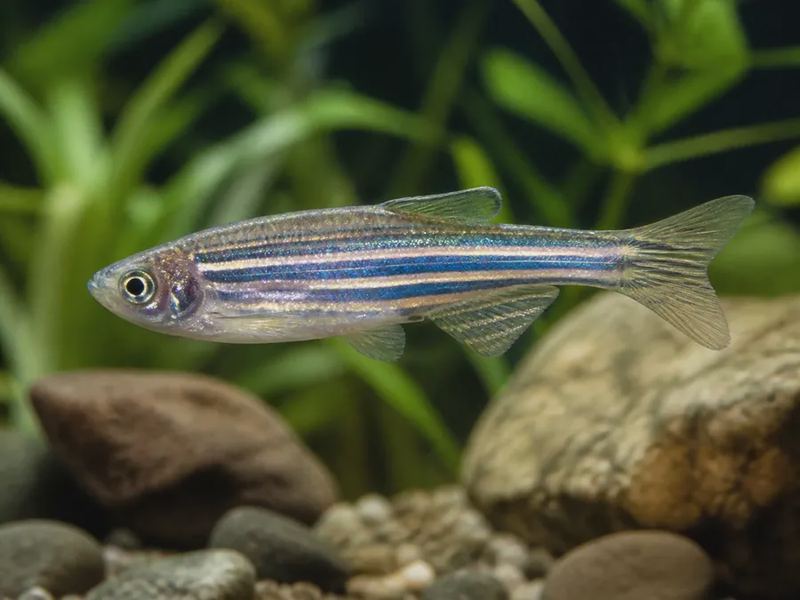
The wild-type zebrafish presents a striking and unmistakable appearance that has made it a favorite in the aquarium trade. The body is elongated, laterally compressed, and fusiform in shape, perfectly adapted for quick, darting movements through vegetated waters. The ground coloration is a pale, silvery-gold or olive-gold, which provides excellent camouflage in the sun-dappled, shallow waters of its native habitat. The most defining feature is the presence of five to seven horizontal, metallic-blue stripes that run the entire length of the body, from the gill cover to the caudal fin. These stripes are composed of specialized pigment cells called iridophores and melanophores, which create a shimmering, reflective quality. The stripes extend into the caudal fin, where they merge and fork, and also onto the anal fin. The dorsal fin is located approximately in the middle of the back and carries a single, dark stripe. The ventral side of the fish is a lighter, creamy white or pale yellow. Males and females exhibit subtle sexual dimorphism. Males are generally more slender, with a slightly more intense golden or yellow hue on the body, particularly on the belly, and their stripes are often more vivid and contrasting. Females, on the other hand, tend to be larger and deeper-bodied, with a more rounded, silver-white belly, especially when gravid with eggs. The anal fin of the male is also slightly more elongated and pointed than that of the female.
In terms of size, Danio rerio is a small fish, which further contributes to its suitability for both home aquaria and laboratory settings. The standard length (excluding the caudal fin) of a fully grown adult typically ranges from 3.5 to 4.5 centimeters (approximately 1.4 to 1.8 inches). Some exceptionally well-fed specimens in aquarium conditions may reach a total length of 5 centimeters (2 inches), but this is uncommon. They reach sexual maturity at approximately three months of age, at which point they are typically around 2.5 centimeters long. The growth rate is relatively rapid in the first few months, slowing considerably as they approach their maximum size. It is worth noting that there are now numerous selectively bred color morphs available in the aquarium trade, including the popular long-finned "veiltail" variety, the "leopard" pattern (which is actually a separate but closely related species, Danio nigrofasciatus, often sold under the same name), and the genetically modified GloFish varieties that express fluorescent proteins. However, the natural, wild-type appearance remains the most biologically accurate and, for many, the most aesthetically pleasing representation of this species.
Diet & Feeding
In its natural environment, Danio rerio is an opportunistic omnivore with a broad dietary repertoire. Stomach content analyses of wild-caught specimens have revealed a diet consisting primarily of small aquatic invertebrates, including mosquito larvae, small crustaceans such as copepods and cladocerans (water fleas), and insect larvae. They also consume terrestrial insects that fall onto the water's surface, as well as zooplankton, algae, and organic detritus. This dietary flexibility is a key adaptation to the seasonal and resource-variable environments they inhabit. They are primarily surface and mid-water feeders, using their upturned mouths to capture prey at the water's surface and in the water column. In the aquarium, this translates to a fish that is very easy to feed, accepting virtually all commercially available foods. However, to maintain optimal health, coloration, and breeding condition, a varied diet is essential. A high-quality flake food or micro-pellet should form the staple of their diet, as these are formulated to provide a balanced nutritional profile. This should be supplemented with live or frozen foods at least two to three times per week. Excellent choices include brine shrimp (Artemia), daphnia, bloodworms (Chironomid larvae), and grindal worms. These protein-rich foods are particularly important for conditioning breeding pairs and promoting rapid growth in juveniles.
When feeding Danio rerio, it is important to remember that they are small fish with small mouths and stomachs. They should be fed small amounts two to three times daily, offering only what they can consume within two to three minutes per feeding. Overfeeding is a common problem that leads to poor water quality and obesity, which can shorten their lifespan and reduce reproductive output. Because they are active, fast-swimming fish, they will readily dart to the surface to grab food, making them a delight to watch during feeding time. It is also beneficial to occasionally offer vegetable matter in the form of blanched spinach, zucchini, or spirulina-based flake foods to mimic their natural intake of algae and plant material. In a community tank, their speed and eagerness at feeding time can sometimes outcompete slower, more docile tankmates, so it is important to ensure that all fish in the aquarium receive adequate nutrition. For those interested in breeding zebrafish, a conditioning diet of live foods, particularly baby brine shrimp and microworms, is virtually indispensable for bringing adults into peak spawning condition.
Aquarium Setup
Setting up an aquarium for Danio rerio is a straightforward process, but replicating key aspects of their natural habitat will greatly enhance their health, coloration, and natural behavior. Due to their small size and active nature, a minimum tank size of 10 gallons (approximately 38 liters) is recommended for a small school of five to six fish. However, a 20-gallon long tank (75 liters) is far superior, as it provides the horizontal swimming space these fish naturally prefer. They are not particularly demanding regarding tank dimensions, but a longer footprint is always better than a tall one. The aquarium should be securely covered with a tight-fitting lid, as zebrafish are notorious jumpers, particularly when startled or during the early morning hours. The substrate should ideally be fine-grained, such as smooth sand or small, rounded gravel. In their native habitat, the bottom is typically soft mud or silt, so sharp, jagged gravel should be avoided as it can damage their delicate barbels. A dark substrate will help to make their metallic stripes stand out and will also make the fish feel more secure, as they are less visible to potential predators from above.
Live plants are highly recommended for a zebrafish aquarium, not only for aesthetic reasons but also for the functional benefits they provide. Dense planting, particularly in the background and along the sides, mimics their natural vegetated habitats and provides refuge and shade, which reduces stress. Hardy, undemanding species such as Java fern (Microsorum pteropus), Java moss (Taxiphyllum barbieri), Anubias, and various species of Cryptocoryne are excellent choices, as they tolerate the slightly alkaline water conditions that zebrafish prefer. Floating plants, such as Salvinia or water sprite (Ceratopteris thalictroides), are also beneficial, as they diffuse the light and provide cover, which can be particularly useful if you intend to breed them in the main tank. Lighting should be moderate; these fish are not light-sensitive, but they do not require intense lighting. A standard LED light on a timer for 8 to 10 hours per day is sufficient to support plant growth and establish a natural day-night cycle. Water movement should be gentle to moderate. While they are capable of swimming in stronger currents, they are not strong swimmers like riverine danios, and a gentle filter outflow or a small powerhead with a spray bar is ideal. A sponge filter or a hang-on-back filter with an adjustable flow rate is perfect, as it provides adequate biological filtration without creating a torrent.
Water Parameters
Maintaining stable and appropriate water parameters is critical for the long-term health and vitality of Danio rerio. As a species adapted to warm, shallow, and often stagnant waters, they are surprisingly tolerant of less-than-perfect water conditions, which is one of the reasons they are so widely used in laboratories. However, this tolerance should not be mistaken for a license to neglect water quality. Consistent, optimal parameters will result in brighter colors, more active behavior, and a greater likelihood of successful spawning. The ideal temperature range for zebrafish is between 22°C and 27°C (72°F to 80°F). They can survive at temperatures outside this range for short periods, but prolonged exposure to temperatures above 28°C (82°F) will increase their metabolic rate, shorten their lifespan, and reduce oxygen levels in the water, making them more susceptible to disease. Conversely, temperatures below 20°C (68°F) will slow their metabolism and make them lethargic and more prone to fungal infections. A reliable aquarium heater is recommended to maintain a stable temperature, particularly in cooler climates or rooms with fluctuating ambient temperatures.
Regarding water chemistry, zebrafish prefer slightly alkaline to neutral conditions. The pH should be maintained between 6.8 and 8.0, with a sweet spot around 7.0 to 7.5. They are not found in highly acidic blackwater environments, so pH levels below 6.5 should be avoided. General hardness (GH) and carbonate hardness (KH) should be moderate. A GH of 5 to 20 dGH (degrees of general hardness) is acceptable, and a KH of at least 3 to 5 dKH is recommended to provide buffering capacity and prevent pH crashes. They are not sensitive to hardness within these ranges, but very soft, acidic water can cause osmotic stress. As with all fish, ammonia and nitrite must be at 0 ppm, and nitrate should be kept below 20 ppm through regular water changes. A weekly water change of 25% to 30% is generally sufficient to maintain excellent water quality in a well-stocked tank. The table below summarizes the recommended water parameters.
| Parameter | Ideal Range | Acceptable Range |
|---|---|---|
| Temperature | 24°C - 26°C (75°F - 79°F) | 22°C - 27°C (72°F - 80°F) |
| pH | 7.0 - 7.5 | 6.8 - 8.0 |
| General Hardness (GH) | 8 - 12 dGH | 5 - 20 dGH |
| Carbonate Hardness (KH) | 4 - 6 dKH | 3 - 10 dKH |
| Ammonia (NH3) | 0 ppm | 0 ppm |
| Nitrite (NO2) | 0 ppm | 0 ppm |
| Nitrate (NO3) | < 20 ppm | < 40 ppm |
Behavior & Compatibility
Danio rerio is a highly social, shoaling species that thrives in the company of its own kind. In the wild, they form loose aggregations of varying sizes, and this social structure is essential for their well-being in captivity. Keeping zebrafish in groups of at least six individuals is mandatory; a smaller group will result in increased stress, which manifests as faded coloration, fin clamping, and a higher susceptibility to disease. In a larger group, a clear hierarchy often develops, but this is usually benign and does not result in serious aggression. They are a diurnal species, being most active during the day, and they spend the majority of their time swimming in the middle and upper water layers, constantly on the move in search of food. Their constant, darting activity can be mesmerizing to watch but may be too energetic for some slow-moving, sedate fish. They are generally a peaceful species and will not nip the fins of other fish, making them excellent community tank inhabitants.
When selecting tankmates, it is important to choose species that share similar water parameter requirements and are not so slow or long-finned that they become stressed by the zebrafish's relentless activity. Good tankmates include other small, fast-moving cyprinids such as cherry barbs (Puntius titteya), harlequin rasboras (Trigonostigma heteromorpha), and other danio species like pearl danios (Danio albolineatus). Peaceful bottom-dwellers such as corydoras catfish (Corydoras spp.) and small loaches like the kuhli loach (Pangio kuhlii) are also compatible, as they occupy a different vertical zone in the aquarium. Small, peaceful gouramis, such as honey gouramis (Trichogaster chuna), can also work, but should be observed carefully as they are much slower and may be outcompeted for food. It is best to avoid keeping zebrafish with large, predatory fish, which will view them as food, or with slow, long-finned fish like fancy guppies or angelfish, which may be stressed by the constant activity and could have their fins nipped out of sheer annoyance. Invertebrates such as cherry shrimp (Neocaridina davidi) and nerite snails are generally safe, although adult shrimp may be eaten if the zebrafish are hungry. The key to a successful community tank is to provide ample swimming space and visual breaks with plants and hardscape to allow all inhabitants to establish their own territories and retreat when needed.
Breeding
Breeding Danio rerio in the home aquarium is a highly rewarding and relatively straightforward endeavor, making it an ideal species for the novice breeder. They are continuous, non-seasonal spawners, meaning that under optimal conditions, they will spawn year-round. In the wild, spawning is typically triggered by the onset of the monsoon season, when rising water levels and cooler temperatures signal abundant food and suitable conditions for larval development. To induce spawning in captivity, you should first condition a group of adult fish with a high-quality diet rich in live and frozen foods for one to two weeks. It is best to set up a separate breeding tank, as adult zebrafish will readily consume their own eggs and fry. A small 5 or 10-gallon tank filled with shallow water (around 15-20 centimeters / 6-8 inches deep) is ideal. The water should be slightly cooler than their main tank, around 22°C to 24°C (72°F to 75°F), and slightly softer. The tank should be furnished with a spawning grid or a layer of large, smooth marbles at the bottom. This creates gaps into which the eggs can fall, rendering them inaccessible to the hungry parents. Alternatively, a dense clump of Java moss or a spawning mop can be used, which serves the same protective function.
To initiate breeding, place two or three males and one or two females (or a group of 6-8 fish with a ratio of 2:1 males to females) into the breeding tank in the evening. Spawning will typically occur at dawn the following morning. The males will actively court the females, swimming around them in circles and displaying their best coloration. The female will then lay a batch of 100 to 300 eggs, which the males will immediately fertilize. The eggs are non-adhesive and will sink to the bottom, falling through the marbles or into the moss. After spawning, which can last for an hour or two, the adult fish should be removed immediately to prevent them from eating the eggs. The eggs are extremely small, about 0.7 mm in diameter, and are nearly transparent. They are highly sensitive to light and should be kept in a dimly lit area. The eggs will hatch in approximately 48 to 72 hours, depending on the temperature. The newly hatched larvae are tiny, approximately 3 mm long, and will remain attached to the substrate or plants for the first few days, absorbing their yolk sac. After the yolk sac is fully absorbed, which takes about five days, the fry become free-swimming and must be fed. Their first food should be infusoria or a commercially available liquid fry food, followed by freshly hatched baby brine shrimp (Artemia nauplii) after a few days. The fry grow rapidly and can be moved to a larger grow-out tank once they are about 1 centimeter long.
Common Diseases & Health
While Danio rerio is a hardy species, they are not immune to disease, and their health can be compromised by poor water quality, stress, or the introduction of pathogens from new fish or plants. The most common health issues observed in aquarium zebrafish are largely preventable through diligent maintenance and quarantine procedures. One of the most frequently seen problems is ich, or white spot disease, caused by the ciliate parasite Ichthyophthirius multifiliis. This manifests as small, white, salt-like grains on the body and fins, accompanied by flashing (rubbing against objects) and lethargy. It is often triggered by a sudden drop in temperature. Treatment involves raising the water temperature gradually to 30°C (86°F) and using a commercial ich medication. Another common issue is fin rot, a bacterial infection that causes the fins to become ragged, discolored, and to disintegrate. Fin rot is almost always a secondary infection resulting from poor water quality or physical injury. The primary treatment is to improve water quality through more frequent water changes and to address the underlying stressor. In severe cases, an antibacterial medication may be necessary.
Zebrafish are also susceptible to various external parasites, including Oodinium (velvet disease), which appears as a fine, gold or rust-colored dust on the body, and skin flukes (monogeneans), which cause excessive mucus production and scratching. Both are treatable with appropriate antiparasitic medications. A more serious and often fatal disease is mycobacteriosis, or fish tuberculosis, caused by Mycobacterium species. This is a chronic, wasting disease that causes symptoms such as weight loss, lethargy, fin loss, and skin ulcers. It is highly contagious and difficult to treat, and affected fish should be euthanized to prevent the spread of the disease to other tank inhabitants. Importantly, mycobacteriosis is a zoonotic disease, meaning it can be transmitted to humans through open wounds, so extreme caution should be exercised when handling sick fish or cleaning the aquarium. To prevent the introduction of diseases, all new fish, plants, and invertebrates should be quarantined in a separate tank for a minimum of two to four weeks before being added to the main display. Maintaining stable water parameters, providing a varied and nutritious diet, and avoiding overcrowding are the most effective strategies for keeping zebrafish healthy and disease-free.
FAQs
1. How many zebrafish should I keep together?
You should keep a minimum of six zebrafish, but a group of eight to ten is even better. They are a highly social, shoaling species, and keeping them in insufficient numbers causes chronic stress, which weakens their immune system and makes them prone to disease. A larger group also displays more natural, fascinating behaviors, including shoaling cohesion and hierarchical interactions.
2. Are zebrafish suitable for a beginner aquarist?
Yes, absolutely. Their hardiness, tolerance of a range of water conditions, and undemanding dietary requirements make them an excellent choice for beginners. However, they are active swimmers and require a suitably sized tank (at least 10 gallons) and a secure lid to prevent jumping. Their ease of breeding also makes them a great first project for those interested in fish reproduction.
3. Can I keep zebrafish with bettas (Siamese fighting fish)?
This is generally not recommended. While individual temperaments vary, bettas are often territorial and slow-moving, whereas zebrafish are fast and darting. The constant activity of the zebrafish can stress a betta, and in some cases, a betta may become aggressive and nip at the zebrafish. It is safer to keep them in separate tanks or choose more compatible community tankmates.
4. Why are my zebrafish losing their color?
Loss of color in zebrafish is almost always a sign of stress. The most common causes include poor water quality (high ammonia or nitrite), being kept in too small a group, or being subjected to sudden changes in temperature or pH. It can also be a symptom of disease. Check your water parameters immediately and ensure your group size is adequate. Once the stressor is removed, their vibrant coloration should return within a few days.
References
- Journal of Experimental Biology
- Journal of Fish Diseases
- University of Cambridge Dept. of Zoology