
Epalzeorhynchos bicolor: The Red-Tailed Black Shark
Species Overview
Epalzeorhynchos bicolor, known in the aquarium trade as the red-tailed black shark, is a freshwater cyprinid native to Southeast Asia. Despite the common name, it is not a true shark; the label is a trade convention applied to several unrelated bottom-dwelling cyprinids with shark-like silhouettes. The species was first described by the British ichthyologist Henry Weed Fowler in 1934, who placed it in the genus Labeo as Labeo bicolor. It was later reassigned to Epalzeorhynchos, a genus that also contains the rainbow shark (Epalzeorhynchos frenatum) and the flying fox (Epalzeorhynchos kalopterus). All three share a similar body plan and are members of the family Cyprinidae, the largest family of freshwater fishes.
The species is endemic to Thailand, where it was historically collected from the Chao Phraya, Mae Klong, and Bang Pakong river basins in the central and western parts of the country. Wild populations have declined dramatically since the mid-twentieth century. The construction of large dams, widespread drainage of wetlands for agriculture, pollution, and collection for the ornamental fish trade all contributed to the collapse. By the 1990s, surveys failed to record the species in most of its former range, and it is now widely considered extinct in the wild or, at best, restricted to a handful of unconfirmed localities. The IUCN Red List classifies E. bicolor as Critically Endangered (Possibly Extinct in the Wild). Every red-tailed black shark available in the aquarium trade today is commercially bred, predominantly in Thailand, Indonesia, and parts of Eastern Europe, with large-scale production also occurring in Florida and Singapore.
In its native habitat, the species inhabited clear, flowing rivers and streams with rocky or gravelly substrates, submerged wood, and dense riparian vegetation. These were moderately fast-moving waters with high dissolved oxygen and seasonal fluctuations in flow tied to the monsoon cycle. Understanding this background is important for aquarists, because it explains the species' preference for well-oxygenated water, structured aquascapes, and stable conditions. Wild fish were largely omnivorous, grazing on algae, aufwuchs, and small invertebrates among rocks and sunken timber.
Appearance & Size
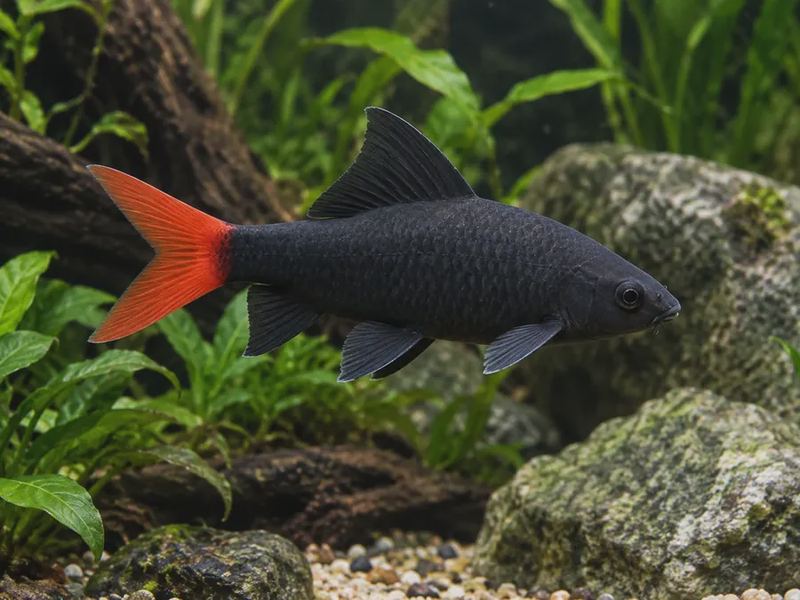
The red-tailed black shark is one of the most visually striking cyprinids in the hobby. The body is elongated and laterally compressed, with a pointed snout and a ventral mouth adapted for grazing surfaces. Mature specimens display a deep, velvety black body that contrasts sharply with a vivid, blood-red caudal fin. The dorsal fin is also black and sits high on the back, while the pectoral, pelvic, and anal fins are typically black or very dark, sometimes with faint red or orange edging in well-conditioned fish. Juveniles are often less intensely colored, with a slightly greyish body that darkens as the fish matures.
Maximum total length is generally reported as 12–15 cm (approximately 5–6 inches) in captivity, with males occasionally reaching the upper end of that range. Females tend to be slightly smaller and, when gravid, noticeably fuller in the belly. Sexual dimorphism is otherwise subtle; males may develop slightly more pointed dorsal fins and a marginally slimmer profile, but these differences are not reliable for casual sexing. The lifespan is respectable for a small cyprinid, with well-maintained individuals routinely living 8–10 years and some reports of fish exceeding 12 years.
One important identification note: the red-tailed black shark is frequently confused with the rainbow shark, Epalzeorhynchos frenatum. The rainbow shark has red or orange coloration in all of its fins, not just the caudal fin, and its body is typically a dark slate grey rather than jet black. The two species also differ in temperament, with the rainbow shark generally being somewhat less aggressive, though both are territorial.
Diet & Feeding
Epalzeorhynchos bicolor is an opportunistic omnivore with strong herbivorous tendencies. In the wild, it grazes on algae, biofilm, and small aquatic invertebrates on rocks and submerged wood. In the aquarium, it should receive a diet that reflects this balance. A high-quality sinking pellet or wafer formulated for herbivorous bottom-dwellers should form the staple. These fish are not surface feeders by preference and will often ignore floating foods, so sinking formulations are essential.
Supplement the staple with blanched vegetables such as zucchini, cucumber, spinach, and shelled peas. These provide fiber and encourage natural grazing behavior. Live or frozen foods—bloodworms, daphnia, brine shrimp, and insect larvae—should be offered two or three times per week to supply protein. Avoid overfeeding protein-rich foods, as this species is prone to obesity and, in some reports, to fatty liver issues when maintained on a meat-heavy diet. A good rule is roughly 70% plant-based matter and 30% animal protein.
Feeding frequency should be two small meals per day for juveniles and once daily for adults, with one fast day per week to support digestive health. Because this species is territorial and often eats from the bottom, ensure food reaches the substrate without being intercepted by faster mid-water tankmates. Target feeding with a pipette or dropping wafers after lights-out can help ensure the shark gets its share in a community setting.
Aquarium Setup
A single adult red-tailed black shark requires a tank of at least 120 cm (4 feet) in length and roughly 250–300 liters (65–80 US gallons). This is not a fish that thrives in a small tank. It is active, territorial, and capable of sudden bursts of speed; cramped quarters exacerbate aggression and stress. If you intend to keep more than one—which is generally not recommended—you would need a tank of 500 liters or more with carefully arranged territories, and even then success is not guaranteed.
Substrate should be fine gravel or sand with a smooth texture, as this species spends much of its time near the bottom and can abrade its delicate barbels and ventral surface on sharp material. Provide plenty of structure: driftwood, rock piles, and caves form natural territorial markers and retreats. The fish will claim a specific cave or crevice and defend it, so multiple hideouts arranged across the tank reduce conflict. Live plants are beneficial but should be robust species such as Anubias, Microsorum, Cryptocoryne, or Vallisneria; delicate plants may be uprooted or nibbled. Java moss and similar epiphytes on wood are usually ignored.
Lighting should be moderate and can be tailored to the plants rather than the fish. The red-tailed black shark is not light-sensitive, but intense lighting combined with a bare aquascape tends to increase skittishness. A photoperiod of 8–10 hours is standard. Filtration must be strong: canister filters or large hang-on-back units rated for at least twice the tank volume per hour are appropriate. The species appreciates noticeable water movement, so a powerhead or spray bar aimed along the length of the tank is a good addition. A tight-fitting lid is mandatory, as this fish is an accomplished jumper, particularly when startled.
Water Parameters
The red-tailed black shark is a tropical riverine species that does best in stable, well-oxygenated, slightly soft to moderately hard water. It tolerates a reasonably wide range of conditions but is sensitive to sudden swings, especially in pH and temperature. Mature aquariums with consistent maintenance schedules suit it far better than newly set-up tanks. Regular partial water changes of 25–30% weekly are recommended, along with monitoring of nitrate, which should be kept below 20 ppm.
| Parameter | Ideal Range | Tolerated Range |
|---|---|---|
| Temperature | 24–27 °C (75–81 °F) | 22–29 °C (72–84 °F) |
| pH | 6.5–7.5 | 6.0–8.0 |
| General Hardness (GH) | 5–12 dGH | 3–18 dGH |
| Carbonate Hardness (KH) | 3–8 dKH | 2–12 dKH |
| Ammonia | 0 ppm | 0 ppm |
| Nitrite | 0 ppm | 0 ppm |
| Nitrate | < 20 ppm | < 40 ppm |
Hardness in the middle of the range is ideal. Very soft, acidic water (below pH 6.0) can stress the fish over time, while extremely hard, alkaline water (above pH 8.0) is tolerated only briefly. If your tap water is far outside the ideal range, consider mixing with RO water or using a buffering substrate rather than chasing numbers with chemicals, which often causes more instability than it solves.
Behavior & Compatibility
The red-tailed black shark is a classic example of a fish whose reputation precedes it. It is territorial, often aggressively so, and its aggression is directed primarily at conspecifics and at other bottom-dwelling fish with similar body shapes or coloration. Juveniles are relatively peaceful and can be kept in community tanks with appropriate tankmates. As the fish matures—usually around 6–10 cm—territorial behavior intensifies, and a previously calm specimen may begin chasing tankmates relentlessly.
Keeping more than one red-tailed black shark in the same tank is almost always a mistake. They will fight, often to the point of injury or death, and the subordinate fish will be stressed into hiding and eventual illness. The same applies to mixing with rainbow sharks or other Epalzeorhynchos species, which are treated as rivals. Even in large tanks, long-term success with multiple specimens is rare and requires meticulous scaping and luck.
Good tankmates include mid-water and upper-water species that do not occupy the shark's preferred bottom zone. Suitable options include larger tetras (e.g., Hyphessobrycon and Hemigrammus species), rasboras, rainbowfish, and robust livebearers. Barb species such as Puntigrus tetrazona can work in large tanks but may nip the shark's fins. Avoid slow-moving, long-finned fish such as angelfish, guppies, and bettas, which are prone to fin-nipping by the shark. Bottom-dwellers such as Corydoras catfish, loaches, and plecos are risky; the shark may harass them constantly, particularly if they occupy the same cave or feeding area. If you must keep bottom-dwellers, choose species that occupy different microhabitats and provide abundant structure.
Individual personality varies widely. Some specimens remain reasonably tolerant throughout their lives; others become tyrants. The safest approach is to plan the community around the shark's needs rather than adding fish later and hoping for the best.
Breeding
Commercial breeding of Epalzeorhynchos bicolor is well established, but home aquarium breeding is rare and difficult. The species is a migratory riverine spawner in the wild, and commercial producers typically induce spawning with hormone injections and controlled environmental manipulation. In the home aquarium, spontaneous spawning is essentially unheard of.
The main obstacle is that the species does not readily pair or spawn in confined quarters, and the aggression between adults makes conditioning pairs impractical. Commercial breeders generally use large, densely planted ponds or vats with soft, slightly acidic water and simulate the onset of the rainy season by dropping temperature slightly and increasing water flow and feeding. Eggs are scattered among fine-leaved plants or spawning mops and hatch within 24–48 hours. The larvae are tiny and require infusoria or specialized micro-foods for the first week before transitioning to baby brine shrimp.
For the home aquarist, the practical takeaway is that any red-tailed black shark you buy is almost certainly farm-raised and that attempting to breed the species is a project for experienced aquarists with dedicated space. If you do attempt it, condition a group of adults in a very large tank with abundant cover and observe for pairing behavior; if a pair forms, move them to a dedicated spawning tank of at least 150 liters with soft, acidic water, spawning mops, and a sponge filter. Remove the adults immediately after spawning, as they will eat the eggs.
Common Diseases & Health
The red-tailed black shark is a hardy species when kept in appropriate conditions, but it is susceptible to the usual freshwater ailments. The most common is Ichthyophthirius multifiliis, or ich, which presents as white spots on the body and fins and is usually triggered by temperature fluctuations or stress from transport or aggression. Treatment with a standard ich medication, combined with raising the temperature to 28–30 °C for 10–14 days, is effective. Because this species is scaleless only on parts of its body—it is not a true scaleless fish—it tolerates most medications at full dose, but copper-based treatments should still be used with caution.
Fin rot, caused by Flavobacterium columnare and other opportunistic bacteria, is common in fish that are being harassed or kept in poor water quality. It manifests as ragged, receding fin edges. Improving water quality and treating with an antibacterial agent usually resolves early cases. More serious is Columnaris itself, which can cause white, cottony lesions on the body and mouth and can kill quickly if untreated.
Internal parasites, particularly flagellates and tapeworms, are common in wild-caught fish but rare in farmed stock. Still, any new fish should be quarantined for at least two to four weeks before introduction to a display tank. This species is also prone to obesity and related health issues when overfed, and to stress-induced immunosuppression when kept in cramped or unstable conditions. The best disease prevention is simple: stable water parameters, a spacious tank, appropriate tankmates, and a balanced diet.
FAQs
How big does a red-tailed black shark get?
Adults typically reach 12–15 cm (5–6 inches) in total length, with males slightly larger than females. This size, combined with their territorial nature, means they need a tank of at least 120 cm in length.
Can I keep a red-tailed black shark with a rainbow shark?
No. The two species are closely related and treat each other as direct competitors. In almost all cases, the result is chronic aggression, stress, and often the death of the subordinate fish. Keep only one Epalzeorhynchos species per tank.
Is the red-tailed black shark extinct in the wild?
It is classified as Critically Endangered and possibly extinct in the wild. Wild populations collapsed in the late twentieth century due to dam construction, habitat loss, and collection for the aquarium trade. All fish in the hobby today are commercially bred.
What tankmates work best with a red-tailed black shark?
Mid-water schooling fish such as larger tetras, rasboras, and rainbowfish are the safest choices. Avoid other bottom-dwellers, long-finned fish, and any species small enough to be bullied. Provide plenty of caves and driftwood so the shark can establish a territory and retreat when it wants to.