
Epalzeorhynchos frenatum: The Rainbow Shark
Species Overview
The rainbow shark, Epalzeorhynchos frenatum, is a freshwater cyprinid perhaps best known for the striking contradiction between its common name and its disposition. Despite the "shark" label — earned from its streamlined body, prominent dorsal fin, and the way it cruises along the substrate — this is a small, largely herbivorous river fish native to Southeast Asia. It belongs to the order Cypriniformes, family Cyprinidae, and is one of four recognized species in the genus Epalzeorhynchos, alongside the red-tailed black shark (E. bicolor), the red-finned shark (E. munense), and E. kalopterus, the latter of which is frequently confused with the "flying fox" of the genus Crossocheilus in the trade.
The species was first described by the French zoologist Henri Émile Sauvage in 1878, originally placed in the genus Labeo as Labeo frenatus. It was later moved to Epalzeorhynchos, a genus erected by Bleeker. The specific epithet frenatum derives from the Latin for "bridled" or "reined," a reference to the dark lateral banding and the reinforced, somewhat bridle-like appearance of the snout and rostral region. The genus name itself is compounded from Greek roots roughly meaning "saddle-snout," referring to the fleshy, somewhat protruding upper lip and rostral cap that these fish use to graze algae and aufwuchs from submerged surfaces.
Wild E. frenatum are distributed across the Mekong, Chao Phraya, and Mae Klong river basins of mainland Southeast Asia, with populations documented in Thailand, Laos, Cambodia, and Vietnam. They are also recorded from the lower reaches of rivers in peninsular Malaysia and parts of the Malay Peninsula, though some of these records may represent introductions or misidentifications. Within these systems, rainbow sharks occupy flowing, well-oxygenated reaches — typically the middle and lower courses of rivers, smaller tributaries, and flooded forest margins where submerged wood, rock, and root structures provide cover and grazing surfaces. They are not found in stagnant swamps or the anoxic backwaters that some cyprinids tolerate; they are, in effect, a rheophilic (current-loving) species that does best when water movement and dissolved oxygen are both high.
In the wild, these fish are largely solitary and territorial, defending patches of submerged structure against conspecifics. This behavioral trait is the single most important thing an aquarist can understand before purchasing one, because it dictates almost every aspect of tank design, tankmate selection, and long-term management. The rainbow shark is not a schooling fish, and it does not appreciate company of its own kind.
Appearance & Size
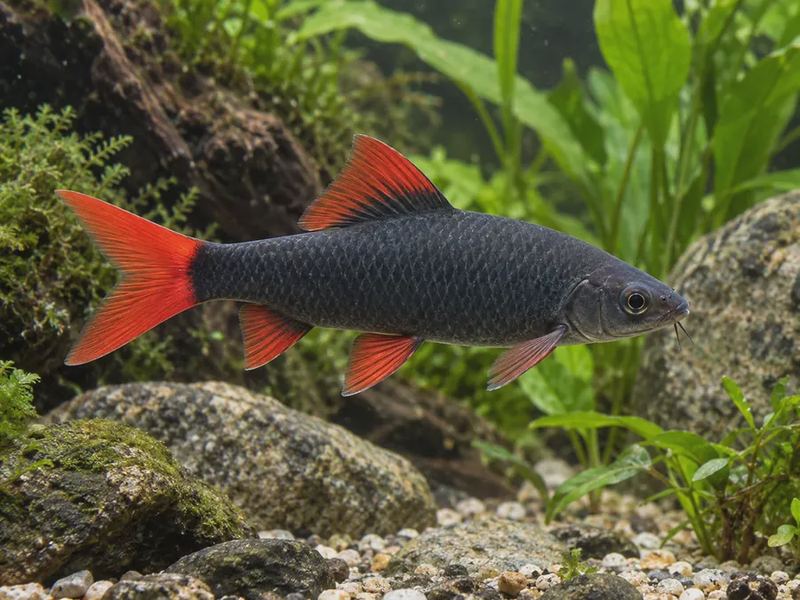
A healthy rainbow shark is a visually arresting animal. The body is elongated, laterally compressed, and torpedo-shaped, with a pointed snout and a ventral mouth equipped with a fleshy, sucker-like lower lip. The dorsal profile rises gently from the snout to a high, triangular dorsal fin set roughly at the midpoint of the body, then tapers to a deeply forked caudal fin. The eyes are relatively large and set high on the head, and two pairs of barbels — one rostral, one maxillary — frame the mouth, used for sensing food in crevices and among gravel.
Coloration is where the species earns its common name. The body is a deep, velvety charcoal to near-black, and in well-conditioned specimens this dark ground color carries a subtle blue or green iridescence under good lighting. The fins — dorsal, anal, pelvic, pectoral, and the outer lobes of the caudal — are a vivid, saturated red to orange-red. The caudal fin is typically red with a black central wedge, giving the tail a distinctive two-toned appearance. Juveniles are often paler, with a more brownish body and less intense fin color, and full adult coloration may take six to twelve months to develop. There is also a widely available albino morph, sometimes sold as the "albino rainbow shark," in which the body is a creamy white to pale pink and the fins remain orange-red; this morph is not a separate species and should not be treated as one.
Sexual dimorphism is subtle and generally only apparent in mature fish. Males tend to be slimmer, with sharper fin edges and, in top condition, a slightly more intense red in the anal and caudal fins. Females, when gravid, become noticeably fuller in the belly and may appear broader from above. There is no reliable external character that separates the sexes with certainty outside of breeding condition.
Maximum size in the aquarium is typically 15 cm (about 6 inches) total length, with occasional reports of fish reaching 18 cm (7 inches) in large, well-maintained systems. Wild-caught specimens and well-fed captive adults commonly settle in the 12–15 cm range. This is a fish that is frequently sold at 4–6 cm and outgrows its first tank within a year, a fact that drives much of the rehoming traffic seen in the hobby. Lifespan is respectable for a cyprinid: 8–10 years is common, and fish in the 12–15 year range are documented in public aquaria and long-term private collections.
Diet & Feeding
Epalzeorhynchos frenatum is best described as an omnivorous grazer with a strong herbivorous bias. In the wild, stomach-content analyses of related Epalzeorhynchos and Labeo species show a diet dominated by filamentous algae, diatoms, periphyton, and the small invertebrates — chironomid larvae, ostracods, and micro-crustaceans — that live within the aufwuchs matrix. The rostral cap and the horny sheathing of the lower lip are adaptations for scraping and rasping, not for tearing flesh, which is why the rainbow shark is a poor choice as a "clean-up" fish for meaty leftovers and an excellent choice for grazing soft algae from wood and rock.
In captivity, a good rainbow shark diet is built on three pillars. First, a quality sinking herbivore pellet or wafer — look for formulations with spirulina, kelp, or other algal meals as the first ingredients. Second, regular offerings of blanched vegetable matter: zucchini, cucumber, shelled peas, spinach, and romaine are all taken readily, and many keepers rubber-band a slice of zucchini to a rock or clip it to the glass for grazing. Third, a moderate protein supplement two or three times a week — frozen or live bloodworms, daphnia, brine shrimp, or a quality omnivore flake — to support growth and coloration. The common mistake is to feed the fish exclusively on high-protein foods intended for carnivores, which over the long term is associated with obesity, fatty liver, and a washed-out appearance.
Feeding frequency should be two small meals per day for juveniles and once daily for adults, with one fast day per week being a reasonable practice. Rainbow sharks are enthusiastic but not gluttonous eaters in the sense of overeating to the point of immediate harm; the real risk is that they graze continuously and become overweight in tanks where food is constantly available. Because they feed from the substrate and from vertical surfaces, food must be delivered in a form that reaches them. Floating flakes are largely wasted on this species. Sinking pellets, wafers, and weighted vegetable matter are the appropriate delivery formats.
One practical note: rainbow sharks are notorious for nibbling the soft leaves of plants such as Cabomba, Rotala, and certain Echinodorus species when underfed or when the tank lacks sufficient algal growth. This is rarely a sign of a "plant-eating" species in the strict sense; it is usually a sign that the fish is hungry and the tank is too clean. Increasing vegetable feeding and allowing some algae to develop on hardscape typically resolves the behavior.
Aquarium Setup
The single most common welfare failure with rainbow sharks is housing them in tanks that are too small. A juvenile sold at 5 cm may look comfortable in a 60-liter tank, but an adult at 14 cm is an active, fast-swimming fish that patrols a territory and needs horizontal swimming space. The minimum acceptable tank size for a single adult is 120 cm (4 feet) in length, with a volume of roughly 200 liters (55 US gallons) or more. A 150 cm (5-foot) tank in the 300–400 liter range is better and is the size at which the species' natural behavior — cruising, grazing, and defending a defined territory — becomes fully visible. Smaller tanks are not impossible to manage, but they reliably produce a stressed, aggressive, or stunted fish, and they should not be considered a long-term home.
Substrate choice matters more than it might appear. Rainbow sharks graze from the bottom and from vertical surfaces, and they will sift through fine gravel and sand in search of food. A soft, rounded substrate — fine gravel or, better, smooth sand — protects the delicate barbels and the rostral cap from abrasion. Sharp crushed coral or angular gravel should be avoided. Because the species is a riverine fish, the aquascape should mimic a flowing stream: a base of sand or fine gravel, punctuated by rounded cobbles and larger rocks, with driftwood roots and branches providing the vertical surfaces that the fish grazes and the visual barriers that break up its territory. Caves and crevices formed by stacked rock or hollow driftwood are used constantly.
Plants are a mixed proposition. Rainbow sharks do not systematically destroy plants the way some Labeo species do, but they will sample soft-leaved species and they will uproot shallow-rooted plants while grazing. Robust, well-rooted species — Anubias, Microsorum pteropus (Java fern), Bolbitis, Cryptocoryne, and Vallisneria — are generally safe, especially when attached to wood or rock rather than planted in the substrate. Floating plants such as Pistia or Salvinia are fine and provide useful shading. Fast-growing stem plants may be nibbled but are rarely killed outright.
Lighting should be moderate and should support the growth of algae on hardscape, which is a natural and beneficial food source for this species. A photoperiod of 8–10 hours is appropriate. Strong, high-output lighting is not necessary and can promote nuisance algae that outcompetes the fish's preferred grazing surfaces. Filtration should be generous and oriented to produce a visible but not overwhelming current; a canister filter or a pair of powerheads arranged to create a gentle unidirectional flow along the length of the tank is ideal. The tank must be tightly covered — rainbow sharks are accomplished jumpers, particularly when startled, and a fish on the floor is a preventable loss.
Water Parameters
Rainbow sharks are adaptable within a fairly wide range, but they are not a "beginner" fish in the sense of tolerating neglect. They are sensitive to poor water quality, particularly to elevated nitrate and to unstable pH, and they do best in mature, well-filtered systems with a regular water-change schedule. The table below summarizes the target parameters for long-term health.
| Parameter | Target Range | Notes |
|---|---|---|
| Temperature | 24–28 °C (75–82 °F) | Stable temperature is more important than a specific value; avoid prolonged periods below 22 °C. |
| pH | 6.5–7.5 | Tolerates 6.0–8.0 short-term; stable is better than "perfect." |
| General Hardness (GH) | 5–15 dGH | Moderate hardness; very soft water is not required. |
| Carbonate Hardness (KH) | 3–10 dKH | Provides pH buffering; avoid KH near zero in planted tanks. |
| Ammonia | 0 ppm | Any detectable ammonia indicates a filtration problem. |
| Nitrite | 0 ppm | As above. |
| Nitrate | <20 ppm | Keep below 20 ppm; 10 ppm or less is preferable. |
| Dissolved Oxygen | High | Surface agitation and flow are important; this is a rheophilic species. |
Weekly water changes of 25–30% are the baseline for this species, and 40–50% is reasonable in heavily stocked tanks. Because rainbow sharks are messy grazers and because they produce a substantial bioload for their size, nitrate accumulation is the most common water-quality problem in their tanks. Test kits for ammonia, nitrite, nitrate, and pH should be on hand, and the fish should be observed for behavioral signs of stress — clamped fins, hiding, loss of color, or gasping at the surface — which often precede measurable water-quality changes.
Rainbow sharks are scaleless or nearly so in the sense that their scales are small and firmly embedded, which makes them somewhat more susceptible to certain medications, particularly those containing malachite green or formalin at full strength. Half-dose treatments are often recommended, and any medication should be used with caution and with the input of a veterinarian or experienced aquarist when possible.
Behavior & Compatibility
This is the section where the rainbow shark most often surprises new keepers. The species is territorial, and it is territorial in a specific and predictable way: it claims a patch of the tank — usually a cave, a piece of driftwood, or a corner — and it defends that patch against fish that enter it. The defense is usually a chase rather than a bite, but a determined rainbow shark can and will nip fins, and it can be relentless with fish that cannot or will not leave its territory. The aggression is typically directed at fish that occupy similar niches: bottom-dwelling cyprinids, loaches, and other algae-grazing species.
Against conspecifics, the species is best kept singly. Two rainbow sharks in the same tank will usually result in one dominating the other, with the subordinate fish hiding, refusing food, and eventually declining. Groups are sometimes attempted in very large tanks (2 meters or more) with abundant structure, but even then the arrangement is fragile and often ends with the death or rehoming of all but one fish. The "one per tank" rule is the safest and most widely supported guideline.
Compatible tankmates are mid- and upper-water column fish that are too large to be eaten, too fast to be caught, and not interested in the rainbow shark's territory. Good candidates include medium to large barbs (Puntius and Barbodes species), danios, larger rasboras, rainbowfish (Melanotaenia, Glossolepis), and robust livebearers such as swordtails and mollies. Many aquarists keep rainbow sharks successfully with peaceful South American cichlids such as Heros or Geophagus in large tanks, provided the cichlids are not small enough to be bullied. Bottom-dwelling species are riskier: Botia loaches, Corydoras, and other grazing catfish may be harassed, and small specimens can be injured.
Fish to avoid include very small tetras and rasboras (which may be chased and stressed), slow-moving fancy goldfish (which are cool-water fish and incompatible on temperature grounds alone), and other territorial bottom-dwellers such as red-tailed black sharks, which occupy the same niche and will fight. The general principle is to build the tank around the rainbow shark's needs rather than to add it to a community that was designed for something else. When the tank is large, well-structured, and stocked with active mid-water fish, the rainbow shark is a striking and largely peaceful centerpiece. When it is crowded into a small tank with similar fish, it becomes a problem.
Breeding
Captive breeding of Epalzeorhynchos frenatum is rare and, when it occurs, is almost always the result of hormone injection or of large-scale commercial operations in Southeast Asia rather than of natural spawning in home aquaria. The species is not a seasonal spawner in the wild in the way that many temperate cyprinids are; it is a riverine fish that appears to spawn in response to rising water levels and increased flow at the onset of the monsoon, and replicating those cues in a closed system is difficult. There are no reliable reports of home-aquarium spawning without hormonal intervention.
What is known of the reproductive biology is drawn largely from commercial breeding operations and from related Epalzeorhynchos species. Mature females become visibly gravid, with a rounded abdomen, and males in breeding condition develop small nuptial tubercles on the snout and pectoral fin rays. Spawning, when induced, is an open-water event: the fish scatter eggs among fine-leaved plants or over a spawning mop, and there is no parental care. Eggs hatch in roughly 24–48 hours at tropical temperatures, and the free-swimming fry are small and require infusoria or commercial fry food for the first week or two before transitioning to finely crushed flake and microworms.
For the home aquarist, the practical takeaway is that breeding this species is not a realistic goal and should not be a factor in deciding whether to keep it. The fish available in the trade are almost entirely captive-bred in Southeast Asia, often in large outdoor or greenhouse systems, and they are produced in sufficient numbers that wild collection is not a significant concern for the species' conservation status. The IUCN Red List currently classifies E. frenatum as Least Concern, though habitat degradation in the Mekong basin remains a long-term pressure on wild populations.
Common Diseases & Health
Rainbow sharks are hardy fish when their basic needs are met, but they are susceptible to the same diseases as other freshwater cyprinids, and a few conditions deserve specific mention. The most common is ich (Ichthyophthirius multifiliis), which presents as white spots on the body and fins, often accompanied by flashing, clamped fins, and lethargy. Ich is usually triggered by temperature fluctuation or by the introduction of an infected fish, and it is treated with elevated temperature (28–30 °C) combined with a suitable medication or with salt at a dose appropriate for scaleless fish. Because rainbow sharks are sensitive to some medications, half-dose treatments and careful observation are prudent.
Fin rot, caused by opportunistic bacteria such as Aeromonas and Flavobacterium, is common in fish that are stressed by poor water quality, overcrowding, or aggression. It presents as ragged, receding fin edges, sometimes with a white or reddish margin. The primary treatment is correction of the underlying water-quality problem, with antibiotic or antiseptic treatment reserved for severe cases. Velvet (Oodinium) is less common but serious, appearing as a fine gold or rust-colored dusting on the body; it is treated similarly to ich but often requires a longer course.
Internal parasites, particularly hexamita and various intestinal nematodes, are seen in wild-caught or poorly quarantined fish and present as weight loss despite feeding, white stringy feces, and a sunken belly. Metronidazole and praziquantel are the standard treatments, and a quarantine period of two to four weeks for all new arrivals is the single most effective preventive measure. Swim bladder disorders are occasionally reported in rainbow sharks fed a diet too high in protein or too low in fiber, and they often resolve with a switch to a more herbivorous diet and a short fast.
Prevention, as always, is better than treatment. A mature, well-filtered tank with stable parameters, a varied diet with a strong vegetable component, a strict quarantine protocol, and a stocking plan that respects the species' territorial nature will prevent the overwhelming majority of health problems. Regular observation — checking fins, body condition, appetite, and behavior daily — catches most issues early, when they are easiest to resolve.
FAQs
How big do rainbow sharks get, and what tank size do they really need?
Adults typically reach 12–15 cm (5–6 inches), with occasional specimens hitting 18 cm. A single adult needs a tank at least 120 cm (4 feet) long and around 200 liters (55 gallons) or more. Smaller tanks cause stress, stunting, and aggression, and they are not a humane long-term option.
Can I keep a rainbow shark with other rainbow sharks or with a red-tailed black shark?
No. The species is territorial and solitary, and conspecifics or other Epalzeorhynchos will be harassed relentlessly. One rainbow shark per tank is the standard, and mixing it with a red-tailed black shark — which occupies the same niche — is a recipe for chronic conflict.
What should I feed a rainbow shark?
A herbivore-biased diet: sinking spirulina or algae wafers as the staple, blanched zucchini, cucumber, peas, and spinach several times a week, and a moderate protein supplement (bloodworms, daphnia, brine shrimp) two or three times weekly. Avoid an all-protein diet, which leads to obesity and poor coloration.
Are rainbow sharks aggressive?
They are territorial rather than aggressive in the general sense. They defend a chosen cave or patch of structure against intruders, usually by chasing, and they can nip fins. In a large, well-structured tank with active mid-water tankmates, they are peaceful and outgoing. In a small tank with similar bottom-dwelling fish, they can be a persistent problem.
Do rainbow sharks eat algae?
Yes — they are grazers and will rasp soft algae and aufwuchs from wood, rock, and glass. They are not a substitute for a proper maintenance routine, and they will not control hair algae or black beard algae, but they do contribute meaningfully to the natural grazing community in a riverine-style tank.