
Puntius titteya: The Cherry Barb
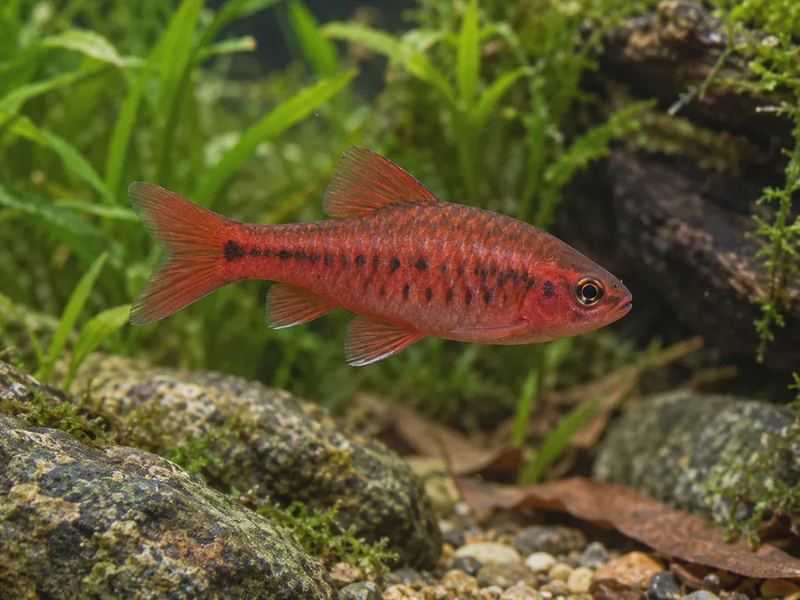
Species Overview
The cherry barb, Puntius titteya, is a small cyprinid native to the shaded forest streams of Sri Lanka, where it has been a favorite of aquarists since its formal description by Paul Deraniyagala in 1929. It belongs to the family Cyprinidae, the largest family of freshwater fishes, which also includes barbs, danios, rasboras, and the goldfish. Within the genus Puntius — a group whose taxonomy has been substantially revised over the past two decades — the cherry barb is one of the few species that has remained consistently placed, and it is widely regarded as the type species most aquarists picture when they hear the word "barb." Its specific epithet, titteya, derives from the Sinhalese common name for the fish, titteya, reflecting its deep roots in Sri Lankan culture and local ichthyology.
Wild cherry barbs are endemic to the wet zone of southwestern Sri Lanka, primarily the lowland river basins draining the island's central highlands, including the Kelani, Kalu, Gin, and Nilwala river systems. They inhabit slow-flowing, heavily shaded forest streams, often in the shallow margins where leaf litter accumulates and submerged roots and marginal vegetation provide dense cover. The water in these habitats is typically soft, slightly acidic, and stained tea-brown by tannins leached from fallen leaves — conditions that are important to replicate in captivity for the fish to display their best coloration and behavior. Cherry barbs are also found in some modified habitats such as rice paddies and secondary forest streams, suggesting a degree of tolerance for altered environments, though populations have declined in parts of their range due to habitat loss, pollution, and the aquarium trade. The species is currently listed as Least Concern on the IUCN Red List, but localized declines have prompted conservation attention, and captive-bred stock now dominates the hobby trade.
Because of its long history in the aquarium hobby, the cherry barb has been line-bred for color intensity, and albino and "gold" morphs are occasionally available. The vast majority of fish sold today are commercially bred in Southeast Asia and Eastern Europe, and wild-caught specimens are relatively uncommon. This is generally good news for conservation, but it also means that aquarists should be aware that farmed fish may be adapted to warmer, harder, more neutral water than their wild counterparts — a point worth remembering when setting up a tank.
Appearance & Size
The cherry barb is a slender, laterally compressed fish with a gently arched dorsal profile and a forked caudal fin. Adults typically reach 4–5 cm (1.6–2 inches) in standard length, with males slightly smaller and more streamlined than females. Maximum reported size is around 5 cm, and fish in home aquaria rarely exceed this. The body is covered in small cycloid scales, and the overall shape is torpedo-like — built for quick bursts of speed in the tangled, vegetated streams it calls home.
Sexual dimorphism is pronounced, especially in mature, well-conditioned fish. Males develop a rich cherry-red to brick-red coloration across the flanks, flanks that in peak breeding condition can deepen to an almost blood-red hue. The red is strongest along the sides and belly, fading toward the back, and the fins — particularly the dorsal, anal, and caudal — may be edged with darker pigment. Females are considerably paler, typically a warm tan, olive-brown, or pale copper, with a subtle greenish or silvery sheen. Females in breeding condition become noticeably plumper as they fill with eggs, and both sexes may show a faint dark lateral stripe that runs from the eye to the base of the caudal fin, though this stripe is more prominent in juveniles and in females than in courting males. Juveniles of both sexes resemble females and can be difficult to sex until they approach maturity at around 3–4 months of age.
One of the cherry barb's most appealing features is its subtle iridescence. In good lighting, the scales along the upper flank can flash gold or greenish-gold, and the eye often shows a bright silver or pale gold iris. The fish's coloration is also highly condition-dependent: stressed, poorly fed, or overcrowded specimens fade to a dull pinkish-tan, while fish kept in soft, slightly acidic water with plenty of plant cover and a varied diet often develop colors that rival those of any "show" barb. Males in particular will color up dramatically when competing for females, and a group of well-kept males in a planted tank is one of the more striking sights in the freshwater hobby.
Diet & Feeding
Cherry barbs are omnivores with a strong opportunistic streak. In the wild, stomach-content analyses of related Puntius species suggest a diet composed largely of aquatic insect larvae, small crustaceans, algae, and detritus, with terrestrial insects and plant matter taken when available. In the aquarium, they are unfussy eaters and will accept a wide range of prepared foods, but they do best when offered variety rather than a single staple flake.
A good baseline diet includes a high-quality micro-pellet or crushed flake food formulated for small tropical omnivores, supplemented several times a week with frozen or live foods such as Daphnia, Artemia (brine shrimp), bloodworms, and chopped blackworms. These protein-rich foods are especially valuable for conditioning fish prior to spawning and for maintaining the deep red coloration of males. Vegetable matter should not be overlooked: blanched zucchini, cucumber, spinach, and spirulina-based foods help support digestive health and provide pigments that may enhance color. Cherry barbs will also graze on soft algae and aufwuchs growing on plants and hardscape, though they are not reliable algae-eaters in the way that, say, Otocinclus or Ancistrus are.
Feed two to three small meals per day, offering only as much as the fish can consume within two to three minutes. Cherry barbs have small stomachs and a short digestive tract, so overfeeding is one of the most common husbandry mistakes; uneaten food fouls the water and contributes to the obesity and fatty liver issues sometimes seen in overfed cyprinids. Because they are mid-water feeders by preference, sinking pellets may be ignored unless they soften and drift, and food that reaches the substrate is often left for bottom-dwellers. A varied, portion-controlled diet is the single most effective way to keep these fish healthy, colorful, and long-lived — captive cherry barbs routinely reach three to five years, and well-cared-for specimens have been reported to live longer.
Aquarium Setup
Cherry barbs are small, active shoaling fish that appreciate a well-planted tank with plenty of cover and open swimming space. A tank of at least 60 cm (24 inches) in length and around 40–60 liters (10–15 US gallons) is suitable for a small group, but larger is always better: a 75–90 cm tank holding 80–120 liters allows a proper shoal of eight to twelve fish to behave naturally and reduces aggression. Because they are shoaling cyprinids, cherry barbs should never be kept singly or in pairs; groups of at least six, and ideally eight to ten or more, bring out their best colors and most interesting behavior.
Substrate choice is flexible. A dark, fine-grained substrate — sand or rounded gravel — is ideal, as it contrasts with the fish's red coloration and supports the growth of plants. Dark substrates also tend to make cherry barbs appear more intensely colored, since fish often adjust their pigmentation to match their surroundings. Avoid sharp or coarse gravel, which can damage delicate barbels and fins, and avoid heavily calcareous substrates if you are aiming for the soft, slightly acidic conditions the species prefers.
Plants are central to a good cherry barb setup. In the wild, these fish live among dense marginal and submerged vegetation, and in the aquarium they will use Java fern (Microsorum pteropus), Anubias species, cryptocorynes, vallisneria, and stem plants such as Rotala and Ludwigia as cover and foraging areas. Floating plants like Salvinia or Pistia are particularly valuable because they diffuse light and create the shaded, dappled conditions cherry barbs favor. A dark background and driftwood or root structures complete the biotope look and provide additional hiding spots. Lighting should be moderate — bright, intense light tends to make these fish skittish and can wash out their colors — and a photoperiod of 8–10 hours per day is sufficient for most planted setups.
Filtration should be gentle but effective. Cherry barbs come from slow-flowing streams and do not appreciate strong currents; a sponge filter, a small canister, or a hang-on-back filter with the flow directed along the tank's long axis works well. If you are keeping the fish in a biotope-style setup, adding dried Indian almond leaves or other botanical material will release tannins, lower pH slightly, and create the tea-colored water of their native streams — an aesthetic that suits the species beautifully, though it is not strictly necessary for captive-bred fish. A tight-fitting lid is essential, as cherry barbs are capable jumpers, particularly when startled or during spawning chases.
Water Parameters
Wild cherry barbs inhabit soft, slightly acidic water, and while captive-bred fish are more adaptable than their wild ancestors, they still do best within a fairly specific range. The table below summarizes the parameters that keep this species thriving. Stability matters more than chasing exact numbers: a steady pH of 7.2 is far better than a pH that swings between 6.0 and 7.5 because of inconsistent water changes or the use of pH-adjusting chemicals.
| Parameter | Ideal Range | Notes |
|---|---|---|
| Temperature | 23–27 °C (73–81 °F) | 24–26 °C is optimal; avoid prolonged exposure above 28 °C |
| pH | 6.0–7.5 | Slightly acidic to neutral; stable values are critical |
| General Hardness (GH) | 4–15 dGH (70–270 ppm) | Soft to moderately hard; wild fish prefer the lower end |
| Carbonate Hardness (KH) | 2–8 dKH | Moderate KH helps buffer pH; very low KH risks pH crashes |
| Ammonia | 0 ppm | Any detectable ammonia indicates a filtration problem |
| Nitrite | 0 ppm | Toxic at very low concentrations; test regularly in new tanks |
| Nitrate | < 20 ppm | Keep low with weekly partial water changes of 25–30% |
Cherry barbs are reasonably tolerant of a wide range of conditions provided changes are gradual, but they are sensitive to sudden shifts in temperature and pH, which can trigger stress, immunosuppression, and outbreaks of disease. Acclimation should be slow — drip acclimation over 30–60 minutes is ideal, especially for shipped fish. In hard, alkaline water, cherry barbs will survive but often show muted coloration and reduced spawning activity; if your tap water is very hard, mixing in RO/DI water or using peat filtration can help bring parameters into range. Regular partial water changes, a mature biological filter, and avoiding overstocking will do more for long-term health than any additive or pH-adjusting product.
Behavior & Compatibility
Cherry barbs are peaceful, active shoaling fish that spend most of their time in the middle and lower-middle levels of the tank, darting among plants and occasionally chasing one another in short, harmless bursts. Males in particular engage in frequent display behavior — flaring fins, tilting their bodies, and chasing females and rival males — but this rarely escalates into real aggression, and it is one of the joys of keeping the species. In a properly sized group, any bullying is spread among many individuals, and no single fish is persistently harassed. Kept singly or in very small numbers, however, cherry barbs can become shy, hide constantly, or turn their nipping behavior toward other tankmates.
Because of their small size and peaceful nature, cherry barbs mix well with a wide range of community fish. Good tankmates include other small cyprinids such as Boraras species, danios, and rasboras; small tetras like Paracheirodon and Hemigrammus species; livebearers such as guppies and platies (provided water parameters overlap); and peaceful bottom-dwellers like Corydoras catfish and small loaches. They also do well with dwarf cichlids such as Apistogramma and Mikrogeophagus ramirezi, provided the tank has enough cover and the cichlids are not spawning. Invertebrates are generally safe: cherry barbs may nip at very small shrimp fry, but adult Neocaridina and Caridina shrimp, as well as most snails, are usually left alone.
Fish to avoid include large or boisterous species that may bully or eat them — angelfish, larger gouramis, most medium-to-large cichlids, and predatory catfish — as well as notorious fin-nippers like tiger barbs (Puntigrus tetrazona), which can harass cherry barbs and outcompete them for food. Long-finned tankmates such as bettas and fancy guppies may also be nipped, though cherry barbs are generally less aggressive than many of their relatives. As with any community tank, the key is to keep fish of similar size and temperament together, provide plenty of cover and visual barriers, and maintain a group size large enough that the cherry barbs focus their attention on each other rather than on their tankmates.
Breeding
Cherry barbs are among the easier egg-scattering cyprinids to breed, and many aquarists report spontaneous spawning in well-planted community tanks. Condition a group of several males and females on live and frozen foods for two to three weeks; females will visibly plump with eggs, and males will intensify in color and begin chasing. For controlled breeding, set up a dedicated spawning tank of 40–60 liters with soft, slightly acidic water at around 25–26 °C, a sponge filter, and either a dense bed of fine-leaved plants (Java moss, Taxiphyllum, or spawning mops) or a layer of marbles or glass beads on the bottom to let eggs fall out of reach of the adults.
Spawning typically occurs in the early morning and involves a male pursuing a female through the plants, nudging her flanks, and pressing against her as both release gametes. The eggs are small, adhesive, and translucent, and a single female can produce several hundred eggs over a spawning period, usually in multiple batches. Adults will eat the eggs and fry if given the chance, so remove the adults as soon as spawning is finished — usually within 24 hours. Eggs hatch in roughly 24–48 hours at 25–26 °C, and the fry become free-swimming after another two to three days, at which point they can be fed infusoria, vinegar eels, or commercial liquid fry food, moving on to microworms and newly hatched brine shrimp as they grow. Growth is moderate; fry reach sexual maturity at around three to four months and can live for several years with good care. Because cherry barbs are so prolific in captivity, there is no justification for removing wild fish from Sri Lanka for the hobby, and aquarists seeking to breed the species should start with healthy captive-bred stock.
Common Diseases & Health
Cherry barbs are hardy fish when kept in clean, stable water, but like all freshwater aquarium fish they are susceptible to a handful of common ailments. The most frequent is Ichthyophthirius multifiliis, or "ich," a protozoan parasite that presents as small white spots on the fins and body, often accompanied by flashing, clamped fins, and lethargy. Ich is usually triggered by temperature fluctuations, poor water quality, or the introduction of new fish without quarantine, and it is treated with raised temperature (28–30 °C), aquarium salt where appropriate, and commercially available antiparasitic medications. Because the parasite's life cycle is temperature-dependent, treatment must continue for several days after visible spots disappear.
Fin rot, caused by opportunistic bacteria such as Aeromonas and Flavobacterium, is another common problem, particularly in tanks with poor water quality or in fish that have been nipped or injured. It manifests as frayed, receding, or white-edged fins and is treated by correcting water quality and, in severe cases, with antibiotics. Velvet disease (Oodinium), a yellowish-gold dusting on the skin, and internal parasites such as Camallanus worms also occur, the latter often appearing as thin, red worms protruding from the vent. Quarantining new arrivals for two to four weeks and avoiding live foods from questionable sources are the best preventive measures.
Prevention is always preferable to treatment. Maintain excellent water quality with regular partial water changes, avoid overcrowding, keep temperature and pH stable, and feed a varied diet. A stressed cherry barb is a sick cherry barb: the same fish that glows crimson in a well-planted, soft-water tank will fade to a washed-out pink and become prone to infection when conditions deteriorate. Regular observation — checking fins, appetite, coloration, and behavior — will let you catch most problems early, when they are easiest to resolve.
FAQs
How many cherry barbs should I keep together?
Aim for a group of at least six, and preferably eight to ten or more. Cherry barbs are shoaling fish, and larger groups reduce stress, encourage natural behavior, and bring out the best coloration in males. A 60–90 cm tank comfortably houses a shoal of ten to twelve.
Can cherry barbs live with bettas or guppies?
Often yes, with caveats. Cherry barbs are peaceful but can nip at long, flowing fins, so a betta with elaborate finnage may be harassed. Guppies generally work well if water parameters overlap, though very small fry may be eaten. Provide plenty of plants and keep the barb group large enough that they focus on each other.
Why is my cherry barb losing its red color?
Fading is usually a sign of stress or suboptimal conditions. Common causes include cool or unstable temperatures, hard or alkaline water, a diet lacking variety, bright lighting with little cover, and overcrowding. Males also color down outside the breeding season. Improving water quality, adding plants and floating cover, and feeding frozen or live foods often restores color within a few weeks.
Are cherry barbs good for beginners?
Yes — they are hardy, adaptable, peaceful, and easy to feed, which makes them an excellent choice for a first community tank. They do best in a mature, well-planted aquarium with stable water parameters, and they reward good care with striking color and lively, engaging behavior.