
Tanichthys albonubes: The White Cloud Mountain Minnow
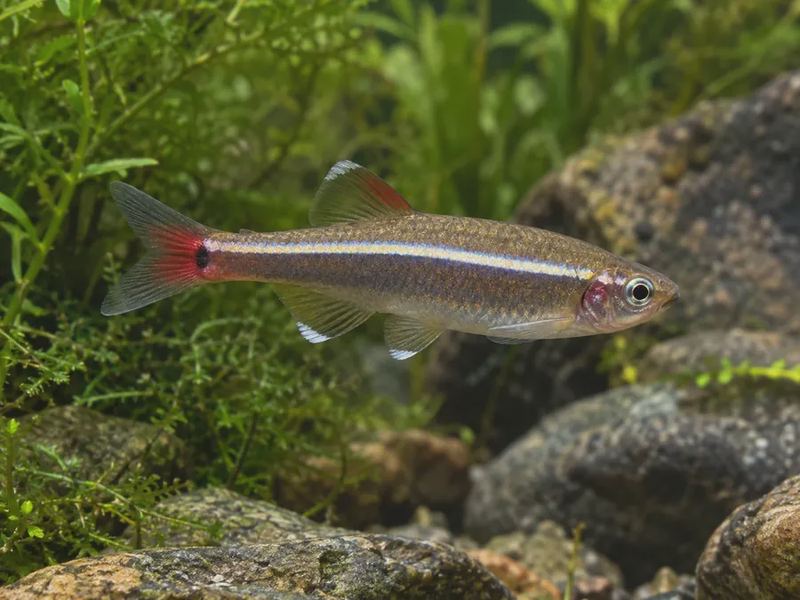
Species Overview
Tanichthys albonubes, the White Cloud Mountain Minnow, is a small cyprinid that has occupied a peculiar dual status in the aquarium world for nearly a century: it is simultaneously one of the most widely kept cold-water community fish on the planet and one of the most endangered fishes in the wild. The species was described in 1932 by the Chinese ichthyologist Lin Shu-Yen, who named the genus Tanichthys after Tan Kam Fei, a Boy Scout leader who reportedly collected the first specimens on White Cloud Mountain (Baiyun Shan) near Guangzhou in Guangdong Province, China. The specific epithet albonubes is Latin for "white cloud," a direct reference to the type locality. The common name in Chinese, 唐鱼 (táng yú) or 白云山鱼 (báiyún shān yú), reflects the same origin.
Lin's original description placed the fish in the subfamily Danioninae, and it has traditionally been treated as a danionin cyprinid allied with genera such as Danio, Devario, and Microdevario. Molecular phylogenetic work has broadly supported a danionin placement, though the precise relationships within the group remain unsettled. The genus Tanichthys itself has expanded in the twenty-first century: T. micagemmae (the Vietnamese Cardinal Minnow) was described from central Vietnam in 2001, and additional species including T. thacbaensis and T. albonubes's close relatives have been recognized from Vietnam and southern China. All are small, laterally compressed, stream-dwelling cyprinids with similar husbandry requirements.
The natural range of T. albonubes is the subject of some confusion because the fish has been introduced, escaped, or deliberately released in many subtropical and warm-temperate waters worldwide. Its confirmed native range centers on the Pearl River (Zhujiang) drainage in Guangdong Province, southern China, with historical records from hill streams on White Cloud Mountain and the surrounding region. Additional populations have been reported from Hainan Island and from northern Vietnam, though the taxonomic identity of some of these populations has been questioned. The species is a hill-stream fish by preference: it inhabits clear, cool, well-oxygenated headwaters and small tributaries with gravel or rocky substrates, often in shaded reaches with submerged vegetation and moderate current. These streams are typically soft to moderately hard, slightly acidic to neutral, and experience significant seasonal temperature swings, dropping to around 10–15 °C in winter and rising into the mid-20s °C in summer.
The conservation picture is stark. The IUCN Red List assessed T. albonubes as Endangered in 2007 and later uplisted it to Critically Endangered (Possibly Extinct in the Wild) following surveys that failed to locate the species at Baiyun Shan and many other historical sites. Habitat loss from urbanization, dam construction, water extraction, pollution, and the introduction of non-native fishes (including introduced Tanichthys and other aquarium species) are the principal threats. Small, apparently native populations have been rediscovered in remote parts of Guangdong and on Hainan, but these are fragmented and vulnerable. The irony is that the aquarium trade maintains an enormous captive population — likely numbering in the tens of millions globally — descended from a handful of founder fish collected in the 1930s and supplemented by later collections. Captive-bred white clouds are therefore not merely pets; they are a genetic reservoir for a species that may no longer exist in viable wild numbers.
Appearance & Size
The White Cloud Mountain Minnow is a slender, laterally compressed fish with a fusiform body and a slightly upturned mouth, typical of small surface- and midwater-dwelling cyprinids. Adults typically reach 3–4 cm (1.2–1.6 inches) in standard length, with well-conditioned females occasionally reaching 4.5 cm; males are generally smaller and more slender. The base coloration is an olive-brown to greyish-tan dorsum that grades into a silvery-white belly, with a distinct dark lateral stripe running from the operculum to the caudal peduncle. This stripe is more pronounced in females and in juveniles, and it can fade or intensify depending on mood, water temperature, and lighting.
The fish's signature feature is the brilliant, iridescent lateral band that runs above the dark stripe: a shimmering line of metallic green, blue, and gold that gives the species its other common name, the "Neon Tetra of cold water." The dorsal, anal, and caudal fins are edged in bright red to orange, with white or pale yellow tips on the dorsal and anal fins. The caudal fin is forked and typically shows red pigment along the upper and lower lobes. Males in breeding condition develop intensified red fin coloration, a brighter iridescent lateral band, and sometimes a slight yellowish wash on the belly. Females are fuller-bodied, especially when gravid, with less intense red in the fins and a more prominent dark lateral stripe.
Several captive color morphs and strains are widely available. The "gold" or "golden" morph is a recessive xanthic form with a pale golden body and reduced dark pigmentation; the "long-finned" or "veiltail" morph has elongated, flowing dorsal, anal, and caudal fins; and "albino" and "metallic" strains also circulate in the trade. Some of these strains are less hardy than the wild-type fish, particularly the long-finned forms, which are more prone to fin damage and nipping. There is also a "Vietnamese Cardinal Minnow" (T. micagemmae) that is sometimes confused with T. albonubes; it is a separate species with a more pronounced red lateral stripe and a smaller adult size. Genuine wild-type T. albonubes — sometimes sold as "wild-type" or "Chinese white cloud" — retain the most robust constitution and the most natural behavior.
Sexual dimorphism is reliable enough for hobbyist breeding purposes: males are slimmer, more brightly colored, and develop visible breeding tubercles (small white bumps) on the head and pectoral fin rays during spawning season, while females are rounder and broader when viewed from above. Juveniles are difficult to sex until they approach 2 cm in length. The species is not long-lived by aquarium standards; a well-kept specimen typically lives 3–5 years, with some reports of 6–7 years in cool, clean, well-maintained systems.
Diet & Feeding
Tanichthys albonubes is an opportunistic omnivore and micropredator. In the wild, stomach-content analyses of related danionins indicate a diet dominated by small aquatic invertebrates — chironomid larvae, small crustaceans, rotifers, and insect larvae — supplemented by algae, diatoms, and other plant material. In the aquarium, the species is unfussy and thrives on a varied diet. A high-quality micro-pellet or crushed flake food should form the staple, ideally one with a protein content around 35–45% and a mix of marine and plant ingredients. Because the fish are small and have comparatively short digestive tracts, foods should be small enough to swallow easily; pellets larger than about 1 mm are often ignored or mouthed and spat out.
Frozen and live foods are highly beneficial and should be offered several times per week. Suitable options include baby brine shrimp (Artemia nauplii), adult brine shrimp, daphnia, moina, cyclops, microworms, grindal worms, and finely chopped blackworms. Live foods are particularly valuable for conditioning breeders and for bringing wild-caught or newly imported fish into good condition. The species will also graze on soft algae and aufwuchs growing on plants and hardscape, and it will accept blanched vegetable matter such as spinach, zucchini, and spirulina-based preparations. A rotation of two or three staple foods plus regular frozen or live offerings is sufficient to maintain excellent color and vigor.
Feeding frequency should be two to three small meals per day for adults, with only as much food as the fish can consume in two to three minutes. Overfeeding is the single most common husbandry error with this species and leads rapidly to obesity, poor water quality, and increased susceptibility to bacterial infections. Because white clouds are active midwater feeders, food that sinks uneaten to the substrate should be siphoned out during routine maintenance. In a species-only or community tank, care should be taken that faster, more aggressive feeders such as barbs or larger tetras do not monopolize the food; white clouds are quick but not aggressive, and in mixed company they benefit from targeted feeding at both ends of the tank. Fasting one day per week is a reasonable practice for adult fish in established aquaria and helps prevent obesity.
Aquarium Setup
The White Cloud Mountain Minnow is one of the most adaptable small cyprinids in the hobby, but it rewards a setup that mimics its native hill-stream habitat. A tank of at least 45–60 cm (18–24 inches) in length and 40–60 liters (10–16 US gallons) is suitable for a group of six to eight fish; larger tanks of 75–120 liters allow for more natural shoaling behavior and easier maintenance of stable water quality. The species is a shoaler and should never be kept singly or in pairs — groups of at least six, and preferably eight to twelve, are needed for the fish to display natural behavior, reduce stress, and show their best coloration. A 60 cm tank with a group of ten to twelve white clouds, a few peaceful bottom-dwellers, and a small school of a compatible midwater species makes an excellent display.
Substrate should be fine gravel or sand in a dark to medium tone; dark substrates intensify the fish's iridescent lateral band and red fin coloration. A sand or fine-gravel substrate also allows the fish to graze and pick at aufwuchs without risk of damage to their small mouths. Driftwood, smooth river stones, and small rock piles provide structure and grazing surfaces, and they help create the shaded, dappled conditions the species prefers. A dark background and a well-planted layout will bring out the best color.
Plants are central to a good white cloud setup. The species appreciates dense plantings of fine-leaved or feathery plants — Cabomba, Ceratophyllum, Myriophyllum, Rotala, Ludwigia, and various mosses — as well as floating plants such as Salvinia, Pistia, or Limnobium to diffuse light and provide cover. Java moss, Christmas moss, and similar bryophytes are excellent for spawning and for providing microfauna for the fish to graze. Anubias and Java fern attached to wood or rock add structure without demanding high light. Because the species comes from shaded streams, it does not require intense lighting; a moderate light of around 30–50 PAR at the substrate is ample for most plant combinations, and a photoperiod of 8–10 hours is appropriate.
Filtration should provide gentle to moderate current without creating a whirlpool. A small canister filter, a sponge filter driven by an air pump, or a hang-on-back filter with the flow directed along the length of the tank all work well. The species is not a strong swimmer and can be stressed by excessive flow, particularly in smaller tanks. A tight-fitting lid is essential: white clouds are accomplished jumpers, especially when startled or during spawning, and an open top will eventually result in losses. Temperature control is discussed below, but the key point is that this is a subtropical, not tropical, fish — it does not need a heater in most homes and in fact does best at cooler temperatures than most community fish.
Water Parameters
The White Cloud Mountain Minnow is famously tolerant of a wide range of water chemistry, which is a major reason for its enduring popularity. It accepts soft to moderately hard water, slightly acidic to slightly alkaline pH, and — unusually for a small cyprinid — genuinely cool temperatures. The table below summarizes the parameters that keep the species thriving in captivity, along with the conditions recorded from its native hill streams.
| Parameter | Captive Target Range | Native Habitat (Approx.) | Notes |
|---|---|---|---|
| Temperature | 16–22 °C (61–72 °F); brief tolerance 10–28 °C | 10–15 °C winter; 20–26 °C summer | Cooler water is strongly preferred; prolonged exposure above 26 °C stresses the fish and shortens lifespan. |
| pH | 6.0–8.0 | 6.5–7.5 | Stable pH matters more than a specific value; avoid rapid swings. |
| General Hardness (GH) | 4–20 dGH (70–350 ppm) | 5–12 dGH | Adaptable; soft to moderately hard water both work well. |
| Carbonate Hardness (KH) | 2–12 dKH | 3–8 dKH | Moderate KH helps buffer pH in planted tanks. |
| Ammonia / Nitrite | 0 ppm | Undetectable | Standard closed-system requirement. |
| Nitrate | <20 ppm | Low | Weekly water changes of 25–30% maintain low nitrate. |
The single most important parameter is temperature. Tanichthys albonubes is a subtropical species that suffers in the warm water typical of many tropical community tanks. Prolonged exposure to 26–28 °C is associated with reduced appetite, faded color, increased susceptibility to bacterial and parasitic disease, and shortened lifespan. In most temperate homes, the fish does best in an unheated or minimally heated aquarium, with room temperature providing the 18–22 °C range. In warm climates or during summer heat waves, a small fan, a chiller, or simply moving the tank to a cooler part of the house may be necessary. Conversely, the fish tolerates near-freezing temperatures for short periods and can overwinter in outdoor ponds in mild temperate climates, though sudden freezes should be avoided.
Water changes of 25–30% weekly are recommended, with larger changes (up to 50%) if nitrate accumulates. The species is not sensitive to chlorine or chloramine once these are removed with a standard conditioner, and it adapts to a wide range of source-water chemistries provided changes are made gradually. In heavily planted, low-stocked tanks, water changes can be reduced somewhat, but the fish benefits from consistent dissolved-oxygen levels and low organic load. Good surface agitation — from a filter return, an airstone, or a small powerhead — is beneficial and mimics the oxygen-rich hill streams the species evolved in.
Behavior & Compatibility
White Cloud Mountain Minnows are peaceful, active, and highly social. In a well-planted tank with a group of eight or more, they form loose shoals, with males frequently sparring and displaying to one another in short, energetic bursts. The sparring is rarely injurious: males circle, flare their fins, and nudge each other, but actual biting or chasing is uncommon. The species is not territorial and does not defend spawning sites, which makes it one of the easiest small cyprinids to keep in groups. They occupy all levels of the tank but tend to favor the midwater and upper regions, particularly where current is gentle and floating plants provide dappled shade.
Compatible tankmates are peaceful, cool-water or subtropical species of similar size. Classic choices include other danionins such as Danio margaritatus (Celestial Pearl Danio), Danio erythromicron, and Microdevario kubotai; small rasboras such as Boraras brigittae and Trigonostigma species; Corydoras catfish, especially cool-tolerant species like Corydoras paleatus and C. aeneus; Otocinclus; and small loaches such as Pangio kuhli loaches. Livebearers like guppies and platies can be kept with white clouds if the temperature is kept at the lower end of the livebearers' range, though the two groups have somewhat different optima. Cold-water species such as Tanichthys micagemmae, ricefish (Oryzias spp.), and some Notropis and Pimephales species also work well in larger, cooler setups.
Tankmates to avoid include large or boisterous fish that will bully or eat the white clouds — angelfish, large barbs, most cichlids, goldfish (which are too large and messy, and which prefer even cooler water), and predatory species of any kind. Fin-nippers such as tiger barbs and some serpae tetras should also be avoided, particularly with long-finned morphs. Invertebrates are generally safe: Neocaridina and Caridina shrimp, Amano shrimp, and most snails coexist peacefully, though very small shrimp fry may be predated by adult white clouds. The species is not a threat to adult shrimp.
Because white clouds are outgoing and nearly always visible, they make excellent "dither" fish in larger aquaria, encouraging shy species to come out. They are also ideal for nano tanks and for beginner aquarists, provided the temperature is kept cool. Their only real behavioral quirk is a tendency to jump when startled, which is easily managed with a lid.
Breeding
Tanichthys albonubes is one of the easiest aquarium fishes to breed, and under good conditions it often spawns spontaneously in community tanks. The species is an egg-scatterer with no parental care. Spawning is triggered by a rise in temperature of a few degrees, an increase in live or frozen food, and the presence of fine-leaved plants or spawning mops. Males chase females through the plants, and spawning typically occurs in the early morning, with the female releasing a small number of eggs that are fertilized as they fall. Adults will eat eggs and fry if given the opportunity, so a dedicated breeding setup or a heavily planted tank with plenty of moss is necessary to raise significant numbers.
A simple breeding setup is a 10–20 liter tank with a sponge filter, a bare bottom or a thin layer of sand, and a large clump of Java moss or a spawning mop. Condition a group of four to six fish (two males to four females, or a small colony) on live and frozen foods for one to two weeks at 20–22 °C. Then raise the temperature by 2–3 °C and add cool, slightly softer water to simulate a spring rain. Spawning usually follows within a few days. Alternatively, place a pair or trio in the breeding tank and remove the adults after spawning; a single female can produce 20–50 eggs per spawn, and a well-conditioned group can produce several hundred eggs over a week.
Eggs are small (about 1 mm), adhesive, and translucent, and they hatch in 36–72 hours at 20–24 °C. The fry are tiny — around 3 mm — and free-swim within a day or two of hatching. First foods should be infusoria, vinegar eels, or commercial liquid fry food; within a few days the fry can take newly hatched brine shrimp nauplii and microworms. Growth is rapid if the fry are fed several times daily and water quality is maintained with gentle partial changes. Sexual maturity is reached at around 3–4 months, and the fish can live and breed for several years. Because the species is critically endangered in the wild, hobbyist breeding is not just a pastime but a genuine conservation contribution; maintaining genetically diverse, well-documented captive lines is valuable.
Common Diseases & Health
The White Cloud Mountain Minnow is a hardy species when kept cool and clean, but it is not immune to the standard aquarium ailments. The most common problems are those associated with warm water and poor husbandry: Ichthyophthirius multifiliis (ich), Columnaris (bacterial fin and mouth rot), Flavobacterium infections, and internal parasites. Ich presents as small white spots on the body and fins, with flashing, clamped fins, and lethargy; it is easily treated with raised temperature (though care must be taken not to exceed the species' thermal tolerance — 26 °C is a practical ceiling for treatment) combined with a commercial ich medication or salt. Columnaris appears as white, fuzzy patches on the mouth, fins, or body and is often triggered by stress, overcrowding, or warm water; it responds to antibiotics such as kanamycin or nitrofurazone, but improving husbandry is essential.
Fin rot, often secondary to nipping or poor water quality, is treated with clean water, aquarium salt, and, if necessary, a broad-spectrum antibiotic. Internal parasites — including Capillaria, Camallanus, and various flagellates — can cause weight loss, pale coloration, and stringy feces; these are best treated with praziquantel or metronidazole, ideally in a quarantine tank. Because wild-caught or newly imported fish may carry parasites, a 2–4 week quarantine period is strongly recommended for all new additions, with observation for abnormal behavior, respiration, or feces.
Prevention is straightforward and far more effective than treatment. Maintain cool, clean, well-oxygenated water; avoid overcrowding; feed a varied diet without overfeeding; quarantine new fish; and avoid sudden temperature swings. The species is not particularly sensitive to copper, so standard copper-based medications can be used with care, but invertebrates in the same tank will not tolerate them. A healthy white cloud is active, brightly colored, and eager to feed; any fish that hangs at the surface, hides constantly, or refuses food should be examined promptly. With good husbandry, disease is the exception rather than the rule, and many keepers report years of trouble-free maintenance.
FAQs
Can White Cloud Mountain Minnows live in a tropical community tank?
They can survive in tropical temperatures for a time, but they do not thrive there. The species is subtropical and does best at 16–22 °C (61–72 °F). Prolonged exposure to 26 °C or above increases stress, fades color, suppresses spawning, and shortens lifespan. If you want to keep them with tropical fish, choose tankmates that also tolerate cooler water — Celestial Pearl Danios, Boraras rasboras, Corydoras paleatus, and similar species — and keep the tank at the low end of the tropical range.
Do White Cloud Mountain Minnows need a heater?
In most temperate homes, no. Room temperature typically provides the 18–22 °C they prefer, and a heater is often unnecessary or even counterproductive. In cold rooms or during winter, a small heater set low (around 20 °C) can prevent dangerous temperature drops, but the fish tolerate brief periods near 10 °C. In warm climates, cooling — via a fan, chiller, or careful placement — is more often the challenge than heating.
How many White Cloud Mountain Minnows should I keep together?
A minimum of six, and preferably eight to twelve, in a tank of at least 45–60 cm in length. They are shoaling fish, and groups of this size reduce stress, encourage natural behavior, and produce the best coloration. A single fish or a pair will often hide, pace, or show washed-out colors. In larger tanks, groups of fifteen or more make a spectacular display.
Are White Cloud Mountain Minnows good for beginners?
Yes — they are among the best beginner fish, provided the tank is kept cool and clean. They are hardy, adaptable to a wide range of water chemistry, peaceful, inexpensive, and easy to breed. Their main requirements are a lid (they jump), a group of at least six, cool water, and regular partial water changes. They are also an excellent choice for planted nano tanks, unheated aquaria, and indoor ponds, and their critically endangered wild status makes captive breeding a meaningful contribution to the species' survival.