
Trigonostigma espei: The Lambchop Rasbora
Species Overview
Trigonostigma espei, known in the aquarium trade as the Lambchop Rasbora, is a small cyprinid native to the forested lowlands of Southeast Asia. It belongs to the family Cyprinidae, the largest family of freshwater fishes, and sits within the genus Trigonostigma, a small group of diminutive, laterally compressed rasborines that also includes the Harlequin Rasbora (T. heteromorpha), the Glowlight Rasbora (T. hengeli), and T. somphongsi. The species was described by the Dutch ichthyologist Marinus Boeseman in 1967, who placed it in the genus Rasbora as Rasbora espei. It was later reassigned to Trigonostigma following the revision of the group by Kottelat and Witte in 1999, a change now widely accepted and supported by both morphological and molecular work. The specific epithet honours the German aquarist and collector Erhard Espei, reflecting the species' long association with the ornamental fish trade.
The natural range of T. espei is centred on the Mekong basin and adjacent coastal drainages of Southeast Asia. It has been recorded from southern Thailand (including the peninsular provinces around Trang and Nakhon Si Thammarat), Cambodia, and southern Vietnam, with populations also reported from parts of the Chao Phraya basin. Within this range it occupies slow-moving and standing blackwater habitats: forest streams, peat swamps, flooded woodland, and shallow pools that are heavily shaded by overhanging vegetation. These waters are typically stained tea-brown by dissolved tannins and humic acids, are very soft, and are markedly acidic, with pH values that can fall below 5 in some localities. Water temperature is high and stable, generally between 24 and 28 °C, and dissolved oxygen levels fluctuate with the dense plant cover and organic load. The species is a shoaling fish in the wild, often found in loose aggregations of dozens of individuals among submerged roots, leaf litter, and aquatic plants, where its disruptive colour pattern—the characteristic "lambchop" marking—serves as camouflage against the dappled light and dark substrate.
Appearance & Size
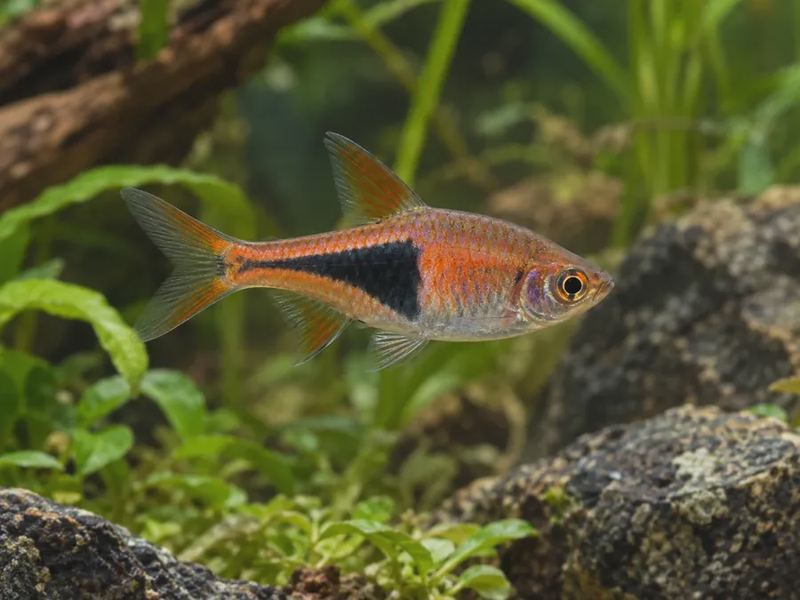
The Lambchop Rasbora is a laterally compressed, deep-bodied fish with a gently arched dorsal profile and a slightly upturned mouth. Adults typically reach 2.5–3.5 cm standard length, with females tending to be fuller-bodied and marginally larger than males. The base colour is a warm coppery-orange to reddish-brown that intensifies with age, condition, and water quality. The defining feature is the dark marking on the posterior half of the flank: in T. espei this takes the form of a narrow, tapering wedge or "lambchop" shape that is noticeably slimmer and more angular than the broad, rounded blotch of T. heteromorpha. The dark pigment is bordered above and below by bright, iridescent orange or pinkish highlights, giving the fish a luminous, almost neon quality under good lighting. The fins are largely translucent to pale orange, with the dorsal and anal fins often showing a faint dark edge. A small, dark spot is usually present at the base of the caudal fin, and the eye is large and silvery with a dark pupil.
Sexual dimorphism is subtle but consistent. Males are generally slimmer, more intensely coloured, and develop a slightly more pronounced dark wedge with sharper edges; the anal fin in males may be slightly more pointed. Females are rounder in the belly, especially when gravid, and their colour is somewhat less saturated. Juveniles are paler and may lack the full wedge until they approach maturity. Because of its small size and peaceful nature, T. espei is often confused with T. hengeli; the two can be distinguished by the shape and size of the dark marking, which in T. hengeli is smaller and more oval, and by the brighter, more extensive orange banding in T. espei. Careful observation of the marking, rather than overall colour, is the most reliable identification method.
Diet & Feeding
In the wild, T. espei is a micropredator and opportunistic omnivore. Its small mouth and streamlined body suit a diet of tiny aquatic invertebrates—microcrustaceans such as cladocerans and copepods, insect larvae, and small worms—along with algae, plant fragments, and other organic detritus. Gut-content studies of related rasborines suggest that animal matter forms a significant proportion of the diet, particularly during periods when insect larvae are abundant. In the aquarium, the species is an eager and unfussy feeder, but its small size means food must be appropriately fine. A varied diet is important for maintaining colour, condition, and breeding readiness.
High-quality micro-pellets or crushed flake food formulated for small tropical fish should form the staple. These can be supplemented with live or frozen foods such as Daphnia, Moina, baby brine shrimp (Artemia nauplii), microworms, and finely chopped bloodworm. Live foods are particularly valuable for conditioning fish prior to spawning and for bringing out the full intensity of the orange and red pigments. Because the fish feeds in mid-water and near the surface, sinking foods may be ignored; offering small amounts several times a day is preferable to one large feed, as it reduces waste and ensures all members of the shoal get enough. Overfeeding is a common cause of obesity and poor water quality in small tanks, so portions should be sized to be consumed within a minute or two. A weekly fast day is generally harmless and can help maintain digestive health.
Aquarium Setup
Despite its small size, T. espei is an active shoaler that appreciates horizontal swimming space. A tank of at least 45–60 cm in length, around 40–60 litres, is suitable for a group of eight to ten individuals; larger volumes are always preferable, as they are more stable and allow a bigger shoal, which is when the species looks its best. The tank should be mature and well-filtered but not subject to strong current, as the species comes from sluggish, still waters. A gentle flow from a sponge filter, air-driven box filter, or a canister filter with a spray bar is ideal. Tight-fitting covers are advisable because rasboras can jump when startled.
The most authentic and healthful setup mimics a blackwater biotope. A dark, fine-grained substrate—river sand or a soft, inert gravel—provides a natural base and helps the fish's colours stand out. Driftwood, particularly pieces that leach tannins, and dried Indian almond (Terminalia catappa) or oak leaves can be added to tint the water and provide cover; the resulting humic substances are believed to have mild antibacterial and antifungal benefits. Dense planting is important: species such as Cryptocoryne, Microsorum pteropus, Taxiphyllum mosses, and floating plants like Salvinia or Pistia create the shaded, dappled environment the fish favours and give the shoal a sense of security. Floating plants are especially useful because they diffuse light and reduce the risk of the fish becoming skittish.
Lighting should be moderate rather than intense, both to match the shaded natural habitat and to prevent stress and algae problems. A dimmable LED fixture or a light partially screened by floating vegetation works well. If the goal is a planted display, a moderate photoperiod of 6–8 hours is sufficient for most low- to medium-light species. The tank should be fully cycled before introducing the fish, and regular partial water changes of 20–30 % per week are recommended to keep dissolved organics low. Because the species is sensitive to sudden changes in water chemistry, new water should be matched in temperature and, where possible, in pH and hardness before being added.
Water Parameters
Wild T. espei inhabit soft, acidic, tannin-rich waters, and captive specimens do best when these conditions are approximated. The species is reasonably adaptable and will tolerate a somewhat wider range than its natural habitat provides, but extremes—particularly hard, alkaline water—should be avoided. Stability matters more than any single reading, and sudden swings in pH or temperature are a common cause of stress and disease. The table below summarises the recommended parameters for long-term maintenance, based on the species' native water chemistry and widespread aquarium experience.
| Parameter | Recommended Range | Notes |
|---|---|---|
| Temperature | 23–28 °C (73–82 °F) | 24–26 °C is ideal; avoid prolonged exposure above 28 °C. |
| pH | 5.0–7.0 | Slightly acidic to acidic; stable values matter more than exact figure. |
| General hardness (GH) | 1–8 °dGH | Very soft to soft water; avoid hard, mineral-rich water. |
| Carbonate hardness (KH) | 0–4 °dKH | Low KH helps maintain a stable, slightly acidic pH. |
| Ammonia / Nitrite | 0 ppm | Any detectable level indicates an uncycled or overloaded tank. |
| Nitrate | < 20 ppm | Keep as low as possible with regular water changes. |
| TDS | 30–150 ppm | Low total dissolved solids suit blackwater species. |
If the local tap water is hard or alkaline, mixing it with reverse-osmosis (RO) water, or using pure RO water reconstituted with a small amount of mineral supplement, is the most reliable way to reach the target range. Peat filtration or the addition of botanicals can help lower pH and hardness naturally, though these methods are slower and less precise than dilution with RO. Whatever approach is used, changes should be made gradually, and the fish should never be exposed to a rapid shift of more than about 0.3–0.5 pH units in a single day.
Behavior & Compatibility
Trigonostigma espei is a peaceful, gregarious shoaling species that should always be kept in a group. A minimum of eight to ten individuals is recommended, and larger groups of 15 or more produce a more natural, active display and reduce the likelihood of nipping or hiding. Within a shoal, a loose dominance hierarchy may form, but aggression is rarely serious; males may briefly spar or display to one another, particularly around spawning sites, without causing injury. The fish are mid-water swimmers that spend most of their time in the upper and middle layers, darting among plants and occasionally hovering near the surface. They are not territorial and can be kept alongside a wide range of similarly sized, non-aggressive tankmates.
Good companions include other small rasborines such as T. heteromorpha and T. hengeli, small danios, peaceful tetras like Paracheirodon species, and dwarf cichlids that are not overly boisterous. Bottom-dwelling species such as Corydoras catfish and small loaches make excellent additions, as they occupy a different part of the tank and help consume food that reaches the substrate. Invertebrates such as Caridina and Neocaridina shrimp and small snails are generally ignored, though very small shrimp fry may be eaten. Species to avoid include large or aggressive cichlids, territorial anabantoids, and any fish big enough to consider the rasbora a meal. Because T. espei is small and relatively timid, it should not be housed with fin-nippers or with species that compete aggressively at feeding time; if such fish are present, the rasboras may fail to get enough food and gradually lose condition.
Breeding
Breeding T. espei is achievable in the home aquarium and is similar in principle to that of the related Harlequin Rasbora, though the Lambchop Rasbora is generally considered somewhat easier to spawn. The species is an egg-scatterer that, in nature, attaches its eggs to the undersides of broad-leaved aquatic plants; in the aquarium, it will use Cryptocoryne leaves, artificial spawning mops, or even the glass and filter intake if no suitable plants are present. Condition a group of well-fed adults on live and frozen foods for two to three weeks, keeping them at around 25–26 °C with soft, slightly acidic water. A separate spawning tank of 20–40 litres, filled with soft, acidic water (pH 5.5–6.5, GH 1–4 °dGH) and furnished with fine-leaved plants or a spawning mop, gives the best results. Sponge filtration and a tight cover are essential, as the eggs and fry are tiny.
Spawning usually occurs in the early morning, often triggered by a partial water change with slightly cooler, softer water and by the first light of day. The male courts the female with displays and nudges, and the pair swims together toward a chosen spawning site, where the female deposits a small batch of adhesive eggs on the underside of a leaf or mop. The process is repeated over several hours, with a total of 50–150 eggs being typical for a well-conditioned female. The adults should be removed immediately after spawning, as they will eat the eggs. Eggs hatch in roughly 24–48 hours depending on temperature, and the free-swimming fry appear a further two to four days later, once the yolk sac is absorbed. First foods should be very small: infusoria, rotifers, or a liquid fry food, progressing to microworms and newly hatched brine shrimp nauplii as the fry grow. Growth is relatively slow, and several weeks of careful feeding and gentle water changes are needed before the young fish begin to show adult colouration.
Common Diseases & Health
Like most small freshwater cyprinids, T. espei is susceptible to the common aquarium diseases, most of which are opportunistic and linked to stress, poor water quality, or sudden environmental change. The most frequent problems are ich (Ichthyophthirius multifiliis), velvet (Oodinium), fin rot, and internal parasites. Ich presents as small white spots on the body and fins, often accompanied by flashing, clamped fins, and lethargy; it is best treated promptly with a suitable proprietary medication or with a temperature-and-salt protocol appropriate to the species, bearing in mind that rasboras are sensitive to some chemicals and to rapid temperature changes. Velvet appears as a fine, dusty golden or rust-coloured coating and is more serious, often requiring copper-based treatment, which must be used with care in soft, acidic water. Fin rot is usually bacterial and follows physical damage or poor conditions; improving water quality and, if necessary, using an antibacterial treatment will usually resolve it.
Prevention is far better than cure. Maintaining stable, species-appropriate water parameters, performing regular partial water changes, avoiding overstocking and overfeeding, and quarantining new arrivals for two to four weeks will prevent the majority of health problems. Because T. espei is a shoaling fish, disease in one individual often signals a problem affecting the whole group, so the entire tank should be assessed whenever a fish shows symptoms. A well-planted, dimly lit tank with clean, soft, slightly acidic water and a varied diet will keep Lambchop Rasboras healthy and colourful for their typical captive lifespan of three to five years, and occasionally longer.
FAQs
How many Lambchop Rasboras should I keep together?
A minimum of eight to ten is recommended, and a group of 15 or more is better. Trigonostigma espei is a shoaling species, and fish kept singly or in very small numbers often become shy, hide, and show poorer colour. A larger shoal also distributes any minor aggression and produces a much more natural, active display.
Can Lambchop Rasboras live in hard tap water?
They can survive for a time in moderately hard water, but they will not thrive. The species evolved in soft, acidic blackwater habitats, and long-term exposure to hard, alkaline water is associated with stress, faded colour, and increased susceptibility to disease. If your tap water is hard, mixing it with RO water or using peat or botanicals to reduce hardness and pH is strongly advised.
What is the difference between Trigonostigma espei and T. hengeli?
The two are very similar and are often confused in the trade. The most reliable difference is the shape of the dark flank marking: in T. espei it is a relatively long, narrow, tapering wedge, while in T. hengeli it is smaller and more oval. T. espei also tends to show a broader, brighter orange band above and below the dark marking. Both species have similar care requirements.
Will Lambchop Rasboras breed in a community tank?
They may spawn, but the eggs and fry are almost certain to be eaten by other fish, and often by the parents themselves. To raise fry successfully, condition a pair or small group in a separate spawning tank with soft, acidic water and fine-leaved plants or a spawning mop, then remove the adults as soon as spawning is complete. The eggs hatch in one to two days, and the fry require very small first foods such as infusoria or microworms.