
Amano Shrimp (Caridina Multidentata): The Ultimate Algae Eater
Species Overview
The Amano shrimp, scientifically designated Caridina multidentata (formerly Caridina japonica), stands as one of the most enduringly popular and biologically significant freshwater dwarf shrimp in the aquarium hobby. First described by the German carcinologist Hermann von Heyden in 1936, the species was initially classified under the genus Caridina and given the specific epithet japonica, a name that persisted for decades. It was only in the early 2000s that taxonomic revision, based on detailed morphological comparison of the rostrum and the dactylus of the third maxilliped, led to the reclassification to Caridina multidentata, a name that had originally been proposed by the Japanese zoologist Taku Komai. This taxonomic correction was crucial, as it resolved a long-standing confusion between two distinct but superficially similar Japanese species. Despite the name change, the aquarium trade universally refers to this shrimp as the Amano shrimp, a tribute to the legendary aquascaper Takashi Amano, who popularized its use in the 1980s and 1990s as a biological algae control agent in his meticulously planted nature aquariums.
The natural range of Caridina multidentata is confined to the freshwater river systems of Japan, specifically the southern islands of Kyushu and Honshu, and it is also recorded from Taiwan. These are fast-flowing, well-oxygenated streams and rivers that originate in forested, mountainous terrain. The water in these habitats is typically cool, clear, and moderately hard, with a neutral to slightly alkaline pH. A critical biological aspect of this species is its amphidromous life cycle. Adult shrimp live and breed in freshwater, but the fertilized eggs hatch into free-swimming planktonic larvae that are immediately swept downstream by the current into brackish or estuarine waters. The larvae spend several weeks developing in these saline environments, feeding on microscopic plankton, before metamorphosing into benthic juveniles that then migrate back upstream into freshwater to mature into adults. This amphidromous lifecycle is a fundamental constraint for aquarists, as it makes captive breeding in pure freshwater virtually impossible without a carefully controlled brackish water phase for the larvae. The wild habitat is characterized by seasonal temperature fluctuations, with winter water temperatures dropping to around 15°C (59°F) and summer peaks reaching 24-26°C (75-79°F), a range that informs their tolerance in captivity.
Appearance & Size
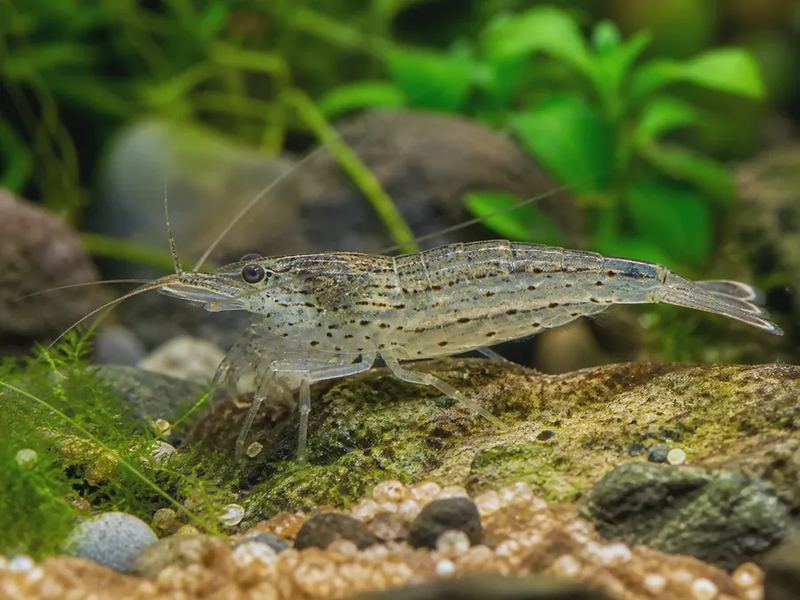
The Amano shrimp is a study in subtle elegance, often described as translucent and ghost-like, yet upon closer inspection, it reveals a complex and beautiful pattern. The body is semi-transparent, ranging from a light greyish-olive to a faint brownish or greenish hue, which allows the internal organs, such as the digestive tract and the developing eggs in females, to be faintly visible. The most distinguishing feature is the series of broken, irregular horizontal dashes and spots that run along the carapace and the abdomen. These markings are typically a dark brown, rust, or black color, and are arranged in a somewhat broken, dashed line pattern. Additionally, a series of smaller, reddish-brown or golden dots are scattered over the flanks, particularly on the pleura (side plates) of the abdomen. The overall effect is a highly effective camouflage, breaking up the shrimp's outline against the rocky, algae-covered substrates of its native streams.
In terms of size, Caridina multidentata is one of the larger dwarf shrimp species. Females are noticeably larger and more robust than males, reaching a total body length of up to 5 centimeters (2 inches), while males typically max out at around 3.5 to 4 centimeters (1.4-1.6 inches). Sexing adults is relatively straightforward. Beyond size, females develop a more pronounced, curved abdominal profile, particularly when carrying eggs, a condition known as being "berried." They also possess a broader, more rounded carapace. Males, conversely, are slimmer and more streamlined. A less obvious but reliable secondary sexual characteristic is the length of the first pair of swimming legs (pleopods); in males, the appendix masculina on the second pleopod is elongated, a feature used for transferring spermatophores during mating. The rostrum, a pointed projection extending forward from the carapace between the eyes, is long and slightly downturned, and bears a variable number of small teeth along its dorsal and ventral edges—a key morphological feature that distinguishes it from the similar Caridina typus. The eyes are large, black, and prominent, providing excellent vision for foraging in dim, shaded waters.
Diet & Feeding
In their natural habitat, Caridina multidentata are omnivorous scavengers and grazers, spending the majority of their time actively foraging over submerged rocks, driftwood, and aquatic plant leaves. Their primary dietary component is periphyton—the complex biofilm of algae, diatoms, bacteria, and microscopic organic detritus that coats surfaces in aquatic environments. They use their specialized fan-like chelipeds (small claws) to scrape and sweep these surfaces, collecting food particles and directing them to their mouthparts. This constant grazing behavior is precisely why Takashi Amano introduced them to the planted aquarium world; they are exceptionally efficient at consuming filamentous algae (such as Cladophora and Spirogyra) and various types of green spot algae that plague many aquariums. Unlike some other algae-eating species that may only consume certain types, Amano shrimp are indiscriminate grazers, making them an invaluable component of a balanced aquarium ecosystem.
In the aquarium, this natural diet must be supplemented to ensure optimal health, color, and longevity. While they will continuously graze on any available algae and biofilm, this is rarely sufficient to sustain a thriving colony in a closed system, especially in a well-maintained tank where algae growth is intentionally minimized. A high-quality, protein-rich sinking pellet or wafer formulated specifically for dwarf shrimp should be provided as a staple. These foods often contain spirulina, kelp, and other plant matter, along with essential minerals and vitamins. It is important to offer food in small quantities, ideally once daily, and to ensure that the food reaches the bottom where the shrimp are foraging. They will also eagerly consume blanched vegetables such as spinach, zucchini, and cucumber, which provide valuable fiber and trace nutrients. A varied diet is crucial; a purely vegetable-based diet can lead to molting problems due to a lack of protein, while an overly protein-heavy diet can cause issues with shell development. Observing their feeding behavior is also a useful health indicator; a healthy Amano shrimp will exhibit a visible, continuous "shoveling" motion of its front legs and will actively patrol the entire tank in search of food.
Aquarium Setup
Creating an appropriate aquarium environment for Caridina multidentata is less about replicating their exact wild conditions and more about providing a stable, mature, and biologically balanced system. These shrimp are not demanding in terms of tank size; a single specimen or a small group can be kept in a nano tank of 20 liters (5 gallons), but for a thriving colony or a mixed community, a larger aquarium of 40-60 liters (10-15 gallons) or more is recommended. The larger the water volume, the more stable the water parameters, which is the single most critical factor for shrimp health. A mature tank (aged for at least 2-3 months) is essential, as it provides a stable biological filter and a natural source of biofilm, which is the shrimp's primary first food and a constant snack. The tank should be densely planted, as the shrimp derive a significant sense of security from dense vegetation. Fine-leaved plants like Cabomba, Limnophila, and Myriophyllum provide excellent grazing surfaces and hiding places, while broad-leaved plants like Anubias and Microsorum (Java fern) offer shaded resting areas.
The substrate choice is important. While Amano shrimp are not obligate burrowers like some crayfish, they do spend considerable time sifting through the substrate in search of food. A fine-grained, inert sand or a specialized shrimp soil that buffers the water is ideal. If using a buffering soil, it is crucial to select one that maintains a neutral to slightly alkaline pH, as many active soils are designed to acidify the water, which is not optimal for this species. Driftwood, particularly Malaysian driftwood or Mopani wood, is highly recommended, as it slowly releases beneficial tannins and, more importantly, provides a vast surface area for biofilm growth. Lighting should be moderate. Amano shrimp do not require strong light, and in fact, they often prefer dimmer conditions. A standard LED light running for 6-8 hours a day is sufficient to support plant growth without causing excessive algae blooms, which, while edible, can become unsightly. Water flow should be gentle to moderate; a sponge filter or a small hang-on-back filter with a pre-filter sponge on the intake is perfect, as it provides biological filtration without creating strong currents or risking the shrimp being sucked into the filter.
Water Parameters
Amano shrimp are renowned for their hardiness and adaptability, which is a primary reason for their enduring popularity. However, "hardy" does not mean they can tolerate rapid or extreme fluctuations. They are a temperate species, and their optimal temperature range is significantly cooler than that of many tropical fish. The ideal temperature is between 20°C and 24°C (68°F - 75°F). They can tolerate short-term dips down to 15°C (59°F) and peaks up to 28°C (82°F), but prolonged exposure to temperatures above 26°C (79°F) can accelerate their metabolism, shorten their lifespan, and reduce the oxygen-carrying capacity of the water, which is particularly dangerous for a species that requires high dissolved oxygen levels. In terms of water chemistry, they prefer moderately hard, alkaline water, which mirrors their native streams. A pH in the range of 7.0 to 7.8 is ideal, with a general hardness (GH) of 6 to 10 dGH and a carbonate hardness (KH) of 4 to 6 dKH. This stable, slightly alkaline environment is crucial for proper molting, as the minerals (primarily calcium and magnesium) are essential for building a new exoskeleton.
Water quality is paramount. Ammonia and nitrite must be undetectable, and nitrate should be kept below 20 ppm. Regular weekly water changes of 20-30% using dechlorinated water are essential for maintaining water quality and replenishing trace minerals. It is critical to ensure that the temperature and pH of the new water closely match that of the tank water to avoid shocking the shrimp. Copper is highly toxic to all invertebrates, including Amano shrimp. It is vital to ensure that the water source is free of copper (check municipal water reports if using tap water) and that no copper-based medications or fertilizers are used in the tank. The following table summarizes the recommended and acceptable ranges for key water parameters:
| Parameter | Optimal Range | Acceptable Range |
|---|---|---|
| Temperature (°C) | 20 - 24 | 15 - 28 |
| Temperature (°F) | 68 - 75 | 59 - 82 |
| pH | 7.0 - 7.8 | 6.5 - 8.0 |
| General Hardness (dGH) | 6 - 10 | 4 - 12 |
| Carbonate Hardness (dKH) | 4 - 6 | 3 - 8 |
| Nitrate (NO3) | < 20 ppm | < 40 ppm |
| Ammonia (NH3) | 0 ppm | 0 ppm |
| Nitrite (NO2) | 0 ppm | 0 ppm |
Behavior & Compatibility
Caridina multidentata are peaceful, diurnal, and highly active invertebrates. They are not shy and will often be seen constantly patrolling the aquarium, foraging for food on every surface. They are social animals that do not exhibit territorial behavior, and they thrive in groups. Keeping a group of at least six or more is highly recommended, as they appear to feel more secure in numbers, and their natural foraging behavior becomes more pronounced and entertaining to observe. They are completely safe with all species of dwarf shrimp, although crossbreeding is not a concern as they are a distinct species. However, they are larger and more boisterous than most Neocaridina species, and they can outcompete them for food, so it is important to ensure that all inhabitants receive adequate nutrition. They are also known for their impressive "escape artist" abilities; they can climb out of open tanks through small gaps, so a tightly fitting lid or a mesh cover is essential.
When selecting tankmates, the primary consideration is that the Amano shrimp are not viewed as a food source. Any fish large enough to swallow them, such as adult angelfish, large cichlids, or aggressive barbs, should be avoided. Excellent tankmates include small, peaceful community fish that occupy the middle and upper water columns, such as neon tetras, cardinal tetras, rasboras, small danios, and dwarf gouramis. Bottom-dwelling fish like corydoras catfish are also generally safe, as they are peaceful scavengers that will not bother the shrimp. Otocinclus catfish are particularly good companions, as they are also algae eaters but occupy a different ecological niche, focusing on diatom films on broad leaves rather than filamentous algae. It is crucial to avoid any fish that is a known invertebrate predator, including dwarf pufferfish, loaches (such as clown loaches or yoyo loaches), and most species of crayfish. Even small, seemingly harmless fish can sometimes nip at the shrimp's long antennae, causing stress. A good rule of thumb is to keep the shrimp with fish that have small mouths and a peaceful temperament, ensuring the shrimp are always the larger species in the tank relative to their tankmates.
Breeding
Breeding Amano shrimp in the home aquarium is one of the most challenging, yet rewarding, endeavors for an advanced aquarist. The primary obstacle is their amphidromous life cycle. In the aquarium, mating is relatively straightforward. A mature female will molt, releasing pheromones into the water that attract males. The males will then swim erratically around the tank, searching for the female, and upon finding her, they will deposit spermatophores on her underside. The female then lays her eggs, which are fertilized externally as they pass over the spermatophores. The female carries the fertilized eggs under her abdomen, attached to her pleopods, where they are constantly fanned to provide oxygenation. The eggs are relatively large for a shrimp, about 1-2 mm in diameter, and are a dark green or brown color. The female will carry these eggs for approximately 4 to 6 weeks, depending on temperature, with warmer temperatures accelerating development.
The difficulty arises when the eggs hatch. They do not hatch into miniature shrimp, but rather into free-swimming planktonic larvae, known as zoea. These larvae are microscopic, translucent, and look nothing like the adults. They are positively phototactic (attracted to light) and will immediately swim towards the surface. In freshwater, these larvae will survive for a few days but will fail to develop and will eventually die. To successfully raise them, they must be transferred to a separate rearing tank containing brackish water, with a specific gravity of approximately 1.020 to 1.025 (which is roughly 50-75% seawater salinity). The larvae must be fed incredibly small food particles, such as marine microalgae (e.g., Nannochloropsis) or commercially available liquid invertebrate foods designed for marine rotifers. They will go through several larval stages over a period of 4-6 weeks, during which they are extremely sensitive to water quality and temperature fluctuations. After this period, they metamorphose into benthic juveniles that resemble miniature adult shrimp. At this point, they must be gradually acclimatized back to freshwater over several hours. This process is labor-intensive, requires a dedicated saltwater setup, and has a very low success rate for most hobbyists. For this reason, almost all Amano shrimp in the aquarium trade are wild-caught or farm-raised in specialized facilities that replicate this brackish water phase.
Common Diseases & Health
Amano shrimp are generally robust and, when kept in optimal conditions, are remarkably resistant to disease. The vast majority of health issues encountered in the aquarium are secondary to poor water quality, stress, or improper acclimation. The most common affliction is a bacterial or fungal infection, which often manifests as white, cottony patches on the exoskeleton. This is frequently a secondary infection that occurs after the shrimp has been injured or is severely stressed. The best treatment is to improve water quality and, in some cases, perform a salt bath (using aquarium-grade salt, not table salt) to help eliminate the pathogen. However, prevention is far more effective; maintaining pristine water conditions and a stable environment is the best defense.
Another significant issue is "White Ring of Death" or molting problems. This occurs when a shrimp fails to successfully shed its old exoskeleton, often becoming trapped and dying. This is almost always caused by a lack of essential minerals, particularly calcium and magnesium, in the water, or by an abrupt change in water chemistry. Ensuring that the GH is within the recommended range (6-10 dGH) and providing a varied diet rich in calcium (such as blanched spinach or specialized mineral supplements) can help prevent this. Parasitic infections, such as Scutariella japonica (a small, white, worm-like ectoparasite that attaches to the carapace), are occasionally observed, particularly in wild-caught specimens. These are treatable with commercial antiparasitic medications, but they are best avoided by quarantining new arrivals for several weeks. Finally, it is crucial to monitor for "Vorticella" or other sessile protozoans, which appear as fuzzy, greyish growths on the shell. These are usually indicative of poor water quality and high organic load. A series of water changes and a thorough gravel vacuuming will typically resolve the issue. Always remember that copper-based medications are lethal to shrimp; any treatment must be specifically labeled as invertebrate-safe.
FAQs
Q: How many Amano shrimp should I keep together?
A: Amano shrimp are social creatures and do best in groups. A group of 6 to 10 individuals is ideal for a standard planted aquarium. They are not territorial, and keeping them in larger numbers not only makes them feel more secure (resulting in more natural, visible behavior) but also ensures they have a more significant impact on algae control. In a smaller tank, even a group of 3-4 will do well, but they will be less confident and may hide more often.
Q: Will Amano shrimp breed in a freshwater aquarium?
A: The adults will mate, and the female will carry eggs to term in freshwater. However, the larvae that hatch are planktonic and require brackish water (specific gravity ~1.020) to survive and metamorphose into juvenile shrimp. Without this saline phase, the larvae will die within a few days. While it is theoretically possible to raise them, it requires a separate saltwater setup and is considered an advanced breeding challenge that is rarely successful in the home aquarium.
Q: Why are my Amano shrimp turning a pale or milky white color?
A: A temporary pale coloration is often a normal precursor to molting, as the old exoskeleton separates from the new one. However, a persistent, milky-white or opaque appearance, especially if accompanied by lethargy, is a serious warning sign. This can indicate a severe bacterial infection or a nutritional deficiency. It can also be a sign of osmotic shock from a rapid change in water parameters. If you observe this, test your water immediately and perform a large water change if parameters are off.
Q: Can I keep Amano shrimp with red cherry shrimp (Neocaridina davidi)?
A: Yes, absolutely. Amano shrimp and Red Cherry shrimp are completely compatible. They are different species and will not interbreed. They share similar dietary and environmental preferences, though Amano shrimp prefer slightly cooler water. The main consideration is that Amano shrimp are larger and more assertive at feeding time, so you must ensure that the smaller Neocaridina are getting enough food. Target feeding the smaller shrimp with a fine powder or small sinking pellets can help ensure everyone is well-fed.
References
- Journal of Crustacean Biology
- Aquaculture Research
- Taiwan Fisheries Research Institute