
Neocaridina davidi Cherry Shrimp: Care & Breeding Guide
Species Overview
The Cherry Shrimp, Neocaridina davidi, represents one of the most significant success stories in the modern aquarium hobby. Originally described scientifically by Bouvier in 1904, this diminutive crustacean belongs to the family Atyidae, a group of freshwater shrimp characterized by their specialized fan-like chelipeds adapted for filter-feeding and grazing. The genus Neocaridina was established by Kubo in 1938 to accommodate species that differ from the closely related Caridina genus in subtle morphological features, most notably the structure of the endopod of the first pleopod in males and the relative length of the rostrum. For decades, the species now known as Neocaridina davidi was incorrectly referred to in aquarium literature as Neocaridina denticulata sinensis or simply Neocaridina heteropoda, but molecular phylogenetic studies in the early 2000s clarified the taxonomy, establishing N. davidi as the correct binomial designation.
In the wild, Neocaridina davidi is native to freshwater habitats across eastern Asia, with confirmed populations in Taiwan, southern China, and parts of the Korean Peninsula. The species thrives in slow-moving streams, shallow river margins, and vegetated irrigation canals where submerged aquatic plants provide both refuge and grazing substrate. These habitats are characterized by soft to moderately hard water with a neutral to slightly alkaline pH, and temperatures that fluctuate seasonally between approximately 15°C and 28°C. The shrimp are remarkably adaptable, tolerating a wide range of environmental conditions, which has facilitated their establishment as an invasive species in several countries including Japan and parts of Europe where aquarium releases have led to feral populations. The striking red coloration that has made them so popular in the aquarium trade is not a feature of wild populations; rather, it is the result of selective breeding programs initiated in Germany and Japan in the 1990s, which fixed a genetic mutation causing the expression of red chromatophores across the entire carapace and abdomen.
From a conservation and ecological standpoint, Neocaridina davidi occupies an important niche as a detritivore and biofilm grazer. In their native habitats, they process leaf litter, algae, and organic debris, recycling nutrients and serving as prey for small fish and amphibians. Their role in the aquarium ecosystem mirrors this function, making them invaluable members of the cleanup crew in planted tanks and community aquaria. The species' reproductive strategy, characterized by continuous breeding in warm conditions and direct development of miniature adults from eggs, has made them exceptionally amenable to captive culture. Indeed, the ease with which they breed has led to their widespread availability in the aquarium trade, with tens of millions of specimens produced annually in commercial farms across Asia, Europe, and the Americas.
Appearance & Size
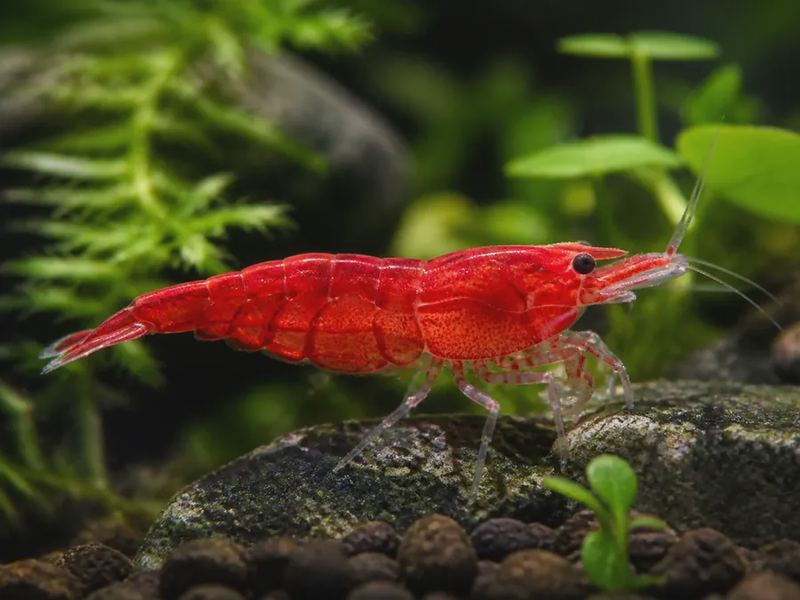
The default wild-type coloration of Neocaridina davidi is a somewhat translucent brownish-green or grey, which provides effective camouflage against the substrates of their native streams. However, the selectively bred red morph, commonly known as the Cherry Shrimp, displays a vibrant crimson pigmentation that can range from a light, almost pinkish-red to a deep, opaque burgundy depending on the grade and genetic line. The intensity of the red coloration is influenced by several factors including water quality, diet, age, and stress levels. Shrimp kept in optimal conditions with a varied diet rich in astaxanthin and other carotenoid pigments will develop deeper, more saturated colors. Conversely, shrimp experiencing poor water quality or aggressive tankmates often exhibit fading or a more translucent appearance. The grading system used by hobbyists—from low-grade "cherry" through "sakura," "fire red," and "painted" grades—reflects the opacity and uniformity of the red coloration, with higher grades commanding premium prices.
In terms of physical dimensions, adult Neocaridina davidi are small crustaceans, with females reaching a maximum total length of approximately 3 to 3.5 centimeters (1.2 to 1.4 inches) measured from the tip of the rostrum to the end of the telson. Males are notably smaller, typically maxing out at around 2 to 2.5 centimeters (0.8 to 1.0 inches). Sexual dimorphism extends beyond size; females are generally more robust and deeper-bodied, particularly when carrying eggs, and may develop a distinctive yellow or orange "saddle" in the dorsal region of the carapace when their ovaries are mature. Males are slimmer and often exhibit slightly less intense coloration. The body plan of Neocaridina davidi is typical of caridean shrimp, featuring a segmented abdomen, a protective carapace covering the cephalothorax, five pairs of walking legs, and three pairs of maxillipeds which assist in feeding. The rostrum is short and blade-like, extending just beyond the eyes, which are mounted on short stalks. The antennae are long and highly sensitive, playing a crucial role in chemoreception and tactile navigation, while the smaller antennules are used for detecting chemical cues in the water column. The fan-like pleopods on the ventral surface of the abdomen serve both for swimming and, in females, for holding and aerating developing eggs.
Diet & Feeding
Neocaridina davidi are quintessential omnivorous detritivores, exhibiting a feeding strategy centered on the continuous grazing of biofilms, periphyton, and organic detritus. In their natural habitat, they spend the majority of their active hours picking at submerged surfaces—leaves, wood, rocks, and sediment—using their specialized chelipeds to scrape and gather food particles. Their diet in the wild consists predominantly of algae, including diatoms and filamentous green algae, as well as bacteria, protozoa, fungi, and decomposing plant matter. This dietary flexibility is a key factor in their adaptability and success in both natural and artificial environments. The shrimp also opportunistically consume small invertebrates and animal matter, including insect larvae, worms, and even carrion, making them effective scavengers.
In the aquarium, providing a balanced and varied diet is essential for maintaining optimal health, coloration, and reproductive success. While Cherry Shrimp will readily graze on naturally occurring biofilm and algae within a mature tank, this alone is rarely sufficient to meet their nutritional needs, particularly in densely stocked aquaria. A high-quality commercial shrimp pellet or granule should form the staple of their diet, as these formulations are specifically designed to provide the protein, lipids, and essential minerals required for shell development and egg production. These should be supplemented with blanched vegetables such as spinach, zucchini, cucumber, and kale, which provide valuable fiber and vitamins. The shrimp show a particular affinity for the soft tissues of these vegetables, and they can be offered once or twice weekly. Additionally, the occasional provision of protein-rich foods such as frozen or live brine shrimp nauplii, daphnia, or bloodworms, as well as specialized invertebrate foods like mulberry leaves and bee pollen, can stimulate breeding and enhance color intensity.
A critical consideration in feeding Neocaridina davidi is the copper content of prepared foods. Copper is an essential trace element for crustaceans, as it is a component of hemocyanin, the oxygen-transporting protein in their blood. However, copper is also highly toxic to shrimp in elevated concentrations. Reputable commercial shrimp foods are formulated with safe, bioavailable copper levels, so they pose no risk when used as directed. Conversely, some fish foods, particularly those designed for herbivorous species, may contain copper levels that are safe for fish but potentially harmful to shrimp over prolonged periods. Hobbyists should therefore select foods specifically marketed for dwarf shrimp or invertebrates. Feeding frequency should be adjusted based on population size and the availability of natural grazing; a general guideline is to offer an amount that the shrimp can consume within two to three hours, once daily, with a fasting day once per week to allow the biofilm to regenerate.
Aquarium Setup
Creating an optimal environment for Neocaridina davidi is relatively straightforward, as these shrimp are remarkably tolerant of a range of conditions compared to many other ornamental shrimp species. However, replicating key aspects of their natural habitat will promote health, vibrant coloration, and prolific breeding. A minimum tank size of 10 gallons (approximately 38 liters) is recommended for a small colony, though many breeders successfully maintain larger populations in 20-gallon or larger aquaria. The larger water volume provides greater stability in water parameters, which is far more critical to shrimp health than the absolute values of those parameters. A well-established tank, running for at least two to three months prior to introducing shrimp, is essential, as the maturation of the nitrogen cycle and the development of a healthy biofilm are crucial for their long-term well-being.
The substrate choice is a matter of some debate among shrimp keepers. While active buffering substrates designed for Caridina species, such as ADA Amazonia or Akadama, are unnecessary and often counterproductive for Neocaridina davidi, which prefer harder, more alkaline water, a fine-grained inert substrate is ideal. Smooth gravel, sand, or a purpose-made shrimp substrate that does not alter water chemistry are all suitable options. The substrate should be shallow enough to allow easy foraging but deep enough to provide a surface for beneficial bacterial colonization. Live plants are not merely decorative but are integral to a successful shrimp aquarium. Dense plantings of mosses such as Java moss (Taxiphyllum barbieri) and Christmas moss (Vesicularia montagnei) are particularly valued, as they provide extensive surface area for biofilm growth and serve as crucial refuge for juvenile shrimp. Other excellent plant choices include Microsorum pteropus (Java fern), Anubias species, floating plants like Salvinia and Limnobium laevigatum, and stem plants such as Rotala rotundifolia and Hygrophila polysperma. These plants not only offer cover but also help maintain water quality by absorbing nitrogenous waste products.
Lighting requirements for a shrimp tank are moderate. While the plants themselves will benefit from a standard planted-tank light fixture running for 6 to 8 hours per day, the shrimp do not have any specific lighting needs. In fact, providing areas of shade and dimmer zones, through floating plants or driftwood, allows the shrimp to exhibit more natural behavior and reduces stress. Filtration is a critical component, and sponge filters are overwhelmingly the preferred choice among shrimp keepers. Sponge filters provide gentle, mechanical and biological filtration without the risk of sucking up tiny shrimp fry, which can be a problem with power filters or canister filters with unprotected intakes. The slow flow they generate is also appreciated by the shrimp, which are not strong swimmers and prefer still or slow-moving water. If a power filter is used, the intake must be covered with a fine-mesh pre-filter sponge. A heater is generally necessary to maintain stable temperatures, particularly in cooler climates, as temperature fluctuations are a leading cause of stress and failed molts.
Water Parameters
Maintaining stable and appropriate water parameters is the single most important factor in keeping Neocaridina davidi healthy and breeding. These shrimp are considered "hard water" shrimp, meaning they prefer water with a moderate to high mineral content, which is essential for proper shell formation and successful molting. The buffering capacity of the water, measured as carbonate hardness (KH) and general hardness (GH), is particularly critical. The following table provides the recommended and acceptable ranges for all key water parameters:
| Parameter | Ideal Range | Acceptable Range | Critical Threshold |
|---|---|---|---|
| Temperature | 21-23°C (70-74°F) | 18-28°C (64-82°F) | Below 15°C / Above 30°C |
| pH | 6.8-7.4 | 6.5-7.8 | Below 6.0 / Above 8.0 |
| General Hardness (GH) | 6-8 dGH | 4-10 dGH | Below 3 dGH / Above 15 dGH |
| Carbonate Hardness (KH) | 3-5 dKH | 2-8 dKH | Below 1 dKH / Above 12 dKH |
| TDS (Total Dissolved Solids) | 200-300 ppm | 150-400 ppm | Below 100 ppm / Above 500 ppm |
| Ammonia (NH3/NH4+) | 0 ppm | 0 ppm | Any detectable level |
| Nitrite (NO2-) | 0 ppm | 0 ppm | Any detectable level |
| Nitrate (NO3-) | Below 20 ppm | Below 40 ppm | Above 60 ppm |
The importance of water stability cannot be overstated. While Neocaridina davidi can tolerate a relatively wide range of parameters, they are highly sensitive to sudden changes. A rapid shift in pH, temperature, or osmotic pressure can trigger premature molting, which is often fatal. When performing water changes, the replacement water must be matched to the tank water in both temperature and chemistry. A slow drip acclimation method over 30 to 60 minutes is recommended for introducing new shrimp to a tank. Regular water changes of 10-20% weekly are generally sufficient to maintain water quality, although the frequency and volume may need adjustment based on stocking density and feeding practices. Tap water can be used if it is appropriately treated with a dechlorinator and if its parameters fall within the acceptable range. However, many hobbyists prefer to use remineralized reverse osmosis (RO) water to have complete control over the water chemistry, particularly in areas with very hard or otherwise unsuitable tap water.
Behavior & Compatibility
Neocaridina davidi are peaceful, social, and diurnal creatures that are most active during the day, although they will also forage at night. They are not territorial and will coexist peacefully with conspecifics of all ages. In a well-planted tank, they will spend the majority of their time actively grazing on surfaces, occasionally pausing to groom themselves with their mouthparts and chelipeds. They exhibit a fascinating behavior known as "swimming," where they release their grip on the substrate and use their pleopods to paddle through the water column. This is most commonly observed in females during mating, but it can also be a sign of distress if performed excessively. Molting is a critical and vulnerable period in their lives; prior to molting, a shrimp may become less active and seek shelter. After molting, the new exoskeleton is soft and pliable, and the shrimp will hide for several hours to a day until it hardens. It is during this post-molt period that they are most susceptible to predation and stress.
Selecting compatible tankmates for Neocaridina davidi requires careful consideration, as many common aquarium fish will view them as a food source. Any fish large enough to fit a shrimp in its mouth will likely consume them, including adult specimens of most tetra species, danios, and all but the smallest corydoras catfish. Even fish that are too small to eat adult shrimp may prey on newly hatched fry. The safest approach is to maintain a species-only tank, which allows for maximum breeding success and observation of natural behaviors. If tankmates are desired, the options are limited to small, peaceful, and non-piscivorous species. Micro-rasboras such as Boraras brigittae (Chili Rasbora) and Boraras maculatus (Dwarf Rasbora) are generally considered safe, as are small otocinclus catfish (Otocinclus macrospilus), which are algae eaters and will ignore the shrimp. Pygmy corydoras (Corydoras pygmaeus) and habrosus corydoras (Corydoras habrosus) are also acceptable, provided they are well-fed and the shrimp have ample hiding places. Snails, including Neritina species and Planorbarius corneus (Ramshorn snails), make excellent tankmates, as they share similar dietary preferences and environmental requirements. It is absolutely crucial to avoid all cichlids, gouramis, bettas, goldfish, and any large or aggressive fish species, as these will decimate a shrimp population.
Breeding
Breeding Neocaridina davidi is remarkably straightforward, and under optimal conditions, they will reproduce prolifically without any intervention from the aquarist. This ease of breeding is one of the primary reasons for their popularity. The reproductive cycle is continuous in warm water, with females carrying a new batch of eggs almost as soon as the previous batch has hatched. Sexual maturity is reached at approximately 3 to 4 months of age, although this can be influenced by temperature and nutrition. At this point, females will develop a visible "saddle" in the dorsal region of their carapace, which is the developing ovaries, appearing as a yellowish or greenish patch. When a female is ready to molt and mate, she releases pheromones into the water to attract males. The males will then swim actively around the tank in search of the female, and upon finding her, they will attempt to mate immediately after she has molted, while her exoskeleton is still soft.
Fertilization is internal, and the female will then carry the fertilized eggs beneath her abdomen, attached to her pleopods. A single clutch can contain anywhere from 20 to 50 eggs, depending on the size and age of the female. The eggs are initially a dark green or brown color, and they are meticulously cared for by the female, who continuously fans them with her pleopods to ensure adequate oxygenation and removes any dead or fungused eggs. The incubation period is temperature-dependent, lasting approximately 20 to 30 days at 22°C (72°F), but shortening to as little as 15 days at 26°C (79°F). It is crucial to maintain stable water parameters during this period, as stress can cause the female to abandon or prematurely release her eggs. Towards the end of the incubation period, small black eye spots become visible within the eggs, signaling that hatching is imminent.
The newly hatched shrimp are miniature replicas of the adults, approximately 2 to 3 millimeters in length, and they are immediately independent, requiring no parental care. They will seek refuge in dense vegetation, particularly moss, where they can graze on biofilm and infusoria. The survival rate of the fry is significantly enhanced by the presence of a mature, well-established tank with abundant microfauna. Supplemental feeding with powdered shrimp food or very finely crushed flakes is beneficial, as the fry have high nutritional demands for growth. The fry grow rapidly, molting every few days, and will begin to develop their characteristic red coloration within a few weeks. However, they will remain vulnerable to predation by fish and even by filter intakes until they reach a size of approximately 1 centimeter. For hobbyists looking to maximize breeding output, maintaining a species-only tank, providing ample moss and plant cover, and ensuring a varied, protein-rich diet are the most effective strategies.
Common Diseases & Health
While Neocaridina davidi are generally hardy and resilient, they are susceptible to a range of health issues, most of which are directly linked to poor water quality or stress. The most common and devastating affliction is the "White Ring of Death" or "White Band Disease," a condition where a white, opaque band appears around the body, typically at the junction between the carapace and the abdomen. This is not a parasitic infection but rather an indication of a failed or incomplete molt, often caused by sudden changes in water parameters, particularly temperature or osmotic shock, or by a deficiency in essential minerals like calcium and magnesium. Affected shrimp typically die within a few days, as they are unable to properly shed their old exoskeleton. Prevention is the only effective strategy, achieved through maintaining stable water parameters, ensuring adequate GH, and providing a diet rich in calcium and other minerals.
Another common issue is the presence of external parasites, most notably Scutariella japonica, a small, white, worm-like flatworm that attaches to the carapace and gills of the shrimp. A minor infestation may not cause noticeable harm, but heavy infestations can irritate the shrimp, leading to excessive grooming, reduced feeding, and increased susceptibility to secondary infections. Treatment involves salt baths using aquarium salt or a brief immersion in a solution of hydrogen peroxide, followed by a water change and improved tank hygiene. Ellobiopsidae, a parasitic algae-like organism, can also infect shrimp, appearing as a yellow or green fuzzy growth under the carapace. This condition is generally fatal and highly contagious, and affected shrimp should be removed and euthanized immediately to prevent spread to the rest of the colony.
Bacterial infections, such as "rust disease" or shell rot, can also occur, typically presenting as brown or black lesions on the exoskeleton. These are often secondary to physical damage or poor water quality. Improving water conditions and feeding a nutritious diet is often sufficient to allow the shrimp to recover through the molting process. The "Vorticella" or "Zoothamnium" species, which are sessile ciliates, can also attach to the shrimp, appearing as a fuzzy, greyish growth. These are usually indicative of poor water quality and high organic load, and they can be controlled through regular water changes and improved filtration. As with all aquarium livestock, the adage "prevention is better than cure" holds true. Maintaining excellent water quality, avoiding sudden parameter shifts, quarantining new plants and animals, and providing a balanced diet are the most effective measures for ensuring a healthy, thriving shrimp colony.
FAQs
Q1: How many cherry shrimp should I start with?
For a 10-gallon tank, starting with a group of 10 to 15 shrimp is ideal. This provides a good genetic base for breeding and ensures that there is enough biofilm and surface area to support the initial colony. Starting with too few shrimp can lead to inbreeding depression over successive generations, while starting with too many can overwhelm an immature tank's carrying capacity. A group of 10-15 will quickly multiply to a self-sustaining colony of several dozen to over a hundred individuals within a few months under optimal conditions.
Q2: Why are my cherry shrimp dying one by one?
The most common cause of gradual, unexplained deaths in cherry shrimp is unstable or unsuitable water parameters, particularly sudden changes in temperature, pH, or GH. Other frequent culprits include ammonia or nitrite spikes from overfeeding or an under-cycled filter, copper toxicity from tap water or fish medications, and predation from tankmates. It is essential to test your water with a liquid test kit, not test strips, and to perform a thorough evaluation of your feeding and maintenance routine. A sudden mass mortality event is almost always due to a toxin or a rapid environmental shift, whereas one-by-one deaths over weeks often indicate a chronic stressor like poor water quality or an undiagnosed parasitic infection.
Q3: How long do cherry shrimp live?
The average lifespan of Neocaridina davidi is approximately 1 to 2 years, with some individuals living slightly longer under optimal conditions. Lifespan is influenced by temperature; higher temperatures accelerate their metabolism and growth rate, but also shorten their lifespan, while cooler temperatures slow their growth and extend their longevity. The lifespan is also affected by the frequency of molting, as each molt carries a risk of complications. Providing a stable environment and a nutritious diet is the best way to ensure your shrimp reach their full lifespan.
Q4: Will cherry shrimp breed with other dwarf shrimp species?
No, Neocaridina davidi will not interbreed with Caridina species, such as Crystal Red Shrimp (Caridina cantonensis) or Amano Shrimp (Caridina multidentata). These are different genera and are reproductively isolated. However, they will interbreed with other Neocaridina species and color morphs, such as Neocaridina palmata (sometimes sold as "Blue Velvet" or "Green Jade"). If you keep different color morphs of Neocaridina davidi together, they will crossbreed, and the resulting offspring will typically revert to a wild-type brownish or clear coloration over several generations. To maintain a pure color line, it is essential to keep only one color morph per tank.
References
- Journal of Crustacean Biology
- Aquaculture Research
- Taiwan Fisheries Research Institute