
Pomacea diffusa mystery snail care guide
Species Overview
The mystery snail, Pomacea diffusa, is one of the most enduring and beloved freshwater gastropods in the aquarium hobby, yet it remains one of the most frequently misidentified species in the trade. Originally described by the American malacologist William B. Marshall in 1926, Pomacea diffusa was for decades conflated with its larger and ecologically destructive cousin, Pomacea canaliculata, the channeled apple snail. It was not until the late 20th century that malacologists recognized P. diffusa as a distinct species, differentiated primarily by shell morphology, reproductive anatomy, and a markedly less aggressive feeding behavior. The specific epithet "diffusa" derives from the Latin diffusus, meaning "spread out" or "diffuse," a nod to the species' relatively flattened, broad shell whorls compared to other apple snails.
In the wild, Pomacea diffusa is endemic to the slow-moving, nutrient-rich freshwater systems of South America, specifically the Paraná, Paraguay, and lower Amazon river basins. Its native range encompasses parts of Brazil, Bolivia, Paraguay, and northern Argentina, where it inhabits shallow, marginal zones of rivers, oxbow lakes, and seasonally flooded floodplains. These environments are characterized by soft, muddy substrates, dense emergent vegetation, and warm, turbid water with a high organic load. Unlike the more tropical P. canaliculata which thrives in rice paddies and can tolerate cooler temperatures, P. diffusa is more stenothermal, preferring consistently warm conditions between 22°C and 28°C (72°F to 82°F). In its natural habitat, the snail is a detritivore and opportunistic grazer, scraping biofilm, decaying plant matter, and algae from submerged surfaces. It is not a primary consumer of living vascular plants in the wild, a behavioral distinction that has made it vastly more suitable for the planted aquarium than its notorious relative.
The taxonomic history of the mystery snail is a cautionary tale in the aquarium trade. For years, virtually every apple snail sold in North American and European pet stores was labeled Pomacea canaliculata, leading to widespread bans and import restrictions in several countries. However, genetic and morphological studies published in the early 2000s confirmed that the vast majority of aquarium-traded specimens were actually Pomacea diffusa. This distinction is not merely academic; it has profound implications for both the hobbyist and the environment. P. diffusa does not possess the same voracious appetite for living vegetation, nor does it have the same invasive potential as P. canaliculata in temperate climates. The species remains legal in most jurisdictions, though some regions still require permits. For the aquarist, understanding this taxonomy is essential to providing appropriate care and avoiding the accidental introduction of a truly invasive species.
Appearance & Size
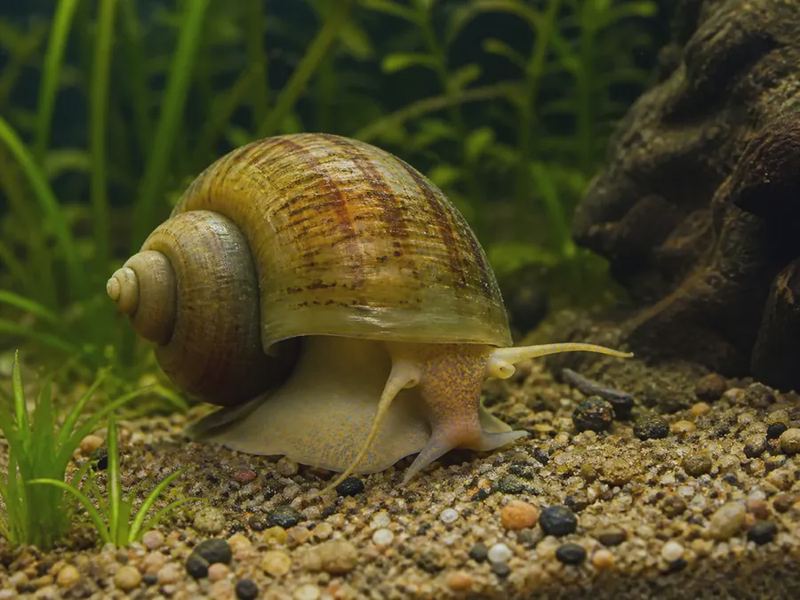
The appearance of Pomacea diffusa is characterized by a globose, somewhat flattened shell with a relatively low spire and a large, inflated body whorl. The shell is smooth and ranges in color from a pale, almost translucent yellow to a deeper golden or olive-brown, often with distinct dark spiral bands or stripes. The aperture is large and oval, closed by a corneous, dark-brown operculum that the snail uses as a trapdoor to seal itself inside during periods of drought or when disturbed. One of the most reliable distinguishing features between P. diffusa and P. canaliculata is the shape of the shell suture: in P. canaliculata, the suture is deeply channeled, while in P. diffusa it is shallow and flat. Additionally, P. diffusa has a more rounded, less elongated aperture.
In terms of size, Pomacea diffusa is a moderately large snail, reaching a maximum shell diameter of approximately 5 to 6 centimeters (2 to 2.4 inches) in well-maintained aquarium conditions. Wild specimens rarely exceed 4.5 centimeters. The body of the snail is a soft, wrinkled mass that can vary in pigmentation from pale grey to dark charcoal, often with lighter speckling. The foot is broad and muscular, used for locomotion and for anchoring the snail against substrate or glass. The head bears two long, tentacle-like sensory structures, with the eyes located at their bases, and a distinct proboscis that houses the radula, a tooth-like rasping organ used for feeding. The siphon, a fleshy tube that extends from the left side of the head, is used to breathe atmospheric air at the surface, a critical adaptation for survival in oxygen-poor water.
Color morphs in the aquarium trade are numerous and selectively bred. The most common varieties include the "golden" (a uniform yellow-gold shell with a pale body), "ivory" (a creamy white shell), "blue" (a pale blue-grey shell), and the "chestnut" or "brown" wild-type. There are also "jade" (greenish-yellow) and "magenta" (pinkish-purple) variants. It is important to note that the body color and shell color are independent traits; a snail with a golden shell may have a dark body. Growth rate is rapid in the first six months, reaching sexual maturity at around 4 to 5 months of age, and slows considerably thereafter. The lifespan of a well-cared-for mystery snail is typically 1 to 2 years, though some specimens have been known to live up to 3 years in optimal conditions.
Diet & Feeding
In its natural environment, Pomacea diffusa is an omnivorous scavenger, feeding primarily on detritus, decaying plant material, periphyton, and the thin biofilm that coats submerged surfaces. It is not an obligate herbivore and will not consume healthy living plants, a key behavioral difference from its destructive cousin P. canaliculata. In the aquarium, this species is a voracious and efficient cleaner, but it requires a balanced and varied diet to maintain good shell health and growth. The radula of the mystery snail is a specialized rasping organ, but it is comparatively weaker than that of other apple snails, making it ineffective at tearing through tough living tissue. This is why the species is considered safe for planted tanks, provided the plants are healthy and not already decaying.
A well-rounded diet for Pomacea diffusa
should include a high-quality sinking pellet or wafer formulated for bottom feeders, such as those designed for shrimp or catfish. These should form the staple of the diet, offered once daily in amounts the snail can consume within a few hours. Supplement this with blanched vegetables, including zucchini, cucumber, spinach, and kale, which should be left in the tank for no more than 24 hours to prevent water fouling. The snails will also graze on soft algae, but they are not effective at controlling green spot algae or hair algae. An essential dietary component for all apple snails is calcium, which is required for shell growth and repair. Without adequate calcium, the shell will become pitted, brittle, and prone to cracking. This can be supplemented through calcium-rich foods, cuttlebone placed in the tank, or liquid calcium additives. Many experienced keepers also offer a small piece of cuttlebone that the snails will rasp on directly.It is crucial to avoid overfeeding, as Pomacea diffusa has a large appetite and will produce substantial waste. Uneaten food decomposes rapidly, leading to ammonia spikes and deteriorating water quality, which is the primary cause of health issues in this species. In a community tank, it is often necessary to target-feed the snails to ensure they receive enough food, as faster-moving fish may outcompete them. A useful technique is to place the food on a small dish or feeding tray near the snail's favorite resting spot. Observe the snail's activity; a hungry snail will actively patrol the tank, while a satiated one will often remain buried in the substrate or attached to the glass near the waterline. The mystery snail is also known to consume the eggs of other invertebrates and will opportunistically eat dead or dying fish, making it a valuable member of the cleanup crew, but it should never be relied upon to control pest snail populations, as it is far too slow and gentle.
Aquarium Setup
Setting up an aquarium for Pomacea diffusa is relatively straightforward, as the species is adaptable and undemanding. The minimum recommended tank size for a single specimen is 10 gallons (38 liters), with an additional 5 gallons (19 liters) per additional snail. While a single snail can survive in a smaller tank, the larger volume provides more stable water parameters and more surface area for grazing. The tank should be securely covered, as mystery snails are infamous escape artists. They will readily crawl above the waterline and out of the tank if given the opportunity, especially if the water quality is poor or if they are seeking a place to lay eggs. A tight-fitting glass or acrylic lid is essential to prevent desiccation and death.
The substrate should be soft and fine-grained, such as sand or fine gravel, to protect the snail's delicate foot. Sharp, coarse gravel can cause abrasions and lead to infection. Pomacea diffusa spends a significant amount of time burrowing into the substrate, so a depth of at least 2 to 3 centimeters is recommended. Live plants are not only compatible but actively beneficial, providing grazing surfaces and hiding places. Hardy, broad-leafed plants such as Anubias, Echinodorus (Amazon sword), and Vallisneria are excellent choices. Floating plants like Salvinia or Limnobium (frogbit) are also appreciated, as they provide cover and shade. The snails will not eat healthy plants, but they may occasionally rasp on dying leaves, which is harmless. Driftwood and smooth rocks should be included to provide additional surface area for biofilm growth and to offer the snails varied terrain to explore.
Lighting requirements are minimal. Pomacea diffusa is not light-sensitive and will thrive under standard aquarium lighting, whether low or high intensity. However, moderate lighting that promotes algae growth on the glass and decorations is beneficial, as it provides a natural food source. The filtration system should be gentle but efficient; strong currents are stressful for the snails, as they have difficulty navigating turbulent water. A sponge filter or a hang-on-back filter with a flow diffuser is ideal. The intake tube of any filter must be covered with a fine sponge or mesh, as the snails are notorious for getting sucked into filter intakes and dying. A heater is required to maintain a stable temperature, as the species is tropical and cannot tolerate temperatures below 20°C (68°F) for extended periods. The heater should be placed horizontally near the substrate to ensure even heat distribution, and a heater guard is recommended to prevent the snail from burning itself on the heating element.
Water Parameters
Maintaining stable and appropriate water parameters is the single most important factor in the long-term health of Pomacea diffusa. This species is far more sensitive to poor water quality than most fish, and it is particularly susceptible to ammonia and nitrite toxicity. They also require relatively hard, alkaline water for optimal shell development. In soft, acidic water, the shell will slowly dissolve, leading to a rough, pitted appearance and increased vulnerability to physical damage. The ideal water chemistry mimics the calcium-rich, moderately buffered waters of its native South American floodplains. Regular water changes of 20-30% weekly are essential to maintain low nitrate levels and remove accumulated organic waste.
The following table summarizes the recommended water parameters for Pomacea diffusa:
| Parameter | Ideal Range | Acceptable Range | Critical Notes |
|---|---|---|---|
| Temperature | 24°C - 27°C (75°F - 80°F) | 22°C - 28°C (72°F - 82°F) | Do not exceed 29°C (84°F); prolonged exposure above this causes stress and mortality. |
| pH | 7.5 - 8.0 | 7.0 - 8.4 | Below 7.0, shell erosion accelerates; buffering capacity is critical. |
| General Hardness (GH) | 8 - 15 dGH | 6 - 18 dGH | GH is a measure of dissolved calcium and magnesium; vital for shell formation. |
| Carbonate Hardness (KH) | 5 - 10 dKH | 3 - 12 dKH | KH stabilizes pH; low KH leads to pH crashes which are fatal. |
| Ammonia (NH3) | 0 ppm | 0 ppm | Highly toxic; any measurable ammonia is an emergency. |
| Nitrite (NO2) | 0 ppm | 0 ppm | Highly toxic; indicates a broken nitrogen cycle. |
| Nitrate (NO3) | <20 ppm | <40 ppm | Chronic exposure to high nitrates causes stress and poor health. |
Tank water should be dechlorinated before introduction, and copper-based medications must be strictly avoided, as copper is lethal to all invertebrates, including snails. When performing water changes, ensure the new water is the same temperature and pH as the tank water to avoid osmotic shock. A reliable test kit is an indispensable investment for any keeper of this species. If the water in your area is very soft, you can add crushed coral or aragonite to the filter or substrate to gradually raise the hardness and alkalinity. Conversely, if the water is too hard, use reverse osmosis water mixed with tap water to achieve the desired parameters. Consistency is more important than chasing exact numbers; a stable pH of 7.2 is far better than a fluctuating pH that swings between 7.0 and 8.0.
Behavior & Compatibility
Pomacea diffusa is a peaceful, slow-moving, and largely nocturnal species. During the day, they can often be found resting on the glass near the waterline, partially buried in the substrate, or tucked into crevices among plants and decor. They become more active in the evening and at night, patrolling the tank in search of food. They are not social animals and do not require conspecifics, but they will not harm each other and can be kept in groups without issue. They are entirely non-aggressive towards fish and other invertebrates, making them ideal community tank inhabitants. One of the most fascinating behaviors of this species is its use of the siphon. The snail extends this long, fleshy tube to the water's surface to breathe atmospheric air, which allows it to survive in water with low dissolved oxygen levels. This behavior is normal and should not be cause for concern.
When selecting tankmates, the primary consideration is avoiding species that will harass or physically harm the snail. Large, aggressive or fin-nipping fish such as Tiger barbs (Puntigrus tetrazona), Oscar cichlids (Astronotus ocellatus), and Red-tailed black sharks (Epalzeorhynchos bicolor) should be avoided. These fish may nip at the snail's tentacles or operculum, causing stress and injury. Any fish large enough to swallow an adult snail is a risk. Conversely, very small, timid fish are perfectly safe. Good tankmates include tetras, rasboras, danios, gouramis, corydoras catfish, and all species of dwarf shrimp, such as Neocaridina davidi. The snails will not eat live shrimp, and the shrimp will not harm the snails, though they may compete for the same sinking foods.
It is also critical to avoid housing mystery snails with any species of loach from the genus Botia or Chromobotia, such as the clown loach (Chromobotia macracanthus), as these fish are specialized mollusk-eaters that will actively hunt and consume snails. Similarly, pufferfish of any species are absolutely incompatible, as they are obligate snail predators. When keeping multiple mystery snails together, ensure they are of similar size to prevent any accidental competition for food. The snails are entirely herbivorous and detritivorous, so they will not harm any fish fry or eggs. In fact, their constant grazing helps keep the tank clean, and their movement stirs up the substrate, preventing anaerobic pockets from forming. The only potential issue is that a large group of snails can produce a significant bioload, so adequate filtration and regular maintenance are essential.
Breeding
Breeding Pomacea diffusa in the aquarium is relatively easy, provided the snails are healthy, well-fed, and mature. The species is dioecious, meaning individuals are either male or female, and they do not change sex. Sexing a mystery snail is notoriously difficult. The most reliable method is to look at the shape of the shell aperture when viewed from the side. In males, the aperture is slightly more rounded and the shell is often smaller, while in females, the aperture is more elongated and the shell is larger. However, this is not always definitive, and the only surefire way to determine sex is to observe the snail during copulation, which can be difficult to catch. A simpler method is to wait for egg-laying; if a snail lays eggs, it is definitively female. If you keep a group of 4-5 snails, it is highly likely you will have at least one pair.
Mating occurs when the male mounts the female's shell and inserts his reproductive organ into her body. The process can last for several hours. The female will store sperm and can produce multiple clutches of eggs from a single mating. After mating, the female will seek a location above the waterline, typically on the underside of the tank lid, the top edge of the glass, or on a piece of driftwood that breaks the surface. She will deposit a clutch of eggs in a gelatinous mass that hardens upon exposure to air. The clutch appears as a pink, grape-like cluster. It is crucial that the eggs are laid above the waterline; if they are submerged, they will drown and fail to hatch. The clutch should be left in place and kept moist but not wet. If the air is too dry, the eggs may desiccate; if too wet, they may rot. A humidity level of around 70-80% is ideal, which is usually achieved naturally in a covered tank.
The incubation period is temperature-dependent, typically lasting 2 to 4 weeks at 24-27°C. The eggs will darken as they mature, and just before hatching, you can see the tiny snails moving inside. When they hatch, the juveniles drop into the water and immediately begin feeding on biofilm and algae. At this stage, they are extremely small and vulnerable to being sucked into filters or eaten by fish. If you wish to raise the young, you should remove them to a separate rearing tank or ensure the tank has no predators. The juveniles grow quickly, reaching a size of 1 centimeter in about 2-3 months. They should be fed finely crushed sinking pellets and blanched vegetables. The sex ratio of a clutch is not fixed, and as they mature, you may find you have more of one sex than the other. Breeding is most successful in tanks with a stable environment, abundant food, and hard, alkaline water. It is not uncommon for a single female to lay a clutch every week or two, but repeated breeding can deplete her calcium reserves, so it is essential to supplement her diet heavily with calcium-rich foods during this period.
Common Diseases & Health
Mystery snails are generally hardy, but they are susceptible to a specific set of health issues, most of which are directly linked to poor water quality or dietary deficiencies. The most common problem is shell erosion or pitting. This manifests as white, chalky patches, cracks, or deep pits on the shell surface. The primary cause is low pH or low calcium levels in the water, which causes the shell's calcium carbonate to dissolve. It can also be exacerbated by a diet lacking in calcium. Treatment involves adjusting the water chemistry to a pH of at least 7.5 and a GH of at least 8 dGH, as well as providing calcium-rich foods and cuttlebone. If the shell is already damaged, the snail cannot repair the existing calcified layer, but it will grow new shell at the aperture. The damage will remain as a permanent scar, but the snail can live a healthy life if the conditions are corrected.
Another frequent issue is "foot damage" or trauma. This occurs when the snail's soft foot is cut or abraded by sharp substrate, rough decor, or aggressive tankmates. The wound can become infected with bacteria or fungi, appearing as a white or grey fuzzy patch. The snail will often attempt to isolate itself, remaining buried in the substrate for extended periods. Treatment involves moving the snail to a quarantine tank with pristine water, adding a mild aquarium-safe antifungal or antibacterial treatment (ensuring it is copper-free), and allowing the snail to rest. A healthy snail can often recover from minor foot injuries without intervention, provided the water is clean.
Sudden, unexplained death is also a common issue, usually caused by a rapid change in water parameters, exposure to copper (often from tap water or medications), or starvation. Mystery snails are not as resilient as some fish and will die quickly if the water quality deteriorates. A telltale sign of a dying snail is a foul odor emanating from the shell, caused by tissue decay. It is also important to note that mystery snails are prone to "siphoning" air at the surface, and if they are unable to reach the surface because the tank is overcrowded or the water level is too high with no access to air, they may drown. Always ensure there is a gap of at least 2-3 centimeters between the water surface and the tank lid. Finally, a condition known as "mantle collapse" can occur, where the snail's body separates from its shell, often due to severe stress or injury. This is usually fatal, and the snail should be removed from the tank to prevent water fouling. Prevention is the best medicine: maintain stable water parameters, provide a varied and calcium-rich diet, and avoid any copper-based treatments.
FAQs
Q: Why is my mystery snail floating at the surface?
Floating is a common and often benign behavior in Pomacea diffusa. Snails can trap air in their shells and float to the surface, which is a natural method of transportation or a way to escape poor water conditions. If the snail is alive and active, it will eventually release the air and sink. However, if the snail floats frequently and appears lethargic, it may be a sign of poor water quality (high ammonia or nitrite) or that the snail is starving. Check your water parameters immediately and offer a sinking food pellet. If the snail is dead, it will float and emit a strong odor.
Q: Will my mystery snail eat my live aquarium plants?
No, Pomacea diffusa is not a plant-eater. Unlike the closely related Pomacea canaliculata, which is a voracious herbivore, the mystery snail feeds primarily on detritus, algae, and decaying matter. They may rasp on the surface of a leaf if it is already dying or damaged, but they will not consume healthy, living plant tissue. They are considered completely safe for planted aquariums, and many aquarists use them as a natural cleanup crew to remove dead leaves and leftover food.
Q: How can I tell if my mystery snail is dead or just sleeping?
A sleeping or resting snail will have its operculum (the trapdoor) slightly open, and you may see the soft foot inside. If you gently touch the operculum or the shell, the snail will retract and close the trapdoor. A dead snail will have the operculum completely open, the body will be limp, and it will often fall out of the shell. The most reliable test is to gently pick the snail up and smell it; a dead snail has a very distinct, foul, ammonia-like odor. If there is no odor and the snail retracts when touched, it is alive.
Q: What do I do with the pink egg clusters on my tank lid?
These are the egg clutches of your mystery snail. They must be kept above the waterline to hatch. Do not submerge them. Leave them in place, and they will hatch in 2-4 weeks, releasing tiny snails into the tank. If you do not want to raise baby snails, you can carefully scrape the clutch off the glass and freeze it for 24 hours before disposing of it in the trash. Do not flush them down the drain, as they could potentially survive in some environments. If you want to keep the babies, ensure there are no fish in the tank that will eat them, and be prepared to feed them finely crushed food.
References
- Journal of Crustacean Biology
- Aquaculture Research
- Taiwan Fisheries Research Institute