
Dwarf Gourami Care Guide (Trichogaster lalius)
Species Overview
The Dwarf Gourami, Trichogaster lalius (formerly Colisa lalia), is one of the most enduringly popular labyrinth fish in the aquarium hobby, and for good reason. Belonging to the family Osphronemidae, which encompasses the gouramis and their relatives, this species was first formally described by British naturalist William Hamilton in 1822. Hamilton, working in India, encountered this fish in the slow-moving waterways of the Ganges basin and initially placed it in the genus Trichopodus. Over the subsequent two centuries, the taxonomy has been revised multiple times, with the species shuffled between Colisa and Trichogaster before settling on its current accepted designation. The genus name Trichogaster derives from Greek, meaning "hair belly," a reference to the thread-like, highly modified pelvic fins that function as tactile sensory organs. The species epithet lalius is believed to originate from a local Bengali name for the fish.
Geographically, T. lalius is native to the Indian subcontinent, with its natural range encompassing the lower reaches of the Ganges and Brahmaputra river systems. Specifically, it is found in the northern Indian states of West Bengal, Assam, and Uttar Pradesh, extending into adjacent regions of Bangladesh. The species has also been introduced, either intentionally for aquaculture or accidentally through escape, to parts of Southeast Asia, including Singapore and Colombia, where feral populations now exist. In its native habitat, the Dwarf Gourami inhabits a very particular ecological niche: the shallow, densely vegetated margins of rivers, oxbow lakes, paddy fields, and irrigation canals. These waters are characteristically sluggish or entirely stagnant, with soft, muddy substrates and heavy overhead canopy that filters sunlight to a dappled gloom. The water is typically warm, soft, and slightly acidic, stained a tea-brown color by the decomposition of leaf litter and other organic matter. This environment is crucial to understanding the fish's physiology, particularly its labyrinth organ—a suprabranchial structure that allows it to breathe atmospheric air. In oxygen-depleted waters, this adaptation is not a luxury but a necessity for survival.
Appearance & Size
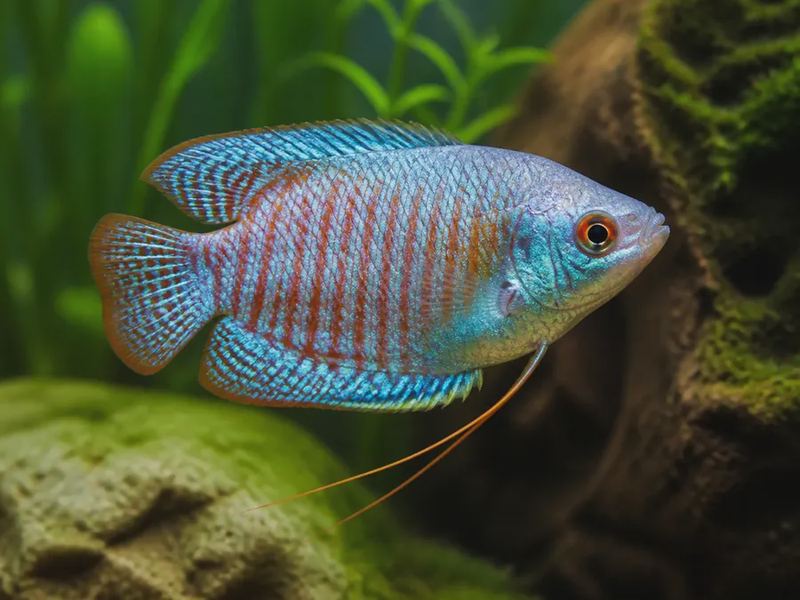
The Dwarf Gourami is a visually stunning species, exhibiting pronounced sexual dimorphism that makes sexing adults straightforward. Males are the more flamboyant of the two sexes, displaying a base coloration of brilliant, electric blue vertical stripes that run from the operculum to the caudal peduncle. These stripes alternate with irregular bands of deep, fiery orange or red, creating a kaleidoscopic effect that intensifies during courtship or territorial displays. The unpaired fins—the dorsal, anal, and caudal—are often suffused with the same orange-red hue, with the dorsal fin extending to a pointed tip. In particularly high-quality specimens, the anal fin may exhibit a delicate, translucent margin. Females, in contrast, are significantly more subdued, presenting a silvery-grey or pale olive body with only faint, vertical barring. Their fins are hyaline and rounded, and they lack the intensity of color seen in males. A useful secondary sexual characteristic is the dorsal fin shape: the male's is longer and more pointed, while the female's is shorter and rounded.
Regarding size, T. lalius is one of the smaller members of the gourami family, which is a significant factor in its suitability for community aquaria. Males typically reach a maximum standard length of approximately 8.0 centimeters (3.1 inches), while females are slightly smaller, averaging around 6.0 to 7.0 centimeters (2.4 to 2.8 inches). These dimensions are measured from the snout to the base of the caudal fin; including the tail, the fish may appear slightly larger. It is worth noting that captive-bred specimens, particularly those from Asian commercial farms, may occasionally exceed these wild-type measurements due to consistent, high-quality feeding. However, they remain a "dwarf" species relative to their larger cousins like the Three-Spot Gourami (Trichopodus trichopterus), which can reach 15 centimeters. The body shape is deep and laterally compressed, almost oval in profile, which allows for agile maneuvering through dense vegetation. The pelvic fins are elongated, thread-like filaments that extend well beyond the anal fin origin, and these are used to probe the substrate and surrounding environment for food and to sense water currents.
Diet & Feeding
In its natural habitat, Trichogaster lalius is an omnivorous generalist with a distinct preference for small invertebrate prey. Stomach content analyses of wild specimens have revealed a diet dominated by aquatic insect larvae, particularly those of mosquitoes and chironomids, along with small crustaceans such as daphnia and copepods. They also consume significant quantities of filamentous algae, soft plant matter, and detritus, which likely supplements their nutrient intake with plant-based vitamins and fiber. This feeding strategy reflects their position in the food web as opportunistic foragers, taking whatever protein-rich morsels are available in their shallow, productive waters.
In the aquarium, the Dwarf Gourami is an unfussy eater and will readily accept a wide range of prepared foods. However, to maintain optimal health, color vibrancy, and reproductive condition, a varied diet is essential. A high-quality flake or micro-pellet food should serve as the dietary staple, ideally one that is fortified with color-enhancing carotenoids to promote the male's red and blue pigmentation. This base diet should be supplemented with regular offerings of live or frozen foods. Brine shrimp (Artemia spp.), bloodworms (Chironomus larvae), daphnia, and white worms are all eagerly consumed. These protein-rich foods are particularly important when conditioning fish for breeding. It is also advisable to include vegetable matter in the diet, such as blanched spinach, spirulina flakes, or even a small piece of zucchini, to mimic their natural intake of algae. Due to their small mouths, all food should be appropriately sized. A feeding frequency of two to three small meals per day is ideal, offering only what the fish can consume within two minutes. Overfeeding is a common issue with this species, particularly with the commercially bred "dwarf gourami" strains, which are prone to obesity and associated liver problems.
Aquarium Setup
Creating a suitable aquarium environment for T. lalius is not particularly demanding, but attention to specific details will significantly enhance the fish's well-being and encourage natural behaviors. Given their small adult size, a tank with a minimum capacity of 40 liters (10.5 US gallons) is adequate for a single specimen or a pair. However, for a small group, or if the fish are to be kept in a community setting, a tank of 60 to 80 liters (16 to 21 US gallons) is far more appropriate. The tank should be longer than it is tall, as these fish are horizontal swimmers and prefer a larger footprint for patrolling their territory. A tight-fitting lid is mandatory, as Dwarf Gouramis are labyrinth fish and will occasionally gulp air from the surface; more importantly, they are known jumpers when startled, and a lid prevents escape.
The substrate should be fine and dark, such as sand or small-grained gravel. A dark substrate not only mimics their native muddy bottoms but also provides a visual contrast that makes the male's colors pop. The most critical aspect of the setup is the inclusion of dense vegetation. Dwarf Gouramis are inherently shy and feel secure when they have ample cover. A heavily planted tank replicates their natural habitat and reduces stress. Excellent plant choices include Vallisneria spp., Cryptocoryne spp., and Hygrophila spp., which tolerate the slightly cooler, softer water conditions. Floating plants, such as Salvinia or Limnobium (frogbit), are also highly recommended, as they diffuse overhead lighting and provide shade, which is crucial for these fish. The lighting itself should be moderate—not too intense—as bright, glaring light can stress them. A photoperiod of 8 to 10 hours per day is sufficient. Driftwood and smooth rocks can be added to create additional hiding spots and break up sight lines, which is particularly important if keeping multiple males. Filtration should be gentle; a sponge filter or a low-flow HOB filter is ideal, as these fish do not tolerate strong water currents.
Water Parameters
Understanding and maintaining correct water chemistry is paramount for the long-term health of Trichogaster lalius. In the wild, these fish inhabit soft, acidic waters that are heavily influenced by the decomposition of organic matter. While commercially bred specimens are often more tolerant of a wider range of conditions than their wild ancestors, replicating their natural parameters is the safest approach and is essential for triggering breeding behavior. The most critical parameter is temperature, as they are strictly tropical and require stable warmth. Fluctuations outside their preferred range can quickly lead to immunosuppression and disease.
Water hardness, both general (GH) and carbonate (KH), should be kept low. High mineral content is not only unnatural for this species but can also interfere with their osmoregulatory processes. The pH should be slightly acidic to neutral. It is also advisable to add tannins to the water, either through the use of Indian almond leaves (Terminalia catappa) or driftwood, which lowers pH further and provides beneficial antibacterial and antifungal properties. Regular water changes of 20-25% weekly are essential to keep nitrate levels low, as these fish are sensitive to organic waste buildup.
| Parameter | Ideal Range | Acceptable Range |
|---|---|---|
| Temperature | 26.0 – 28.0 °C (78.8 – 82.4 °F) | 24.0 – 30.0 °C (75.2 – 86.0 °F) |
| pH | 6.5 – 7.0 | 6.0 – 7.5 |
| General Hardness (GH) | 4 – 8 dGH | 2 – 12 dGH |
| Carbonate Hardness (KH) | 3 – 5 dKH | 1 – 8 dKH |
| Nitrate (NO3) | < 20 mg/L | < 40 mg/L |
| Ammonia (NH3) / Nitrite (NO2) | 0 mg/L | 0 mg/L |
Behavior & Compatibility
The Dwarf Gourami is generally a peaceful, shy species, but its behavior is nuanced and heavily influenced by gender and social structure. Males are territorial, particularly towards conspecifics and other gourami species with similar coloration or body shape. Two males in a small tank will almost certainly engage in prolonged, ritualized displays and physical skirmishes, which can result in torn fins or stress-related illness. Keeping a single male with multiple females is the most natural social structure, as the male will establish a breeding territory and the females will form a loose hierarchy. In a larger, heavily planted tank, a group of several males can sometimes be maintained if the tank is large enough to allow each male to establish a distinct territory with visual barriers.
When selecting tankmates, it is crucial to avoid fast, boisterous, or fin-nipping species. The long, flowing ventral filaments of the male Dwarf Gourami are particularly attractive to fin-nippers like tiger barbs (Puntigrus tetrazona) or serpae tetras (Hyphessobrycon eques), and these should be strictly avoided. Similarly, large, aggressive cichlids are unsuitable. Ideal tankmates include small, peaceful community fish that inhabit the middle and upper water columns or the bottom. Good choices include small rasboras (e.g., Boraras brigittae), small tetras like neon tetras (Paracheirodon innesi), peaceful bottom-dwellers such as Corydoras catfish, and small, non-aggressive loaches like Pangio kuhli loaches. Shrimp, such as Neocaridina davidi, are also generally safe, as the gourami's small mouth cannot easily catch adult shrimp. Snails are also excellent tankmates. It is best to avoid keeping them with other labyrinth fish, such as Bettas or other gourami species, as this can lead to cross-species aggression.
It is also important to note that Dwarf Gouramis are not schooling fish; they are solitary or pair-bonding. They will often hover in one area of the tank, using their pelvic fins to "feel" the environment. They are slow, deliberate swimmers, and their calm demeanor can make them targets of harassment from more active fish. Therefore, the aquarium should be stocked with a majority of peaceful, gentle species.
Breeding
Breeding Trichogaster lalius is a fascinating and achievable endeavor for the dedicated aquarist, as they are bubble-nest builders. The process requires a separate breeding tank, typically shallow (water depth of 15-20 cm is ideal) to ensure the warmer, more stable water temperature near the surface where the nest will be built. The water should be soft (GH < 8 dGH), acidic (pH around 6.5), and warm (around 28°C). The tank should contain a spawning mop or a broad-leaved plant, such as Cryptocoryne or a floating piece of polystyrene, to provide a surface for the nest. A gentle sponge filter is necessary, but the flow must be minimal to avoid disturbing the nest.
Conditioning is the first step. The breeding pair should be conditioned with high-quality live foods, such as mosquito larvae, bloodworms, and daphnia, for at least a week prior to introduction. The female should be visibly plump with eggs. The male is introduced first to the breeding tank, and he will immediately begin constructing a bubble nest at the surface, using plant material and air bubbles coated with saliva to create a raft of bubbles. After 24-48 hours, the female is introduced. The male will court her with an intense display of color and fin flaring, often swimming in a zigzag pattern beneath the nest. If the female is receptive, she will approach the nest, and the male will embrace her, wrapping his body around hers to squeeze out the eggs, which he then fertilizes. The eggs are lighter than water and float up into the bubble nest.
Spawning can produce several hundred eggs. Immediately after spawning, the female must be removed, as the male will become highly protective and may attack her. The male then assumes sole responsibility for guarding the nest, retrieving any eggs that fall and repairing the nest structure. The eggs hatch in approximately 24 to 36 hours, and the fry remain in the nest for another 3 to 4 days, absorbing their yolk sacs. Once the fry become free-swimming, the male should also be removed, as his parental instincts will wane and he may consume the fry. The fry require infusoria (microscopic organisms) or commercially available liquid fry food for the first few days, before graduating to newly hatched brine shrimp nauplii. The fry grow relatively quickly and will need regular water changes to maintain water quality.
Common Diseases & Health
While generally hardy, Trichogaster lalius is susceptible to several specific health issues, the most notorious of which is Dwarf Gourami Iridovirus (DGIV). This is a highly virulent, systemic viral infection that has devastated commercially bred populations in recent decades. Symptoms of DGIV include lethargy, loss of appetite, faded or darkened coloration, and the development of internal hemorrhaging that manifests as red or purple patches on the body. The disease is almost invariably fatal, with no known cure, and it is highly contagious. Because of this, it is crucial to quarantine any new Dwarf Gourami for at least 4-6 weeks before introducing them to a community tank. Many aquarists now seek out "wild-type" or locally bred specimens, which are less likely to carry the virus than mass-produced Asian imports.
Aside from DGIV, the most common ailments are parasitic and bacterial infections. Ichthyophthirius multifiliis, commonly known as "Ich" or white spot disease, is a frequent problem, presenting as small, white, salt-like grains on the fins and body. It is often triggered by sudden temperature drops or stress. Treatment involves raising the temperature gradually and using a commercial anti-parasitic medication. Another common issue is Oodinium (velvet disease), which appears as a fine, gold or rust-colored dusty film on the skin, often accompanied by clamped fins and rapid breathing. This is also treatable with commercial medications, but early detection is vital. Bacterial infections, such as fin rot, are often secondary to poor water quality or physical injury. Fin rot presents as frayed, discolored, or receding fins and is best treated by improving water conditions and, if severe, using an antibacterial treatment.
Dwarf Gouramis are also prone to a specific parasitic infection known as Dermocystidium, which causes the formation of cyst-like nodules under the skin. This is less common but is often misdiagnosed. Finally, due to their deep-bodied shape, they can suffer from swim bladder disorders, which cause buoyancy issues, often as a result of overfeeding or constipation. Preventative health is best achieved through pristine water quality, a varied and moderate diet, and low-stress environmental conditions. Avoid overcrowding and provide ample hiding places.
FAQs
Q: Can I keep two male Dwarf Gouramis together?
A: It is generally not recommended unless the aquarium is very large (over 100 liters) and densely planted. Male T. lalius are territorial and will fight, which can lead to severe stress, torn fins, and secondary infections. The fighting is not just physical; the constant stress of visual confrontation suppresses their immune system. If you want to keep more than one, the safest option is to keep a single male with two or more females, or to keep a single male as a solitary showpiece in a community tank.
Q: Why is my Dwarf Gourami always at the surface?
A: This is a completely normal behavior for a labyrinth fish. The Dwarf Gourami possesses a labyrinth organ, which is a specialized structure that allows it to breathe atmospheric oxygen directly. They will regularly rise to the surface to take a gulp of air. This is not a sign of distress unless the fish is gasping rapidly, struggling to reach the surface, or spending all its time there with clamped fins. If you observe frantic gasping, it may indicate poor water quality (low dissolved oxygen, high ammonia) or a gill infection.
Q: What is the difference between Dwarf Gourami and Honey Gourami?
A: The Honey Gourami (Trichogaster chuna) is a separate, closely related species. While both are small and peaceful, they differ in appearance and hardiness. Honey Gouramis are typically a solid, honey-gold color (males turn a deeper orange with a black throat during breeding), and they lack the striking vertical blue and red stripes of the Dwarf Gourami. More importantly, Honey Gouramis are generally considered more robust and less susceptible to Dwarf Gourami Iridovirus (DGIV) than the heavily inbred commercial strains of T. lalius.
Q: How long do Dwarf Gouramis live?
A: With proper care, a healthy Dwarf Gourami can live for 4 to 6 years in an aquarium. However, many commercially purchased specimens have a much shorter lifespan, often succumbing to disease (particularly DGIV) within the first year. Achieving a long lifespan requires stable water parameters, a high-quality varied diet, and a stress-free environment. Avoiding overcrowding and providing a well-planted tank are the best ways to maximize their longevity.
References
- Journal of Fish Biology (labyrinth organ studies)
- Ichthyological Research (Springer)
- Smithsonian National Zoo & Conservation Biology Institute