
Black Molly (Poecilia sphenops) Care Guide
Species Overview
The Black Molly, scientifically designated Poecilia sphenops, is one of the most enduring and recognizable livebearer species in the aquarium hobby, yet its common name belies a complex taxonomic and ecological history. First formally described by the French naturalist Achille Valenciennes in 1846 as Mollienesia sphenops, the species was later reclassified into the genus Poecilia, where it currently resides within the family Poeciliidae—a group renowned for internal fertilization and live birth. The specific epithet sphenops derives from Greek roots meaning "wedge-faced," a reference to the species' somewhat pointed, triangular head profile when viewed from above. However, the taxonomic story is far from settled; Poecilia sphenops is part of a larger species complex that historically included numerous described variants, some of which are now considered distinct species (e.g., Poecilia mexicana and Poecilia latipinna), while others remain cryptic or hybridogenic in nature. For the aquarist, this means that "Black Molly" often refers to a selectively bred, melanistic domestic strain of P. sphenops, sometimes crossed with P. latipinna or P. velifera to produce the large, sailfin-like dorsal fins seen in fancy varieties. The wild-type form, by contrast, is a modestly colored, silvery-olive fish that rarely appears in the trade.
Geographically, Poecilia sphenops boasts one of the most extensive natural ranges of any poeciliid, spanning from the Rio Grande drainage in southern Texas and northeastern Mexico, southward through Central America (including Belize, Guatemala, Honduras, Nicaragua, and Costa Rica), and continuing along the Pacific and Atlantic slopes of Colombia and Venezuela. This broad distribution has led to significant local adaptation, with populations inhabiting everything from fast-flowing highland streams to sluggish lowland rivers, brackish coastal lagoons, and even hypersaline inland pools. The species is notably euryhaline, meaning it tolerates a wide range of salinities, a trait that has facilitated its introduction and naturalization in tropical and subtropical regions worldwide, including parts of Africa, Asia, and Australia, where feral populations now exist. In its native habitat, P. sphenops prefers shallow, well-vegetated waters with moderate current, often congregating near submerged tree roots, overhanging vegetation, and aquatic plant beds. These microhabitats provide both refuge from predators and a rich supply of epiphytic algae, detritus, and small invertebrates, which form the bulk of its omnivorous diet. Water conditions in the wild are highly variable, but typically range from neutral to slightly alkaline (pH 7.0–8.5) with moderate hardness, and temperatures between 22–28°C (72–82°F), though the fish can endure brief excursions outside this range, particularly in seasonal pools where evaporation concentrates minerals and raises temperature.
Appearance & Size
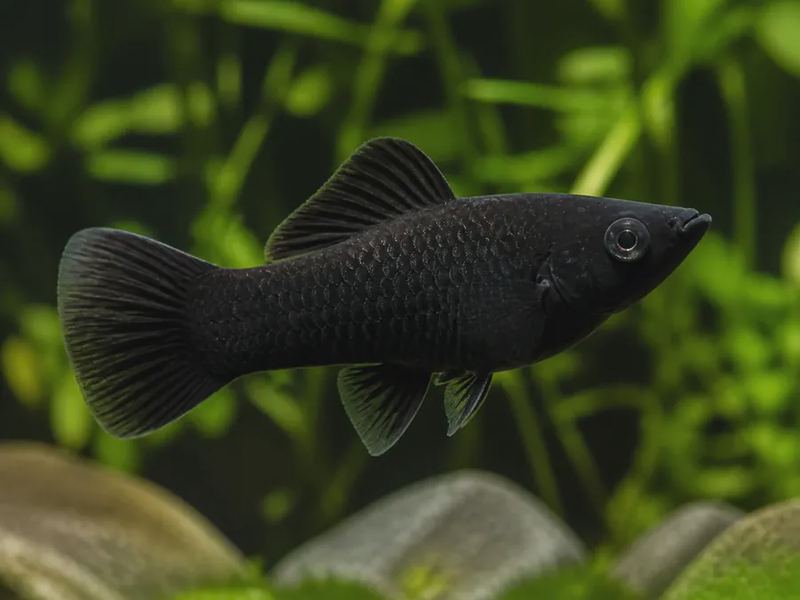
The domestic Black Molly is immediately identifiable by its uniform, velvety black coloration, a trait resulting from a recessive melanistic mutation that has been fixed through selective breeding. This black pigmentation extends across the entire body, fins, and even the eyes, giving the fish a striking, almost silhouette-like appearance that contrasts sharply with the bright green of aquarium plants. However, it is crucial to note that not all Black Mollies are entirely black; commercial strains include "gold dust" (orange-yellow with black speckling), "marble" (irregular black and white patches), "dalmatian" (white base with black spots), and "platinum" (pale silver-white), all of which are color morphs of the same species, often with varying degrees of P. latipinna or P. velifera introgression. Wild-type Poecilia sphenops exhibit a more subdued appearance: a steel-grey to olive-brown body with a silvery belly, a series of faint vertical bars along the flanks, and a distinct black spot on the dorsal fin of males, which is used in courtship displays. The species displays pronounced sexual dimorphism, with males being noticeably smaller and more slender than females. A mature male Black Molly typically reaches 5–7 cm (2–2.8 inches) in total length, while females are larger and more robust, attaining 8–10 cm (3.2–4 inches), with some exceptional specimens in spacious, well-maintained aquaria reaching 12 cm (4.7 inches).
Body shape in Poecilia sphenops is fusiform and laterally compressed, adapted for quick bursts of speed to escape predators. The dorsal fin is positioned mid-back and, in standard short-finned varieties, is rounded and modest in size; in "sailfin" or "lyretail" varieties, the dorsal fin is dramatically enlarged and elongated, and the caudal fin may develop extended filaments, though these fancy traits are more commonly associated with hybridization. The mouth is upturned and terminal, suited for surface feeding and grazing on biofilm. The scales are relatively large and cycloid, and the lateral line is prominent. One subtle but useful identification feature is the presence of 8–10 dorsal fin rays and 9–10 anal fin rays, which helps distinguish P. sphenops from its close relative Poecilia mexicana, which typically has more rays. In males, the anal fin is modified into a gonopodium—a tubular, intromittent organ used for sperm transfer—which is pointed and slightly curved, whereas in females the anal fin is fan-shaped. Juvenile Black Mollies are born fully formed and miniature, measuring 6–10 mm at birth, and they exhibit their black pigmentation from the very first day, though it may appear mottled or grey until they mature. Growth is rapid, with fish reaching sexual maturity in as little as 3–4 months under optimal conditions, though continued skeletal growth occurs for up to a year.
Diet & Feeding
In its natural environment, Poecilia sphenops is a classic omnivorous generalist, consuming a diet that shifts seasonally and with local resource availability. Gut content analyses of wild populations have revealed a predominance of filamentous algae, diatoms, and other periphyton scraped from submerged surfaces, supplemented by aquatic insect larvae, small crustaceans (notably copepods and cladocerans), and terrestrial insects that fall onto the water's surface. This feeding strategy positions the species as a crucial link in the aquatic food web, converting primary production into animal biomass. The mouthparts of P. sphenops are adapted for this dual role: a protrusible upper jaw allows for precise picking of small prey, while pharyngeal teeth grind plant matter. Interestingly, the species has been observed to engage in "grazing" behavior, moving in small shoals over plant leaves and rocks, leaving behind characteristic scrape marks on the biofilm.
For the aquarium, replicating this omnivorous diet is essential for long-term health, coloration, and reproductive vigor. A high-quality flake or micro-pellet food formulated for livebearers should serve as the staple, but it must be supplemented with vegetable matter—spirulina flakes, blanched spinach, zucchini slices, or nori sheets—offered at least twice weekly. Black Mollies are particularly prone to nutritional deficiencies if fed exclusively on protein-rich foods, which can lead to bloating, constipation, and a heightened susceptibility to the protozoan infection Ichthyophthirius multifiliis (ich). Live and frozen foods are eagerly accepted and should be provided regularly: brine shrimp nauplii, daphnia, bloodworms, and grindal worms are excellent choices that mimic the natural invertebrate component of their diet. It is worth noting that the melanistic strains of Black Molly have higher metabolic demands than wild-type fish due to the energetic cost of producing and maintaining black pigmentation; therefore, they should be fed small portions three to four times daily rather than one large feeding. Overfeeding is a common error, as these fish will readily accept food at every opportunity; a good rule of thumb is to offer only what the fish can consume within two minutes per feeding, and to fast them one day per week to allow their digestive systems to clear. Because they are surface and mid-water feeders, ensure that sinking pellets are also provided occasionally to accommodate any shy individuals that may not compete effectively at the surface.
Aquarium Setup
Designing an appropriate aquarium for Poecilia sphenops requires balancing the species' need for open swimming space with its preference for densely vegetated refugia. A minimum tank size of 75 liters (20 gallons) is recommended for a small group of 4–6 individuals, but a 120-liter (30-gallon) tank or larger is far preferable, particularly if keeping multiple males, as this provides adequate territory to diffuse aggression. The tank should be longer than it is tall, as these fish are active shoalers that appreciate horizontal swimming lanes. Substrate choice is flexible, but a fine to medium-grade sand or smooth gravel is ideal, as it allows for natural foraging without risk of injury to the delicate barbels (though P. sphenops lacks barbels, they do sift through substrate). Darker substrates, such as black sand or small-grade basalt, not only enhance the contrast of the fish's black coloration but also reduce stress by mimicking the dark, organic-rich bottoms of their native pools. Live plants are non-negotiable for this species; not only do they provide cover for fry and subordinate individuals, but they also harbor the microalgae and biofilm that the fish naturally graze. Hardy, alkaline-tolerant species are preferred, including Vallisneria spiralis, Sagittaria subulata, Anubias barteri (attached to driftwood or rock), and Cryptocoryne species. Floating plants such as Salvinia minima or Limnobium laevigatum offer shade and a sense of security, though they should not cover more than 30% of the surface area, as P. sphenops is a surface-oriented species that requires open areas for feeding and breathing.
Lighting should be moderate to bright, around 0.5–0.7 watts per liter (2–3 watts per gallon), to promote healthy plant growth and algae production, which the fish will appreciate. However, direct, harsh lighting without shaded areas can cause stress and increase the risk of "black molly disease" (a non-contagious condition characterized by skin lesions and fin erosion, often linked to chronic stress and poor water quality). The inclusion of driftwood and rock structures is beneficial, as they create visual breaks and territories, but avoid sharp-edged decor that could damage the delicate fins of fancy varieties. A tight-fitting lid is essential, as Poecilia sphenops is a notorious jumper, particularly when startled or when water quality deteriorates. Filtration should be robust but gentle; a sponge filter or a hang-on-back filter with adjustable flow is ideal, as these fish prefer minimal current. Given their high waste production and sensitivity to organic pollutants, consider adding a small powerhead with a pre-filter sponge to increase oxygenation without creating strong currents. The tank should be cycled before introducing fish, and a period of at least 4–6 weeks is recommended for a new setup to establish stable nitrifying bacteria colonies.
Water Parameters
The importance of stable, appropriate water chemistry for Poecilia sphenops cannot be overstated, particularly for the selectively bred Black Molly strains, which are markedly more sensitive to parameter fluctuations than their wild counterparts. The species is adapted to hard, alkaline water, and deviations from this can lead to osmoregulatory stress, suppressed immunity, and a condition known as "shimmies" (a trembling, uncoordinated swimming behavior caused by electrolyte imbalance). The following table summarizes the recommended parameters for long-term maintenance and breeding:
| Parameter | Optimal Range | Tolerable Range | Critical Threshold |
|---|---|---|---|
| Temperature (°C / °F) | 24–27°C / 75–80°F | 22–29°C / 72–84°F | <20°C / >32°C |
| pH | 7.5–8.2 | 7.0–8.5 | <6.5 / >9.0 |
| General Hardness (dGH) | 12–20 | 8–25 | <5 / >30 |
| Carbonate Hardness (dKH) | 10–15 | 6–20 | <4 |
| Nitrate (mg/L) | <20 | 20–40 | >60 |
| Ammonia / Nitrite | 0 mg/L | 0 mg/L | >0.1 mg/L |
| Salinity (specific gravity) | 1.000–1.003 | 1.000–1.010 | >1.015 |
Maintaining a pH above 7.0 is critical; in soft, acidic water, Black Mollies often develop a condition called "acidosis," which manifests as labored breathing, clamped fins, and eventual death. To buffer the water, incorporate crushed coral, aragonite, or limestone in the filter or substrate. Regular water changes of 25–30% weekly are essential, as P. sphenops is sensitive to nitrate accumulation, which can trigger fin rot and a weakened immune system. When performing water changes, temperature-match the new water precisely, and if tap water is soft, add a commercial alkaline buffer or a small amount of marine salt (1–2 teaspoons per 20 liters) to raise hardness and provide essential electrolytes. Interestingly, many experienced breeders maintain Black Mollies in slightly brackish water (specific gravity 1.002–1.005), which not only matches their native estuarine habitats but also reduces the osmotic stress on the fish and suppresses many external parasites. However, this practice is not necessary if the water is otherwise hard and alkaline. Always test water parameters weekly with a reliable liquid test kit, and keep a log to detect gradual trends before they become problems.
Behavior & Compatibility
Poecilia sphenops is a gregarious, peaceful species that thrives in groups, and it should always be kept in shoals of at least 4–6 individuals, with a higher proportion of females to males (ideally 2–3 females per male) to prevent harassment. Males are perpetually interested in mating and will chase females relentlessly; without a surplus of females, this pursuit can escalate into chronic stress, fin nipping, and even exhaustion of the females. In a well-balanced group, the fish exhibit a fascinating social hierarchy, with a dominant male displaying more intense coloration and more frequent courtship "dipping" behaviors (a lateral arching of the body near the female). Fights between males are usually ritualistic—parallel swimming, fin flaring, and jaw-locking—but can cause torn fins if space is cramped. The species is not aggressive toward other fish, making it an excellent community tank occupant, provided tankmates are chosen with care. Ideal companions include other peaceful livebearers such as guppies (Poecilia reticulata), platies (Xiphophorus maculatus), and swordtails (Xiphophorus hellerii), as well as small, non-nippy characins like neon tetras (Paracheirodon innesi) or rummy-nose tetras (Hemigrammus rhodostomus), and peaceful bottom-dwellers like corydoras catfish (Corydoras spp.) or small plecos (e.g., Ancistrus spp.).
Avoid keeping Black Mollies with fin-nipping species such as tiger barbs (Puntigrus tetrazona) or serpae tetras (Hyphessobrycon eques), as the long, flowing fins of fancy varieties are irresistible targets. Large, predatory cichlids (e.g., Oscar, Jack Dempsey) will view Mollies as food, and even medium-sized cichlids like angelfish (Pterophyllum scalare) may bully them. Invertebrates such as cherry shrimp (Neocaridina davidi) will be consumed as opportunistic snacks, and should not be kept with adult Mollies. A notable behavioral trait of P. sphenops is its tolerance of brackish water, which allows for cohabitation with species like bumblebee gobies (Brachygobius doriae) or mollies from other genera (e.g., Poecilia latipinna), though hybridization is possible and should be avoided if pure breeding is desired. When introducing new fish, always quarantine for at least 2–3 weeks, and add Mollies to the tank last, as they are territorial about their preferred surface-feeding zones. The species is diurnal, active throughout the day, and will often gather at the front of the glass when the aquarist approaches, a behavior that indicates they associate humans with food. They are also known to "sleep" at night, resting motionless on plant leaves or the substrate, and they prefer dim lighting during these periods.
Breeding
Breeding Poecilia sphenops is remarkably straightforward, and for many aquarists, the first sign of successful breeding is the unexpected appearance of fry in a community tank. Like all poeciliids, the species is ovoviviparous: fertilization is internal, and females give birth to live, free-swimming young. The male uses his gonopodium to transfer sperm packets (spermatophores) to the female's genital pore, and the female can store viable sperm for several months, allowing her to produce multiple broods from a single mating. This is why a female purchased from a store may give birth weeks later, even if no male is present in the home aquarium. Sexual maturity is reached at 3–5 months of age, depending on temperature and nutrition, and breeding can occur year-round under stable warm conditions. To breed selectively, set up a dedicated breeding tank of 40–60 liters (10–15 gallons) with dense floating plants (e.g., Ceratophyllum demersum or Vesicularia dubyana) and a spawning mop, as these provide cover for fry and reduce cannibalism. Condition a chosen pair or trio with high-quality live foods and vegetable matter for two weeks prior to breeding. The gestation period is 28–35 days, and a well-fed, mature female can produce 30–80 fry per brood, with larger females producing more, sometimes exceeding 100.
As the due date approaches, the pregnant female will develop a prominent, boxy swelling in the abdominal region, and a dark "gravid spot" will appear near the anal fin—a darkened area where the developing embryos' eyes are visible through the translucent body wall. In Black Mollies, this spot is less visible due to the dark pigmentation, so observation of behavioral changes (increased appetite, seeking solitude, or hiding near the substrate) is more reliable. On the day of birth, the female may shiver or twitch as she releases the fry, which emerge tail-first and immediately swim to the surface to inflate their swim bladders. Remove the female immediately after birth to prevent her from eating the fry, and feed the fry powdered flake food, infusoria, or freshly hatched brine shrimp nauplii three to five times daily. The fry grow quickly, and within 4–6 weeks they can be sexed, with males developing a gonopodium and exhibiting more intense black coloration. To prevent inbreeding depression, outcross with unrelated stock every few generations. Interestingly, Black Molly strains are sometimes difficult to breed true, as the black coloration is polygenic and influenced by environmental factors; crossing a black male with a black female usually yields mostly black offspring, but some silver or grey fry may appear, and these can be culled or used as "dither" fish. A common challenge is that fancy Black Mollies, particularly those with large sailfin dorsal fins, are often less fertile and more prone to birthing difficulties; selecting for robust body conformation over extreme finnage will improve breeding success.
Common Diseases & Health
Black Mollies are generally hardy, but their intensive domestication has rendered them more susceptible to several diseases than their wild relatives, and their dark coloration can make early signs of illness difficult to detect. The most prevalent affliction is "Molly disease," a catch-all term for a bacterial infection (often Flexibacter columnaris or Aeromonas species) that causes greyish-white, cotton-like patches on the skin, fin erosion, and lethargy. This is almost always secondary to stress, particularly from poor water quality (high ammonia or nitrite), sudden temperature drops, or overcrowding. Treatment involves immediate water changes, raising the temperature to 26–28°C (79–82°F), and adding aquarium salt at a concentration of 1–2 teaspoons per 10 liters (which also helps osmoregulation), along with a broad-spectrum antibacterial medication. Another common issue is Ichthyophthirius multifiliis (ich), a protozoan parasite that presents as white pinhead-sized spots on the body and fins. Because Black Mollies are scaleless only in the sense of having small scales, ich can be particularly irritating; treatment with a commercial ich remedy, along with a temperature increase to 30°C (86°F) for 3–5 days, is effective, provided the fish are otherwise healthy.
Fungal infections, often appearing as white, fluffy growths on wounds or clamped fins, are secondary to physical injury or bacterial infection, and are treated with antifungal agents. Internal parasites, such as Camallanus worms, can be introduced via live foods; symptoms include emaciation, red thread-like worms protruding from the anus, and a loss of appetite. Treatment with a dewormer containing levamisole or fenbendazole is necessary, and quarantine of new fish is essential. A less infectious but equally concerning condition is "shimmies," a neurological disturbance characterized by a side-to-side rocking motion and a loss of buoyancy control. This is not a pathogen but a symptom of severe electrolyte imbalance, typically caused by keeping the fish in soft, acidic water. Correcting the water hardness and pH, and adding a small amount of marine salt, usually resolves the issue within 24–48 hours. Another problem specific to fancy Black Mollies is "fin rot," which is a progressive necrosis of the dorsal and caudal fins, often caused by Pseudomonas or Mycobacterium bacteria. Early signs include a milky white edge on the fins, which then fray and disintegrate. Treatment requires pristine water conditions, antibiotic baths, and, in severe cases, culling to prevent spread. Finally, obesity and hepatic lipidosis are common in overfed Mollies; a distended abdomen in a non-pregnant fish, along with a yellowish tint to the body, indicates fat accumulation, and the treatment is dietary restriction and increased vegetable matter. Regular observation, a strict maintenance schedule, and quarantining all new additions are the pillars of preventive health care for this species.
FAQs
Q: Can Black Mollies live in freshwater, or do they require salt?
A: Black Mollies can live and breed in pure freshwater, provided the water is hard and alkaline (pH above 7.5, dGH above 10). However, they are naturally adapted to brackish environments, and adding a small amount of aquarium salt (0.5–1 teaspoon per 10 liters) or marine salt mix significantly improves their osmoregulatory function, reduces stress, and suppresses external parasites. If you keep them in soft, acidic water, they will almost certainly develop health problems; in such cases, salt is not optional—it is a necessity.
Q: Why is my Black Molly swimming upside down or at a 45-degree angle?
A: This is a classic sign of swim bladder disorder, often caused by overeating, constipation, or a sudden change in water temperature. Black Mollies are particularly prone to this if fed dry foods that expand in the gut. Fast the fish for 24–48 hours, then feed a blanched, deshelled pea (mashed into small pieces) to act as a laxative. Ensure the water temperature is stable and within the recommended range. If the problem persists, check water parameters for ammonia or nitrite spikes, as these can also cause buoyancy issues.
Q: How many Black Mollies should I keep together, and what is the ideal male-to-female ratio?
A: Black Mollies are social and should never be kept alone. A group of at least 4–6 individuals is recommended, with a ratio of 2–3 females per male. This ratio is critical because males are relentless in their pursuit of females; without enough females, the females will be stressed, and the males will fight among themselves. In a 20-gallon tank, a group of 5 (1 male, 4 females) is a good starting point.
Q: My Black Molly gave birth, but I only see a few fry. Did she eat them?
A: Yes, almost certainly. Adult Mollies, including the mother, will readily consume their own fry if given the opportunity. To maximize fry survival, move the pregnant female to a separate breeding tank with dense floating plants (e.g., Java moss) before she gives birth, and remove her immediately after delivery. Alternatively, in a heavily planted community tank, some fry will survive by hiding in the foliage, but the survival rate will be low. For serious breeding, a dedicated fry tank is essential.
References
- Science (AAAS)
- Proceedings of the Royal Society B
- Oxford University Dept. of Zoology (Endler lab)