
Xiphophorus maculatus: The Southern Platyfish
Species Overview
The Southern Platy, Xiphophorus maculatus, is one of the most enduring and widely recognized freshwater fish in the aquarium hobby, yet its scientific and natural history is often overshadowed by its commonality in pet stores. Described originally by Günther in 1866, the species was first scientifically documented from specimens collected in the Río Papaloapan drainage in Veracruz, Mexico. The genus name Xiphophorus derives from the Greek for "sword-bearer," a reference to the elongated caudal fin extensions seen in males of some congeners, although notably, X. maculatus males lack this prominent sword. The specific epithet maculatus refers to the species' characteristic spotted or blotched patterning, a feature that has been selectively amplified in countless domesticated strains. The species belongs to the family Poeciliidae, a group of live-bearing freshwater fishes that also includes guppies (Poecilia reticulata) and mollies (Poecilia sphenops), all sharing internal fertilization and the production of free-swimming young.
In its natural range, Xiphophorus maculatus is distributed along the Atlantic slope of Central America, from the state of Veracruz in southern Mexico through Belize, Guatemala, and into northern Honduras. The species is most abundant in slow-moving, lowland river systems, drainage ditches, and seasonal floodplain pools. Unlike many rift lake cichlids or fast-water characins, the Southern Platy is a species of warm, turbid, and often vegetation-choked waters. These habitats are typically characterized by soft, silty substrates and dense stands of emergent and submerged aquatic plants. Water flow is minimal to nonexistent, and the fish are frequently found in shallow margins where temperatures can fluctuate considerably between day and night. The wild environment is seasonally dynamic; during the wet season, water levels rise dramatically, inundating adjacent forests and grasslands, while the dry season concentrates fish into shrinking pools where dissolved oxygen can drop. This adaptability to variable and often challenging conditions is a key factor in the species' hardiness in captivity and its ability to establish feral populations in tropical regions worldwide, from Colombia to Southeast Asia.
For the aquarist, understanding that X. maculatus is a fish of warm, low-flow, alkaline-to-neutral waters is essential for replicating its natural success. The species has been in the aquarium trade since the early 20th century, and intensive selective breeding has produced a bewildering array of color morphs, including the ubiquitous red wag, sunset, blue, and the various "mickey mouse" patterns. However, the wild-type fish remains a subtly beautiful creature, typically exhibiting a golden-olive base color with a series of dark, irregular blotches along the flanks and a distinctive black crescent or "comma" on the caudal peduncle. These wild markings serve as disruptive camouflage in the dappled light of their native, plant-shaded waters. The species is also of significant scientific interest, having been a model organism for studies in behavioral ecology, sexual selection, and, most notably, cancer genetics, as certain hybrids between X. maculatus and other Xiphophorus species are prone to melanoma-like tumors, providing a unique window into the genetic basis of oncogenesis.
Appearance & Size
The Southern Platy is a robust, deep-bodied fish with a relatively short, laterally compressed form. Its dorsal profile is noticeably arched, giving it a somewhat rhomboidal shape that distinguishes it from the more slender swordtails (Xiphophorus hellerii) and the more elongated mollies. The head is blunt and the mouth is upturned and terminal, adapted for picking at surface insects and grazing on periphyton. The caudal fin is rounded, and the dorsal fin is positioned approximately mid-body. In terms of sexual dimorphism, males are generally smaller and more slender than females, and they possess a modified anal fin called a gonopodium, which is used for internal fertilization. Females are typically larger, deeper-bodied, and exhibit a more rounded, gravid appearance, especially when carrying developing embryos. Adult size is modest, with males reaching a maximum total length of approximately 4 centimeters (1.6 inches), while females can attain 6 centimeters (2.4 inches), though aquarium specimens rarely exceed these dimensions in well-maintained conditions.
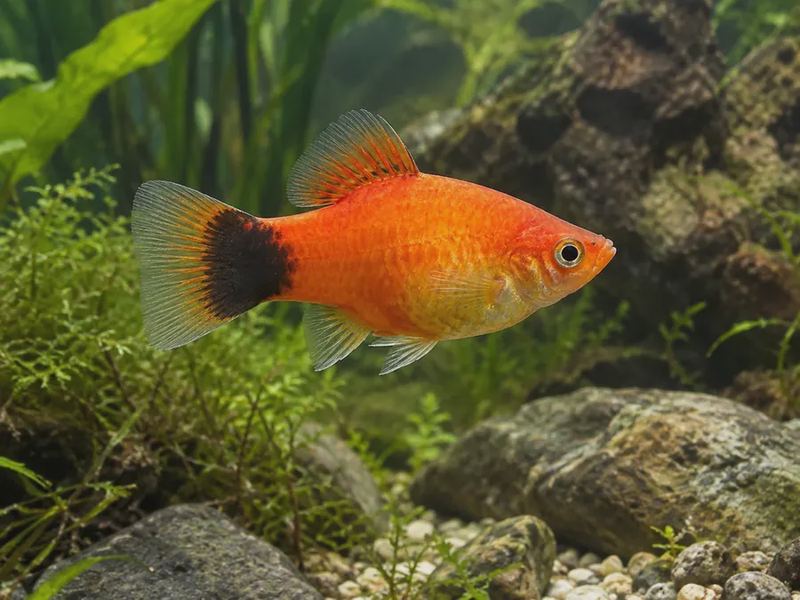
Color variation in domesticated Xiphophorus maculatus is extraordinary, far exceeding the natural range of the species. Wild-type fish are generally olive-brown to golden-yellow with a series of black, vertically elongated blotches that can coalesce into irregular bars. The belly is lighter, often silvery-white. The caudal peduncle bears a characteristic dark, crescent-shaped marking. In selectively bred strains, these patterns have been transformed. The "red wag" displays a solid, bright red body with jet-black dorsal and caudal fins. The "sunset" morph exhibits a gradient from bright yellow at the head to deep orange-red at the tail. The "blue" platy has a shimmering, metallic blue sheen over a silver base. The "mickey mouse" platy, perhaps the most whimsical, features a black spot at the base of the caudal fin with two smaller spots immediately anterior to it, resembling the silhouette of a cartoon character's head. It is crucial to note that these color morphs are not distinct species or subspecies; they are all X. maculatus and can interbreed freely, producing a kaleidoscope of offspring. Furthermore, the species is known to hybridize readily with the green swordtail (X. hellerii) and the variable platy (Xiphophorus variatus) in captivity, leading to many commercially available "platies" that are actually interspecific hybrids, though pure X. maculatus strains remain common.
One of the most fascinating aspects of platy coloration is its plasticity. The intensity of red, orange, and yellow pigments is directly influenced by dietary carotenoids. Fish fed a diet deficient in these compounds will gradually fade, losing their vibrant hues, while supplementation with high-quality, color-enhancing foods restores their brilliance. This is not merely cosmetic; carotenoid-based coloration in livebearers is often an honest signal of health and foraging ability, influencing mate choice. Additionally, the black pigmentation (melanin) is genetically controlled and generally stable, though stress can cause temporary paling or darkening. The dorsal fin in males is sometimes more pointed than in females, but this is a subtle distinction. For the aquarist, the practical takeaway is that a platy's appearance is a direct reflection of both its genetic lineage and the quality of its environment and diet.
Diet & Feeding
In its natural habitat, Xiphophorus maculatus is an omnivorous generalist with a strong tendency toward herbivory. Gut content analyses of wild specimens have revealed a diet composed predominantly of filamentous algae, diatoms, and detritus, supplemented by a significant proportion of aquatic insect larvae, small crustaceans, and terrestrial insects that fall onto the water's surface. This dietary flexibility is a hallmark of the species' ecological success. The upturned mouth is well-suited for skimming surface films, where they consume mosquito larvae and other aerial fallout. Conversely, they are frequently observed grazing on submerged wood, rocks, and plant leaves, scraping off periphyton and biofilm with their small, pharyngeal teeth. This constant, low-level feeding behavior is an important aspect of their biology; they are not pulse-feeders but rather continuous grazers.
For the aquarium keeper, replicating this omnivorous-herbivorous diet is straightforward but requires attention to quality and variety. A high-quality flake food or small pellet designed for tropical livebearers should form the staple of the diet. However, it is essential to supplement this dry food with fresh or frozen foods to ensure optimal health and coloration. Offer small portions of frozen or live Daphnia, Artemia (brine shrimp), or bloodworms two to three times per week. These protein-rich foods are particularly important for conditioning breeding pairs and promoting growth in juveniles. Crucially, unlike many carnivorous fish, platies require a substantial proportion of plant matter in their diet. This can be provided in several ways: blanched spinach, zucchini, or cucumber slices are readily accepted and should be offered once or twice a week. Alternatively, commercially available algae wafers or spirulina-based flakes are excellent, convenient sources of vegetable matter. The presence of live aquatic plants in the aquarium is not a sufficient food source, but platies will graze on soft-leaved species and any attached algae, which is beneficial for their digestive health.
Feeding frequency should mimic their natural grazing behavior. Adult platies benefit from two to three small feedings per day, with each feeding lasting no more than two to three minutes, ensuring no uneaten food remains to pollute the water. Overfeeding is a common cause of health issues, particularly in livebearers, leading to obesity, constipation, and deteriorated water quality from excess organic waste. Juvenile platies, due to their rapid growth rates, should be fed more frequently—up to four or five small meals per day of finely crushed flake or powdered fry food. It is also noteworthy that platies are not shy feeders and will readily compete for food at the surface, mid-water, and bottom, making them ideal community inhabitants. Observing their feeding behavior provides valuable insight into their health; a platy that suddenly refuses food or exhibits a distended abdomen after feeding may be suffering from an internal issue or poor water quality. A varied diet, moderate portions, and consistent feeding schedule are the cornerstones of a healthy platy population.
Aquarium Setup
When designing an aquarium for Xiphophorus maculatus, the primary goal should be to replicate the shallow, densely vegetated, low-flow environments of their native Central American waterways. While platies are adaptable and can thrive in a bare quarantine tank, a well-planted, biologically mature aquarium will bring out their natural colors and behaviors. Regarding tank size, a 10-gallon (approximately 38 liters) aquarium is considered the absolute minimum for a small group of three to four individuals. However, because platies are social, shoaling fish that appreciate space to swim and establish social hierarchies, a 20-gallon "long" (75 liters) or larger is strongly recommended for a permanent community. The greater water volume also provides a buffer against fluctuations in water chemistry, which is particularly important for maintaining stability in a livebearer tank. The tank should have a substantial footprint rather than height, as platies are not strong vertical swimmers and prefer horizontal swimming space.
Substrate choice should reflect their natural habitat. A fine to medium-grade sand or small, rounded gravel is ideal. Platies do not dig or burrow, so substrate depth is more about aesthetics and providing a surface for beneficial bacteria. A dark-colored substrate can help to intensify their colors and reduce stress by providing visual contrast. The most critical element of the aquarium setup is the inclusion of dense, live aquatic plants. Platies naturally inhabit waters thick with vegetation, which provides them with refuge from perceived threats, resting spots, and a grazing surface for biofilm and microfauna. Hardy, undemanding species are best, including Vallisneria, Java fern (Microsorum pteropus), Anubias species, and floating plants such as Salvinia or Limnobium (frogbit). Floating plants are particularly beneficial as they diffuse intense lighting and provide cover for newborn fry. Stem plants like Hygrophila or Cabomba can be planted in the background to create a lush, jungle-like effect. Platies will not uproot plants, but they may nibble on soft, new growth, so robust species are preferable.
Lighting requirements are moderate. Platies do not require intense lighting, but adequate illumination is necessary to support plant growth. A standard LED light on a timer for 8 to 10 hours per day is sufficient. If algae becomes problematic, reducing light duration or intensity is preferable to using chemical treatments. Filtration should provide gentle, efficient water movement. Sponge filters, hang-on-back filters, or small canister filters are all excellent choices, provided the outflow is diffused or directed against a wall to minimize current. Platies originate from still or slow-moving waters and can become stressed by strong water flow. In terms of hardscape, driftwood and smooth rocks can be added to create visual interest and additional surface area for grazing, but they should not crowd the swimming space, leaving a clear open area at the front of the tank. A secure lid is essential, as platies, particularly when startled, are capable of jumping. Maintaining a mature, cycled aquarium with stable conditions is far more important than any specific piece of equipment.
Water Parameters
The Southern Platy is renowned for its hardiness, but this does not mean it thrives under any conditions. While it can tolerate a wide range of water parameters for short periods, long-term health, vibrant coloration, and successful breeding require conditions that align with its natural, subtropical-to-tropical environment. The species is native to waters that are typically warm, moderately hard, and alkaline, though they frequently experience seasonal variations. The most critical factor is stability; rapid fluctuations in temperature or pH are far more harmful than a slightly suboptimal constant value. A well-maintained, cycled aquarium with regular partial water changes is the single most important practice for ensuring good water quality.
Temperature is a key parameter. Wild X. maculatus experience a range from the low 20s°C (68°F) during winter cold snaps in the northern parts of their range to over 30°C (86°F) in summer shallows. For aquarium purposes, a consistent temperature between 24°C and 26°C (75°F to 79°F) is ideal. Temperatures at the lower end of this range slow their metabolism and can reduce breeding activity, while temperatures above 28°C (82°F) increase metabolic rate, requiring more oxygen and leading to faster aging. A reliable aquarium heater with a thermostat is recommended to maintain a stable temperature, particularly in rooms subject to ambient temperature fluctuations.
Water chemistry, specifically pH and hardness, is another crucial aspect. Platies are not found in soft, acidic blackwater environments. Their native waters are typically neutral to slightly alkaline, with a carbonate hardness that buffers against pH swings. The table below provides the recommended and acceptable ranges for key parameters. Regular water testing is essential, especially for novice aquarists, to ensure these parameters remain within safe bounds.
| Parameter | Ideal Range | Acceptable Range | Notes |
|---|---|---|---|
| Temperature | 24°C - 26°C (75°F - 79°F) | 22°C - 28°C (72°F - 82°F) | Stable temperature is more critical than exact value. |
| pH | 7.2 - 7.8 | 6.8 - 8.2 | Gradual acclimation is needed if pH differs from store water. |
| General Hardness (GH) | 10 - 20 dGH | 5 - 25 dGH | Measured as degrees of general hardness (dGH). |
| Carbonate Hardness (KH) | 8 - 15 dKH | 5 - 20 dKH | KH buffers pH; low KH can cause dangerous pH swings. |
| Ammonia (NH₃/NH₄⁺) | 0 ppm | 0 ppm | Any detectable ammonia is toxic and indicates cycling issues. |
| Nitrite (NO₂⁻) | 0 ppm | 0 ppm | Should always be zero in a cycled tank. |
| Nitrate (NO₃⁻) | < 20 ppm | < 40 ppm | Reduced through regular water changes. |
To achieve these parameters, most municipal tap water sources are suitable, provided they are treated with a dechlorinator. If your tap water is very soft and acidic (common in areas with rainwater collection), you can increase hardness and pH by adding crushed coral or limestone to the filter or substrate. Conversely, if your water is excessively hard, dilution with reverse osmosis (RO) water can be used, though this is rarely necessary for platies. Regular weekly water changes of 25-30% are recommended to remove nitrates and replenish essential minerals. The species is quite tolerant of slightly elevated nitrate levels compared to more sensitive fish, but consistent low levels are essential for preventing disease and promoting growth.
Behavior & Compatibility
Xiphophorus maculatus is a peaceful, gregarious species that exhibits a clear social structure when kept in groups. They are not true schooling fish in the sense of synchronized swimming, but rather a shoaling species that maintains a loose aggregation. This social behavior is important for their well-being; keeping a single platy or a pair in isolation can lead to stress and lethargy. A group of at least three to four individuals, with a higher ratio of females to males, is the minimum recommended social structure. The social dynamics are most evident in male-male interactions. Males will constantly display to each other and to females, erecting their dorsal fins and performing lateral displays. These interactions are typically non-destructive, involving chasing and posturing rather than physical fighting. However, if the ratio of males to females is too high, or if the tank is too small, persistent harassment can stress females significantly. A ratio of one male to two or three females is ideal, as it allows males to compete for female attention without overwhelming any single female.
When selecting tankmates, the peaceful nature of the platy makes it an excellent community fish, but consideration must be given to both its water parameter preferences and its small adult size. Ideal companions include other small, peaceful livebearers such as guppies (Poecilia reticulata) and mollies, though mollies can be more boisterous. Small, non-aggressive tetras, rasboras, and danios are also suitable. Bottom-dwelling species like corydoras catfish and small loaches (e.g., Pangio species) are excellent additions, as they occupy a different ecological niche and do not compete for surface food. Dwarf cichlids like Apistogramma or Mikrogeophagus ramirezi can also be kept, but care must be taken to ensure the aquarium is large enough to avoid territorial disputes, especially during breeding. It is crucial to avoid housing platies with any fish large enough to eat them, such as medium to large cichlids (e.g., Angelfish, which will view adult platies as prey), or aggressive, fin-nipping species like tiger barbs or some gouramis. The long, flowing fins of fancy guppies may tempt a platy to nip, so it is generally safer to keep platies with short-finned or similarly robust fish.
Platies are naturally active and occupy the top and middle levels of the aquarium, though they will explore all areas. Their compatibility also extends to invertebrates; most species of freshwater snails and dwarf shrimp (e.g., Neocaridina davidi) are safe, as platies will not actively hunt them, though they may consume very small shrimp fry. A key behavioral consideration is their constant foraging. They are not aggressive, but they are opportunistic and will eagerly investigate any potential food source. This makes them excellent members of a "clean-up" crew for uneaten food, but it also means they may outcompete slower, more timid feeders for food. It is essential to ensure that all tankmates receive adequate nutrition, possibly by offering sinking foods for bottom dwellers or feeding in different areas of the tank. Overall, a well-planted, spacious community tank with a group of platies at its center is a vibrant and dynamic display of natural behavior.
Breeding
Breeding Xiphophorus maculatus is one of the easiest and most rewarding aspects of keeping this species, making it an ideal introduction to livebearing fish reproduction. As with all poeciliids, fertilization is internal. The male uses his gonopodium, a modified anal fin, to transfer sperm packets to the female. A single mating can provide the female with enough sperm to produce multiple broods over several months, a phenomenon known as sperm storage. This means that a female acquired from a store, which may have been housed with males, is almost certainly pregnant and can produce fry for months without further male contact. Gestation period is temperature-dependent, typically lasting 24 to 30 days at 25°C (77°F). As the embryos develop, the female's abdomen becomes visibly distended and squared-off, and a dark "gravid spot" near the anal fin becomes more pronounced. In light-bodied females, the developing fry's eyes may even be visible through the translucent abdominal wall.
When the female is ready to give birth, it is advisable to move her to a separate breeding trap or a heavily planted nursery tank to protect the fry. Platies are notorious for cannibalizing their own young. In a densely planted community aquarium with fine-leaved plants like Java moss or floating plants with long, trailing roots, some fry will survive to adulthood, but the survival rate is much higher with intervention. A simple breeding trap that hangs inside the main tank is effective, but it can stress the female. A dedicated 5-10 gallon nursery tank with a sponge filter and floating plants is a more humane and effective option. The female should be conditioned with high-quality, protein-rich foods for a few days before transfer. When she gives birth, she will typically release between 20 and 80 fry, though larger, older females can produce over 100 in a single brood. The fry are born fully formed, free-swimming miniature versions of their parents, typically 6-8 mm in length.
Immediately after birth, the fry need to be separated from the mother to prevent predation. They can be fed infusoria or commercially available liquid fry food for the first few days, but they will quickly accept newly hatched brine shrimp nauplii or finely crushed high-quality flake food. Powdered fry foods are also excellent. Growth is rapid under optimal conditions, and the fry can be sexed within 4 to 6 weeks, at which point males will begin to develop their gonopodium. At this age, it is advisable to separate males from females if you do not want continuous, uncontrolled breeding, or to selectively cull for desired traits. Platies reach sexual maturity at approximately 3 to 4 months of age. It is important to note that females grow larger than males, and if you are selecting breeding stock, choose robust, active individuals with intense coloration. Breeding for specific color morphs requires understanding simple Mendelian genetics, as many color patterns are sex-linked. For the casual hobbyist, allowing a group of platies to breed naturally in a well-planted tank is a fascinating experience, and the surplus fry can often be traded to local fish stores or given to other hobbyists. The species' prolific nature is a testament to its evolutionary strategy of r-selection, producing many offspring with relatively low parental investment.
Common Diseases & Health
While Xiphophorus maculatus is a robust species, it is susceptible to a range of common aquarium diseases, most of which are secondary to stress or poor water quality. The most frequently observed health issues in platies are ectoparasitic infections, particularly Ichthyophthirius multifiliis, or "Ich," which presents as small, white, salt-like grains on the fins and body. Ich is often triggered by sudden temperature drops or the introduction of new fish. Another common external parasite is Velvet (Oodinium), which gives the fish a dusty, gold or rust-colored sheen and causes them to flash against objects. Fungal infections, appearing as white, cottony growths, typically occur on open wounds or as a secondary infection. Bacterial infections, such as fin rot, characterized by ragged, disintegrating fins, and columnaris, which presents as pale, ulcerated patches on the body and gills, are also common, particularly in tanks with high organic waste levels.
A significant health concern specific to livebearers is a non-infectious condition often called "livebearer disease" or a prolapsed anus, which is frequently a symptom of chronic constipation or internal bacterial infection. This is often linked to a diet excessively high in dry, low-fiber foods. Another issue is the development of spinal curvature (scoliosis or lordosis), which can be congenital or result from nutritional deficiencies, particularly a lack of vitamin C or calcium. Furthermore, platies, due to their history in genetic research, are known to be prone to malignant melanoma, particularly in certain hybrid crosses. While this is less common in standard aquarium strains, any dark, rapidly growing tumor-like mass on the body should be noted, as it may be a form of neoplasia. The most prevalent health problem, however, is simply stress-induced immunosuppression. A platy kept in poor water conditions—high ammonia, nitrite, or nitrate; unstable temperature; or overcrowding—will be far more susceptible to all these pathogens.
Prevention is unequivocally the best medicine. Quarantining all new fish for a minimum of two to four weeks in a separate tank is the single most effective measure to prevent the introduction of disease. Maintaining pristine water quality through regular partial water changes, avoiding overfeeding, and providing a stress-free environment with adequate hiding places will prevent most outbreaks. When disease does occur, correct diagnosis is crucial. For Ich and Velvet, raising the temperature gradually to 30°C (86°F) for 48-72 hours can disrupt the parasite's life cycle, combined with a commercial anti-parasitic medication. For fungal and bacterial infections, over-the-counter treatments are available, but it is essential to identify the primary cause. A fish with fin rot is almost certainly suffering from poor water quality, and treatment will be ineffective without addressing the underlying environmental issue. A quarantine tank is essential for treating sick fish, as many medications are toxic to invertebrates and can damage biological filtration in a main display tank. Observing your platies daily for changes in behavior, appetite, or appearance is the best way to catch problems early. A healthy platy is active, has a voracious appetite, displays vibrant color, and has clear eyes and intact fins.
FAQs
1. How many platies should I keep together, and what is the ideal male-to-female ratio?
Platies are social fish and should never be kept alone. A group of at least 4 to 6 individuals is recommended for a 20-gallon tank. To minimize stress and harassment of females by males, maintain a ratio of at least two, preferably three, females for every male. This allows the females to have respite from constant male attention, which is vital for their health and longevity. Keeping a single male with multiple females is the most natural and harmonious setup.
2. My platy is pregnant. What should I do to ensure the fry survive?
First, confirm she is gravid by looking for a distended abdomen and a dark gravid spot. To maximize fry survival, you have two options. The easiest is to leave her in a densely planted community tank, where some fry will find refuge among fine-leaved plants like Java moss. However, survival will be low. For a higher yield, transfer her to a separate, small breeding tank (5-10 gallons) with a sponge filter and plenty of floating plants. After she gives birth, return her to the main tank immediately, as she will eat the fry. Feed the fry finely crushed flake food or baby brine shrimp two to three times daily.
3. Why is my platy losing its color?
Color loss in platies is almost always due to one of three factors: poor diet, stress, or old age. A lack of dietary carotenoids will cause red, orange, and yellow pigments to fade. Ensure you are feeding a high-quality flake food supplemented with color-enhancing foods containing spirulina or astaxanthin. Stress from poor water quality, aggressive tankmates, or overcrowding can also cause paling. Test your water parameters and observe for bullying. Finally, as with all animals, older platies will naturally lose some color intensity as they age.
4. Can I keep platies with guppies?
Yes, platies and guppies are generally compatible tankmates, as they share similar water parameter preferences (slightly alkaline, hard water) and have peaceful temperaments. However, a few caveats apply. Male guppies have long, flowing caudal fins, and platies, being omnivorous and opportunistic nibblers, may occasionally nip at these fins, especially if they are not fed enough vegetable matter. Keeping platies with short-finned female guppies or endler's livebearers (Poecilia wingei) is often safer. Also, be aware that they can theoretically hybridize, though it is rare and usually results in sterile offspring. A spacious, well-planted tank with ample food will minimize any risk of fin-nipping.