
Clark's Clownfish (Amphiprion clarkii) Care Guide
Species Overview
Amphiprion clarkii, commonly known as Clark's Clownfish or the Yellowtail Clownfish, represents one of the most geographically widespread and phenotypically variable members of the damselfish family Pomacentridae. First formally described by British naturalist Edward Turner Bennett in 1830, the species was named in honor of John Clark, a Scottish zoologist and curator at the University of Aberdeen who contributed significantly to early ichthyological collections. The taxonomy of this species has undergone considerable revision over the decades, with multiple former subspecies and color morphs once considered distinct species—including Amphiprion snyderi, Amphiprion melanurus, and Amphiprion xanthurus—now synonymized under A. clarkii due to genetic and morphological evidence demonstrating continuous intergradation across its range.
The natural distribution of Clark's Clownfish is remarkably extensive for an anemonefish, spanning the Indo-Pacific region from the Persian Gulf and Red Sea eastward through the Indian Ocean, across the Malay Archipelago, and extending as far north as southern Japan and as far south as northern Australia. This species has also been documented in the waters surrounding Taiwan, the Philippines, Indonesia, and numerous Pacific island groups including Vanuatu and Fiji. Unlike many of its congeners that exhibit strict endemism to particular reef systems, A. clarkii demonstrates exceptional ecological plasticity, occupying a diverse array of habitats ranging from shallow lagoonal flats to outer reef slopes at depths between 1 and 55 meters. This adaptability extends to its anemone associations; while most clownfish species demonstrate strong fidelity to one or two host anemone species, Clark's Clownfish has been documented associating with at least ten different anemone genera, including Stichodactyla, Heteractis, Entacmaea, and Cryptodendrum, making it the most generalist anemonefish in terms of host selection.
In the wild, Amphiprion clarkii exhibits a facultative symbiotic relationship with its host anemones, meaning that while it derives significant protection from the anemone's stinging tentacles, it can survive without a host under certain conditions—a trait rarely observed in other clownfish species. This behavioral flexibility has contributed to its success across such a vast geographic range and has made it a particularly interesting subject for studies on coevolution and habitat selection. The species demonstrates a protandrous hermaphroditic social structure typical of anemonefish, with groups consisting of a dominant breeding female, a smaller breeding male, and several non-reproductive subordinate individuals. This social hierarchy, combined with the species' hardiness and adaptability, has made A. clarkii one of the most commercially important clownfish species in the aquarium trade, with wild-caught and captive-bred specimens widely available to hobbyists worldwide.
Appearance & Size
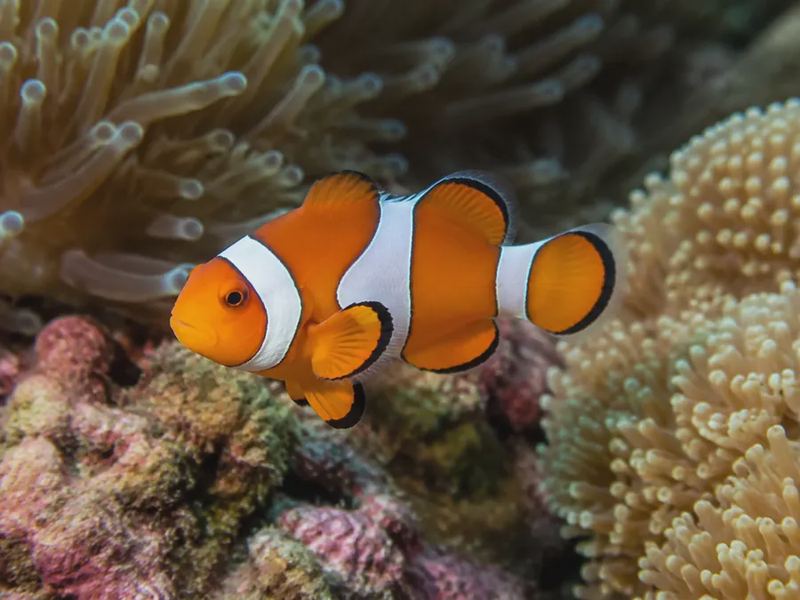
Clark's Clownfish presents a striking and highly variable appearance that has historically complicated taxonomic classification. The base body coloration ranges from deep black to dark brown, with some specimens exhibiting orange or yellow hues, particularly in populations from the western Indian Ocean and Red Sea. The most characteristic feature is the presence of two vertical white bars: the first bar runs just behind the eye, while the second traverses the body approximately midway between the head and the caudal peduncle. These bars are typically outlined with thin black margins, though the thickness of these margins varies considerably among geographic populations. A third white marking appears on the caudal peduncle, though this is often reduced to a saddle-like patch or may be entirely absent in some individuals. The caudal fin is typically bright yellow or orange, giving rise to the common name "Yellowtail Clownfish," although some populations, particularly those from the Marshall Islands and parts of Micronesia, display white or pale yellow caudal fins.
Juvenile specimens exhibit a distinctly different coloration pattern from adults, typically displaying bright orange bodies with white bars that lack the black pigmentation seen in mature individuals. As the fish mature, the orange gradually darkens to brown or black, a transformation that typically begins around 6-8 months of age and may take several additional months to complete. This ontogenetic color change is influenced by both genetic factors and environmental conditions, with water temperature and diet playing documented roles in the rate and extent of darkening. The dorsal fin is continuous, comprising 9-10 spines and 15-17 soft rays, while the anal fin contains 2 spines and 13-15 soft rays. The pectoral fins are typically yellow or orange, matching the caudal fin coloration in most populations.
Regarding size, Amphiprion clarkii ranks among the larger clownfish species, with adult females reaching total lengths of approximately 15 centimeters (6 inches) in the wild, though aquarium specimens typically attain slightly smaller maximum sizes of 12-13 centimeters. Males are considerably smaller, generally reaching 8-10 centimeters (3-4 inches) at full maturity. This pronounced sexual dimorphism in size reflects the species' polygynous breeding system, where larger females dominate social hierarchies and produce more eggs. The species has a moderately deep, laterally compressed body profile typical of the genus, with a rounded caudal fin that becomes more pronounced with age. When fully mature, these fish exhibit a robust, muscular appearance that distinguishes them from the more delicate body forms of smaller clownfish species such as Amphiprion ocellaris.
Diet & Feeding
In their natural habitat, Clark's Clownfish are omnivorous with a distinct preference for animal matter, though they demonstrate considerable dietary flexibility that has contributed to their survival across diverse reef environments. Wild populations feed primarily on zooplankton, including copepods, amphipods, and larval crustaceans, which they capture from the water column during daylight hours. They also actively graze on benthic algae, consuming filamentous and turf algae growing on coral substrates and rock surfaces. Interestingly, A. clarkii has been observed consuming the tentacles and mucus of its host anemone, a behavior that provides both nutritional benefits and reinforces the chemical camouflage that protects the fish from the anemone's nematocysts. This anemone consumption appears to be particularly important for maintaining the protective mucus coating on the fish's skin, as the anemone's toxins and symbiotic zooxanthellae contribute to the fish's acquired immunity.
Additionally, Clark's Clownfish will readily consume small polychaete worms, copepod eggs, and occasionally fish eggs from other species' nests, demonstrating opportunistic feeding behavior when high-quality food sources become available. The species employs a combination of active foraging strategies, including picking individual prey items from the water column, grazing on algal-covered surfaces, and occasionally sifting through fine substrate particles in search of small invertebrates. This dietary breadth is unusual among clownfish species and represents a significant advantage in both natural and captive environments.
For aquarium maintenance, Amphiprion clarkii is exceptionally easy to feed, accepting virtually all prepared foods offered. A varied diet consisting of high-quality marine flake food, slow-sinking pellets, and frozen preparations such as mysis shrimp, brine shrimp, and finely chopped seafood should form the dietary staple. It is essential to include vegetable matter in the diet, either through spirulina-enriched prepared foods or by offering small amounts of nori or other marine algae. Feed adult specimens two to three times daily in small portions that can be consumed within two to three minutes, while juveniles may benefit from more frequent feedings of smaller particle sizes. This species is known for its aggressive feeding behavior and may outcompete more timid tankmates for food, so careful observation during feeding times is recommended to ensure all aquarium inhabitants receive adequate nutrition. Supplementation with vitamin-enriched foods and occasional offerings of live or frozen copepods can help maintain optimal health, coloration, and reproductive condition.
Aquarium Setup
Clark's Clownfish is an ideal candidate for a wide range of aquarium systems, from modest nano-reefs to large community displays, provided their fundamental requirements are met. The minimum recommended tank size for a single specimen or a mated pair is 30 gallons (114 liters), though larger systems of 50 gallons (190 liters) or more are strongly recommended if the fish are to be kept with tankmates or if a host anemone is to be included. This species is active and requires adequate swimming space, particularly given its larger adult size compared to other clownfish species. A longer footprint tank, such as a 36-inch or 48-inch standard aquarium, is preferable to tall, narrow tanks, as it provides greater horizontal swimming area and more stable water conditions.
Substrate selection should consider both aesthetic preferences and the fish's natural behaviors. A fine to medium-grade aragonite sand substrate of 1-2 inches depth is ideal, as it provides a natural appearance, buffers pH, and allows for the burrowing behavior occasionally exhibited by this species. However, A. clarkii is not an obligate burrower, and bare-bottom tanks or those with crushed coral substrate are also acceptable. Live rock should be arranged to create multiple caves, overhangs, and crevices, providing the fish with refuge areas and territory boundaries. The aquascape should include open swimming areas in the front and middle of the tank, with rock structures concentrated at the rear and sides. This species will establish territories centered around preferred shelter sites, and providing multiple potential territories can reduce aggression in community settings.
Regarding plants and photosynthetic organisms, Clark's Clownfish does not require live plants and may actually damage delicate macroalgae through grazing. However, the inclusion of hardy macroalgae species such as Caulerpa or Chaetomorpha in a refugium or display area can provide additional grazing opportunities and contribute to nutrient export. The primary consideration for the aquarium environment is lighting, which should be tailored to any photosynthetic invertebrates kept in the system. If a host anemone is to be maintained, lighting must be of sufficient intensity and spectrum to support the anemone's zooxanthellae—typically requiring LED or T5 fluorescent fixtures capable of delivering 100-150 PAR (photosynthetically active radiation) at the anemone's placement location. If no anemone is kept, standard reef lighting of moderate intensity is sufficient, though the fish will benefit from a natural photoperiod of 10-12 hours daily. It is important to note that while A. clarkii will readily accept artificial host substitutes such as clay pots, PVC fittings, or coral skeletons, the presence of a suitable anemone can significantly enhance the fish's natural behaviors and overall well-being.
Water Parameters
Maintaining stable, high-quality water conditions is paramount to the long-term health and success of Amphiprion clarkii in the aquarium environment. While this species is notably hardy and tolerant of a wider range of conditions than most clownfish species, consistent water quality within the parameters listed below will promote optimal health, coloration, and breeding behavior. Regular water testing should be conducted weekly, with adjustments made gradually to avoid sudden parameter fluctuations that can stress the fish and compromise their immune systems. The following table provides the recommended water parameters for Clark's Clownfish in a closed aquarium system:
| Parameter | Recommended Range | Optimal Value |
|---|---|---|
| Temperature | 24.0 - 28.0°C (75.2 - 82.4°F) | 26.0°C (78.8°F) |
| pH | 8.0 - 8.4 | 8.2 |
| Specific Gravity | 1.020 - 1.025 | 1.024 |
| Salinity | 28 - 34 ppt | 32 ppt |
| Carbonate Hardness (KH) | 8 - 12 dKH | 10 dKH |
| Calcium | 380 - 450 ppm | 420 ppm |
| Magnesium | 1250 - 1350 ppm | 1300 ppm |
| Ammonia (NH₃) | 0 ppm | 0 ppm |
| Nitrite (NO₂⁻) | 0 ppm | 0 ppm |
| Nitrate (NO₃⁻) | < 20 ppm | < 10 ppm |
| Phosphate (PO₄³⁻) | < 0.05 ppm | < 0.03 ppm |
Temperature stability is particularly critical for A. clarkii, as this species is susceptible to rapid temperature swings that can induce stress responses and increase susceptibility to disease. Use a reliable submersible heater with a thermostat and consider a backup heater in larger systems. The pH should be maintained through regular water changes and proper alkalinity management, with aragonite-based substrates and calcium reactors or two-part dosing systems helping to buffer against pH depression. It is worth noting that while this species can tolerate brief excursions outside these parameters, prolonged exposure to suboptimal conditions will negatively impact growth, coloration, and reproductive capability.
Behavior & Compatibility
Clark's Clownfish exhibits a complex behavioral repertoire that makes it one of the most fascinating and rewarding marine fish to observe in the home aquarium. As a highly territorial species, A. clarkii will vigorously defend its chosen shelter site and surrounding area against intruders, including conspecifics and other fish species. This territoriality is most pronounced when the fish has established a bond with a host anemone, in which case the defended area may extend to a radius of 30-60 centimeters from the anemone's base. While this defensiveness can be managed through proper tank sizing and aquascaping, aquarists should be aware that this species is significantly more aggressive than the more docile Amphiprion ocellaris or Amphiprion percula. In smaller tanks or with timid tankmates, this aggression can become problematic, potentially leading to injury or chronic stress in other inhabitants.
Regarding conspecific interactions, Clark's Clownfish can be maintained in small groups of 4-6 individuals in sufficiently large systems, provided they are introduced simultaneously as juveniles to allow natural hierarchy formation. In such groups, a dominant female will emerge, followed by a breeding male and subordinate individuals. However, if a mated pair is introduced to an established tank containing other clownfish, severe aggression often ensues, and it is generally recommended to keep either a single specimen or a bonded pair unless the aquarium is exceptionally large. When selecting tankmates, choose species that are too large to be perceived as threats, too fast to be easily harassed, or that occupy different water column regions. Suitable tankmates include most damselfish (though these may compete for territory), anthias, firefish, gobies, blennies, wrasses, tangs, and angelfish. Avoid keeping A. clarkii with other clownfish species, as interspecific aggression is common and can result in serious injury or death of the less dominant species.
The compatibility of Clark's Clownfish with invertebrates is generally positive, with the fish rarely bothering ornamental shrimp, crabs, snails, or other sessile invertebrates. However, caution should be exercised with small, delicate crustaceans such as ornamental shrimp of the genus Lysmata, as the clownfish may occasionally nip at them, particularly during spawning periods when territorial defense intensifies. The presence of a host anemone significantly modifies the fish's behavior, with the fish spending the majority of its time in close proximity to the anemone and exhibiting characteristic "hosting" behaviors such as rubbing against the tentacles and darting into the anemone's protection when threatened. While A. clarkii will accept a wide variety of anemone species, the bubble-tip anemone (Entacmaea quadricolor) is the most commonly available and reliable choice for aquarium use, being both hardy and readily accepted by this clownfish species.
Breeding
Breeding Amphiprion clarkii in the home aquarium is a highly achievable goal for dedicated hobbyists, as this species readily reproduces under appropriate captive conditions. Like all clownfish, Clark's Clownfish is a protandrous hermaphrodite, meaning that all individuals are born male and the dominant individual in a group will transition to female when the current female dies or is removed. This sex change is irreversible, and the largest, most dominant fish in a group will always be the female. To establish a breeding pair, either acquire a known bonded pair from a reputable source or raise a group of 4-6 juveniles together, allowing them to naturally pair off as they mature. Pairs typically form between 12-18 months of age, with the female growing noticeably larger than the male over time.
Spawning behavior is initiated by the male, who will begin cleaning a flat, vertical or slightly inclined surface near the host anemone or shelter site, removing algae and debris to create a suitable egg-laying substrate. Suitable spawning surfaces include flat pieces of slate, ceramic tiles, or the underside of large coral skeletons. The female will lay between 200 and 600 eggs in a single clutch, depending on her size and age, with eggs being deposited in a single layer and immediately fertilized by the male. The eggs are elongated, measuring approximately 2-3 millimeters in length, and initially appear orange in color, darkening to a silvery-gray as the embryos develop over the 6-8 day incubation period. During this time, both parents actively tend the eggs, with the male taking primary responsibility for fanning them with his pectoral fins to ensure adequate oxygenation and removing any dead or fungused eggs from the clutch.
Upon hatching, the larvae are tiny, translucent, and approximately 3-4 millimeters in length, possessing a functional yolk sac that sustains them for the first 24-48 hours. At this point, they must be offered appropriately sized live foods, beginning with rotifers (Brachionus plicatilis) enriched with highly unsaturated fatty acids (HUFA) and microalgae. The larvae are pelagic for approximately 8-12 days, during which time they require careful attention to water quality, temperature, and light cycles to ensure successful development. Metamorphosis to the juvenile stage occurs when the larvae settle and begin to exhibit the characteristic white bars and swimming behavior of juvenile clownfish. At this stage, they can be transitioned to newly hatched brine shrimp nauplii and eventually to finely crushed flake food. Rearing clownfish larvae requires significant dedication and specialized equipment, including a separate larval rearing tank with gentle aeration, appropriate lighting, and meticulous water change protocols. However, the reward of successfully raising a new generation of these magnificent fish makes the effort worthwhile for the dedicated aquarist.
Common Diseases & Health
While Amphiprion clarkii is considered one of the hardier clownfish species, it remains susceptible to a range of common marine aquarium diseases, many of which are preventable through proper quarantine, nutrition, and water quality management. The most prevalent disease affecting this species is Marine Ich, or Cryptocaryonosis, caused by the ciliate parasite Cryptocaryon irritans. Symptoms include the appearance of small white spots on the body and fins, flashing or rubbing against substrate, rapid gill movement, and lethargy. This parasite has a complex life cycle that includes a free-swimming stage susceptible to treatment, and it is highly contagious. Treatment typically involves copper-based medications in a quarantine tank, hyposalinity (reducing specific gravity to 1.010-1.012), or newer commercial treatments containing chloroquine phosphate. It is essential to note that many invertebrates, including anemones and shrimp, are highly sensitive to copper-based treatments, necessitating the use of a separate quarantine system.
Brooklynella hostilis, commonly known as Clownfish Disease, is another significant health concern, particularly for wild-caught specimens. This parasite causes respiratory distress, excessive mucus production, skin lesions, and rapid deterioration of the fish's condition, often proving fatal within days if left untreated. The disease is characterized by a whitish, cloudy appearance of the skin and labored breathing at the water surface. Formalin-based treatments in a quarantine tank are the most effective therapeutic approach, though the prognosis is guarded if treatment is delayed. Prevention through proper quarantine of all new arrivals for a minimum of 4-6 weeks is strongly recommended to prevent introduction of this devastating pathogen to established systems.
Other health issues that may affect Clark's Clownfish include bacterial infections such as fin rot and ulcerative skin lesions, which typically arise secondary to physical injury or chronic stress. Maintaining excellent water quality, providing a varied and nutritious diet, and minimizing aggressive interactions will go a long way toward preventing these conditions. Additionally, this species is susceptible to nutritional deficiencies if fed exclusively on one type of food, with symptoms including faded coloration, poor growth, and increased susceptibility to disease. A varied diet supplemented with vitamins and omega-3 fatty acids is essential. Finally, it is worth noting that A. clarkii is occasionally affected by a condition known as "clownfish wasting syndrome," characterized by progressive weight loss despite normal feeding behavior. While the exact etiology remains unclear, it is believed to be associated with an intestinal parasite or chronic bacterial infection and often responds poorly to treatment, emphasizing the importance of prevention through the acquisition of healthy, quarantined specimens.
FAQs
Q: Can Clark's Clownfish be kept without a host anemone?
Yes, Amphiprion clarkii can thrive in an aquarium without a host anemone, provided suitable alternative shelter is available. Unlike some clownfish species that exhibit significant behavioral stress without an anemone, Clark's Clownfish is notably adaptable and will readily accept artificial substitutes such as clay flowerpots, PVC elbows, or large coral skeletons as territory centers. Many aquarists successfully keep this species for years in reef tanks without anemones, as the fish will establish territories around rockwork and still display natural behaviors. However, providing a suitable anemone, particularly a bubble-tip anemone (Entacmaea quadricolor), will encourage more natural hosting behavior and may increase the likelihood of successful breeding.
Q: How can I tell the difference between male and female Clark's Clownfish?
Sexing Amphiprion clarkii is primarily based on size, as there are no reliable color or fin differences between the sexes. The female is always the largest fish in a group, typically 3-5 centimeters longer than the male in a bonded pair. In mature pairs, the female will also have a more rounded, fuller belly, particularly when gravid with eggs. Juvenile fish cannot be externally sexed, as all individuals are initially male. The most reliable method of confirming a breeding pair is observing the egg-laying and fertilization process, though the size differential between established pairs is usually sufficient for confident sex determination.
Q: What is the lifespan of a Clark's Clownfish in captivity?
With proper care, Clark's Clownfish can live for 10-15 years in the home aquarium, with some exceptional specimens reaching 20 years of age. This longevity is contingent upon maintaining stable water parameters, providing a varied and nutritious diet, and minimizing stress from aggressive tankmates or overcrowding. Wild-caught specimens may have a shorter captive lifespan due to the stress of collection and transport, while captive-bred individuals, which are increasingly available from commercial breeders, often prove more resilient and adapt more readily to aquarium life.
Q: Are Clark's Clownfish aggressive toward other fish in the aquarium?
Clark's Clownfish can be moderately to highly aggressive, particularly when defending their territory or spawning site. This aggression is most pronounced toward conspecifics (other clownfish) and fish that venture too close to their chosen shelter. In larger aquariums with ample space and careful tankmate selection, aggression can be minimized. However, in smaller tanks or with timid tankmates, this species may harass other fish to the point of stress or injury. It is generally recommended to add the clownfish last to an established community and to avoid keeping them with very shy or slow-moving species that cannot effectively avoid confrontation.
References
- Journal of Experimental Marine Biology
- Coral Reefs (Springer)
- NOAA Ocean Service