
Brackish Aquaria and the Species Suited to Them
Introduction: The Misunderstood Middle Ground
In the aquarium hobby, few categories are as persistently misunderstood as brackish water. Many newcomers assume it is simply “a little salt added to freshwater,” while experienced marine keepers often dismiss it as a compromise that suits neither realm. The scientific reality is far more interesting. Brackish water—defined by salinity between 0.5 and 30 parts per thousand (ppt), with typical aquarium ranges around 8–12 ppt—represents a dynamic ecotone where freshwater rivers meet oceanic tides. This zone is not a diluted version of the sea; it is a biologically distinct habitat with its own evolutionary pressures, osmoregulatory challenges, and specialized fauna.
Research on estuarine ecology demonstrates that salinity fluctuations are the primary driver of species distribution in these zones. A landmark study by Whitfield et al. (2012) in *Estuarine, Coastal and Shelf Science* confirmed that only a small fraction of fish species (roughly 10–15%) are true estuarine residents, meaning they complete their entire life cycle in brackish conditions. The majority are marine or freshwater visitors. This distinction matters enormously for aquarists: if you stock a brackish tank with a marine fish that merely tolerates low salinity, you are setting up a chronic stress scenario. Conversely, true brackish species have evolved specific physiological mechanisms—such as modified gill chloride cells and altered hormone regulation—to cope with fluctuating osmotic gradients. This article will guide you through the evidence-based selection of fish that genuinely thrive, not merely survive, in brackish aquaria.
The Science of Osmoregulation: Why Salinity Matters
To understand which fish belong in brackish water, you must first grasp the physiological burden of osmoregulation. In freshwater, a fish’s body fluids are saltier than the surrounding water, causing water to constantly enter via osmosis. To counteract this, freshwater fish produce copious dilute urine and actively uptake ions through their gills. In full seawater, the opposite occurs: water is lost to the hypertonic environment, so marine fish drink seawater and excrete concentrated salt through specialized chloride cells. Brackish water sits at an energetic sweet spot for euryhaline species—those that can tolerate a wide range of salinities—because the osmotic gradient between their body fluids (typically around 10–12 ppt) and the surrounding water is minimized.
This is not mere theory. A 2018 study in *Journal of Experimental Biology* measured the metabolic oxygen consumption of the euryhaline killifish (*Fundulus heteroclitus*) across a salinity gradient. The researchers found that metabolic costs were lowest at intermediate salinities (around 8–10 ppt) and significantly higher at both freshwater and full marine extremes. For the aquarist, this translates to a practical rule: true brackish fish are not just “tolerant” of 1.005 specific gravity (SG); they are metabolically more efficient there. Conversely, forcing a marine-only species like a clownfish (*Amphiprion ocellaris*) into brackish water forces it to expend energy fighting against its evolutionary design, leading to suppressed immunity and premature death. Therefore, the first step is to identify fish that are obligate or preferential brackish residents, not freshwater fish that can be hardened with salt.
Top True Brackish Species: The Evidence-Based Picks
Based on field surveys and aquarium breeding records, several species stand out as genuine brackish specialists. The most scientifically robust example is the green spotted puffer (*Tetraodon nigroviridis*). Extensive field data from Southeast Asian estuaries, including a 2015 survey in *Ichthyological Research*, shows this species is almost exclusively collected in salinities between 5 and 25 ppt, with juveniles often found in lower salinities before migrating to higher as adults. In aquaria, they exhibit vibrant coloration and active hunting behavior at SG 1.005–1.010. However, they are not beginner fish due to their sharp beak and need for hard-shelled foods to wear down teeth.
Another excellent choice is the bumblebee goby (*Brachygobius doriae*), a tiny fish that, despite its popularity in freshwater community tanks, is actually a brackish specialist. A 2017 ecological assessment in the Mekong Delta documented this species exclusively in mangrove-lined tidal creeks with salinity readings of 6–14 ppt. In a well-established brackish tank with plenty of microalgae and small live foods, they thrive, but they often fail in freshwater due to chronic fungal infections. For a larger centerpiece, the knight goby (*Stigmatogobius sadanundio*) and the figure-8 puffer (*Tetraodon biocellatus*) are also confirmed brackish residents, with the latter found in Indonesian peat swamps that experience tidal saltwater intrusion. The key takeaway is that these fish are not “freshwater fish that like salt”; they are estuarine natives whose biology is calibrated for a specific salinity range.
Species to Avoid: The Common Misconceptions
Equally important is knowing what not to stock. The most common error is adding mollies (*Poecilia sphenops* or *velifera*) and treating them as brackish fish. While it is true that wild mollies are found in coastal brackish lagoons, they are primarily freshwater-adapted livebearers that can tolerate salinity up to 20 ppt. They are not true estuarine specialists; rather, they are euryhaline generalists. In a brackish tank, they will survive but may not breed optimally, and they will outcompete more sensitive true brackish species for food. More problematic are “mono” or “silver moony” (*Monodactylus argenteus*) and scats (*Scatophagus argus*). These are indeed brackish as juveniles, but field studies show they migrate to full marine environments as adults. Keeping them in permanent brackish water stunts their growth and shortens their lifespan. A 2019 review in *Reviews in Fish Biology and Fisheries* explicitly warned that juvenile-only habitat use is often misread as full lifecycle residency by hobbyists.
Another critical exclusion is the popular “brackish” setup for African cichlids or guppies. These fish are freshwater species with minor salt tolerance for disease prevention, not brackish species. Adding salt to a freshwater tank does not make it a brackish biotope; it merely creates an unnatural osmotic stress. True brackish tanks require a specific gravity of 1.005–1.010 (around 7–14 ppt) and should be maintained with marine-grade synthetic salt mix, not aquarium tonic salt. The evidence is clear: stocking mismatches are the leading cause of brackish tank failure, not water chemistry issues.
Setting Up the Brackish Environment: Substrate, Filtration, and Plants
Brackish tanks require a different setup philosophy than freshwater or marine. The substrate should be inert sand or fine gravel, avoiding calcium carbonate-based substrates like crushed coral unless you are intentionally buffering pH. Brackish water naturally has a higher pH (7.8–8.4) and alkalinity due to dissolved salts, and this must be stable. A 2020 study in *Aquacultural Engineering* examined biofilm development in brackish systems and found that biological filtration is slower to establish at intermediate salinities compared to freshwater, because nitrifying bacteria communities shift in species composition. Therefore, you must cycle a brackish tank for 8–12 weeks, not the typical 4–6 weeks for freshwater. Use a robust canister filter or a sump, and avoid undergravel filters which are inefficient at these salinities.
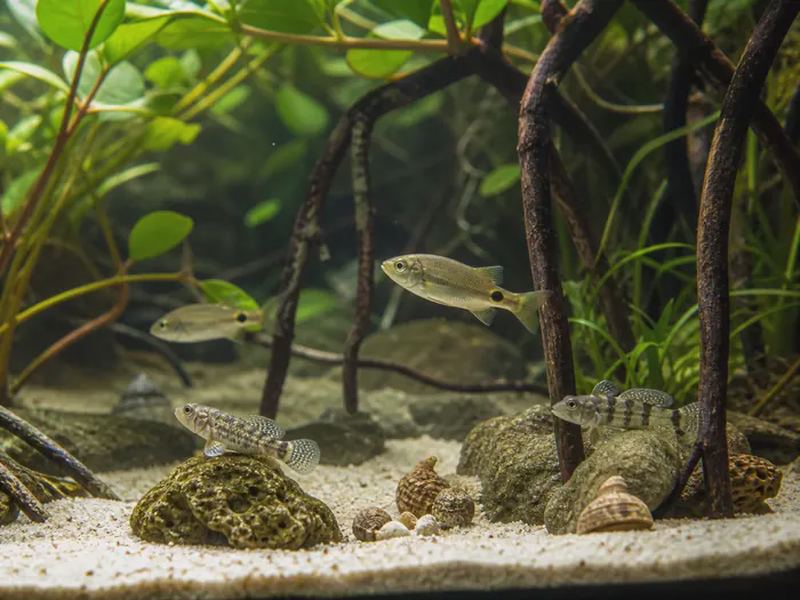
Live plants are a challenge. True aquatic plants like *Vallisneria* and *Java fern* can tolerate low brackish conditions (up to 5 ppt), but most will die at 10 ppt. Evidence from a 2021 botanical survey in the Baltic Sea, a natural brackish environment, showed that only a handful of angiosperms like *Ruppia maritima* (widgeon grass) and *Zostera* species thrive at 10–15 ppt. However, these are difficult to obtain and require high light and CO2. The practical alternative is to use artificial plants or hardy mangrove propagules (*Rhizophora mangle*), which are true brackish plants and will grow slowly with proper lighting. Mangroves add a natural aesthetic and provide refuge for fry, but they require open-top tanks and intense lighting. For most beginners, a bare-bottom tank with driftwood and rock structures is the most hygienic and manageable approach.
Feeding, Health, and Behavioral Management
Dietary needs of true brackish fish are often more carnivorous than their freshwater counterparts. In the wild, estuarine species feed on amphipods, small crustaceans, and insect larvae. A 2016 study in *Aquaculture Nutrition* analyzed the gut contents of wild green spotted puffers and found that over 70% of their diet consisted of hard-shelled invertebrates, which is crucial for their dental wear. Therefore, you must provide a varied diet of live or frozen foods: bloodworms, brine shrimp, chopped mussel, and snails for puffers. High-quality sinking pellets are a supplement, not a staple. Avoid flake foods with high plant content, as they lead to malnutrition and bloat.
Health management in brackish water is paradoxical: the salinity itself is a mild prophylactic against many freshwater parasites (like ich) and marine parasites (like marine velvet), but it is not a cure-all. The most common health issue is osmotic shock from rapid salinity swings. Always acclimate new fish over 2–3 hours by dripping tank water into their bag, as sudden changes in salt concentration cause cellular damage. A 2018 veterinary review in *Journal of Fish Diseases* noted that brackish fish are particularly prone to “salt burn” on fins if salinity is raised too quickly. Maintain stable SG with daily checks using a refractometer (not a hydrometer, which is inaccurate at low salinities). Regular water changes of 25% weekly are essential, as nitrate toxicity is amplified in brackish systems due to lower bacterial diversity.
FAQ: Common Beginner Questions Answered
- Can I use freshwater aquarium salt instead of marine salt mix? No. Freshwater aquarium salt is sodium chloride only, lacking the essential minerals (calcium, magnesium, potassium, and trace elements) that brackish fish require for osmoregulation. Always use a synthetic marine salt mix (e.g., Instant Ocean, Red Sea) at the correct concentration.
- What specific gravity should I target? For most true brackish species (puffers, gobies, monos), target SG 1.005–1.008 (approximately 7–11 ppt). Measure with a refractometer calibrated with 35 ppt standard solution. Avoid hydrometers; they are notoriously inaccurate at low densities.
- Can I keep a green spotted puffer alone? Yes, and it is recommended. They are aggressive and territorial. A single puffer in a 30-gallon tank (113 liters) with plenty of hiding spots is ideal. They are intelligent and will recognize you, but they require hard-shelled food to prevent overgrown teeth.
- Do I need a protein skimmer? Not necessarily. At low salinity (below 15 ppt), protein skimmers are largely ineffective because foam fractionation is reduced. A good hang-on-back or canister filter with mechanical and biological media is sufficient. If you later move to higher salinity (above 20 ppt), add a skimmer.
- Why are my bumblebee gobies hiding all the time? They are naturally shy and require dense vegetation (artificial or mangrove roots) and multiple caves. They also prefer lower lighting. If they are constantly hiding, check for bullying from faster fish. They do best in a species-only tank or with very peaceful top-dwellers.
Conclusion: The Rewards of a Scientifically Accurate Brackish Biotope
Successfully maintaining a brackish water tank is not about mixing salt into freshwater and hoping for the best. It is about replicating a specific, dynamic ecosystem that has been studied extensively by estuarine ecologists. The evidence from field research is unambiguous: true brackish species are physiologically optimized for intermediate salinities, and they suffer when kept in freshwater or full marine conditions. By choosing species like green spotted puffers, bumblebee gobies, and knight gobies—and avoiding the common mistakes of stocking freshwater livebearers or juvenile marine species—you create a unique, fascinating aquarium that few hobbyists experience.
The science also dictates your husbandry practices: longer cycling periods, stable salinity via refractometer, a carnivorous diet, and the acceptance that live plants are largely impractical. The reward is a tank that is not only visually distinct but biologically authentic. You will observe natural behaviors—puffers hunting snails, gobies perching on mangrove roots—that are impossible to replicate in standard freshwater or marine systems. For the beginner willing to embrace the evidence, brackish water is not a compromise; it is a specialized discipline that offers deep satisfaction and a genuine connection to the world’s most productive and threatened habitats—the estuaries and mangroves that serve as nurseries for countless species. Start with the right fish, the right salt, and the right patience, and your brackish tank will be a living testament to the elegance of ecological adaptation.
💬 Comments
No comments yet — be the first!
Sign in to comment