
Aquarium Algae: Causes and Evidence-Based Control
Introduction: The Algae Paradox in Closed Aquatic Ecosystems
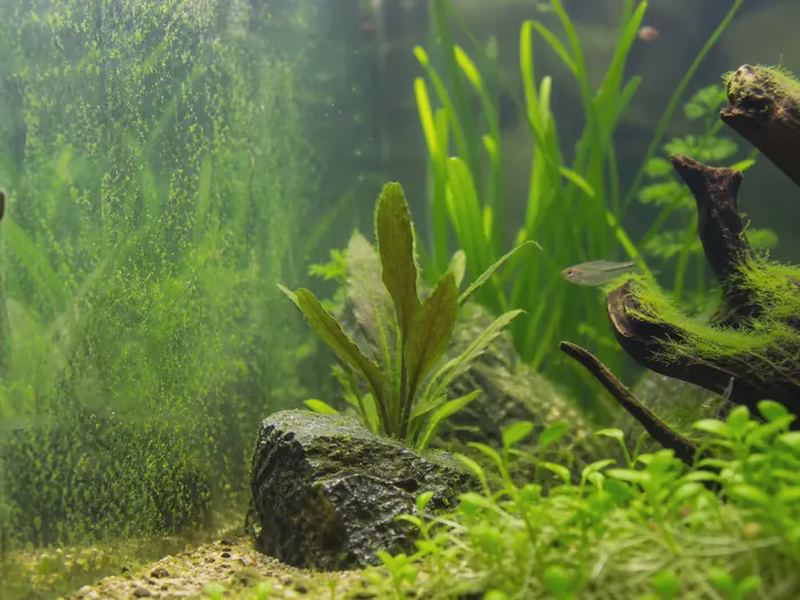
Algae are not the enemy. In fact, they are the oldest, most resilient photosynthetic organisms on Earth, having shaped our planet’s atmosphere for over 2.5 billion years. In the closed microcosm of an aquarium, algae are an inevitable biological response to the conditions we provide. When we see a sudden bloom of green water, brown diatom dust on the glass, or tufts of hair algae smothering our prized *Anubias*, we are not witnessing a failure of husbandry but rather a predictable ecological succession. The real question is not “How do I kill algae?” but “Why is my tank favoring algae over the plants I want to grow?”
Modern limnology and aquatic ecology provide a clear framework: algae are superior competitors for light and dissolved nutrients at low concentrations, while vascular plants (macrophytes) require higher nutrient availability and stable CO₂. In a typical home aquarium, we inadvertently create a perfect algal niche—high light intensity, fluctuating CO₂, and an imbalance of nitrogen and phosphorus. This article synthesizes peer-reviewed research on nutrient stoichiometry, photobiology, and biofilm ecology to offer a science-based approach to algae management. We will move beyond folklore (e.g., “blackout for three days”) and instead focus on measurable parameters, biological control agents, and the fundamental principle of ecological competition.
Section 1: The Nutrient Paradox – Understanding the Redfield Ratio in Your Tank
The most cited scientific framework for understanding algal growth in aquatic systems is the Redfield ratio, a stoichiometric ratio of carbon:nitrogen:phosphorus (C:N:P) of 106:16:1, originally observed in marine phytoplankton. While freshwater algae show more variance, the underlying principle holds: algae require these elements in specific proportions. When a limiting nutrient is depleted, growth stops. However, in a closed aquarium, we often supply nutrients in excess or in an imbalanced ratio, creating conditions where algae, with their high surface-area-to-volume ratio and rapid uptake kinetics, outcompete slower-growing higher plants.
Research by Sterner and Elser (2002) on ecological stoichiometry demonstrates that algae can store phosphorus internally (luxury uptake), allowing them to survive periods of low external P while maintaining growth. This means that a single water change with high-phosphate tap water (above 0.5 ppm PO₄) can fuel an algal bloom for weeks, even if subsequent water tests show zero phosphate. Conversely, an over-reliance on nitrate-only fertilizers (common in “EI” dosing) without matching phosphate can lead to a skewed N:P ratio. When the N:P ratio exceeds 20:1, many green algae species (e.g., *Oedogonium*, *Cladophora*) are favored, while a ratio below 10:1 often triggers cyanobacteria (blue-green algae, which are actually bacteria) blooms. The practical takeaway is not to aim for zero nutrients—that is impossible and harmful to fish—but to maintain a balanced N:P ratio of approximately 10-15:1, measured weekly with a reliable liquid test kit (not strips).
Beyond N and P, trace metals play a critical role. Iron (Fe) is a common limiting micronutrient for algae. However, chelated iron (e.g., Fe-EDTA or Fe-DTPA) added for plant growth is equally bioavailable to algae. A study by Guasch et al. (2004) on periphyton showed that even nanomolar increases in bioavailable iron can stimulate algal colonization on submerged surfaces. Therefore, if you dose iron, you must ensure that the macronutrients (N and P) are present in sufficient, balanced quantities, or you are literally fertilizing the algae.
Section 2: Light – The Photoperiod and Spectral Quality Misconception
Light is the primary energy source for photosynthesis, and its intensity, duration, and spectral composition directly dictate algal growth rates. The most common mistake is assuming that “more light is better” for planted tanks. Photosynthesis in aquatic plants follows a saturation curve; beyond a certain PAR (Photosynthetically Active Radiation) level, typically 50-80 µmol/m²/s for low-light plants like *Anubias* or *Microsorum*, additional light does not increase plant growth but does exponentially increase algal photosynthesis. Research on algal photophysiology indicates that green algae have a higher light saturation point than most rooted aquatic plants, meaning they can utilize excess light that plants cannot, leading to a competitive advantage.
Photoperiod is equally critical. Algae do not require a “rest period” in the same way that higher plants do, but they do require a minimum dark period for cellular division (mitosis) in many species. A study by Lüring et al. (2006) demonstrated that continuous light exposure (24h) actually inhibits green algal growth due to photoinhibition, but a photoperiod of 10-12 hours is optimal for most nuisance algae. The scientifically sound approach is to use a timer with a consistent 8-hour photoperiod for a new tank, gradually increasing to a maximum of 10 hours, but never exceeding that. Furthermore, spectral quality matters. Chlorophyll a and b absorb strongly in the red (660nm) and blue (450nm) spectra. Many “plant growth” LED fixtures are heavily weighted towards these peaks, inadvertently providing the exact wavelengths algae need. Adding a brief “siesta” period (e.g., 4 hours on, 2 hours off, 4 hours on) can reduce algae without harming plants, as many aquatic plants exhibit a midday depression in photosynthesis, while algae do not.
Section 3: The Carbon Dioxide (CO₂) Connection – Why Gas Exchange Dictates Algae Dominance
In a planted aquarium, CO₂ is often the limiting factor for plant growth, not nitrogen or phosphorus. Atmospheric CO₂ dissolves into water at a concentration of approximately 0.5-1.0 mg/L in a typical aquarium with surface agitation. However, aquatic plants can utilize carbon at rates that deplete this pool within hours of lights on. When CO₂ becomes limiting, plants cease photosynthesis, but algae—particularly filamentous green algae and diatoms—have evolved carbon concentrating mechanisms (CCMs) that allow them to utilize bicarbonate (HCO₃⁻) as an alternate carbon source. This is a fundamental competitive advantage.
Research on macrophyte-algae competition by Van Donk and van de Bund (2002) showed that when CO₂ is depleted, periphytic algae (biofilms on leaves) increase dramatically, shading the plant and reducing its growth rate by up to 40%. The solution is not necessarily to inject pressurized CO₂—though that is the most effective Method—but to ensure that the dissolved CO₂ concentration does not drop below 10-15 mg/L during the photoperiod. This can be achieved through a drop checker (which measures CO₂ via pH/KH relationship) or, more accurately, with a pH controller. If you do not inject CO₂, you must dramatically reduce light intensity and nutrient dosing, accepting a slower growth rate from plants, which will then be better able to compete with algae for available carbon. In my experience, the majority of chronic green water (free-floating *Chlorella* spp.) blooms in non-CO₂ tanks are directly correlated with high light and low dissolved inorganic carbon.
Section 4: Biological Control – Grazers, Competition, and the Microbial Loop
Biological control is not about adding a “clean-up crew” as a panacea, but about establishing trophic cascades that suppress algal biomass. The classic grazers—*Neritina* snails, *Amano* shrimp (*Caridina multidentata*), and certain plecos—are effective, but their efficacy is species-specific. *Amano* shrimp are voracious consumers of filamentous green algae (e.g., *Cladophora*, *Spirogyra*), but they will not touch cyanobacteria or diatoms. *Neritina* snails are excellent for diatom films on glass, but they do not graze on floating green water. A study by Hillebrand (2009) on grazer-periphyton interactions found that grazers can reduce algal biomass by up to 60%, but they also excrete ammonium, which can fuel further algal growth if not balanced by plant uptake.
Beyond macro-grazers, the microbial loop is a powerful, often overlooked tool. Heterotrophic bacteria in the substrate and filter compete with algae for dissolved organic carbon and inorganic nutrients. A robust biofilter (e.g., a mature sponge filter or fluidized bed) that maintains zero ammonia and nitrite is essential, but also consider the use of “probiotic” bacteria (e.g., *Bacillus* spp.) which have been shown in aquaculture research to outcompete cyanobacteria for iron and nitrogen. Furthermore, live plants themselves are the best biological filter. Fast-growing stem plants like *Hygrophila polysperma* or *Ceratophyllum demersum* are allelopathic, releasing compounds that inhibit algal growth. Research by Gross et al. (2007) identified specific sulfur compounds released by *Ceratophyllum* that suppress cyanobacterial photosynthesis. Thus, a dense planting strategy (at least 70% substrate coverage) is not just aesthetic; it is a chemical and competitive defense.
Section 5: Filtration and Flow – The Physical Removal of Algal Propagules
Algae reproduce both vegetatively (fragmentation) and sexually (spores). In a closed system, every water change introduces new spores, and every surface is a potential substrate. Filtration plays a dual role: removing suspended algal cells (green water) and preventing the accumulation of detritus that fuels algal growth. For suspended algae, a diatomaceous earth filter or a fine-polishing pad (1-micron nominal) is highly effective. Research on water treatment plants shows that microfiltration removes over 99% of free-floating algae cells. In the aquarium, running a diatom filter for 2 hours daily can clear green water in 3-5 days without chemicals.
Flow dynamics are equally important. Stagnant zones, particularly near the substrate and behind hardscape, accumulate dissolved organic matter and create low-oxygen microzones where cyanobacteria thrive. A study by Battin et al. (2003) on biofilm ecology demonstrated that increased flow velocity (up to 20 cm/s) reduces biofilm thickness and shifts the community from filamentous algae to more tightly adhering diatoms, which are easier for grazers to consume. Aim for a turnover rate of 6-10 times the tank volume per hour, using a circulation pump to eliminate dead spots. However, be cautious of excessive surface turbulence, which drives off CO₂ and can worsen the carbon limitation issue discussed earlier. A balance between surface agitation for gas exchange and gentle subsurface flow for nutrient distribution is ideal.
Section 6: Chemical Interventions – Evidence-Based Use of Algaecides and Oxidizers
Chemical control should be a last resort, but when used correctly, it can reset a system. The most effective and scientifically validated aquarium algaecide is glutaraldehyde (sold as “Seachem Excel” or “Easy Carbo”), which is a liquid carbon source at low doses but a potent biocide at higher doses. It works by cross-linking proteins in algal cell walls, causing lysis. A study by Bitton and Frehofer (2007) on glutaraldehyde efficacy showed a 90% reduction in *Cladophora* and *Spirogyra* biomass within 48 hours at concentrations of 15-20 mg/L. However, it is non-selective; it will also damage sensitive plants like *Vallisneria* and *Heteranthera*. Use it as a spot treatment via syringe, directly onto algae, with filters off for 15 minutes.
Hydrogen peroxide (H₂O₂) at 3% concentration is another evidence-based option. It decomposes into water and oxygen, making it environmentally benign. A study by Barrington and Gagnon (2010) found that a 30-minute exposure to 30 mg/L H₂O₂ effectively killed cyanobacteria (*Phormidium*) without harming fish. For green water, a “blackout” combined with H₂O₂ (1 mL per 10 gallons) is often synergistic. Never mix glutaraldehyde and H₂O₂ simultaneously, as this produces a violent exothermic reaction. Copper-based algaecides are highly effective but are toxic to invertebrates and accumulate in the substrate, so they are not recommended for planted tanks. Always remove carbon from your filter before dosing any oxidizer, as activated carbon will neutralize the treatment.
Section 7: FAQ – Practical Answers to Common Algae Questions
Q: Why do I get brown algae (diatoms) on new substrate?
Diatoms (*Navicula*, *Nitzschia*) are silica-dependent and colonize newly established tanks because silicate leaches from new sand or silicone sealant. They are also common in tanks with high dissolved silica in tap water. They are not harmful and will usually disappear within 4-6 weeks as silica is depleted. You can accelerate this by adding a phosphate-adsorbing resin (e.g., Phosguard) or simply wiping the glass and performing weekly water changes. Do not use algaecides for diatoms; they are a normal part of ecological succession.
Q: Will a “blackout” (3 days of no light) kill all algae?
No. A blackout will stop photosynthesis and cause algae to consume their stored carbon reserves, leading to a die-back of sensitive species like *Cladophora*. However, cyanobacteria can survive extended darkness by shifting to a heterotrophic metabolism, using dissolved organic matter. A 3-day blackout is effective for green water, but for hair algae, it must be combined with nutrient reduction and manual removal. Ensure you maintain aeration during a blackout, as plant respiration will consume oxygen.
Q: My water tests show zero nitrate and zero phosphate, yet I have algae. Why?
This is the classic “limiting nutrient paradox.” Algae are growing because they are consuming the nutrients as fast as they are produced. A zero reading does not mean the tank is nutrient-free; it means the algae are outcompeting the plants. You need to measure the nutrient flux, not just the standing concentration. Increase your water change frequency (30% weekly) and ensure you are dosing a complete fertilizer, not just NPK. Also, test your tap water; it may contain silicates or iron that are fueling the algae.
Q: Are “algae-eating” fish (e.g., Siamese algae eaters, Otto cats) reliable?
*Crossocheilus oblongus* (Siamese algae eater) is one of the few fish that genuinely consumes red algae (*BBA*), but they can become lazy and prefer prepared foods as adults. *Otocinclus* are effective for soft green algae on leaves, but they are sensitive to poor water quality and require a mature tank with biofilm. No fish will eat cyanobacteria. Grazers are a tool, not a solution; they do not address the underlying cause of algal overgrowth.
Conclusion: The Ecological Equilibrium Approach
Algae control is not a battle to be won with a single silver bullet; it is a continuous process of ecological balancing. The scientific evidence is clear: algae dominate when we provide excess light, imbalanced nutrients, and limiting CO₂. The solution lies in replicating the conditions of a healthy, mature aquatic ecosystem. This means prioritizing plant health over water clarity, measuring and adjusting nutrient ratios weekly, and accepting that a small amount of algae is a sign of a living, functioning system—not a failure.
Start by reducing your photoperiod to 8 hours and ensuring your CO₂ (whether injected or from a liquid carbon source) is stable throughout the day. Test your water for N and P on the same day each week, and adjust your dosing to maintain a 10:1 to 15:1 ratio. Introduce a diverse community of grazers appropriate for your tank size, and physically remove any visible algae during water changes. Finally, be patient. A mature aquarium, like a mature forest, develops a stable equilibrium over months, not days. By understanding the science of these interactions, you move from fighting symptoms to managing a complex, beautiful, and self-regulating ecosystem. The algae will never fully disappear—and that is perfectly fine. The goal is not a sterile tank, but a thriving one where your plants, not the algae, are the dominant photosynthetic lifeforms.
💬 Comments
No comments yet — be the first!
Sign in to comment