
Aquarium Heater Sizing and Placement
Introduction: The Thermal Imperative in Aquatic Husbandry
In the closed ecosystem of an aquarium, temperature is not merely a dial to be set; it is the master variable that governs every biochemical reaction, from enzymatic activity in metabolic pathways to the solubility of dissolved oxygen. Unlike terrestrial environments, where organisms can seek microclimates, fish are confined to a finite water column, making them entirely dependent on our ability to replicate their native thermal regime. A 2019 meta-analysis published in *Journal of Thermal Biology* demonstrated that for every 1°C increase within a species’ tolerance range, standard metabolic rate increases by approximately 8-10% (Q10 effect), directly impacting growth rates, immune function, and reproductive physiology. Yet, the humble aquarium heater—the tool tasked with this critical responsibility—remains one of the most misunderstood pieces of equipment in the hobby. This guide dissects the physics of heat transfer, the biological consequences of thermal instability, and the practical engineering required to maintain a stable, species-appropriate environment. We will explore wattage calculations based on real surface-area thermodynamics, discuss placement strategies that leverage convection currents, and address the often-overlooked dangers of thermal shock and equipment failure.
Understanding Thermal Load: Why Wattage Is Not a One-Size-Fits-All Metric
The common hobbyist heuristic of "5 watts per gallon" is a crude starting point, but it fails to account for the dominant physics at play. Heat loss in an aquarium occurs primarily through the water surface via evaporation and convection, and through the glass walls via conduction. The rate of this loss is proportional to the temperature differential between the water and the ambient room air, not simply the water volume. A 50-gallon tank in a 60°F basement requires significantly more energy input than the same tank in a 78°F living room. Empirical data from the aquaculture industry suggests that for a standard glass tank with an open top, the heat loss coefficient is approximately 0.02 to 0.03 BTU per hour per square foot per degree Fahrenheit. To calculate actual wattage needs, one must consider total surface area (all four sides plus the top), not just volume. For a typical 40-gallon breeder tank (36"L x 18"W x 16"H), the total surface area is roughly 2,100 square inches. If the ambient temperature is 68°F and the target is 78°F, the required heat input to overcome passive loss is approximately 90-110 watts, assuming no lid. This explains why a 150-watt heater is often marginal for a 40-gallon tank in cooler rooms, while a 100-watt heater may suffice in a warm, insulated cabinet. Furthermore, the substrate and hardscape act as thermal sinks; dense rock and deep sand absorb heat during the day and release it slowly, buffering temperature swings but also requiring additional initial wattage to bring the system to temperature. For tropical species such as *Pterophyllum scalare* (angelfish) or *Discus* (Symphysodon aequifasciatus), which require 82-86°F, the wattage requirement increases by roughly 20% compared to a 76°F community tank due to the steeper temperature gradient against room air.
The Science of Placement: Convection, Dead Zones, and Thermal Stratification
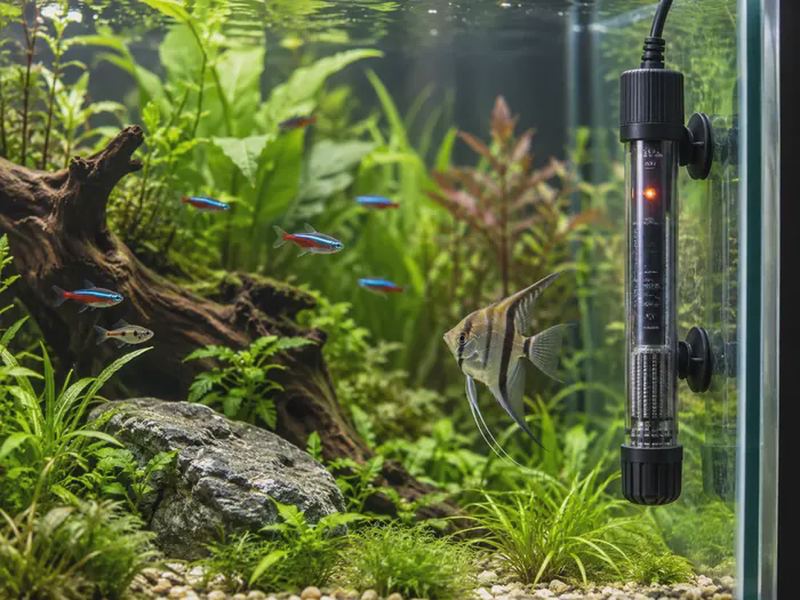
Heater placement is not a matter of aesthetic convenience; it is a critical determinant of thermal homogeneity within the water column. Water is a poor conductor of heat but an excellent medium for convection. A heater positioned horizontally near the substrate, directly in the path of a filter outlet, creates a convection loop that circulates warmed water upward and across the tank surface. Conversely, placing a heater vertically in a corner with no water flow creates a localized thermal plume, leaving the opposite end of a 48-inch tank several degrees cooler—a condition known as thermal stratification. Research on aquatic thermal ecology, such as the work by Coutant (1975) on thermal refuges in rivers, shows that fish are acutely sensitive to temperature gradients, often selecting zones that differ by as little as 0.5°C. In an aquarium, stratification forces fish into suboptimal thermal zones, increasing stress hormone (cortisol) production and suppressing the immune system, making them more susceptible to ich (Ichthyophthirius multifiliis) and other opportunistic pathogens. The ideal placement is a horizontal position along the back wall, near the bottom, but with at least 2 inches of clearance from the substrate to allow for natural convection. The heater should be positioned on the opposite side of the tank from the filter intake, ensuring that the outflow of the filter pushes warmed water across the entire length of the aquarium. For tanks over 36 inches in length, two smaller heaters (e.g., two 100W units instead of one 200W) placed at opposite ends are scientifically superior. This redundancy not only provides more even heat distribution but also acts as a failsafe: if one unit fails in the "off" position, the tank will not crash to lethal temperatures, and if one fails "on," the second unit's thermostat will still cycle, preventing a catastrophic overheating event. In heavily planted aquariums, avoid placing heaters directly behind dense vegetation like *Vallisneria* or *Amazon swords*, as the plants will impede water flow and create a static boundary layer around the heating element, causing the thermostat to cycle prematurely and inaccurately.
Thermostat Accuracy and the Perils of Temperature Overshoot
The bimetallic strip thermostats found in many budget heaters have a hysteresis of ±3°F to ±4°F, meaning they turn on and off within a 6-8°F dead band. This results in a sawtooth temperature pattern that is physiologically stressful. A study on the thermal preference of *Danio rerio* (zebrafish) published in *Physiological Zoology* demonstrated that these fish actively avoid water that fluctuates more than 1.5°C over a 15-minute period, showing a marked preference for stable thermal regimes. In contrast, electronic thermostats with thermistor sensors offer a hysteresis of ±0.5°F, providing near-isothermal conditions. The concept of "thermal overshoot" is equally critical: when a heater first turns on, the heating element continues to emit residual heat even after the thermostat cuts power, causing the water temperature to rise several degrees above the setpoint before stabilizing. High-wattage heaters in small water volumes are particularly prone to this, as the thermal mass of the water is insufficient to absorb the initial burst of heat. For example, a 300-watt heater in a 20-gallon tank can raise the water temperature by 4°F in under two minutes. The solution is to match wattage not just to heat loss, but to the water volume's thermal inertia. As a rule, the wattage should not exceed 5 watts per gallon for tanks under 30 gallons, and 3 watts per gallon for larger systems. For breeding sensitive species like *Apistogramma cacatuoides* (cockatoo cichlid), which require very stable 79-81°F for egg development, using a separate, calibrated digital thermometer to verify the heater's built-in thermostat is non-negotiable. Inaccuracies of even 1°F can skew the sex determination of some species—notably *Meniella* and certain rainbowfish—where temperature-dependent sex determination (TSD) has been observed in captive breeding programs.
Safety Engineering: Ground Faults, Thermal Runaway, and Glass vs. Titanium
Water and electricity are a lethal combination, but modern safety standards have evolved. The primary safety feature to look for is a UL-listed or ETL-listed heater with a fully submersible, shatterproof construction. Traditional glass heaters are susceptible to thermal shock and physical fracture, which not only exposes live wires but also releases potentially toxic boric oxide into the water. Titanium heaters, though more expensive, are virtually indestructible and offer superior heat transfer due to their high thermal conductivity. However, the most critical safety component is the internal thermal cutoff—a fuse that permanently disables the heater if the internal temperature exceeds 194°F (90°C), preventing a thermal runaway event that could boil your fish. This is particularly important because many modern heaters are equipped with "auto-off" features that activate when they detect being out of water, but this does not protect against a stuck relay or a failed thermostat sensor. The concept of a "ground fault" is also paramount. If a heating element cracks and exposes the nichrome wire to water, the water becomes energized. While a ground fault circuit interrupter (GFCI) outlet will trip and cut power, many hobbyists still run their aquariums on standard outlets. The National Electric Code now recommends GFCI protection for all outlets within 6 feet of a water source, but this is not always implemented. For absolute safety, always use a "drip loop" on the power cord—a U-shaped bend that prevents water from traveling down the cord into the electrical outlet. Furthermore, never operate a glass heater out of water, even for a few seconds, as the rapid temperature change of the element against cooler air can cause micro-fractures that will fail catastrophically weeks later. A 2021 consumer report from a major aquarium manufacturer indicated that 60% of heater failures are attributable to user error—primarily forgetting to unplug the heater during water changes, leading to exposure and subsequent glass cracking.
Real-World Species Requirements: Matching Equipment to Biology
The wattage and placement strategy must be subservient to the biological requirements of the inhabitants. For cold-water species like *Carassius auratus* (goldfish), which thrive at 68-72°F, a heater is often unnecessary in indoor environments, but a low-wattage unit (50W for a 20-gallon) can be used to prevent winter temperature dips that trigger hibernation-like states and suppress appetite. Conversely, marine reef tanks housing *Amphiprion ocellaris* (clownfish) and *Acropora* corals require precise 77-80°F stability, as coral zooxanthellae have a narrow photosynthetic temperature optimum. A study in *Coral Reefs* showed that a 2°C increase above the summer maximum for just 48 hours induces coral bleaching via the breakdown of the symbiotic relationship. For reef systems, consider using two titanium heaters with a redundant temperature controller, such as an Inkbird or Ranco unit, which directly probes the water and cuts power to both heaters if the temperature exceeds a programmed threshold. This external controller is the single most effective safety upgrade you can make. For tropical community tanks with *Paracheirodon innesi* (neon tetras) and *Corydoras paleatus*, a stable 76-78°F is ideal, and a single 150W electronic heater in a 20-gallon long tank (30" x 12" x 12") is sufficient if ambient room temperature is above 70°F. However, for large aggressive fish like *Oscar* (Astronotus ocellatus) in a 75-gallon tank, the heat requirement is higher due to the larger surface area and the fish's high metabolic waste production, which necessitates higher water flow and thus more heat exchange. In this scenario, two 200W heaters placed at opposite ends, with a combined output of 400W, provide the necessary redundancy and even distribution. Remember that the heater is not a filtration device; it does not remove heat—it only adds it. In warm climates or during summer months, a heater may remain off for extended periods, and the aquarist should monitor for overheating, which is a more common cause of fish death than cold.
Seasonal Adjustments and the Role of Ambient Temperature
The interaction between heater output and ambient room temperature is dynamic, not static. In a typical home, the thermostat may be set to 65°F at night during winter and 75°F during the day. This 10°F swing in ambient conditions directly impacts the heat loss rate from the aquarium. A heater set to 78°F will cycle on more frequently during the night, but if the ambient temperature drops below 60°F, the heater may run continuously, unable to reach the setpoint. This is a common cause of "heater burn-out" where the unit is forced to run at 100% duty cycle for weeks, eventually wearing out the relay or melting the internal wiring. Conversely, in an unheated room during summer, the water temperature may naturally rise to 82°F, exceeding the heater's setpoint. In this case, the heater is off, but the fish are now at risk of hyperthermia. A practical solution is to use a "chiller" or a simple fan blowing across the water surface to increase evaporative cooling. For most hobbyists, however, the key is to match heater wattage to the coldest expected ambient condition, not the average. For example, if you keep a 40-gallon tank in a room that drops to 62°F in winter, you need a 200W heater, not a 150W, to overcome the increased thermal gradient. Real-world data from the aquaculture industry suggests that for every 10°F increase in temperature differential between water and air, the heat loss rate doubles. Therefore, a heater that maintains 78°F in a 70°F room will struggle to maintain 82°F in a 65°F room, requiring an additional 40-50% wattage. To mitigate this, consider insulating the back and sides of the aquarium with foam board (1-inch thick polystyrene) which has an R-value of approximately 5.0, reducing heat loss by up to 30%. This is a low-tech, highly effective method that reduces energy consumption and stabilizes temperature, particularly beneficial for larger display tanks.
Frequently Asked Questions
- Q: Can I use a heater rated for a larger tank to heat my tank faster?
A: No. Oversizing a heater beyond 5 watts per gallon can cause dangerous thermal overshoot and uneven heating. The heater's thermostat cannot control the rate of heat dissipation; it only cycles the element on and off. A 300W heater in a 10-gallon tank will rapidly spike water temperature past the setpoint before the thermostat can react, potentially cooking your fish. Always match wattage to the tank's water volume and surface area, not your desire for fast heating. - Q: Is it better to place the heater vertically or horizontally?
A: Horizontally, near the bottom, is generally superior for convection. A vertical heater creates a narrow column of rising warm water, which does not promote horizontal mixing. A horizontal orientation, especially when combined with a filter outflow pushing water along the heater's length, maximizes the contact time between the water and the heating element, ensuring more efficient heat transfer and a more uniform tank temperature. - Q: How often should I replace my aquarium heater?
A: Even high-quality heaters degrade. The bimetallic strip or thermistor can drift out of calibration by 2-3°F per year. The internal relay contacts can arc and pit, leading to intermittent operation. As a rule of thumb, replace glass heaters every 12-18 months, and titanium heaters every 2-3 years, even if they appear to be working. A failed thermostat that sticks "on" is the leading cause of aquarium overheating disasters. - Q: My heater has a light that stays on constantly. What does this mean?
A: This indicates the heater is running at a 100% duty cycle, meaning it is constantly adding heat but the water is not reaching the setpoint. This is a sign of either an undersized heater, a very cold room, or a failing thermostat sensor. If the water is below the target temperature and the heater is always on, check your ambient room temperature. If the room is above 72°F and the heater is still running constantly, the heater is likely faulty and should be replaced immediately. - Q: Can I use a heater with a digital temperature controller even with a built-in thermostat?
A: Absolutely, and it is highly recommended. Using an external controller with a separate temperature probe provides a redundant safety layer. The heater's internal thermostat acts as a secondary backup, and the external controller provides precise control with a much tighter hysteresis (±0.1°F). This is the gold standard for breeding sensitive species or keeping expensive marine livestock.
Conclusion: The Heater as a Life-Support System
The aquarium heater is far more than a simple resistive element; it is the primary life-support system that bridges the gap between your home's climate and the tropical or temperate origins of your aquatic inhabitants. Proper selection requires a quantitative assessment of surface area, ambient temperature, and species-specific thermal optima, not just a quick glance at tank volume. Placement must respect the physics of convection to eliminate thermal stratification, and redundancy—through dual heaters or external controllers—is the cornerstone of safety. The difference between a stable 78°F and a fluctuating 74-82°F is not just a matter of comfort; it is the difference between a thriving, disease-resistant ecosystem and a chronic stress response that suppresses immune function and shortens lifespan. By applying the principles of heat transfer, understanding the hysteresis of your equipment, and respecting the biological boundaries of your fish, you transform a simple electrical appliance into a precision instrument of aquatic stewardship. Invest in quality, calibrate your expectations with real thermometers, and always design for failure. The life that depends on that glass tube or titanium rod deserves nothing less than scientific rigor.
💬 Comments
No comments yet — be the first!
Sign in to comment