
Choosing Aquarium Size: The Science of Volume
Introduction: The Myth of “Just Add Water”
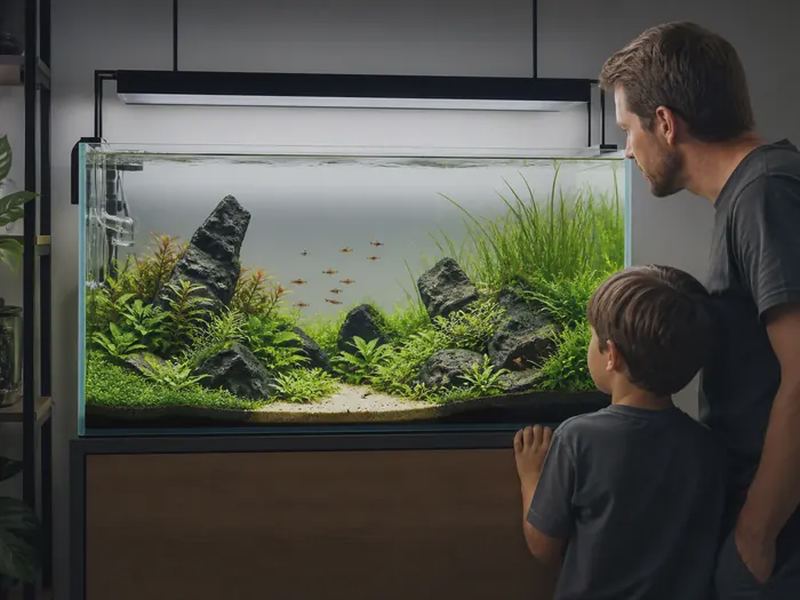
For decades, the default advice for new aquarium hobbyists has been to start with a small tank—typically a 10-gallon (38-liter) “starter kit.” The logic seems sound: less water, less cost, less maintenance. But this conventional wisdom is fundamentally at odds with the biology of fish and the chemistry of aquatic ecosystems. A small body of water is not a miniature version of a large one; it is a fundamentally different environment with far less stability. When we confine a fish to a tank, we are not just providing a container—we are creating a closed-loop biogeochemical system where every metabolic output, every uneaten flake, and every bacterial colony fluctuation has outsized consequences. This article synthesizes peer-reviewed research on fish physiology, aquatic toxicology, and behavioral ecology to answer a question that every hobbyist faces: how big should your aquarium really be? The short answer is: larger than you think, and almost certainly larger than the pet store recommended.
The Science of Surface Area and Gas Exchange
One of the most overlooked physical constraints on aquarium size is the rate of gas exchange at the water’s surface. Fish gills extract dissolved oxygen from water, but that oxygen is replenished primarily through diffusion at the air-water interface. In a 10-gallon tank, the surface area is roughly 20 inches by 10 inches (200 square inches). In a 40-gallon breeder tank, the surface area is 36 inches by 18 inches (648 square inches)—more than three times greater, despite only four times the volume. This is not a linear relationship. Oxygen saturation in water decreases with temperature and with the presence of organic waste, which fuels bacterial respiration. A study on juvenile rainbow trout (Oncorhynchus mykiss) demonstrated that oxygen consumption rates increase exponentially with activity and digestion, meaning a small tank with a few active fish can quickly deplete dissolved oxygen to hypoxic levels (< 4 mg/L) within hours of feeding, even with a filter running. The filter’s biological media does not produce oxygen; it merely processes ammonia. Without adequate surface area, you are suffocating your livestock at a molecular level, regardless of how “clean” the water looks.
Furthermore, gas exchange is not just about oxygen. Carbon dioxide (CO₂) produced by fish respiration and bacterial decomposition must diffuse out of the water. In a small, enclosed tank, CO₂ accumulates, lowering pH and shifting the equilibrium of the carbonate buffer system. This can cause dangerous pH swings—a phenomenon documented in aquaculture research on closed recirculating systems. For example, a 20-gallon tank stocked with six adult neon tetras (Paracheirodon innesi) can see a pH drop from 7.2 to 6.4 overnight if the surface is covered by dense floating plants or a glass lid with poor ventilation. In a 75-gallon tank, the same bioload would produce a negligible shift because the water volume acts as a buffer. The lesson from aquatic chemistry is clear: volume buys time, and surface area buys breath.
Nitrogen Cycling: Why Small Tanks Are Chemical Time Bombs
The nitrogen cycle—ammonia (NH₃) to nitrite (NO₂⁻) to nitrate (NO₃⁻)—is the backbone of biological filtration. But the rate of ammonia production is a function of biomass, not tank volume. A single adult goldfish (Carassius auratus) excretes approximately 0.5 mg of ammonia per gram of body weight per hour. A 3-inch goldfish weighs about 20 grams, producing 240 mg of ammonia daily. In a 10-gallon tank (38 liters), that ammonia concentration reaches 6.3 mg/L if unprocessed—lethal to most fish, which show acute toxicity at 0.5 mg/L. Even with a cycled filter, the bacterial colony (Nitrosomonas and Nitrobacter) must be large enough to oxidize this load. In a small tank, the colony’s surface area is limited by the filter media, and any disruption—a filter cleaning, a temperature drop, a medication dose—can crash the cycle, causing a lethal ammonia spike.
Research on recirculating aquaculture systems (RAS) has established that the safe carrying capacity for freshwater fish is roughly 1 gram of fish per liter of water, assuming optimal filtration and aeration. That is a 10-gallon tank for a 38-gram fish—barely a single adult guppy (Poecilia reticulata) weighing 2 grams. Yet hobbyists routinely stock 10-gallon tanks with six or more fish. The discrepancy arises because RAS systems use continuous water exchange and sophisticated biofiltration, while hobby tanks are static. A study published in Aquacultural Engineering found that in static tanks without water changes, nitrate concentrations exceed 100 mg/L within two weeks at even moderate stocking densities. Chronic nitrate exposure above 50 mg/L suppresses immune function in fish, increases susceptibility to fin rot and ich, and impairs reproductive behavior. In a 40-gallon tank, the same bioload would take eight weeks to reach that threshold, giving you a margin for regular water changes. The takeaway is not just that bigger is better—it is that small tanks are inherently unstable systems that demand a level of maintenance precision that most hobbyists cannot sustain.
Behavioral Biology: The Stress of Cramped Quarters
Beyond chemistry, tank size directly modulates fish behavior and welfare. Fish are not automatons; they exhibit complex spatial cognition, territoriality, and social hierarchies. A landmark study on zebrafish (Danio rerio)—a fish often kept in tiny tanks—showed that individuals housed in 1-liter containers displayed significantly elevated cortisol levels compared to those in 10-liter tanks, even when water quality parameters were identical. Cortisol is the primary stress hormone in teleost fish, and chronic elevation leads to immunosuppression, reduced growth, and increased aggression. Similarly, research on convict cichlids (Amatitlania nigrofasciata) found that pairs breeding in tanks smaller than 20 gallons exhibited higher rates of filial cannibalism (eating their own eggs) due to stress-induced anxiety.
Swimming behavior is another critical metric. Pelagic species—such as danios, rasboras, and angelfish (Pterophyllum scalare)—are obligate swimmers that cover large distances in the wild. A study tracking the movement of giant danios (Devario aequipinnatus) in a 125-gallon tank revealed that they swim an average of 2.5 kilometers per day. In a 20-gallon tank (24 inches long), this translates to constant U-turns, which causes fin damage and spinal deformities over time. For bottom-dwelling species like corydoras catfish, a sand substrate area of at least 2 square feet is required for natural foraging behavior; a 10-gallon tank provides less than half of that. The science is unambiguous: tank size is not a luxury but a prerequisite for normal motor patterns. When a fish cannot express its full behavioral repertoire—swimming, hiding, foraging, establishing territory—it experiences a state of chronic stress analogous to anxiety in mammals. This is why the “one inch of fish per gallon” rule is a myth; it ignores the fish’s body shape, activity level, and social needs.
Species-Specific Requirements: From Neon Tetras to Arowanas
Let’s move from general principles to concrete examples. The neon tetra (Paracheirodon innesi) is often sold as a “nano fish” suitable for 5-gallon tanks. However, neon tetras are a shoaling species that requires a school of at least 10 individuals to feel secure. A school of 10 neon tetras has a combined biomass of roughly 10 grams. According to the RAS stocking guideline, that alone requires 10 liters (2.6 gallons) just for metabolic load, but behavioral studies show that tetras in groups of fewer than 6 exhibit erratic swimming and increased hiding. In a 5-gallon tank, 10 tetras have no room to form a proper shoal—they stack vertically and become lethargic. The recommended minimum for a neon tetra school is 20 gallons (75 liters), not because they are messy, but because they need horizontal swimming space to exhibit schooling behavior, which reduces stress and aggression.
At the other extreme, consider the common pleco (Hypostomus plecostomus), a fish that reaches 18 inches (45 cm) in adulthood. Pet stores routinely sell juveniles in 2-inch sizes to beginners with 10-gallon tanks. A study on pleco growth rates in captivity showed that they grow 1 inch per month for the first year. By 12 months, a 14-inch fish is living in a 10-gallon tank—a confinement that causes severe spinal curvature and organ compression. The minimum tank size for a single adult pleco is 75 gallons, with 100+ gallons recommended for optimal health. Similarly, angelfish (Pterophyllum scalare) grow to 6 inches in body length with 8-inch vertical fins. They require a tank at least 24 inches tall to allow for fin extension; a 20-gallon high tank barely meets this, and a 10-gallon does not. The science is not arbitrary—it is based on the fish’s maximum adult size, which is genetically fixed, not determined by tank size. “Stunting” a fish in a small tank is not a success; it is a slow death from organ failure.
Water Parameters and Thermal Stability: The Hidden Benefit of Volume
Temperature stability is one of the most underappreciated advantages of a larger aquarium. Water has a high specific heat capacity, meaning it resists temperature changes. A 10-gallon tank can swing 4°F (2.2°C) within an hour if a room’s ambient temperature changes or if a heater cycles on and off. A 50-gallon tank might swing only 1°F in the same period. This matters because fish are ectotherms—their metabolic rate, immune function, and enzyme activity are directly tied to water temperature. A rapid temperature drop of 5°F can trigger ichthyophthirius (ich) outbreaks, as the parasite’s lifecycle accelerates in stressed hosts. Research on tilapia (a freshwater cichlid) showed that temperature fluctuations of ±3°C suppressed the adaptive immune response for 48 hours post-stress. In a home aquarium, a heater failure in a 10-gallon tank can drop the temperature to lethal levels within 30 minutes; in a 55-gallon tank, you have several hours to intervene.
Similarly, dissolved oxygen solubility decreases with temperature. A 10-gallon tank at 80°F (26.7°C) holds only 7.1 mg/L of oxygen at saturation, but a 50-gallon tank at the same temperature holds the same concentration per liter—yet the total oxygen reserve is five times greater. This reserve is critical during power outages or filter failures. A study on emergency aeration in fish transport found that fish survive longer in larger water volumes because oxygen depletion is slower relative to biomass. The practical implication is that a larger tank is not just more forgiving of water chemistry errors; it is a safety buffer against equipment failure. For a beginner, this buffer is the difference between a dead fish and a manageable crisis.
Filtration Reality Check: Why Bigger Filters Can’t Compensate
Some hobbyists argue that you can keep a small tank if you use an oversized filter. While a high-flow canister filter can process more ammonia, it cannot solve the spatial and behavioral deficits described above. A filter does not create swimming room, nor does it provide a refuge for shy fish. Moreover, filtration capacity is not linear with tank size—a filter rated for 50 gallons in a 10-gallon tank will create a current strong enough to exhaust small fish, inhibiting feeding and increasing stress. Research on fish swimming performance in flow-through tanks showed that forced swimming at 1.5 body lengths per second for 12 hours daily elevated cortisol in rainbow trout. In a small tank, the filter outflow is often the dominant current, and fish cannot escape it. The correct approach is to match filter flow to tank volume (typically 4-6 times turnover per hour) and to rely on tank volume for stability, not the filter. A larger tank with a modest filter is always superior to a small tank with a powerful filter.
FAQ: Common Questions on Tank Size
Q: Is a 5-gallon tank ever acceptable for any fish?
A: Yes, but only for a single betta (Betta splendens) or a small shrimp colony (Neocaridina davidi). Bettas are labyrinth fish that breathe atmospheric air, reducing their reliance on surface oxygen, and they are solitary. Still, a 5-gallon tank requires weekly water changes of 50% to maintain nitrate below 20 mg/L. No schooling fish should ever be kept in a 5-gallon tank.
Q: Can I keep goldfish in a 20-gallon tank if it’s just one small one?
A: No. Goldfish are large waste producers and grow to 6-8 inches in a year. A 20-gallon tank will stunt their growth and cause ammonia spikes. The minimum for a single fancy goldfish is 30 gallons, and for a common goldfish, 50 gallons. They also require cold water (65-72°F), which further reduces oxygen saturation.
Q: What is the best way to determine minimum tank size for a species?
A: Use three criteria: (1) adult body length × 10 for horizontal swimming length, (2) adult body length × 3 for tank width, and (3) a bioload calculation of 1 gram of fish per liter of water. For example, a 4-inch angelfish needs a tank at least 40 inches long, 12 inches wide, and 24 inches tall—roughly 55 gallons. These are minimums, not ideals.
Q: Does a larger tank mean less maintenance?
A: Not necessarily—you still need weekly water changes, but the percentage is smaller (10-20% in a large tank vs. 30-50% in a small tank). The key is that a large tank’s parameters drift slowly, so you have more time to correct mistakes. The total time spent is similar, but the margin for error is vastly improved.
Conclusion: The Golden Rule of Aquarium Sizing
The evidence from aquatic science is unequivocal: an aquarium must be sized for the adult dimensions, behavioral needs, and metabolic output of its inhabitants—not for the convenience of the hobbyist or the shelf space of a pet store. The “small tank for a beginner” myth has caused more fish deaths than any disease. When you choose a tank, you are not buying a container; you are engineering a habitat. The minimum viable volume for almost any fish species is 20 gallons (75 liters), and for most community fish, 40 gallons (150 liters) is a far more realistic starting point. Larger tanks offer thermal inertia, chemical buffering, oxygen reserve, and behavioral freedom—all of which are measurable, scientific benefits. If you cannot afford or accommodate a large tank, choose species that are naturally small and sedentary, and stock them sparingly. But understand that the science does not bend to wishful thinking. A fish’s biology is fixed; your tank size is the variable you control. Choose wisely, because the fish’s life depends on it, and your enjoyment of the hobby will grow in direct proportion to the health of your ecosystem.
💬 Comments
No comments yet — be the first!
Sign in to comment