
Aquarium Heater Size, Placement & Temperature Guide
Why Every Aquarium Needs a Heater
Fish are ectothermic, meaning their body temperature depends on the water around them. A stable temperature is critical for digestion, immune function, and overall health. An aquarium heater is not optional for tropical fish — it is essential. Even if your room stays warm, water temperature can fluctuate by 5–10°F (3–6°C) daily without a heater, stressing fish and making them prone to diseases like white spot (Ich).
Choosing the Right Heater Size
The rule of thumb is 3–5 watts per gallon of water. For a 10-gallon tank, you need a 50-watt heater. For larger tanks (over 40 gallons), use two smaller heaters on opposite ends for even heat distribution and redundancy. Below is a sizing table based on tank volume and desired temperature rise.
| Tank Size (Gallons) | Recommended Wattage | Max Temp Rise Above Room Temp |
|---|---|---|
| 5 | 25–50 W | 10°F (5.5°C) |
| 10 | 50–75 W | 10°F (5.5°C) |
| 20 | 100–150 W | 10°F (5.5°C) |
| 30 | 150–200 W | 10°F (5.5°C) |
| 40–55 | 200–300 W (use two 150 W) | 10°F (5.5°C) |
| 75+ | 300–500 W (split across 2–3 heaters) | 10°F (5.5°C) |
If your room is very cold (e.g., 60°F / 15.5°C), go up one wattage tier. For a betta in a 5-gallon tank, a 25 W heater is usually enough, but a 50 W with a thermostat is safer. Always use a heater with an adjustable thermostat or a separate controller.
Where to Place Your Aquarium Heater
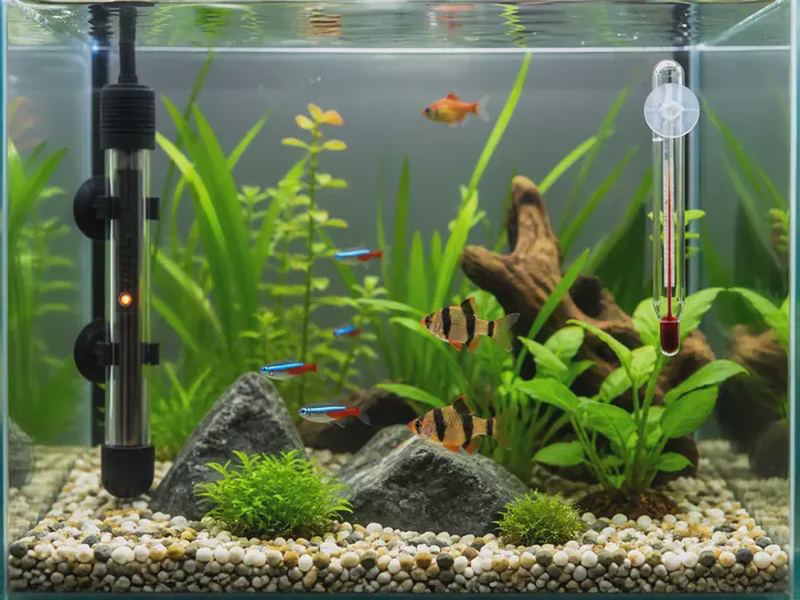
Place the heater horizontally near the water flow — ideally next to the filter outlet or a circulation pump. This prevents hot spots and ensures even temperature distribution. Never bury the heater fully in gravel; keep the heating element fully submerged (check the min water line) and leave at least 2 inches (5 cm) of clearance above the heater top to avoid overheating. For glass heaters, use a suction cup holder and angle it slightly (30–45 degrees) to improve convection. In tanks over 40 gallons, place heaters at opposite ends for uniform heating.
From experience: I once placed a heater vertically in a corner with poor flow. The water near the heater was 84°F (29°C) while the opposite side was 74°F (23°C). My neon tetras got stressed and developed Ich. After moving the heater to the filter outflow, the temperature stabilized at 76°F (24°C) across the tank. Placement matters as much as wattage.
Best Temperature Settings for Common Fish
Each species has a preferred temperature range. Keeping fish at the upper end of their range can speed metabolism and growth, but also shortens lifespan. Below is a reference table for popular species.
| Fish Species | Ideal Temperature (°F) | Ideal Temperature (°C) | pH Range |
|---|---|---|---|
| Betta | 78–80 | 25.5–26.5 | 6.5–7.5 |
| Neon Tetra | 72–78 | 22–25.5 | 6.0–7.0 |
| Goldfish (Fancy) | 68–75 | 20–24 | 7.0–8.0 |
| Guppy | 72–82 | 22–28 | 7.0–8.2 |
| Cherry Shrimp | 65–80 | 18–26.5 | 6.5–8.0 |
For a community tank, pick a middle temperature like 76°F (24°C) that suits most species. If you keep goldfish, remember they are coldwater — do not use a heater unless your room drops below 68°F (20°C). Check out our fancy goldfish breeds guide for specific care.
How to Set Up and Maintain Your Heater
Before plugging in a new heater, let it sit in the tank water for 15 minutes to equalize temperature — otherwise the glass may crack. Set the thermostat to the desired temperature (e.g., 78°F for bettas) and wait 24 hours for stabilization. Use a separate thermometer to verify; never trust the heater dial alone. Check the thermometer daily during the first week.
Clean the heater monthly by gently wiping off algae and mineral deposits with a soft cloth. Do not use abrasive pads. Inspect the cord for cracks and the rubber seals for leaks. Replace any heater that shows signs of corrosion or if the thermostat drifts more than 2°F (1°C) from the set point.
From experience: I had a heater fail in a 20-gallon tank — it stuck on and cooked the water to 92°F (33°C). I lost a school of neon tetras. Now I always use a separate temperature controller as a backup, and I set the heater a few degrees lower than the controller. It costs $20 and saves lives.
Heater Safety and Redundancy
Never use a heater rated for a tank larger than yours — it can overheat the water rapidly if it malfunctions. Always unplug the heater during water changes if the water level drops below the heater. Use a surge protector. For tanks over 20 gallons, two half-wattage heaters are safer than one large one: if one fails, the other maintains partial heat. For example, in a 40-gallon breeder, use two 150 W heaters instead of one 300 W. This also prevents hot spots.
If you have a betta, a 5-gallon tank is the minimum, and a 25–50 W heater with a thermostat is sufficient. See our betta fish care guide for full details. For community tanks, always cycle the tank before adding fish — the nitrogen cycle takes 4–6 weeks and requires ammonia and nitrite to be 0 ppm, with nitrate below 20–40 ppm. Learn more in our nitrogen cycle guide.
Signs Your Heater Is Failing
Watch for these red flags: water temperature is more than 2°F (1°C) from the set point, the heater glass has cracks or fogging, the indicator light flickers or stays on constantly, or fish are gasping at the surface (too hot) or clustering near the heater (too cold). If you see any, replace the heater immediately. Keep a spare on hand — a heater can die overnight, and a temperature crash can kill fish within hours.
Frequently Asked Questions
Can I use a heater in a goldfish tank?
Fancy goldfish prefer 68–75°F (20–24°C). If your room stays above 68°F, you may not need a heater. But if temperatures drop, use a low-wattage heater to maintain stability. See our fancy goldfish breeds guide for details.
What size heater for a 10-gallon tank?
A 50–75 W heater is ideal for a 10-gallon tank. This provides enough power to raise the temperature 10°F (5.5°C) above room temperature, which is sufficient for most tropical fish.
How often should I replace my aquarium heater?
Replace every 2–3 years, or sooner if you notice temperature drift, cracks, or corrosion. Budget heaters may fail sooner; invest in a quality brand with a warranty.
Can I put two heaters in a small tank?
It is not recommended for tanks under 10 gallons — the risk of overheating is high. For 10–20 gallons, one properly sized heater is enough. Use two only in tanks 20+ gallons for redundancy.
Do I need a heater for cherry shrimp?
Cherry shrimp tolerate 65–80°F (18–26.5°C). If your room stays above 65°F, a heater is optional but recommended to prevent fluctuations. A stable 72°F (22°C) is ideal for breeding.
What temperature should I set for a community tank with neon tetras and guppies?
Set the heater to 76°F (24°C). This falls within the range for neon tetras (72–78°F) and guppies (72–82°F), and also works for many other community fish. Monitor with a thermometer.
💬 Comments
No comments yet — be the first!
Sign in to comment