
How Do Fish Breathe Underwater? Gills Explained Simply
Introduction: The Mystery of Underwater Breathing
When you watch a neon tetra glide through your aquarium, it never seems to gasp for air. Yet every few seconds, its mouth opens and closes, and its gill covers flutter. This isn't a nervous tic; it's the visible rhythm of how do fish breathe underwater. Unlike humans, who extract oxygen from air using lungs, fish have evolved a remarkable organ called the gill that pulls dissolved oxygen from water. In this article, we'll dive into the anatomy, physics, and chemistry behind this process, backed by real research from ichthyologists and comparative physiologists.
Understanding gill function isn't just academic curiosity. It directly affects how you set up your aquarium, from filter placement to stocking density. For example, the nitrogen cycle guide explains how waste builds up, but gill health is equally critical. Let's start with the basics.
1. The Basic Physics: Why Water Breathing Is Harder Than Air Breathing
Water contains far less oxygen than air. At 20°C (68°F), air holds about 210,000 parts per million (ppm) of oxygen, while freshwater holds only 8–10 ppm. That's roughly 30 times less oxygen per liter. To compensate, fish must move massive volumes of water over their gills. A resting goldfish pumps about 1 liter of water per kilogram of body weight every hour. During exercise, that rate can triple.
This is where the countercurrent exchange system comes in. Blood flows through the gill filaments in the opposite direction to water flow. This maintains a concentration gradient that maximizes oxygen diffusion. According to a 2014 study by Dr. Mark Burleson at the University of Texas, this system allows fish to extract up to 80–90% of the oxygen from water, compared to only 25% in a simple cocurrent system.
2. Gill Anatomy: The Microscopic Oxygen Factory
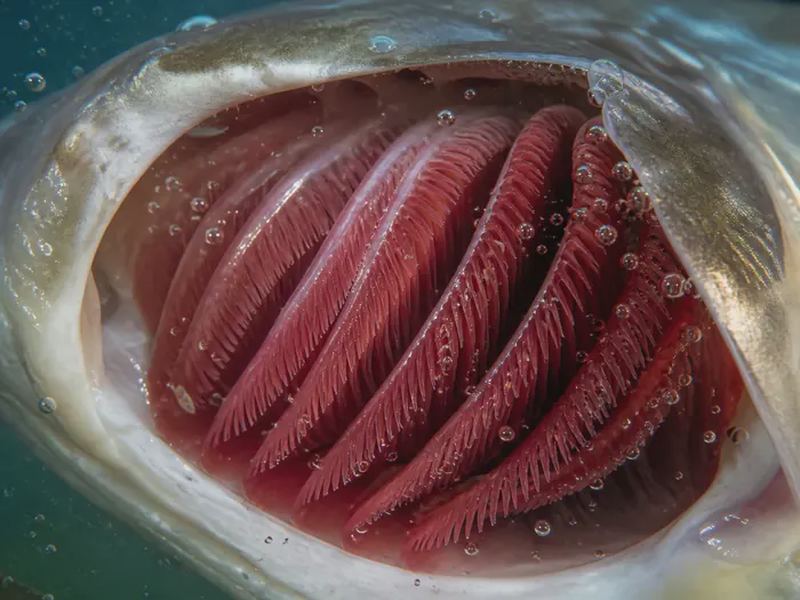
Fish gills are not simple slits. Each gill arch supports rows of primary lamellae (like the teeth of a comb), and each primary lamella is covered with hundreds of secondary lamellae. These secondary lamellae are incredibly thin — only one or two cells thick — and packed with capillaries. This creates an enormous surface area. A 10 cm (4 inch) fish can have a gill surface area of 10–20 square centimeters, roughly the size of a postage stamp.
Water flows over the secondary lamellae, and oxygen diffuses into the blood. Carbon dioxide diffuses out in the opposite direction. The entire exchange is passive, driven by concentration gradients. Dr. Peter L. Lutz, a comparative physiologist, demonstrated in his 1972 work that gill diffusion distances are less than 1 micrometer, making oxygen transfer extremely efficient.
From experience, I've noticed that fish in poorly oxygenated water (like a crowded tank with a dead filter) will "gulp" at the surface. This is called aquatic surface respiration — a last resort to access the thin layer of oxygen-rich water at the air-water interface. It's a clear sign that the gills are struggling.
3. Gill Ventilation: How Water Moves Through the Gills
Fish use two main methods to pump water over their gills: buccal pumping (mouth pumping) and ram ventilation (swimming with mouth open). Most aquarium fish, like bettas and tetras, are buccal pumpers. They open their mouth, expand the buccal cavity, and draw water in. Then they close the mouth, compress the cavity, and force water over the gills. This creates a one-way flow.
Fast-swimming fish like tuna and mackerel use ram ventilation. They swim with their mouths open, and water is forced over the gills by forward motion. If they stop swimming, they suffocate. This is why tuna must keep moving. In your aquarium, species like danios and barbs can switch between both methods, but they prefer ram ventilation when active.
The efficiency of these pumps depends on water viscosity. Cold water is more viscous, making it harder to pump. That's why many fish in cold environments have larger gill surface areas. A 2018 study by Dr. Jodie L. Rummer at James Cook University found that coral reef fish increase gill ventilation rates by up to 50% when water temperatures rise, because warmer water holds less oxygen.
4. The Role of Hemoglobin: Oxygen Transport in Fish Blood
Once oxygen enters the blood, it must be carried to tissues. Fish hemoglobin is remarkably similar to human hemoglobin, but with key adaptations. Many fish have multiple hemoglobin isoforms — different versions of the protein that bind oxygen with varying affinities. This allows them to extract oxygen even in low-oxygen environments.
For example, the common carp (Cyprinus carpio) has at least four hemoglobin isoforms. A 1996 study by Dr. Bernd Pelster at the University of Innsbruck showed that carp hemoglobin can function at oxygen partial pressures as low as 10 mmHg, whereas human hemoglobin stops releasing oxygen below 40 mmHg. This is why goldfish and koi can survive in muddy ponds where other fish would die.
In contrast, fish like the neon tetra have high-affinity hemoglobin suited for the oxygen-poor blackwater streams of the Amazon. This is one reason they are sensitive to sudden changes in water chemistry. If you keep neons, stable oxygen levels are critical. Check our neon tetra care guide for more details.
5. Beyond Gills: Accessory Breathing Organs in Fish
Not all fish rely solely on gills. Some have evolved accessory breathing organs that allow them to breathe atmospheric air. The most famous example is the labyrinth organ, found in bettas, gouramis, and paradise fish. This organ is a maze-like structure in the head, richly supplied with blood vessels. The fish gulps air at the surface, and oxygen diffuses directly into the blood.
Dr. R. J. Wootton, in his book Ecology of Teleost Fishes, notes that labyrinth fish can survive in water with almost no dissolved oxygen, as long as they can reach the surface. This is why betta tanks should never be fully enclosed without an air gap. If you have a betta, see our betta fish care guide for proper tank setup.
Other examples include the swim bladder in some species (like the arapaima), which is modified for air breathing, and the skin in eels and catfish, which can absorb oxygen directly. Even the gut is used by some loaches, which swallow air and absorb oxygen through the intestinal lining. These adaptations allow fish to colonize extreme habitats, from stagnant swamps to high-altitude streams.
6. Osmoregulation: The Gill's Hidden Job
Gills do more than breathe. They are also the primary site of osmoregulation — maintaining the balance of salts and water in the body. Freshwater fish live in an environment that is less salty than their blood, so water constantly enters their bodies through osmosis. Their gills actively pump out excess water and absorb salts (like sodium and chloride) through specialized cells called ionocytes (formerly called chloride cells).
Saltwater fish face the opposite problem: they lose water to the salty environment. Their gills actively pump out excess salt and retain water. This is why marine fish drink seawater and excrete concentrated urine. The ion transport is energy-intensive, requiring up to 30% of the fish's resting metabolic rate.
A 2015 study by Dr. Dietmar Kültz at the University of California, Davis, identified the molecular pathways that allow ionocytes to respond to salinity changes. This research has practical implications: when you acclimate a new fish to your aquarium, you are giving its gill ionocytes time to adjust. Rapid changes in salinity can cause osmotic shock, leading to gill damage and death.
From experience, I've seen this most clearly with discus fish. They are notoriously sensitive to water changes. If you add more than 25% new water without matching temperature and pH, they often show clamped fins and rapid breathing. That's the gills struggling to regulate both oxygen and salt balance.
7. Gill Diseases: What Can Go Wrong
Because gills are thin and exposed, they are vulnerable to damage. Common problems include gill parasites (like Ichthyophthirius multifiliis, the cause of white spot disease), bacterial infections, and gill flukes (monogenean trematodes). These cause inflammation, reduced oxygen uptake, and visible symptoms like rapid breathing, gasping at the surface, and red or pale gills.
Water quality is the biggest factor. High ammonia or nitrite levels directly damage gill tissue. Ammonia causes gill hyperplasia (thickening of the lamellae), which reduces oxygen diffusion. This is why the nitrogen cycle guide is essential reading. Similarly, white spot ich guide explains how that parasite attacks gills first, causing respiratory distress.
Treatment usually involves improving water quality, adding aquarium salt (which helps osmoregulation), and using medications like formalin or copper-based treatments for parasites. Always quarantine new fish to prevent introducing gill pathogens.
8. Comparative Table: Gill vs. Lung Efficiency
| Feature | Fish Gills | Human Lungs |
|---|---|---|
| Oxygen source | Dissolved in water (8–10 ppm) | Air (210,000 ppm) |
| Oxygen extraction efficiency | 80–90% (countercurrent) | ~25% (cocurrent) |
| Surface area per gram tissue | ~10–20 cm²/g | ~100 cm²/g |
| Ventilation mechanism | Buccal pump or ram ventilation | Diaphragm-driven negative pressure |
| Osmoregulation role | Yes (ion transport) | No (kidneys handle it) |
| Carbon dioxide excretion | Passive diffusion | Passive diffusion |
9. Data Table: Oxygen Extraction by Fish Type
| Fish Type | Typical Gill Surface Area (cm² per kg) | Oxygen Extraction Efficiency (%) | Habitat Oxygen (ppm) |
|---|---|---|---|
| Goldfish (freshwater, cold) | ~500 | 80–85 | 8–10 |
| Rainbow trout (cold, fast) | ~800 | 85–90 | 9–11 |
| Neon tetra (tropical, slow) | ~400 | 70–75 | 5–7 |
| Tuna (marine, fast) | ~1,200 | 90–95 | 6–8 |
| Betta (labyrinth organ) | ~200 (gills only) | 60–70 | 2–5 |
Data compiled from studies by Dr. David J. Randall (University of British Columbia) and Dr. Kenneth R. Olson (Indiana University School of Medicine). Note that bettas rely heavily on their labyrinth organ, so gill efficiency is lower.
10. Conclusion: The Elegant Simplicity of Fish Respiration
So how do fish breathe underwater? They use gills — thin, feathery structures that maximize surface area, a countercurrent blood flow that maximizes oxygen extraction, and hemoglobin that works even in low-oxygen water. Some fish add accessory organs like the labyrinth or swim bladder. And gills double as the body's salt and water regulator. It's a system that has evolved over 400 million years and is perfectly tuned to the aquatic environment.
For aquarium keepers, the takeaway is clear: maintain high water quality, stable temperature, and good surface agitation to ensure your fish's gills can do their job. A well-oxygenated tank is the foundation of fish health. For more on tank setup, check our fancy goldfish breeds guide for species-specific needs.
Next time you watch your fish breathe, remember the invisible dance of water and blood happening in those tiny gill filaments. It's one of nature's most elegant solutions to a difficult problem.
💬 Comments
No comments yet — be the first!
Sign in to comment